

Phase 1: Empathy (Story-Driven Opening)
안녕하세요! 매일한글 에디터입니다. (Hello! I’m your Daily Hangul editor.)
Have you ever scrolled through Korean social media or portal sites like Naver and Daum, only to see shocking headlines screaming: “국내 연구진, 완치율 100% 암 치료제 세계 최초 개발!” (Domestic research team develops world’s first 100% cure for cancer!)? For advanced learners and Korean media consumers, encountering these explosive scientific headlines is an everyday experience. But when you delve into the comments section, you might find savvy native speakers dissecting the claim with razor-sharp skepticism, leaving comments like: “또 제목 장사 하네. 교차 검증은 해봤냐?” (Selling clickbait titles again. Have they even cross-verified?).
At the C2 level, Korean is no longer just about polite everyday interactions or academic regurgitation; it is about engaging in rigorous intellectual discourse, dissecting sensational journalism, and articulating scientific skepticism with precision. Navigating the murky waters between sensational media hype (언론 플레이) and peer-reviewed reality requires sophisticated lexical tools and nuanced cultural awareness. In this guide, backed by years of linguistic tutoring and real feedback from foreign journalists and researchers living in Seoul, we will equip you with high-level vocabulary, idiomatic idioms, and cultural debate strategies to champion scientific fact-checking in native-level Korean conversations.
Phase 2: 3 Core Expressions In-Depth Analysis
1. 침소봉대하다 (Chimsobongdaehada)
- Pronunciation: [Chim-so-bong-dae-ha-da] (Think of chimney-so-bong-day-ha-da with a crisp, articulated cadence)
- Meaning: Literal: “Making a needle as big as a club” (침: needle, 봉: club) | Actual Nuance: Grossly exaggerating a minuscule scientific finding or minor lab anomaly to look like a revolutionary breakthrough.
- K-Culture Moment: Commonly heard on Korean current-affairs debate shows like 썰전 (War of Words) or investigative podcasts when panelists critique journalists for turning preliminary mouse trials into miracle human cures.
- Editor’s Insight: This classical four-character idiom (사자성어) instantly elevates your intellectual status. It exposes the media’s tendency to amplify preliminary research data beyond scientific legitimacy.
- Situation Spectrum: Casual: ⚠️ | Semi-formal: ✅ | Formal: ✅
- 🤔 Think About It: In English, we might say “blowing things out of proportion” or “making a mountain out of a molehill.” How does the visual contrast between a tiny needle (침) and a giant club (봉) reflect the Korean philosophical distaste for disingenuous embellishment?
2. 교차 검증을 거치다 (Gyocha geomjeung-eul geochida)
- Pronunciation: [Gyo-cha geom-jeung-eul geo-chi-da] (Gyo-cha sounds like gyoza but with a sharp ‘ch’; geom-jeung sounds like gum-jeung)
- Meaning: Literal: “To undergo cross-validation/verification” | Actual Nuance: To rigorously double-check scientific claims, data sources, and experimental methodology across independent third-party institutions.
- K-Culture Moment: In the critically acclaimed investigative journalism drama Argon (아르곤), the lead anchor relentlessly barks this exact phrase to his investigative team before publishing any scoop.
- Editor’s Insight: Using the verb ‘거치다’ (to pass through a process) implies that rigorous validation is not an optional add-on, but an indispensable pipeline in ethical communication.
- Situation Spectrum: Casual: ⚠️ | Semi-formal: ✅ | Formal: ✅
- 🤔 Think About It: Why has ‘교차 검증’ transitioned from dry academic jargon into a mainstream buzzword in the vibrant Korean civic netizen sphere?
3. 섣부른 일반화의 오류 (Seotbureun ilbanhwa-ui oryoo)
- Pronunciation: [Seot-bu-reun il-ban-hwa-ui o-ryu] (Seot-bu-reun rhymes with foot-bull-run, il-ban-hwa sounds like ill-bahn-hwa)
- Meaning: Literal: “Fallacy of hasty generalization” | Actual Nuance: Critiquing journalists or public figures who draw sweeping, definitive conclusions from unrepresentative sample sizes or isolated data points.
- K-Culture Moment: Frequently utilized on Korean scientific YouTube channels like 안될과학 (Unrealscience) when dismantling wellness pseudoscience and exaggerated diet trends.
- Editor’s Insight: Pairing ‘섣부른’ (hasty, premature) with the formal logical term ‘일반화의 오류’ (fallacy of generalization) allows you to criticize an argument objectively without sounding aggressively personal.
- Situation Spectrum: Casual: ⚠️ | Semi-formal: ✅ | Formal: ✅
- 🤔 Think About It: Notice how formal Korean critiques logical structures rather than attacking the speaker directly. How does this maintain social harmony while relentlessly pursuing truth?
Phase 3: Textbook Korean vs. Real Korean
Situation 1: Calling out exaggerated, sensational headlines
- 📖 교과서 한국어 (Textbook Korean): 이 기사의 제목은 너무 과장되어 있어서 사실과 다릅니다. (I gisa-ui jemok-eun neomu gwajang-doeeo isseoseo sasil-gwa dareumnida. / The title of this article is too exaggerated and differs from the facts.)
- 🗣️ 진짜 한국어 (Real Native Korean): 완전 조회수 장사용 어그로성 기사네요. 침소봉대가 너무 심합니다. (Wanjeon johuisu jangsayong eogeuroseong gisa-neyo. Chimsobongdaega neomu simhamnida. / It’s purely clickbait to farm views. The sensational exaggeration is over the line.)
- 💡 왜 다를까? (Why the difference?): Native speakers combine high-register idiomatic expressions (침소봉대) with contemporary digital slang (어그로, 조회수 장사) to deliver concise, culturally punchy critiques.
Situation 2: Demanding peer review and institutional fact-checking
- 📖 교과서 한국어 (Textbook Korean): 다른 연구자의 논문을 읽고 사실인지 확인해야 합니다. (Dareun yeonguja-ui nonmun-eul iltgo sasil-inji hwaginhaeya hamnida. / You must read other researchers’ papers to confirm whether it is true.)
- 🗣️ 진짜 한국어 (Real Native Korean): 동료 평가(Peer Review)나 학계의 교차 검증 없이는 단순한 가설에 불과합니다. (Dongryo pyeongga-na hakgye-ui gyocha geomjeung eopsineun dansunhan gaseor-e bulgwahamnida. / Without peer review or cross-validation from academia, it amounts to nothing more than a mere hypothesis.)
- 💡 왜 다를까? (Why the difference?): Advanced Korean discourse relies heavily on precise Sino-Korean rhetorical structures (e.g., ~에 불과하다, 동료 평가) rather than simplistic verbal constructions.
Phase 4: K-Culture Deep Dive & Non-Verbal Manners
4-1. 눈치 (Nunchi) & Non-Verbal Manners in Intellectual Debates
When engaging in scientific skepticism in Korea, criticizing someone’s research or a shared news article requires elevated Nunchi (social intuition). Directly blurted accusations like “You are wrong” (틀렸어요) can cause severe loss of face (체면 손상).
* Gaze & Posture: Avoid aggressive direct finger-pointing. Tilt your head slightly, maintain reflective eye contact, and use an open palm gesture when referencing data.
* Softening Prefixes: Always preface skeptical claims with diplomatic cushions such as: “원론적인 취지에는 공감합니다만…” (While I empathize with the fundamental premise…) or “학술적 맥락에서 짚고 넘어가자면…” (If we were to address this strictly within an academic context…).
4-2. Cultural Code Analysis: The Hwang Woo-suk Syndrome & Media Literacy
Modern Korean scientific skepticism was deeply shaped by the historic 2005 stem cell controversy surrounding Dr. Hwang Woo-suk. The collective national trauma of initially accepting media sensationalism at face value, only to uncover manipulated data through rigorous investigative journalism (specifically MBC’s PD Notebook), transformed Korean society. Today, Korean netizens and academia hold an exceptionally high standard of scientific scrutiny, making public discourse on fact-checking both passionate and unforgiving of intellectual dishonesty.
Phase 5: Real-Life Roleplay Scenario
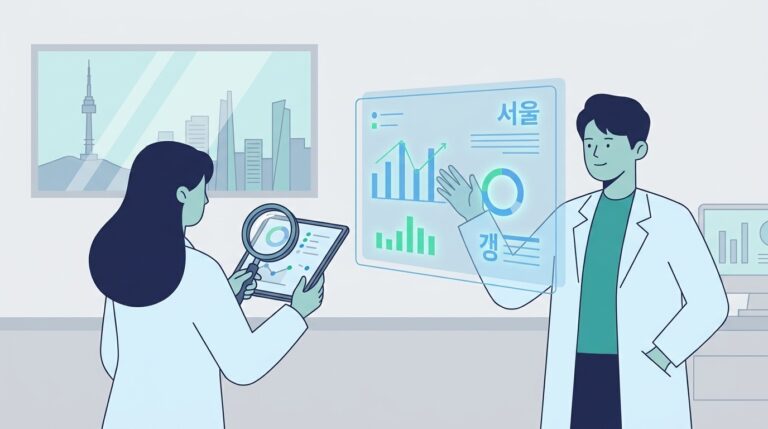
Setting: A chic seminar room in Gangnam, Seoul. Min-jun (a senior tech researcher) and Dr. Clara (a visiting foreign bio-analyst) are analyzing a breaking viral article about an alleged “room-temperature superconductor” breakthrough.
- 민준 (Min-jun):
🎭 스마트폰 화면을 찡그리며 보여주며클라라 박사님, 이 속보 보셨어요? 국내 연구진이 상온 초전도체를 완전히 상용화했다고 대서특필되었네요.
(Kleurara baksanim, i sokbo bosyeosseoyo? Gungnae yeongujini sang-on chojeondochereul wanjeonhi sang-yonghwahaetdago daeseoteukpil-doeeonneyo.)
“Dr. Clara, have you seen this breaking news? It’s headlined everywhere that a domestic team completely commercialized room-temperature superconductors.” -
클라라 (Clara):
🎭 기사 본문의 데이터 도표를 꼼꼼히 훑어보며글쎄요, 헤드라인만 보면 노벨상 감이지만 데이터의 신뢰도가 다소 의문스럽습니다.
(Geulsseyo, hedeurain-man bomyeon nobel-sang gam-ijiman deiteo-ui sinroedoga daso uimunseureopseumnida.)
“Well, the headline sounds Nobel-worthy, but the reliability of the data looks rather questionable.” -
민준 (Min-jun):
🎭 턱을 괴고 고개를 끄덕이며저도 동의합니다. 표본 크기도 너무 작고, 재현성 실험에 대한 구체적 언급이 없네요.
(Jeodo dong-uihamnida. Pyobon keukido neomu jakgo, jaehyeonseong silheom-e daehan guchejeok eongeubi eomneyo.)
“I agree. The sample size is far too small, and there’s no concrete mention of reproducibility experiments.” -
클라라 (Clara):
🎭 손가락으로 레퍼런스 섹션을 가리키며맞아요. 권위 있는 학술지의 동료 평가를 거치지 않은 사전 논문(Preprint) 단계일 뿐입니다.
(Majayo. Gwon-wi inneun haksulji-ui dongryo pyeonggareul geochiji aneun sajeon nonmun dangye-il ppun-imnida.)
“Exactly. It’s merely at the preprint stage without having undergone peer review in a reputable academic journal.” -
민준 (Min-jun):
🎭 한숨을 쉬며 혀를 차며결국 포털 사이트의 클릭수를 노린 전형적인 침소봉대식 보도군요.
(Gyeolguk poteol saiteu-ui keulliksureul norin jeonhyeongjeogin chimsobongdaesik bドogunya.)
“In the end, it’s just typical sensationalist reporting designed to milk portal clicks.” -
클라라 (Clara):
🎭 단호하고 차분한 어조로대중의 과학적 불신을 막기 위해서라도 독립된 연구 기관의 교차 검증 결과가 나올 때까지 판단을 유보해야 합니다.
(Daejung-ui gwahakjeok bulsin-eul makgi wihaeseorado dongnipdoen yeongu gwigwan-ui gyocha geomjeung gyeolgwaga naol ttaekkaji pandan-eul yubohaeya hamnida.)
“To prevent public distrust in science, we must suspend judgment until cross-validation results from independent research bodies emerge.” -
민준 (Min-jun):
🎭 공감하며 미소를 짓는다맞습니다. 섣부른 낙관론보다는 냉철한 팩트 체크가 선행되어야겠죠.
(Masseumnida. Seotbureun nakgwanron-bodaneun naengcheolhan paekteu chekeuga seonhaengdoeeoyagetjyo.)
“Spot on. Cool-headed fact-checking must precede premature optimism.” -
클라라 (Clara):
🎭 랩탑을 열며네, 해외 주요 랩들의 재현 테스트 진행 상황을 함께 모니터링해 보시죠.
(Ne, hae-oe juyo raepdeur-ui jaehyeon teseuteu jinhaeng sanghwang-eul hamkke moniteoringhae bosijo.)
“Yes, let’s monitor the reproduction test progress from major international labs together.”
🔀 Interactive Branching Moment
If a colleague asks you what you think about a viral unverified health-fad article, how do you respond?
- Option A: “이거 가짜 뉴스니까 당장 보지 마세요.” (This is fake news, don’t read it right away.)
- Feedback: [Risk] Too blunt and aggressive. It dismisses your peer without providing an objective scientific rationale, potentially inducing awkward defensive tension.
- Option B: “기사의 주장이 흥미롭긴 하지만, 학계의 공인된 교차 검증을 거쳤는지 추가 확인이 필요해 보입니다.” (While the claim is interesting, it seems necessary to double-check whether it has undergone verified academic cross-validation.)
- Feedback: [Best] Flawless C2 diplomacy! You acknowledge the interlocutor’s interest while steering the conversation toward rigorous fact-checking.
- Option C: “기자가 쓴 거니까 일단 무조건 맞겠죠.” (A reporter wrote it, so it’s probably unconditionally true.)
- Feedback: [Bad] Fails the test of scientific skepticism and sounds overly naive for high-level intellectual discussions.
Phase 6: 10-Second Emotion Shadowing Drill
Practice reading these lines aloud with the indicated pause markers (/) and dynamic emotional modulation:
[🧐 냉철하고 분석적으로 - Analytical & Objective]
“단순한 상관관계를 / 인과관계로 비약하는 것은 / 치명적인 오류입니다.”
(Dansunhan sanggwangwangyereul / ingwagwangyero biyakhaneun geos-eun / chimyeongjeogin oryoo-imnida.)
(“Leaping from a simple correlation / to a causal relationship / is a fatal fallacy.”)-
[😤 단호하고 비판적으로 - Firm & Critical]
“이런 자극적인 헤드라인은 / 대중의 확증 편향을 자극할 뿐 / 학술적 가치는 전무합니다.”
(Ireon jageukjeogin hedeuraineun / daejung-ui hwakjeung pyeonhyang-eul jageukhal ppun / haksuljeok gachineun jeonmuhamnida.)
(“Such sensational headlines / merely exploit public confirmation bias / and possess zero academic value.”) -
[🤝 정중하지만 흔들림 없이 - Polite yet Uncompromising]
“섣부른 속단보다는 / 독립된 연구 기관의 / 교차 검증을 지켜보는 것이 / 바람직합니다.”
(Seotbureun sokdan-bodaneun / dongnipdoen yeongu gwigwan-ui / gyocha geomjeung-eul jikyeoboneun geos-i / baramjikhamnida.)
(“Rather than hasty conclusions / waiting for cross-validation / from independent research bodies / is far more desirable.”)
Phase 7: K-Culture Mini Dictionary
- 확증 편향 (Hwak-jeung Pyeon-hyang) | Confirmation Bias
- Usage: Essential when discussing how algorithm-driven media feeds reinforce existing biases among netizens regarding controversial science or medical news.
- 어그로 (Eogeu-ro) | Aggro / Sensational Clickbait
- Usage: Originating from gaming vocabulary, native speakers frequently use “어그로를 끌다” to describe media outlets crafting bait headlines to deliberately provoke clicks.
- 재현성 (Jae-hyeon-seong) | Reproducibility / Replicability
- Usage: The gold standard metric in Korean science critiques when judging whether lab experiments can be replicated worldwide under the same conditions.
- 대서특필 (Dae-seo-teuk-pil) | Splashing Big Headlines / Featured Extensively
- Usage: Used to describe sensational front-page media coverage, frequently contrasted with the actual scientific insignificance of the finding.
Phase 8: Survival Kit for Travelers & Analysts
Survival Expressions TOP 3
- 팩트 체크가 완료된 사안인가요? (Paekteu chekeuga wanryodoen sa-an-ingayo?)
- Pro Tip: Use this in conferences or business meetings to ask whether a cited news metric has been verified.
- 원천 논문의 출처를 확인할 수 있을까요? (Woncheon nonmun-ui chulcheoreul hwaghinhal su isseulkkayo?)
- Pro Tip: The most polite and professional way to request the original source paper without insulting the presenter.
- 공식 반박 보도자료가 나왔는지 확인해 보세요. (Gongsik banbak bodojaryoga nawaneunji hwaginhae boseyo.)
- Pro Tip: Helpful when advising colleagues to check if official refutations or rebuttals have been published.
Editor’s Travel & Life Note
If you are living in Korea or attending scientific symposiums in Songdo or Daejeon (Daedeok Innopolis), navigating factual resources is critical. Make sure to download the Naver News Application and Media Fact-Check Portal to cross-reference headlines, and install the KakaoMap Navigation App for real-time transportation routing between Seoul’s major research clusters.
Phase 9: “One Step Deeper” (Reflective Cultural Essay)
South Korea boasts one of the fastest fiber-optic digital infrastructures in the world, fostering an intensely dynamic “Palli-Palli” (빨리빨리 – hurry-hurry) news ecosystem. However, this hyper-speed environment frequently generates a friction point between the slow, methodical rigor of scientific verification and the breakneck speed of sensational digital journalism. In response, Korean civil society has forged a sophisticated subculture of grassroots digital fact-checking on science forums, where ordinary citizens and scholars collaborate to decode raw data. True fluency in Korean at the C2 level means understanding that healthy skepticism is not cynicism; rather, it is a deeply valued civic contribution toward societal transparency.
💬 Your Turn: Have you ever spotted an exaggerated scientific headline in your own native media and compared it to Korean coverage? What Korean phrase would you use to critique it? Share your thoughts in the comments below!
Phase 10: FAQ & Common Mistakes
Q: Can I use “가짜 뉴스 (Fake News)” interchangeably with “선정적 보도 (Sensationalist Reporting)”?
A: Not quite. “가짜 뉴스” refers to entirely fabricated misinformation created with malicious or deceptive intent. In contrast, “선정적 보도” or “과장 보도” describes real, preliminary scientific findings that have been irresponsibly exaggerated or framed with sensational clickbait. Using “선정적 보도” shows greater linguistic precision.
Q: Is the idiom “침소봉대” appropriate for casual conversations among close friends?
A: While it is grammatically correct, using four-character idioms (사자성어) in very casual youth settings might sound somewhat theatrical or academic. Among close peers, you can casually say “너무 오버한다” (They’re overdoing it) or “완전 침소봉대 수준인데?” (That’s practically making a mountain out of a molehill) with a lighthearted tone.
Q: How do I challenge someone’s scientific claim without sounding disrespectful in Korean?
A: Always utilize the indirect proposal or hedging endings: “~일 가능성도 배제할 수 없지 않을까요?” (Should we not also consider the possibility that…?) or “조금 더 데이터가 축적될 때까지 지켜볼 필요가 있어 보입니다.” (It appears necessary to wait until more data has accumulated).
🚨 Common Mistakes Warning Board
- Mistake: Saying “이 기사는 거짓말이에요” (This article is a lie) during professional discussions.
- Correct Action: Use “데이터의 왜곡이나 과장이 개입되었을 가능성이 있습니다” (There is a possibility that distortion or exaggeration of data is involved).
- Mistake: Confusing ‘인과관계’ (Causality) with ‘상관관계’ (Correlation).
- Correct Action: Clearly distinguish between “단순한 상관관계” (mere correlation) and “직접적인 인과관계” (direct causal relationship).
- Mistake: Overusing English terms like “Fact check” when high-level Sino-Korean words like ‘진위 여부 판별’ (determining veracity) or ‘교차 검증’ (cross-validation) provide significantly greater gravitas.
Phase 11: Action Mission & Engagement
- 🥉 Bronze Mission: Stand in front of your mirror and practice the phrase “섣부른 일반화의 오류에 빠지지 않도록 교차 검증이 필요합니다” smoothly within 5 seconds.
- 🥈 Silver Mission: Open a Korean news portal (Naver/Daum), find a science article, and post a short Korean review on your study Instagram or Twitter tagging
#매일한글 #팩트체크analyzing its claims. - 🥇 Gold Mission: Engage in an online or offline discussion with a native Korean speaker about a trending technology (e.g., AI, room-temperature superconductors), using at least two expressions learned today.
- 🎮 K-Culture Mission: Watch an episode of a Korean investigative drama (such as Argon or Pinocchio) and jot down every time the characters demand evidence or cross-validation!
Phase 12: Interactive Quiz Challenge
1. Context Judgment Quiz
Your coworker excitedly brings you an unverified article claiming that drinking three cups of dark roast coffee a day grants complete immunity to viral infections. Which response best exhibits refined scientific skepticism?
* A) “정말요? 당장 오늘부터 커피 다섯 잔씩 마셔야겠네요!”
* B) “단일 연구의 상관관계만으로 그런 결론을 내리는 것은 섣부른 일반화의 오류일 수 있습니다.”
* C) “그 기자는 바보인 것 같으니 당장 그 신문사를 고소합시다.”
2. Fill-in-the-Blank Quiz
독립적인 연구 기관의 ( ________ )을 거치지 않은 발표는 학술적 신뢰성을 담보하기 어렵습니다. (A release that hasn’t undergone [ ________ ] from independent research institutions struggles to guarantee academic credibility.)
* Word bank: [침소봉대 / 교차 검증 / 대서특필]
3. True or False Cultural Quiz
In Korean intellectual debates, pointing out logical fallacies by attacking the speaker’s personal character is considered acceptable if the science is objectively wrong. (T / F)
🔍 Click to view Quiz Answers & Explanations
- Answer: B | Explanation: Option B accurately identifies the logical fallacy (섣부른 일반화의 오류) with diplomatic elegance, whereas A is naive and C is inappropriately aggressive.
- Answer: 교차 검증 (Cross-validation) | Explanation: ‘교차 검증’ refers to the rigorous third-party verification required for academic credibility.
- Answer: False (F) | Explanation: Korean academic etiquette strictly separates the critique of data/logic from personal character. Maintaining 체면 (face) and respectful discourse is paramount even during intense debates.






