

How to Say “We Click!” in Korean: The Ultimate MBTI Guide for Beginners
Phase 1: 공감 (Opening Story)
안녕하세요! 매일한글 에디터입니다. (Hello! I’m your Daily Hangul editor.)
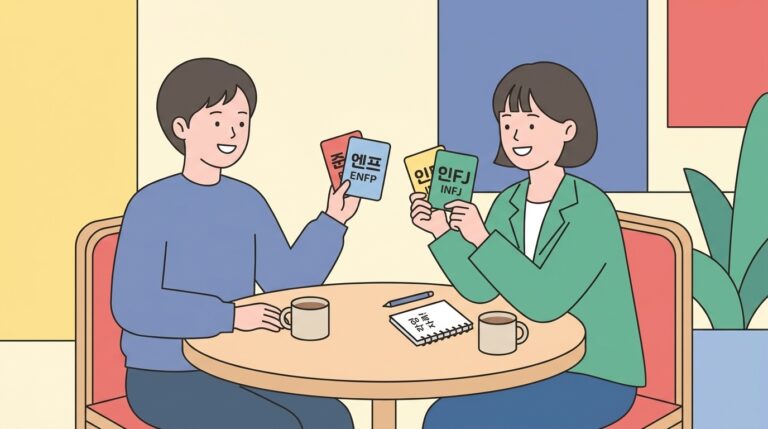
Picture this: You are sitting at a cozy café in Yeonnam-dong with a new Korean friend. Within five minutes of ordering iced Americanos, they lean in with bright eyes and ask the ultimate Korean icebreaker: “MBTI가 뭐예요?” (What is your MBTI?) You share your 4-letter code, and suddenly their face lights up: “대박! 우리 성격 진짜 잘 맞아요!” (Awesome! Our personalities match so well!)
In South Korea, MBTI is not just a personality test—it is a modern love language, a friendship shortcut, and a cultural bonding ritual seen in every K-drama and K-pop variety show (from BTS to SEVENTEEN). But if you are a beginner, you might freeze, wondering how to express that you two get along without sounding like a robotic grammar book. Based on real feedback from hundreds of beginner learners at Daily Hangul, this step-by-step A1 guide will help you talk about personality compatibility effortlessly and make instant Korean friends!
Phase 2: 핵심 표현 3선 심층 분석 (Top 3 Key Expressions)
1. 성격이 잘 맞아요 (Seong-gyeog-i jal maja-yo)
- Pronunciation: [Seong-gyeog-i jal maja-yo] (Sounds like “Sung-gyuk-ee jal mah-jah-yo”)
- Meaning: Literal: “Personality fits well” / Natural: “Our personalities match well” or “We get along great.”
- K-Culture Moment: Seen in hit dating shows like Single’s Inferno or Heart Signal whenever contestants realize they share identical communication styles.
- Editor’s Insight: The word 맞다 (mat-da) means “to fit/to be correct.” Adding 잘 (jal – well) creates an instant feeling of warm friendship.
- Situation Spectrum: Casual: ✅ | Semi-formal: ✅ | Formal: ⚠️ (Use ‘성격이 잘 맞습니다’ in formal speeches)
- 🤔 Think About It: In English, we say “We click” or “We vibe.” Why do you think Korean uses the metaphor of puzzle pieces fitting (맞다) together?
2. MBTI가 뭐예요? (MBTI-ga mwo-ye-yo?)
- Pronunciation: [Em-bee-tee-eye-ga mwo-ye-yo?] (Say “MBTI” in English + “gah mwo-yay-yo?”)
- Meaning: Literal: “What is your MBTI?” / Natural: “What is your personality type?”
- K-Culture Moment: Every K-pop idol interview starts with this question to break the ice.
- Editor’s Insight: The ending ~예요? (ye-yo?) is the polite beginner-friendly question marker for “Is it / What is?”
- Situation Spectrum: Casual: ✅ | Semi-formal: ✅ | Formal: ⚠️
- 🤔 Think About It: Blood types used to be Korea’s main icebreaker. How does asking MBTI reflect a desire for quick empathy in modern society?
3. 우리 케미 좋아요 (Uri ke-mi jo-a-yo)
- Pronunciation: [U-ri ke-mi jo-a-yo] (Sounds like “Oo-ree kay-mee joh-ah-yo”)
- Meaning: Literal: “Our chemistry is good” / Natural: “We have great chemistry!”
- K-Culture Moment: Fans often comment this under YouTube clips of dynamic K-drama lead couples.
- Editor’s Insight: 케미 (kemi) comes from the English word chemistry. Combined with 우리 (uri – we/our), it makes you sound like a true local.
- Situation Spectrum: Casual: ✅ | Semi-formal: ✅ | Formal: 🚫
- 🤔 Think About It: Notice how Koreans use “우리 (Our)” instead of “내 (My)” even when referring to their own school or friends? Shared connection is everything!
Phase 3: 교과서 한국어 vs 진짜 한국어 (Textbook vs. Real Korean)
- Situation 1: Agreeing with someone’s opinion
- 📖 교과서 한국어: 저는 당신의 의견에 전적으로 동의합니다. (Jeoneun dangsin-ui uigyeon-e jeonjeog-euro dong-uihamnida – I fully agree with your opinion.)
- 🗣️ 진짜 한국어: 맞아요! 진짜 그래요! (Maja-yo! Jinjja geurae-yo! – That’s right! Totally!)
- 💡 왜 다를까?: Textbook phrases sound like a UN conference debate. Native speakers use quick, energetic agreement words like 맞아요 to build immediate warmth.
- Situation 2: Saying you have different personalities
- 📖 교과서 한국어: 우리의 성격은 서로 상이합니다. (Uri-ui seong-gyeog-eun seoro sang-ihamnida – Our personalities are mutually different.)
- 🗣️ 진짜 한국어: 우리는 성격이 반대예요! (Uri-neun seong-gyeog-i bandae-ye-yo! – We have opposite personalities!)
- 💡 왜 다를까?: Koreans find charm in “opposites attract” (반대 – opposite), framing differences as complementary rather than distant.
Phase 4: K-Culture 딥다이브 & 비언어적 매너 (Culture & Body Language)
4-1. 눈치 (Nunchi) & Reaction Manners
When a Korean friend shares their MBTI, don’t just nod silently. Match their energy!
* The Double Nod & Clapping: Lightly clap your hands once and nod twice while saying “맞아요!” (Maja-yo!).
* Eye Contact & Leaning In: Leaning forward slightly shows active listening and warmth (정, Jeong).
4-2. The K-MBTI Phenomenon
In Korea, MBTI is rarely about rigid psychological profiling. It is used as a lighthearted social tool to understand boundaries. For example, if someone says they are an I (Introvert), friends will respect their need to recharge at home without taking it personally. If they are a T (Thinking) type, people understand their direct answers are meant to be helpful, not rude!
Phase 5: 실전 롤플레이 시나리오 (Real-Life Roleplay)
- Setting: A stylish photo booth (인생네컷) in Hongdae with Minji, your new Korean classmate.
-
Minji: 혹시 MBTI가 어떻게 되세요? (Hoksi MBTI-ga eotteoke doeseyo?) 🎭 [Tilts head curiously with a warm smile]
- You: 저는 ENFP예요! 민지 씨는요? (Jeoneun ENFP-ye-yo! Minji ssi-neun-yo?) 🎭 [Smiles and holds up 4 fingers]
- Minji: 헐, 대박! 저 INFJ예요! (Heol, daebak! Jeo INFJ-ye-yo!) 🎭 [Gasps happily and claps hands]
- You: 와, 우리 성격이 진짜 잘 맞아요! (Wa, uri seong-gyeog-i jinjja jal maja-yo!) 🎭 [Nods enthusiastically]
- Minji: 맞아요, ENFP랑 INFJ는 찰떡궁합이래요! (Maja-yo, ENFP-rang INFJ-neun chaltteok-gunghap-iraeyo!) 🎭 [Shows a thumbs up]
- You: 우리 케미 완전 좋아요! (Uri ke-mi wanjeon jo-a-yo!) 🎭 [Laughs and strikes a pose for the camera]
- Minji: 오늘 사진 진짜 잘 나오겠어요! (Oneul sajin jinjja jal naogesseoyo!) 🎭 [Pushes the photo booth button]
- You: 맞아요! 기대돼요! (Maja-yo! Gidaedwae-yo!) 🎭 [Puts on cute bunny ears headband]
🔀 인터랙티브 분기점 (Interactive Branching)
What do you say when Minji says her MBTI is the opposite of yours?
* Option A: “우리는 안 맞아요. 끝이에요.” (We don’t match. It’s over.)
* 🚫 Feedback (Risk): Too blunt and harsh! Minji will think you genuinely dislike her.
* Option B: “반대라서 더 재미있어요!” (Because we are opposites, it’s even more fun!)
* 🌟 Feedback (Best): Super positive, showing curiosity and social warmth!
* Option C: “MBTI는 비과학적이에요.” (MBTI is unscientific.)
* ⚠️ Feedback (Bad): While factually true, it totally kills the casual vibe.
Phase 6: 10초 감정 섀도잉 드릴 (10-Second Shadowing Drill)
Repeat after the emotional markers! Pause at the slashes (/):
[😊 Super excited & amazed]대박! / 우리 성격 / 진짜 잘 맞아요! (Daebak! / Uri seong-gyeok / jinjja jal maja-yo!)[🤔 Curious & polite]혹시 / MBTI가 / 뭐예요? (Hoksi / MBTI-ga / mwo-ye-yo?)[🥰 Warm & friendly bonding]우리 / 케미 / 완전 좋아요! (Uri / ke-mi / wanjeon jo-a-yo!)
Phase 7: K-Culture 미니 사전 (Mini Dictionary)
- 케미 (Kemi) [Noun]: Chemistry between people. Used for friends, coworkers, or romantic couples who click instantly.
- 티키타카 (Tiki-taka) [Noun]: Fast-paced, witty verbal back-and-forth banter. Inspired by soccer passing.
- 찰떡궁합 (Chaltteok-gunghap) [Noun]: A perfect match; sticking together like sweet rice cakes (찰떡).
- E 성향 / I 성향 (E-seonghyang / I-seonghyang) [Noun]: Extroverted traits / Introverted traits in daily slang.
Phase 8: 여행자를 위한 생존 키트 (Traveler’s Survival Kit)
Top 3 Survival Phrases
- 사진 같이 찍어요! (Sajin gachi jjigeoyo!) – Let’s take a photo together!
- Pro Tip: Perfect line at trending self-photo studios in Hongdae or Seongsu.
- 저도 그렇게 생각해요. (Jeodo geureoke saenggak-haeyo.) – I think so too.
- Pro Tip: The ultimate polite agreement phrase for making friends.
- 또 만나요! (Tto mannayo!) – Let’s meet again!
- Pro Tip: Warm and casual farewell for peers.
Editor’s Travel Note
When hanging out with local friends in Seoul, download the Naver Map navigation application to easily find trendy themed cafes in Yeonnam-dong. If you plan to split dessert or coffee costs, cash is rarely used—make sure to carry an international travel debit card for fast kiosk payments.
Phase 9: 한 발 더 깊이 (Think Deeper)
In many Western cultures, individuality and uniqueness are highlighted from day one. In South Korea, sharing categories like MBTI or blood types is not about putting people in boxes; it is a cultural tool to quickly find common ground and establish 유대감 (yudaegam – a sense of belonging). By asking your MBTI, Koreans are offering a friendly bridge into their world.
💬 Your Turn: What is your MBTI, and do you feel your personality matches well with introverts or extroverts? Share in the comments below in Korean: “저는 [MBTI]예요!”
Phase 10: FAQ & 흔한 실수 (FAQ & Common Mistakes)
Q: Can I use “성격이 잘 맞아요” with my boss or professor?
A: It is slightly informal. With your boss or professor, say “저희는 업무 스타일이 잘 맞습니다” (Our work styles align well) instead.
Q: How do I say my MBTI in Korean if I don’t know the Korean letter names?
A: Simply pronounce the English alphabet letters normally (e.g., E-N-F-P-ye-yo)! Everyone understands.
Q: What is the difference between “잘 맞아요” and “좋아요”?
A: 좋아요 means “It’s good/I like it,” whereas 잘 맞아요 specifically means “It fits well/It matches.”
🚨 흔한 실수 (Common Mistakes)
- Mistake: Saying “당신과 성격이 맞아요.” (Using 당신 for “you”).
- 👉 Correct Action: Drop 당신! Use their name: “[Name] 씨랑 성격이 잘 맞아요.”
- Mistake: Pronouncing 맞아요 as [mat-ah-yo].
- 👉 Correct Action: Pronounce it smoothly as [mah-jah-yo] due to sound linking.
- Mistake: Forgetting the polite ending ~요 (-yo) with new acquaintances.
- 👉 Correct Action: Always keep -요 until you mutually agree to speak casually (반말).
Phase 11: 액션 미션 & 참여 유도 (Action Missions)
- 🥉 Bronze Mission: Stand in front of a mirror and say “우리 성격이 잘 맞아요!” 3 times with a big smile.
- 🥈 Silver Mission: Post your 4-letter MBTI on your Instagram Story with the caption: “저랑 성격 잘 맞을 사람? (Who matches my personality?)”.
- 🥇 Gold Mission: In your next language exchange or meetup, ask your Korean partner: “MBTI가 뭐예요?”
- 🎮 K-Culture Mission: Watch any episode of Run BTS or Going SEVENTEEN and spot when the members mention their MBTI!
Phase 12: 인터랙티브 퀴즈 챌린지 (Interactive Quiz)
1. Situation Quiz: Your friend says they love quiet cafes, and you love quiet cafes too! What is the best phrase?
* A) 성격이 안 맞아요.
* B) 성격이 잘 맞아요!
* C) MBTI가 싫어요.
2. Fill-in-the-blank: 우리 _____ 완전 좋아요! (We have great chemistry!)
* (Hint: K-pop slang for chemistry)
3. True or False: Asking someone’s MBTI on a first friendly meeting in Korea is considered rude.
🔍 Click here to reveal Answers & Explanations!
- Answer: B) 성격이 잘 맞아요! (Explanation: You both share the same preference, so your personalities fit well together!)
- Answer: 케미 (kemi) (Explanation: 우리 케미 완전 좋아요! means Our chemistry is totally awesome!)
- Answer: False (Explanation: MBTI is one of the most common and beloved friendly icebreakers in contemporary Korea!)







