

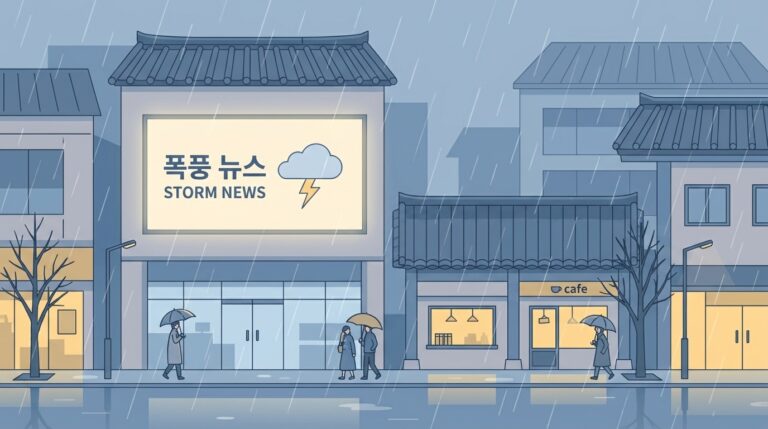
How to Understand Korean Typhoon News and Talk Like a Local
Phase 1: Empathy (Story-Driven Opening)
안녕하세요! I’m your Daily Hangul editor.
Imagine you are sitting in a cozy cafe in Hongdae on a humid summer afternoon. Suddenly, every smartphone in the cafe buzzes simultaneously with a piercing alarm sound that makes everyone look up. On the cafe’s wall-mounted TV, a news anchor in a crisp suit urgently speaks before a giant satellite map showing swirling red storm clouds: “제14호 태풍이 한반도를 향해 북상하고 있습니다.”
Your Korean friend instantly frowns, opens their weather app, and texts their family: “태풍 대비 잘해!” Meanwhile, you feel a surge of panic. Is it a slight rain shower or a serious hurricane? Should you cancel your train trip to Busan tomorrow? What should you say when your Korean coworkers ask if you prepped your apartment windows?
Listening to Korean disaster broadcasts and responding naturally can feel intimidating at the B1 intermediate level. Broadcast Korean uses formal Sino-Korean vocabulary, yet conversations with friends switch immediately to warm, colloquial safety checks. In this lesson, built on real feedback from international residents in Korea, you’ll master essential news listening keywords and everyday conversational phrases so you can stay safe and connect meaningfully with Koreans when storm warnings hit!
Phase 2: Core Expressions Deep Dive
1. 태풍이 북상하고 있습니다 (Taepung-i buksanghago itseumnida)
- Pronunciation: [tae-poong-ee book-sang-ha-go eet-seum-nee-da] (Sounds like tae-pung + book + sang)
- Meaning: Literal: “The typhoon is moving north.” | Nuance: “A typhoon is heading straight toward Korea / approaching the peninsula.”
- K-Culture Moment: The iconic breaking news screen caption (속보 – Sokbo) that appears across all major Korean networks whenever a storm enters the Jeju Island waters.
- Editor’s Insight: 북상하다 (buksanghada) combines 북 (North) and 상 (Up). Because Korea sits in the northern hemisphere above the Pacific tropics, typhoons almost always move northward toward the Korean Peninsula.
- Situation Spectrum: Casual 🚫 | Semi-formal ⚠️ | Formal ✅ (Used in broadcasts, formal announcements, and workplace updates)
- 🤔 Think About It: How does weather reporting in your country describe approaching natural disasters? Do you use directional words or speed words?
2. 피해 없으시길 바랍니다 (Pihae eopseusigil baramnida)
- Pronunciation: [pee-hae eop-seu-she-geel bah-rahm-nee-da] (Sounds like pee-hae + up-sue-she-geel)
- Meaning: Literal: “I hope there is no damage.” | Nuance: “Stay safe and hope you experience no storm damage / wishing you safety.”
- K-Culture Moment: The warm closing text message sent between colleagues, clients, and neighbors right before a typhoon makes landfall.
- Editor’s Insight: In Korean culture, checking on others’ well-being before and after bad weather is a vital courtesy known as 안부 묻기 (anbu mutgi). It shows thoughtful empathy and community solidarity.
- Situation Spectrum: Casual ⚠️ (Better: 피해 없길 바라!) | Semi-formal ✅ | Formal ✅
- 🤔 Think About It: In your culture, is it common to send proactive safety wishes to business acquaintances before a storm begins?
3. 창문 단속 잘 하세요 (Changmun dansok jal haseyo)
- Pronunciation: [tchang-moon dahn-sok jahl ha-seh-yo] (Sounds like chang-moon + dahn-sohk)
- Meaning: Literal: “Do window control/inspection well.” | Nuance: “Make sure your windows are firmly locked and secured.”
- K-Culture Moment: Neighborhood apartment broadcasting systems (아파트 안내방송) chiming into every living room before a major typhoon strikes.
- Editor’s Insight: 단속 (dansok) means securing, locking down, or strictly managing something. For high-rise apartment living in Korea, locking the window sash prevents glass rattling and pressure breakage during gale-force winds.
- Situation Spectrum: Casual ⚠️ (Better: 창문 단속 잘해!) | Semi-formal ✅ | Formal ✅
- 🤔 Think About It: What is the most standard safety step people in your home country take when severe weather strikes?
Phase 3: Textbook Korean vs. Real-world Korean
Situation 1: Warning a friend about the storm
- 📖 교과서 한국어 (Textbook): “내일 태풍이 올 예정이니 우산을 준비하십시오.” (Tomorrow, a typhoon is scheduled to arrive, so please prepare an umbrella.)
- 🗣️ 진짜 한국어 (Real Life): “내일 태풍 직격탄이래. 웬만하면 나가지 마!” (They say tomorrow will take a direct hit from the typhoon. Try not to go outside if possible!)
- 💡 왜 다를까? (Why the difference?): In real life, an umbrella is useless during a typhoon. Koreans use the vivid expression 직격탄 (jikgyeoktan – direct hit) and advise staying indoors with 웬만하면 (if possible/unless necessary).
Situation 2: Asking if a coworker experienced damage after the storm
- 📖 교과서 한국어 (Textbook): “태풍으로 인해 어떤 피해를 입으셨습니까?” (What kind of damage did you incur due to the typhoon?)
- 🗣️ 진짜 한국어 (Real Life): “어제 태풍 때문에 별일 없으셨어요?” (Did everything go alright despite the typhoon yesterday?)
- 💡 왜 다를까? (Why the difference?): Asking directly “what damage did you incur” assumes they suffered misfortune. 별일 없으셨어요? is far more polite, warmly asking if everything remained peaceful and uneventful.
Phase 4: K-Culture Deep Dive & Non-Verbal Manners
4-1. Nunchi & Emergency Etiquette
When an emergency disaster text (긴급재난문자 – Gingeup Jaenan Munja) sounds with a loud siren in public spaces, silence your phone quickly to prevent collective noise stress, check the short Korean text for location names, and look around. If you are at work or in a meeting, a slight nod of the head and a calm utterance like “태풍 주의보 떴네요 (A typhoon advisory just popped up)” demonstrates quick awareness (눈치 – nunchi) without causing panic.
4-2. Cultural Code: The Pre-Typhoon Convenience Store Rush & Tape Technique
In K-dramas and real life alike, an impending typhoon creates a unique grocery pattern: instant ramyeon, bottled water, and canned goods disappear from convenience stores. You will also see Koreans applying X-shaped tape or damp newspapers across large balcony windows to reinforce the glass against violent gusts. It’s a classic visual symbol of Korean disaster prep!
Phase 5: Interactive Roleplay Scenario
Setting: Office breakroom in Mapo-gu, Seoul. Rain is starting to lash against the glass as the 5 PM news broadcast plays on the TV.
Characters: Minji (민지) – Your considerate Korean team senior; You (학습자) – An intermediate Korean learner.
- 민지: (창밖을 보며 걱정스러운 표정으로) 뉴스 보셨어요? 태풍 ‘힌남노’가 오늘 밤에 상륙한대요.
(News bosyeosseoyo? Taepung ‘Hinnamno’ga oneul bame sangryukhandae-yo.)
🎭 Looking out the window with a worried expression: Did you see the news? They say Typhoon Hinnamno will make landfall tonight. - You: (스마트폰 재난문자를 확인하며) 네, 방금 재난문자 왔더라고요. 바람이 벌써 거세네요.
(Ne, banggeum jaenanmunja watdeoragoyo. Barami beolsseo geosene-yo.)
🎭 Checking the emergency alert on phone: Yes, an alert just came through. The wind is already getting fierce. - 민지: 맞아요. 퇴근길 지하철 지연될 수도 있으니까 오늘은 칼퇴해야겠어요.
(Majayo. Toegeungil jihacheol jiyeondoel sudo isseunikka oneureun kaltoehaeyagesseoyo.)
🎭 Sighing lightly: Exactly. The subway might get delayed during evening rush hour, so we should leave work on the dot today. - You: 민지 님 댁은 저지대 아니에요? 괜찮으세요?
(Minji nim daegeun jeojidae anieyo? Gwaenchaneuseyo?)
🎭 Asking with genuine concern: Isn’t your home in a low-lying area, Minji? Are you okay? - 민지: 다행히 3층이라 침수 걱정은 없는데, 베란다 창문 단속 단단히 해야죠.
(Dahaenghi sam-cheung-ira chimsu geokjeongeun eopneunde, beranda changmun dansok dandanhi haeyajyo.)
🎭 Smiling gratefully: Fortunately I’m on the third floor so flooding isn’t a worry, but I need to secure my balcony windows tightly. - You: 맞아요, 창틀 사이에 신문지나 박스를 끼워두면 덜 흔들린대요.
(Majayo, changteul saie sinmunjina bakseureul kkiwodumyeon deol heundeullindae-yo.)
🎭 Sharing a practical tip: Right, I heard if you wedge newspapers or cardboard into the window frame, it shakes less. - 민지: 오, 좋은 팁이네요! 오늘 밤에 아무 피해 없으시길 바라요.
(Oh, joeun tibiney-yo! Oneul bame amu pihae eopseusigil barayo.)
🎭 Nodding approvingly: Oh, that’s a great tip! I hope you have zero storm damage tonight. - You: 민지 님도 조심히 들어가시고 내일 봬요!
(Minji nimdo josimhi deureogasigo naeil bwaeyo!)
🎭 Bowing politely: You get home safely too, Minji. See you tomorrow!
🔀 Interactive Choice Point
Minji asks you: “오늘 저녁 약속 취소하고 바로 집에 가실 거죠?” (You’re canceling your dinner plans and heading straight home, right?)
- Option A: “네, 태풍 온다니까 약속 미루고 바로 집으로 가려고요.” (Yes, since the typhoon is coming, I’m postponing plans and heading right home.)
- Feedback (Best): Perfect! Natural grammar, uses the indirect quotation 온다니까, and shows great common sense.
- Option B: “아니요, 비가 와도 삼겹살 약속은 꼭 가야 해요!”
- Feedback (Risk): While funny, during a severe typhoon warning, insisting on going to a barbecue hangout sounds reckless and unaware of storm severity.
- Option C: “태풍이 무서워서 회사를 지금 당장 도망칠 겁니다.”
- Feedback (Bad): 도망칠 겁니다 (I will flee) is dramatic and unnatural for an office setting. Use 조기 퇴근 (leaving early) instead.
Phase 6: 10-Second Emotion Shadowing Drill
Read aloud focusing on rhythm pauses (/) and emotional tone indicators:
[😟 걱정스럽고 다급하게 / Worried & urgent]- “뉴스 보니까 / 오늘 밤이 / 고비라고 하네요!”
- (Nyuseu bonikka / oneul bami / gobirago hanaeyo!)
- Meaning: According to the news, tonight is the critical turning point!
[💡 차분하고 친절하게 / Calm & helpful]- “창문 단속 잘 하시고 / 외출은 / 웬만하면 자제하세요.”
- (Changmun dansok jal hasigo / oechureun / wenmanhamyeon jajehaseyo.)
- Meaning: Make sure your windows are secured and please refrain from going outside if possible.
[🙏 진심 어린 따뜻함으로 / Heartfelt & warm]- “다들 / 큰 피해 없이 / 무사히 지나갔으면 좋겠어요.”
- (Dadeul / keun pihae eopsi / musahi jinagasseumyeon jokgesseoyo.)
- Meaning: I really hope it passes safely for everyone without big damage.
Phase 7: K-Culture Mini Dictionary
- 상륙하다 (Sangryukhada) | To make landfall
- Used constantly in news broadcasts when the eye of a typhoon reaches the Korean mainland (e.g., 새벽에 남해안 상륙 – Making landfall on the southern coast at dawn).
- 침수 (Chimsu) | Flooding / Submersion
- Refers to roads, basements, or subway stations taking in water (e.g., 지하차도 침수 주의 – Beware of underpass flooding).
- 결항 (Gyeolhang) | Flight / Ferry Cancellation
- Crucial for travelers; indicates suspended plane or boat departures due to wind advisories (e.g., 제주행 항공편 전편 결항 – All flights to Jeju canceled).
- 칼퇴 (Kaltoe) | Leaving work right on time
- Slang combining 칼 (knife-sharp) and 퇴근 (leaving work). When a typhoon approaches, managers often encourage early or sharp departures.
Phase 8: Survival Kit for Travelers
Top 3 Survival Expressions
- 태풍 때문에 비행기 결항되었나요? (Taepung ttaemune bihaenggi gyeolhangdoe-eotnayo?)
- Pro Tip: Use this at the airport counter or call center to check if your flight is grounded.
- 지금 배달 주문 가능한가요? (Jigeum baedal jumun ganeunghangayo?)
- Pro Tip: During heavy storms, food delivery apps shut down rider service for safety.
- 비바람이 너무 심해서 대피할 곳이 있나요? (Bibalami neomu simhaeseo daepihal gosi itnayo?)
- Pro Tip: Essential if caught outside during unexpected torrential gusts.
Editor’s Travel Note
- Install the Safety Korea (안전디딤돌 – Emergency Disaster Notification) government app on your phone for multi-language emergency push alerts.
- Before traveling between cities, verify express bus and KTX train schedules in real time using the KORAIL Talk (코레일톡) app rather than third-party portals, as mountain routes often suspend operations early.
Phase 9: A Step Deeper (Reflection)
In Korea, natural disasters trigger a collective linguistic reflex: 안부 문자 (checking-in texts). Rather than viewing a typhoon solely as an individual inconvenience, Korean society treats it as a communal event where caring for neighbors, colleagues, and family is expected. Asking “별일 없으세요?” or “창문 단속 잘하세요” is not just about weather—it reflects the deep-rooted 정 (Jeong) and mutual responsibility embedded in the Korean language.
💬 Your Turn: How does your community react linguistically when a major storm or blizzard hits? Share your favorite emergency expressions in the comments below!
Phase 10: FAQ & Common Mistakes
Q: What is the difference between 태풍 주의보 and 태풍 경보?
A: 주의보 (Advisory) is issued when strong winds and heavy rain are expected to cause caution-level risks. 경보 (Warning) is a higher tier of danger, issued when severe damage or dangerous winds are imminent.
Q: Should I use 반말 (informal speech) when texting friends about typhoon safety?
A: Yes! With close friends, say “태풍 조심해! (Be careful of the typhoon!)” or “창문 꼭 닫아! (Make sure to close your windows!)”.
Q: Why do Korean news anchors use terms like ‘초속 30미터’ instead of km/h?
A: Korean weather broadcasts report wind velocity in meters per second (m/s, 초속 몇 미터), while storm movement speed is stated in kilometers per hour (km/h, 시속 몇 킬로미터).
🚨 Common Mistakes Warning Board
- Mistake: Saying “태풍을 축하해요” thinking it means “Hope you enjoy the rain”.
- Correct Action: Typhoons cause severe destruction. Always say “태풍 피해 없으시길 바랍니다”.
- Mistake: Using “비가 와요” for hurricane-strength typhoons.
- Correct Action: Upgrade your vocabulary to 폭우 (heavy downpour) or 강풍을 동반한 비바람 (rainstorm accompanied by gale-force winds).
- Mistake: Translating “Watch out for the typhoon” as “태풍을 보세요” (Look at the typhoon).
- Correct Action: Say “태풍 조심하세요” (조심하다 = be careful / watch out).
Phase 11: Action Missions
- 🥉 Bronze Mission (Solo Practice): Read the Phase 6 shadowing drill 3 times aloud in front of a mirror with genuine facial expressions.
- 🥈 Silver Mission (Social Connection): Send a message to a Korean friend or language exchange partner saying: “오늘 태풍 온다는데 창문 단속 잘하고 조심해!”
- 🥇 Gold Mission (Real Life): Watch a 2-minute weather forecast segment on YouTube (search: KBS 날씨 태풍) and identify at least three words: 북상, 상륙, 주의보.
- 🎮 K-Culture Mission: Find a scene in a slice-of-life K-drama where characters tape their apartment windows before a typhoon!
Phase 12: Interactive Quiz Challenge
- Situational Judgment: Your Korean coworker looks worried about the upcoming typhoon. What is the most considerate phrase to say?
- A) 축하합니다!
- B) 큰 피해 없이 지나가면 좋겠어요.
- C) 비행기 결항 축하해요.
- Fill in the Blank: “태풍이 한반도를 향해 빠르게 _______하고 있습니다.” (The typhoon is rapidly moving north toward the Korean peninsula.)
- A) 퇴근
- B) 상륙
- C) 북상
- True or False: Emergency disaster text messages (재난문자) in Korea are only sent in English.
👉 Click here to check the Answers and Explanations!
- Answer: B | 큰 피해 없이 지나가면 좋겠어요 warmly expresses hope that the storm passes without major damage.
- Answer: C (북상) | 북상하다 means moving north, the standard term for typhoons heading toward Korea.
- Answer: False | Standard alerts are sent in Korean, though designated foreign-language safety apps provide English translations.







