

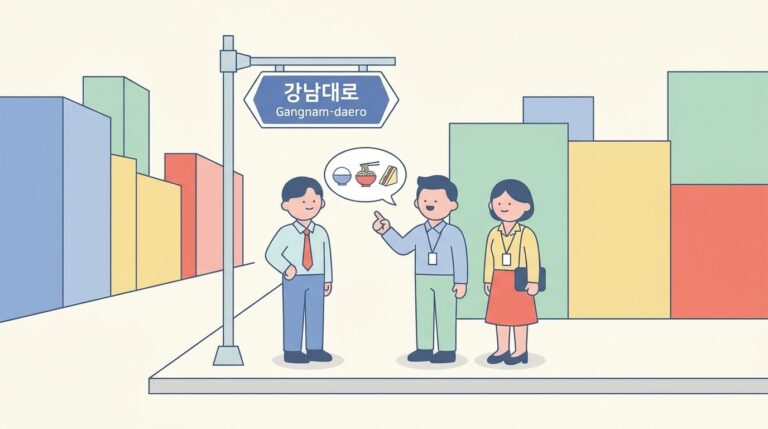
Surviving the Korean Office Lunch: How to Order with Nunchi
Phase 1: The 11:50 AM Stare-Down
안녕하세요! It’s your Daily Hangul editor and cultural navigator. Picture this: The clock in your Seoul office hits 11:50 AM. Keyboard clicking slows down. Suddenly, your manager turns around, looks at the team, and drops the heaviest question in corporate Korea: “오늘 점심 뭐 먹을까요?” (What should we eat for lunch today?).
If you have watched K-dramas like Misaeng or Gaus Electronics, you know this is not a simple dining inquiry. It is a high-stakes psychological chess match known as Nunchi (눈치). Propose something too pricey, and you look careless. Say you want pizza when the director had heavy drinks last night and needs spicy soup (haejang), and the room turns freezing cold. Many intermediate learners tell us, “I froze because I didn’t know how to express preferences politely without breaking harmony!” This guide provides battle-tested phrases and cultural codes to help you navigate office lunch menus effortlessly like a seasoned local.
Phase 2: Core 3 Lunch Survival Expressions
1. 저는 다 좋아요 (Jeoneun da joayo)
- Pronunciation: [Jeo-neun da jo-a-yo] (Sounds like “John-un dah jo-ah-yo”)
- Meaning: Literal: “As for me, all is good.” | Real Nuance: “I’m totally flexible, please lead the way!”
- K-Culture Moment: Used by junior employees in Korean variety shows when the senior member asks what everyone wants to eat.
- Editor’s Insight: While this is the safest default phrase, saying it too flatly can make you seem passive. Pair it with a bright smile.
- Situation Spectrum: Casual ✅ | Semi-formal ✅ | Formal ✅
- 🤔 Think About It: Why does Korean workplace culture prioritize group consensus over individual culinary cravings?
2. 어제 뭐 드셨어요? (Eoje mwo deusyeosseoyo?)
- Pronunciation: [Eo-je mwo deu-syeo-sseo-yo?] (Sounds like “Uh-jeh mwo do-she-uh-so-yo?”)
- Meaning: Literal: “What did you eat yesterday?” | Real Nuance: “Let’s rule out what you recently ate so we don’t repeat meals.”
- K-Culture Moment: A sharp junior staff member deflecting the decision back to the manager with polite consideration.
- Editor’s Insight: This is pure tactical brilliance. It shows you care about the other person’s palate while avoiding being put on the spot.
- Situation Spectrum: Casual ⚠️ | Semi-formal ✅ | Formal ✅
- 🤔 Think About It: How does asking about past meals create an effortless conversational bridge in your own culture?
3. 혹시 매운 거 괜찮으세요? (Hoksi maeun geo gwaenchaneuseyo?)
- Pronunciation: [Hok-si mae-un geo gwaen-chan-eu-se-yo?] (Sounds like “Hoke-she may-oon guh gwen-chahn-ew-seh-yo?”)
- Meaning: Literal: “By any chance, is spicy stuff okay with you?” | Real Nuance: “I’m craving something spicy, but only if you’re up for it.”
- K-Culture Moment: Pitching Kimchi-jjigae or Tteokbokki without sounding demanding.
- Editor’s Insight: Adding 혹시 (hoksi – by any chance) softens any question in Korean business life by 50%.
- Situation Spectrum: Casual ✅ | Semi-formal ✅ | Formal ✅
- 🤔 Think About It: Notice how Korean questions often check dietary comfort rather than declaring rigid personal demands.
Phase 3: Textbook Korean vs. Real Korean
Situation 1: Asking what colleagues are craving
- 📖 Textbook Korean: 무엇을 먹고 싶습니까? (Mueoseul meokgo sipsumnikka? – What do you want to eat?)
- 🗣️ Real Korean: 오늘 뭐 땡기세요? (Oneul mwo ttaeng-gi-se-yo? – What are you craving today?)
- 💡 Why is it different?: The verb 땡기다 (ttaenggida) literally means “to pull”, functioning colloquially as “to crave”. It sounds warm, conversational, and natural among coworkers.
Situation 2: Stating you aren’t picky with food
- 📖 Textbook Korean: 저는 편식하지 않습니다. (Jeoneun pyeonsikhaji anseumnida. – I do not eat an unbalanced diet.)
- 🗣️ Real Korean: 저 아무거나 다 잘 먹어요! (Jeo amugeona da jal meogeoyo! – I eat pretty much anything without fuss!)
- 💡 Why is it different?: Real Korean office life values adaptability. Saying you eat “anything well” shows team spirit and easygoing camaraderie.
Phase 4: K-Culture Deep Dive & Non-Verbal Etiquette
4-1. Nunchi & Table Etiquette
When walking to the restaurant, match your walking pace with the group leader. Once seated, junior staff traditionally place napkins down and distribute water cups and metal chopsticks (sujeo) on top of napkins for everyone. Do not pick up your spoon until the most senior person has taken their first bite.
4-2. Cultural Code: The Art of “Menu Tong-il” (메뉴 통일)
In fast-paced Gangnam or Yeouido business hubs, restaurants get packed during peak lunch hour (12:00–1:00 PM). To get food served quickly, teams frequently practice 메뉴 통일 (Menyu Tong-il)—everyone ordering the same category (e.g., all ordering stew instead of four different customized dishes). Pay attention if your team leans toward this trend!
Phase 5: Real-Life Roleplay Scenario
Setting: 11:55 AM at a tech company in Pangyo. Manager Park (박 팀장) and Coworker Minji (민지 씨) stand up from their desks.
- Turn 1 (Manager Park): 🎭 (Stretches arms and checks watch) 민지 씨, 오늘 점심 뭐 먹을까? (Minji-ssi, oneul jeomsim mwo meogeulkka? / Minji, what should we eat for lunch today?)
- Turn 2 (Minji): 🎭 (Smiles playfully) 글쎄요, 팀장님 어제 한식 드셨죠? (Geulsseyo, timjangnim eoje hansik deusyeotjyo? / Well, Team Leader, you had Korean food yesterday, right?)
- Turn 3 (Manager Park): 🎭 (Rubs stomach) 응, 어제 회식해서 오늘은 좀 가볍게 먹고 싶네. (Eung, eoje hoesikhaeseo oneul-eun jom gabyeopge meokgo simne. / Yeah, had a team dinner yesterday, so I want something light today.)
- Turn 4 (You): 🎭 (Politely chiming in) 혹시 일식 깔끔한 거 어떠세요? (Hoksi ilsik kkalkkeumhan geo eotteoseyo? / How about some clean Japanese food, by any chance?)
- Turn 5 (Minji): 🎭 (Nods in agreement) 아, 회사 앞에 새로 생긴 소바집 괜찮던데요! (A, hoesa ape saero saenggin sobajib gwaenchantondeyo! / Oh, that new soba place in front of the company is pretty good!)
- Turn 6 (Manager Park): 🎭 (Brightens up) 소바? 좋지! 시원하게 먹으러 가자. (Soba? Joji! Siwonhage meogeureo gaja. / Soba? Sounds great! Let’s go grab something refreshing.)
- Turn 7 (You): 🎭 (Grabbing your company badge) 제가 자리 있는지 얼른 보고 올게요. (Jega jari inneunji eolleun bogo olgeyo. / I’ll quickly check if there are seats available.)
- Turn 8 (Manager Park): 🎭 (Pats your shoulder) 오, 센스 있네! 가자고. (O, senseu inne! Gajago. / Oh, great initiative! Let’s go.)
🔀 Interactive Choice Point
The restaurant line is long, and Manager Park asks you: “웨이팅 긴데 다른 데 갈까?” (The wait is long, should we go somewhere else?)
- Option A: “팀장님, 근처에 5분 거리 덮밥집도 있는데 거기로 갈까요?” (Team Leader, there is a rice-bowl place 5 mins away, should we head there?)
- Feedback: 🌟 Best! Demonstrates prompt problem-solving and situational awareness.
- Option B: “아무 데나 빨리 가요. 배고파요.” (Let’s just go anywhere fast. I’m starving.)
- Feedback: 🚫 Bad. Sounds blunt and complaining, disrupting team atmosphere.
- Option C: “그냥 여기서 계속 기다려요.” (Let’s just keep waiting here.)
- Feedback: ⚠️ Risk. Might waste precious lunch break time unless the senior insisted on waiting.
Phase 6: 10-Second Emotion Shadowing Drill
[😊 밝고 배려있게 - Cheerful & Considerate]
전 다 좋으니까 / 편하신 걸로 / 골라주세요!
(Jeon da joeunikka / pyeonhasin geollo / gol-la-ju-se-yo!)-
[👀 눈치 보며 조심스럽게 - Tactful & Cautious]
혹시 / 뜨거운 국물 종류 / 괜찮으세요?
(Hoksi / tteu-geo-un gung-mul jong-nyu / gwaen-chan-eu-se-yo?) -
[🙋♂️ 센스있고 싹싹하게 - Quick-witted & Helpful]
제가 먼저 가서 / 자리 맡아둘게요!
(Je-ga meon-jeo ga-seo / ja-ri ma-ta-dul-ge-yo!)
Phase 7: K-Culture Mini Dictionary
- 점메추 (Jeom-me-chu): Abbreviation for 점심 메뉴 추천 (Lunch Menu Recommendation). Commonly typed in office group chats around 11:30 AM.
- 메뉴 통일 (Menyu Tong-il): “Menu Unification.” Ordering matching dishes to ensure fast kitchen preparation during peak office rush.
- 법카 (Beop-ka): Abbreviation for 법인카드 (Corporate credit card). When the boss pays with this, lunch is on the company!
- 국룰 (Guk-rul): “National Rule” / Unwritten social standard (e.g., getting iced Americano immediately after lunch even in sub-zero winter).
Phase 8: Traveler & Expat Survival Kit
Top 3 Survival Phrases
- 몇 분이세요? (Myeot bun-i-se-yo?) – “Party of how many?” (Answer: 두 명이요 [Du myeong-i-yo – Two people]).
- 따로 계산해 주세요. (Ttaro gyesanhae juseyo.) – “Please split the bill / charge separately.”
- 포장도 되나요? (Pojangdo doenayo?) – “Can I get this to go?”
Editor’s Travel Note
Before heading to busy business districts like Yeouido or Teheran-ro, make sure to search nearby hot spots using the official Naver Map application download and restaurant rating guide. When dining in teams, split-billing via mobile payment is widespread, but in traditional diners, paying with one card and transferring via KakaoPay later is appreciated by busy restaurant staff.
Phase 9: A Step Deeper (한 발 더 깊이)
In many Western workplaces, lunch is viewed as individual downtime for personal errands or private rest. In Korea, sharing a table (Bapsang) remains a bedrock of interpersonal bonding (Jeong). When coworkers ask what you want to eat, they aren’t merely ordering calories—they are testing collective harmony and building relational warmth. Understanding this transforms lunch from a chore of anxiety into a fun cultural ritual.
💬 Your Turn: What is the most delicate social etiquette rule during lunch breaks in your country? Let us know in the comments below!
Phase 10: FAQ & Common Mistakes
Q: Can I honestly say I want to eat alone?
A: Yes! Solo dining (Honbap / 혼밥) is increasingly respected in Korea. You can politely say: “오늘은 개인 일정이 있어서 혼자 먹고 올게요!” (I have some personal errands today, so I will grab a solo bite!).
Q: What if I have strict dietary restrictions (halal, vegan, allergies)?
A: State it early and positively: “제가 채식을 해서 그런데, 혹시 비빔밥 메뉴 있는 곳 괜찮으실까요?” (Since I am vegetarian, would a place with Bibimbap work for you?).
Q: Who pays the bill when eating with coworkers?
A: If a senior executive invites you, they often pay. Among peers of similar rank, splitting the bill (더치페이 / Dutch pay) or taking turns buying post-lunch coffee is the standard.
🚨 Common Mistakes Warning Board
- Mistake: Saying “아무거나” (Whatever) in an annoyed or indifferent tone. -> Correct Action: Use “저는 다 좋습니다!” with an energetic smile.
- Mistake: Picking the most expensive specialty dish when someone else offers to treat you. -> Correct Action: Check what the host orders and choose a dish in a similar price bracket.
- Mistake: Digging in the moment your bowl arrives while seniors are still waiting. -> Correct Action: Wait until everyone’s food is served or the senior says “먼저 드세요” (Please eat first).
Phase 11: Action Missions
- 🥉 Bronze Mission (Solo Practice): Read the 3 shadowing sentences in Phase 6 out loud 5 times using proper pauses.
- 🥈 Silver Mission (Social Connection): Text a Korean-speaking friend or tutor: “오늘 점심 뭐 땡기세요?”
- 🥇 Gold Mission (Real Life Application): During your next lunch out, take the initiative to ask “혹시 매운 거 괜찮으세요?” before choosing a restaurant.
- 🎮 K-Culture Mission: Watch an episode of a Korean workplace drama and spot whether coworkers grab coffee together right after lunch!
Phase 12: Interactive Quiz Challenge
Test your office lunch street smarts!
Q1 (Situational): Your manager had heavy drinks last night. Which lunch proposal shows optimal Nunchi?
* A) 시원한 북어국이나 콩나물국밥 (Refreshing dried pollack soup or bean sprout soup)
* B) 꾸덕한 치즈 피자 (Heavy cheese pizza)
* C) 뷔페 (All-you-can-eat buffet)
Q2 (Fill-in-the-Blank): Fill in the blank to say “What are you craving today?”:
* “오늘 뭐 ________?”
Q3 (True / False): In Korean workplace dining, it is good etiquette to grab your spoon and start eating before the senior manager picks up theirs.
🔍 Click to reveal answers & explanations!
- A1 Answer: A. Korean office etiquette relies heavily on considering coworkers’ condition. Soothing hangover soups (Haejangguk) show elite empathy.
- A2 Answer: 땡기세요 (ttaenggiseyo).
- A3 Answer: False. Always wait until the senior lifts their utensils and takes the first bite, or gives you the nod to start!







