

Phase 1: Empathy & Story-driven Opening
안녕하세요! (Hello!) I am your editor and cultural navigator at Daily Hangul.
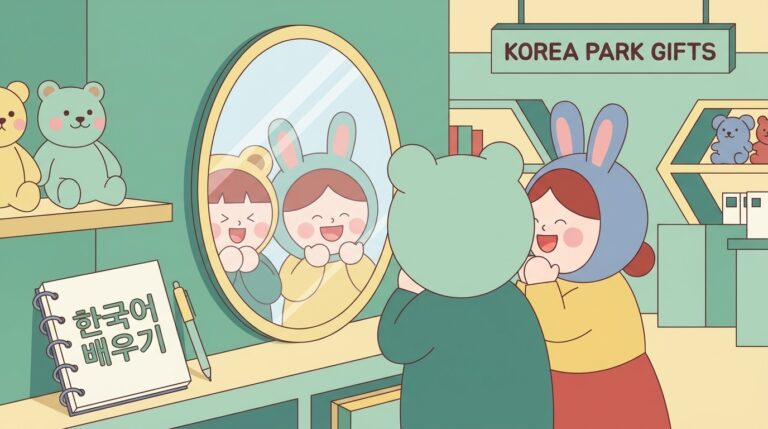
Imagine this: You step through the magical gates of Lotte World or Everland in Seoul. The castle towers rise into the sky, pop music echoes across the square, and almost every single person—from couples on romantic dates to groups of school friends—is rocking super-cute animal ear headbands (머리띠, meoritti). You walk into the bustling souvenir shop wanting to grab the iconic bunny or red panda ears for your own theme park photos, but you suddenly freeze. Can I just pick it up and try it on in front of the mirror? How do I ask the staff if this one looks better? What if I pick the wrong phrase and sound too robotic?
Don’t worry at all! Picking out your signature headband is a rite of passage for every theme park visitor in Korea. In this guide, tailored specifically for A2 (beginner) learners, you will learn the exact, natural phrases to ask permission to try items on, seek opinions from friends or staff, and purchase your favorite headband with total confidence. Based on real feedback from hundreds of our learners, mastering these simple lines will turn a stressful shopping moment into one of the happiest highlights of your Korea trip!
Phase 2: Top 3 Core Expressions Deep Dive
1. 이거 써봐도 돼요? (Igeo sseobwado dwaeyo?)
- Pronunciation: ee-guh ssuh-bwah-doh dway-yoh? (Sounds like “subway” in the middle!)
- Meaning: “May I try this on?” (Literal: “Even if I wear this, is it okay?”)
- K-Culture Moment: Seen in countless K-Dramas (like Business Proposal or Weightlifting Fairy Kim Bok-joo) during the mandatory amusement park date scene where the couple playfully tests cute animal ears on each other.
- Editor’s Insight: In Korean, the verb for wearing something on your head (hats, headbands, glasses) is 쓰다 (sseuda), not 입다 (ipda, for clothes) or 신다 (sinda, for shoes). Using
써보다(try wearing on the head) marks you instantly as someone who knows genuine Korean!- Situation Spectrum:
- Casual (with close friends): 이거 써봐도 돼? (Igeo sseobwado dwae?) ✅
- Semi-formal (to shop staff): 이거 써봐도 돼요? (Igeo sseobwado dwaeyo?) ✅
- Formal/Business: 착용해 봐도 되겠습니까? (Chagyonghae bwado doegesseumnikka?) ⚠️ (Too stiff for a fun gift shop!)
- 🤔 Think About It: Why does Korean use different action verbs for wearing clothes depending on the body part (head, body, feet, hands)? How does this compare to your native language?
2. 어떤 게 더 잘 어울려요? (Eotteon ge deo jal eoullyeoyo?)
- Pronunciation: uht-tuhn geh duh jahl uh-ool-lyuh-yoh?
- Meaning: “Which one looks better on me?” / “Which one suits me more?”
- K-Culture Moment: When K-Pop idols film behind-the-scenes vlogs at amusement parks, holding two different character headbands up to the camera and asking fans to choose.
- Editor’s Insight: The phrase 잘 어울리다 (jal eoullida) means “to match well” or “to suit someone’s vibe.” It is one of the most flattering, friendly expressions you can use in fashion and shopping situations.
- Situation Spectrum:
- Casual: 어떤 게 더 잘 어울려? (Eotteon ge deo jal eoullyeo?) ✅
- Semi-formal: 어떤 게 더 잘 어울려요? (Eotteon ge deo jal eoullyeoyo?) ✅
- Formal: 어느 것이 더 적합합니까? 🚫 (Sounds like choosing a job candidate!)
- 🤔 Think About It: When asking for fashion advice in your culture, do you focus on the object (“Which is prettier?”) or the harmony with the person (“Which suits me?”)?
3. 이걸로 할게요. (Igeollo halgeyo.)
- Pronunciation: ee-guhl-loh hahl-geh-yoh.
- Meaning: “I’ll take this one.” (Literal: “I will do with this one.”)
- K-Culture Moment: The triumphant final decision moment at the cash register before heading straight to the roller coaster.
- Editor’s Insight: Instead of the literal “I will buy this” (이거 살게요), native speakers use
~로 할게요(~ro halgeyo, “I’ll go with this option”) when making a selection from several choices.- Situation Spectrum:
- Casual: 이걸로 할래. (Igeollo hallae.) ✅
- Semi-formal: 이걸로 할게요. (Igeollo halgeyo.) ✅
- Formal: 이것으로 결정하겠습니다. ⚠️ (Too formal for retail shopping.)
- 🤔 Think About It: How does saying “I’ll do this one” show decisive politeness in everyday retail interactions?
Phase 3: Textbook Korean vs. Real-Life Korean
Situation 1: Asking if you can try on a headband
- 📖 Textbook Korean: 머리띠를 착용해 보아도 됩니까? (Meorittireul chagyonghae boado doemnikka?)
- 🗣️ Real-Life Korean: 이거 써봐도 돼요? (Igeo sseobwado dwaeyo?)
- 💡 Why is it different? While textbooks teach formal Sino-Korean nouns like 착용 (wearing/dressing), everyday theme park staff and shoppers prefer soft, native Korean verbs (쓰다) paired with polite informal endings (~아/어 돼요).
Situation 2: Asking for the price
- 📖 Textbook Korean: 이것의 가격은 얼마입니까? (Igeosui gagyeogeun eolmaimnikka?)
- 🗣️ Real-Life Korean: 이거 얼마예요? (Igeo eolmayeyo?)
- 💡 Why is it different? Real spoken Korean drops unnecessary particles and uses contracted pronouns (이거 instead of 이것은). It keeps the rhythm light and approachable.
Phase 4: K-Culture Deep Dive & Non-Verbal Manners
4-1. 눈치 (Nunchi) & Gestures in the Souvenir Shop
- The Mirror Courtesy: Gift shops have dozens of mirrors. It is completely normal and encouraged to put on headbands to check how they look in the mirror before buying. However, remember Nunchi (social situational awareness): do not block the mirror for too long if other visitors are waiting to take selfies or check their look!
- Two-Hand Card Handoff: When handing over your credit card or cash to the cashier, gently hold the card with both hands (or touch your left hand to your right forearm). This small gesture shows sincere respect.
4-2. The Theme Park Headband Culture (머리띠 문화)
In Korea, theme park headbands aren’t just for children—they are an absolute essential fashion statement for teens, couples in their 20s and 30s, and international travelers alike! Often paired with rented Korean high school uniforms (a wildly popular trend outside Lotte World), choosing complementary headbands (커플 머리띠) is considered the first official mission of any theme park day to ensure aesthetic photos for Instagram (인생샷).
Phase 5: Real-Life Roleplay Scenario
Setting: Everland Souvenir Shop near the carousel. Bright lights, carnival music playing softly in the background.
Characters:
* You (Traveler looking for the perfect headband)
* Staff Minji (A cheerful theme park store employee wearing cute cat ears)
- Turn 1 (You): 저기요, 이거 써봐도 돼요?
(Jeogiyo, igeo sseobwado dwaeyo? / Excuse me, may I try this on?)
🎭 [Smiling and gently pointing toward the cat-ear headband on display] - Turn 2 (Minji): 네, 물론이죠! 거울 저쪽에 있어요.
(Ne, mullon-ijyo! Geoul jeojjoge isseoyo. / Yes, of course! The mirror is right over there.)
🎭 [Gesturing warmly toward a brightly lit full-length mirror] - Turn 3 (You): 감사합니다! (Takes mirror selfie) 혹시… 어떤 게 더 잘 어울려요?
(Gamsahamnida! Hoksi… eotteon ge deo jal eoullyeoyo? / Thank you! By any chance… which one looks better on me?)
🎭 [Holding a cat headband on head, and a bear headband in hand for comparison] - Turn 4 (Minji): 음, 손님한테는 곰돌이 머리띠가 진짜 귀여우세요!
(Eum, sonnimhanteneun gomdori meorittiga jinjja gwiyeouseyo! / Hmm, on you, the teddy bear headband looks really cute!)
🎭 [Nodding enthusiastically and giving a thumbs up] - Turn 5 (You): 정말요? 이거 얼마예요?
(Jeongmalyo? Igeo eolmayeyo? / Really? How much is this?)
🎭 [Grinning happily at the compliment] - Turn 6 (Minji): 만 이천 원이에요.
(Man icheon won-ieyo. / It is 12,000 KRW.)
🎭 [Pointing to the price tag on the back] - Turn 7 (You): 좋아요, 이걸로 할게요. 카드로 계산할게요.
(Joayo, igeollo halgeyo. Kadeuro gyesanhalgeyo. / Great, I’ll take this one. I’ll pay by card.)
🎭 [Handing the headband and card forward with both hands] - Turn 8 (Minji): 네! 바로 착용하고 가시겠어요?
(Ne! Baro chagyonghago gasigesseoyo? / Got it! Would you like to wear it right away?)
🎭 [Removing the price tag neatly with scissors with a bright smile]
🔀 Interactive Branch: How will you answer Minji’s last question?
- Choice A: “네, 쓰고 갈게요!” (Ne, sseugo galgeyo! – Yes, I’ll wear it right now!)
- 👉 Feedback (Best Choice): 100% natural and enthusiastically Korean! The clerk will snip the tag off immediately and hand it to you ready to wear.
- Choice B: “봉투에 넣어 주세요.” (Bongtue neoeo juseyo. – Please put it in a bag.)
- 👉 Feedback (Good Alternative): Very polite if you want to keep it clean until you reach a specific photo spot or give it as a gift (Note: shopping bags usually cost 100~200 KRW in Korea).
- Choice C: “아니요, 사지 않겠습니다.” (Aniyo, saji ankkesseumnida. – No, I will not buy it.)
- 👉 Feedback (Risk / Awkward): You just agreed to pay! Saying this will confuse the cashier completely.
Phase 6: 10-Second Emotion Shadowing Drill
Practice reading these lines aloud with the emotional rhythm markers (/ = brief breath pause):
[😊 Excitement & Curiosity]- 저기요, / 이거 써봐도 돼요? / (Jeogiyo, / igeo sseobwado dwaeyo?)
[🤔 Playful Indecision]- 어떤 게 / 더 잘 어울려요? / (Eotteon ge / deo jal eoullyeoyo?)
[🎉 Happy & Decisive]- 좋아요! / 이걸로 할게요. / (Joayo! / Igeollo halgeyo.)
[✨ Cheerful Request]- 네, / 바로 쓰고 갈게요! / (Ne, / baro sseugo galgeyo!)
Phase 7: K-Culture Mini Dictionary
- 머리띠 (Meoritti): Headband / Hairband. In theme parks, it almost exclusively refers to cute character or animal ear headbands.
- 거울 (Geoul): Mirror. Essential for asking “거울 어디 있어요?” (Where is the mirror?).
- 인생샷 (Insaengsyat): “Life shot” (The photo of a lifetime). The ultimate goal of wearing theme park accessories.
- 커플템 (Keopeultem): “Couple item” (Matching matching accessories or clothes worn by couples or close friends).
Phase 8: Survival Kit for Travelers
Top 3 Survival Phrases
- 1. 새 상품 있어요? (Sae sangpum isseoyo?)
- Pronunciation: Sae sang-poom ee-ssuh-yoh?
- Pro Tip: Since display headbands are tried on by many people, ask this after deciding to get a fresh, packaged one from stock!
- 2. 영수증 버려주세요. (Yeongsujeung beoryeojuseyo.)
- Pronunciation: Young-soo-jeung buh-ryuh-joo-seh-yoh.
- Pro Tip: “Please discard the receipt.” Great if you don’t need paper receipts during busy park outings.
- 3. 태그 떼어 주세요. (Taegeu ttee-eo juseyo.)
- Pronunciation: Tae-geu tteh-uh joo-seh-yoh.
- Pro Tip: “Please cut off the price tag.” Use this so you can put your ears on right away!
Editor’s Travel Note
- Navigation Tip: Finding the gift shops with the largest collections is easiest when searching theme park internal maps on the Naver Map App Download Guide. Both Lotte World Adventure and Everland have dedicated retail stores near their main castle/carousel centers.
- Payment Tip: Korea is virtually cashless. International Visa, Mastercard, and mobile credit payment options are accepted everywhere from main shops to outdoor snack carts.
Phase 9: A Step Deeper (Reflection)
In many Western cultures, wearing oversized animal ears in public might feel reserved only for small kids or costume parties. In Korea, however, theme parks exist as a socially accepted “wonderland oasis” where adults can freely embrace playful innocence, Aegyo (cuteness), and shared group joy without any self-consciousness. It is a collective celebration of youthful aesthetics and bonding.
💬 Your Turn: Have you ever worn themed headbands or costumes at an amusement park? Which animal ears would you pick first if you entered Lotte World today? Tell us in the comments below!
Phase 10: FAQ & Common Mistakes
Q: Can I take photos in the shop wearing the headband without buying it immediately?
A: Yes, it is completely acceptable to take a quick mirror selfie to check your look. However, taking extended photo shoots without intending to purchase anything is frowned upon by staff.
Q: What is the difference between “모자” (Moja) and “머리띠” (Meoritti)?
A: 모자 (Moja) means a cap or hat that covers the head, while 머리띠 (Meoritti) refers strictly to a headband band that sits over the hair.
Q: What if the staff asks me “봉투 필요하세요?” (Bongtu piryohaseyo)?
A: They are asking “Do you need a shopping bag?”. If you will wear the headband right away, simply say “아니요, 괜찮아요” (Aniyo, gwaenchanayo – No, it’s okay).
🚨 Common Mistakes Alert (외국인 학습자의 흔한 실수 TOP 3)
- Using ‘입어보다’ (Ibeoboda) for headbands:
- Incorrect: 머리띠 입어봐도 돼요? ❌
- Correct Action: Use 써보다 (sseoboda) for headwear -> 머리띠 써봐도 돼요? ✅
- Handing payment with only one casual flick of the hand:
- Correct Action: Always hold your card with two hands or support your elbow/wrist with the left hand.
- Overusing ultra-formal Korean in casual shops:
- Incorrect: 이것을 구입하고자 합니다 (Igeoseul guiphagoja hamnida). ❌
- Correct Action: Keep it warm and simple: 이걸로 할게요 (Igeollo halgeyo) ✅.
Phase 11: Action Mission & Engagement
- 🥉 Bronze Mission (Solo Practice): Stand in front of your mirror at home with a hat or headband and practice saying: “이거 써봐도 돼요? … 음, 이걸로 할게요!” 3 times smoothly.
- 🥈 Silver Mission (Social Share): Find a photo of a K-Pop idol wearing funny ears, screenshot it, and post in your Korean study group with the caption: “어떤 게 더 잘 어울려요?”
- 🥇 Gold Mission (Real Life): Visit a Korean gift shop or theme park, pick up an accessory, ask the clerk “이거 써봐도 돼요?” and pay with two hands!
🎮 K-Culture Discovery Mission: Watch an episode of any Korean variety show (like Running Man or an idol reality show at an amusement park) and spot how many seconds it takes for the cast members to put on matching 머리띠!
Phase 12: Interactive Quiz Challenge
Quiz 1. Situation Judgment
You find two cute headbands (a bunny and a frog). You want your friend’s opinion on which one matches your face better. What do you say?
* A) 이거 얼마예요?
* B) 어떤 게 더 잘 어울려요?
* C) 봉투에 넣어 주세요.
👉 Click to view Answer & Explanation
Correct Answer: B) 어떤 게 더 잘 어울려요? (Eotteon ge deo jal eoullyeoyo?)
Explanation: Option B directly asks “Which one looks better on me / suits me more?”. Option A asks for the price, and Option C asks for a shopping bag.
Quiz 2. Fill-in-the-Blank
Fill in the correct verb for wearing a headband:
* “저기요, 이 머리띠 [ ______ ] 봐도 돼요?”
👉 Click to view Answer & Explanation
Correct Answer: 써 (Sseo)
Explanation: The base verb for headwear is 쓰다 (sseuda), which conjugates with ~어 보다 into 써보다 (sseoboda).
Quiz 3. True or False
In Korean theme parks, only young children wear animal ear headbands in public.
👉 Click to view Answer & Explanation
Correct Answer: False
Explanation: People of all ages—especially teenagers, couples in their 20s/30s, and friend groups—enthusiastically wear character headbands as a classic theme park culture!







