

Finding Zen in the Land of Pali-Pali: Modern Mindfulness, Meditation Apps, and Inner Peace in Korea
Phase 1: Empathy & Storytelling Opening
안녕하세요! Welcome back to Daily Hangul! I’m your Korean culture navigator.
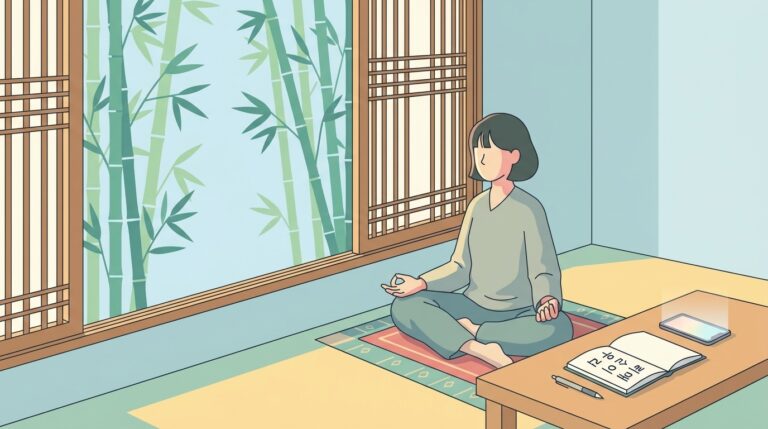
Picture this: You are riding the Seoul Subway Line 2 during morning rush hour. People are packed shoulder to shoulder in silence. But if you glance at their smartphone screens, you won’t just see webtoons or stock tickers—you will increasingly spot soothing gradients of teal and lavender, featuring meditation timers, digital temple bells, and guided breathing exercises. In ultra-fast, high-octane Korea—a society driven by the relentless ppalli-ppalli (hurry-hurry) ethos—a profound cultural shift toward mindfulness and secularized inner peace has quietly taken root.
For advanced (C2) learners, discussing spirituality and mental wellbeing in Korean requires far more than basic vocabulary like ‘스트레스’ (stress) or ‘행복’ (happiness). It demands nuanced linguistic tools that navigate Korea’s syncretic spiritual heritage (Buddhism, Taoism, Neo-Confucianism) alongside the hyper-modern mental wellness industry. Based on feedback from hundreds of advanced learners who struggled to articulate abstract existential thoughts in native-level discussions, this guide will empower you to discuss modern mental health, meditation culture, and psychological self-care with elegance, depth, and effortless cultural fluency.
Phase 2: In-Depth Analysis of 3 Core Expressions
1. 마음 챙김 (Maeum Chaeng-gim)
- Pronunciation: [Mae-um chaeng-gim] (Sounds like my-oom cheng-geem, smooth rhythm with a crisp ‘ch’)
- Meaning: Literal: “Packing/taking care of one’s mind” | Real Nuance: “Mindfulness” (The secularized, active practice of conscious self-awareness and emotional grounding).
- K-Culture Moment: Frequently featured on lifestyle variety shows like I Live Alone (나 혼자 산다) where celebrities share their morning meditation and journaling routines before a hectic shooting schedule.
- Editor’s Insight: While 명상 (myeong-sang) refers to the act of formal meditation, 마음 챙김 represents the continuous lifestyle state of attentiveness. The verb 챙기다 implies deliberate, proactive care—just like packing vitamins or essential supplies.
- Situation Spectrum: Casual ✅ | Semi-formal ✅ | Formal ✅
- 🤔 Think About It: In English, “mindfulness” focuses on the “mind” as an intellectual and cognitive space. Why do you think Korean connects this concept to 마음 (heart-mind), which blends emotional feeling with cognitive presence?
2. 멘탈을 다잡다 (Men-tal-eul Da-jap-da)
- Pronunciation: [Men-tal-eul da-jap-da] (Think of mental + tah-jahp-dah)
- Meaning: Literal: “Re-grasping/tightening one’s mentality” | Real Nuance: “Pulling oneself together emotionally; steeling one’s resolve during anxiety or burnout.”
- K-Culture Moment: Often heard in workplace K-dramas like Misaeng or survival reality shows where contestants look into the mirror to shake off panic and regain focus.
- Editor’s Insight: The loanword 멘탈 (mentality/psyche) pairs uniquely with the native verb 다잡다 (to pull together firmly). It signals self-regulation and psychological resilience without relying on rigid religious terminology.
- Situation Spectrum: Casual ✅ | Semi-formal ✅ | Formal ⚠️
- 🤔 Think About It: How does phrasing mental strength as an active physical motion (잡다 – to grip) reflect Korean attitudes toward personal perseverance and agency?
3. 멍때리다 (Meong-ttae-ri-da) & 불멍/물멍 (Bul-meong / Mul-meong)
- Pronunciation: [Meong-ttae-ri-da] (Pronounced mung-teh-ree-dah with a tense, accented ttae)
- Meaning: Literal: “Hitting a blank state” | Real Nuance: “Spacing out as deliberate mental rest / micro-meditation without thoughts.”
- K-Culture Moment: Korea famously hosts the annual Space-Out Competition (멍때리기 대회) in the Han River Park, where hundreds gather to do absolutely nothing in the name of reclaiming mental bandwidth.
- Editor’s Insight: Historically seen as laziness, 멍때리다 has been reframed as a crucial counterweight to digital overstimulation. Specialized terms like 불멍 (fire-gazing meditation) and 물멍 (water-gazing tranquility) are now ubiquitous in glamping and relaxation aesthetics.
- Situation Spectrum: Casual ✅ | Semi-formal ⚠️ | Formal 🚫 (In formal essays, use 심신 안정 or 무념무상 instead)
- 🤔 Think About It: Why has an informal slang for zoned-out distraction transformed into a celebrated cultural trend in hyper-connected societies?
Phase 3: Textbook Korean vs. Real Korean
Situation 1: Expressing that you are de-stressing using a mindfulness app
- 📖 교과서 한국어 (Textbook Korean): “저는 스마트폰 애플리케이션을 이용하여 매일 명상을 하고 스트레스를 해소합니다.” (Jeoneun seumateupon aepeullikeisyeoneul iyonghayeo maeil myeongsangeul hago seuteureseureul haesohamnida. – I use a smartphone application to meditate daily and relieve stress.)
- 🗣️ 진짜 한국어 (Real Native Korean): “요즘 번아웃이 와서 자기 전에 명상 앱 켜두고 마음 챙김 루틴을 돌려요.” (Yojeum beon-a-usi waseo jagi jeone myeongsang aep kyeodugo maeum chaeng-gim rutineul dollyeoyo. – I’ve been feeling burned out lately, so I turn on a meditation app before bed and run through a mindfulness routine.)
- 💡 왜 다를까? Advanced native Korean seamlessly blends modern loanwords (번아웃, 루틴) with natural compound phrasing (켜두고, 마음 챙김), turning a sterile textbook statement into an authentic, relational admission.
Situation 2: Recommending someone to empty their mind
- 📖 교과서 한국어 (Textbook Korean): “마음의 평화를 위해 종교적 수양을 해보시는 것이 어떨까요?” (Maeumui pyeonghwareul wihae jonggyojeok suyang-eul haebosineun geosi eotteolkkayo? – How about doing spiritual self-cultivation for inner peace?)
- 🗣️ 진짜 한국어 (Real Native Korean): “생각이 너무 복잡할 때는 그냥 캠핑 가서 불멍 때리면서 뇌를 좀 쉬어주는 게 최고예요.” (Saenggagi neomu bokjaphal ttaeneun geunyang kaemping gaseo bul-meong ttaerimyeonseo noereul jom swieojuneun ge choegoyeyo. – When your head is spinning with thoughts, heading out camping and spacing out in front of a campfire to rest your brain is the best remedy.)
- 💡 왜 다를까? Modern urban Koreans favor secular, nature-oriented sensory resets over formal religious jargon when offering peer-to-peer wellness recommendations.
Phase 4: K-Culture Deep Dive & Non-Verbal Etiquette
4-1. 눈치 (Nunchi) & Mindful Bodily Etiquette
When discussing mental health and modern spirituality in Korean social circles, emotional tone and non-verbal cues (눈치) are vital.
* Vulnerability Calibration: Avoid treating mental fatigue as mere incompetence. Use a softened tone accompanied by gentle head nods (끄덕임) and open posture.
* Temple Etiquette vs. Digital Mindfulness: If visiting a Korean Buddhist temple for a Temple Stay (템플스테이) or practicing quiet meditation, maintain 차수 (Chasu – placing one hand cupped softly over the other against the lower abdomen) when walking or listening. Avoid loud sighs, pointing, or excessive phone checks.
4-2. Cultural Code: From Temple Stay to Digital Zen
Korea’s contemporary obsession with meditation apps like Mabo (마보) or Lucid Island represents the intersection of ancient Seon (Zen) Buddhism and high-tech urban survival. While historic generations turned strictly to traditional mountain temples, Gen Z and Millennials (MZ세대) have repackaged Buddhist philosophy into micro-habits: soundscapes featuring moktak (wooden bell) beats, ambient monk chanting remixes on YouTube, and five-minute breathing sessions between corporate sprints in Gangnam.
Phase 5: Real-Life Roleplay Scenario
Setting: A quiet rooftop café in Seongsu-dong overlooking the sunset.
Characters:
* Min-jun (민준): A 30-something tech startup lead suffering from chronic fatigue.
* You (Learner): An empathetic C2-level friend discussing wellness strategies.
- 민준: “요즘 진짜 하루도 안 쉬고 달렸더니 멘탈이 완전히 바닥났어. 번아웃인가 봐.” (Yojeum jinjja harudo an swigo dallyeotdeoni mentari wanjeonhi badangnasseo. Beon-a-usinga bwa.)
🎭 [sighs heavily, holding his iced Americano] (I haven’t taken a single day off recently, and my mental state is completely depleted. Must be burnout.) -
You: “안 그래도 얼굴에 피로가 묻어있더라. 그럴 때일수록 의식적으로 브레이크를 밟아야 해.” (An geuraedo eolgure piroga mudeoitdeora. Geureol ttaeilsurok uisikjeogeuro beureikeureul balbaya hae.)
🎭 [looks at Min-jun with genuine concern] (I could tell fatigue was written on your face. That’s when you consciously need to hit the brakes.) -
민준: “머릿속에 잡념이 너무 많아서 주말에도 통 잠을 못 자. 뭔가 마음을 리셋할 방법이 없을까?” (Meoritsoge jamnyeomi neomu manaseo jumaredo tong jameul mot ja. Mwon-ga maeumeul risethal bangbeobi eopseulkka?)
🎭 [rubs his temples in frustration] (There are so many stray thoughts in my head that I can’t sleep on weekends. Isn’t there any way to reset my mind?) -
You: “혹시 마음 챙김 명상 앱 써봤어? 요즘 나도 일과 끝나고 10분씩 숨고르기 하는데 제법 도움 돼.” (Hoksi maeum chaeng-gim myeongsang aep sseobwasseo? Yojeum nado ilgwa kkeutnago sip-bunssik sumgoreugi haneunde jebeop doum dwae.)
🎭 [speaks with a calm, reassuring smile] (Have you tried mindfulness meditation apps? Lately, I do ten minutes of breathwork after work, and it helps considerably.) -
민준: “앱으로 명상을? 솔직히 그런 게 집중이 될까 싶어서 반신반의했거든.” (Aebeuro myeongsang-eul? Soljiki geureon ge jipjungi doelkka sipeoseo bansinbanihaetgeodeun.)
🎭 [tilts head quizzically] (Meditation via an app? Honestly, I was skeptical whether one could actually focus with that.) -
You: “가이드 음성에 집중하다 보면 자연스럽게 뇌에 쉼표가 찍히더라고. 종교적인 것과 상관없이 마음을 비우는 훈련이야.” (Ga-ideu eumseong-e jipjunghada bomyeon jayeonseureopge noe-e swimpyoga jjikhideorago. Jonggyojeogin geotgwa sanggwan-eopsi maeumeul biuneun hullyeoniya.)
🎭 [gestures gently with palms resting flat] (Following the audio guide naturally places a pause in your brain. Regardless of religion, it’s training to empty your clutter.) -
민준: “마음에 쉼표라… 그 말이 와닿네. 추천해 줄 만한 루틴이 있어?” (Maeume swimpyora… geu mari wadanne. Chucheonhae jul manhan rutini isseo?)
🎭 [relaxes shoulders slightly] (A pause in the heart… that really strikes a chord. Is there a routine you’d recommend?) -
You: “오늘 밤엔 일단 5분짜리 ‘수면 바디스캔’부터 시작해 봐. 잡념 내려놓는 데 딱이야.” (Oneul bamen ildaen o-bunjjari ‘sumyeon badiseukaen’buteo sijakhae bwa. Jamnyeom naeryeononneun de ttagiya.)
🎭 [nods encouragingly] (Tonight, just start with a 5-minute ‘Sleep Body Scan.’ It’s perfect for setting aside lingering thoughts.)
🔀 Interactive Choice Point
What would you say next to conclude the conversation with warmth and cultural tact?
- Option A (Best): “이번 주말엔 시간 내서 근교 숲길 걸으면서 ‘풀멍’이라도 때리러 가자. 내가 좋은 곳 알아!” (Ibeon jumaren sigan naeseo geun-gyo supgil georeumyeonseo ‘pul-meong’irado ttaerireo gaja. Naega joeun got ara! – Let’s take time this weekend to walk a forest trail and zone out in nature. I know a great spot!)
- 👉 Feedback (Best): Blends empathy with a practical, non-pressuring nature-retreat suggestion using vivid slang (풀멍).
- Option B (Bad): “종교가 없어서 그런 거니까 이번 일요일에 나랑 절이든 교회든 가자.” (Jonggyoga eopseoseo geureon geonikka ibeon iryoire na-rang jeorideun gyohoedeun gaja. – It’s because you lack religion, so come to temple or church with me this Sunday.)
- 👉 Feedback (Bad): Disregards secular mindfulness and risks alienating the listener with unsolicited proselytization.
- Option C (Risk): “그냥 술 한잔 거하게 마시고 잊어버려. 명상은 다 상술이야.” (Geunyang sul hanjan geohage masigo ijeobeoryeo. Myeongsang-eun da sangsuriya. – Just drink heavily and forget it. Meditation is all commercial gimmickry.)
- 👉 Feedback (Risk): Dismisses his vulnerability with unhealthy coping advice, cutting short a productive cultural discussion.
Phase 6: 10-Second Emotional Shadowing Drill
- [😔 Deep Empathy & Sincerity]
“머릿속이 복잡할 땐 / 억지로 버티지 말고 / 잠시 숨을 고르는 게 우선이에요.”
(Meoritsogi bokjaphal ttaen / eokjiro beotiji malgo / jamsi sumeul goreuneun ge useonieyo.)
Pause after each slash to convey gentle reassurance. (When your mind is chaotic / don’t force yourself to endure / catching your breath comes first.) -
[😌 Calming & Reflective]
“명상 앱의 싱잉볼 소리를 들으며 / 잡념을 털어내고 / 내면의 고요를 찾았어요.”
(Myeongsang aep-ui singingbol sorireul deureumyeo / jamnyeomeul teoreonaego / naemyeon-ui goyoreul chajasseoyo.)
Keep your vocal cadence low and relaxed. (Listening to the singing bowl on the meditation app / brushing away stray thoughts / I found inner tranquility.) -
[🔥 Re-centering & Resolute]
“흔들리는 멘탈을 다잡고 / 지금 이 순간에 집중해 볼게요.”
(Heundeullineun mentareul dajapgo / jigeum i sungane jipjunghae bolgeyo.)
End the sentence with crisp conviction. (Steeling my wavering resolve / I will focus on this very present moment.)
Phase 7: K-Culture Mini Dictionary
-
심신 안정 (Sim-sin An-jeong | 心身安定)
- Definition: Physical and mental stabilization; deep holistic tranquility.
- Usage: Used in formal, health-oriented, or advertising contexts (e.g., “심신 안정에 좋은 아로마 티” – Aroma tea beneficial for calming mind and body).
- 마음 챙김 (Maeum Chaeng-gim)
- Definition: Mindfulness; attentive psychological presence.
- Usage: Standard terminology in psycho-educational, HR corporate wellness, and meditation app sectors.
- 번아웃 증후군 (Beon-a-ut Jeung-hu-gun)
- Definition: Burnout syndrome.
- Usage: Frequently utilized in professional networking and casual conversations to describe existential work exhaustion.
- 무념무상 (Mu-nyeom-mu-sang | 無念無想)
- Definition: Free from all stray thoughts and conceptual attachments; pure empty mind.
- Usage: A classical Buddhist idiom used both deeply in spiritual literature and humorously in daily life when daydreaming.
Phase 8: Traveler’s Survival Kit (Mindfulness in Korea)
Survival Expressions TOP 3
- “여기 조용히 묵상할 수 있는 공간이 있나요?”
(Yeogi joyonghi muksanghal su inneun gonggani innayo?)
Pro Tip: Perfect when seeking quiet contemplation areas in temples, botanical gardens, or meditation spaces. - “템플스테이 일일 체험 프로그램 예약하고 싶어요.”
(Tempeulseutei iril cheheom peurogeuraem yeyakhago sipeoyo.)
Pro Tip: Use this at Korean Buddhist cultural centers to book a 1-day mindfulness and tea ceremony experience. - “오디오 가이드에 영어 명상 모드도 지원되나요?”
(Odio ga-ideue yeong-eo myeongsang modeudo jiwondoenayo?)
Pro Tip: Handy when renting museum guides or using specialized sensory exhibition apps in Seoul.
Editor’s Travel Note
- Recommended Wellness Apps: Download the official Templestay Information and Booking Portal to experience authentic monastic retreats across South Korea. For daily digital practice, explore apps like Mabo (마보) or use curated playlist searches on YouTube like “수면 유도 백색소음” (Sleep-inducing white noise) or “사찰 빗소리” (Temple rain sounds).
- Local Navigation Tip: Search for “치유의 숲” (Healing Forests) or “명상 정원” (Meditation Gardens) on Naver Map when you need a quiet retreat away from urban centers.
Phase 9: Going Deeper (Cultural Perspective)
Korea’s contemporary embrace of meditation apps reflects a fascinating socio-cultural reconciliation. For decades, the hyper-competitive development era demanded external validation, relentless productivity, and social conformity. However, modern Koreans are increasingly seeking sovereignty over their internal world. By adapting traditional Buddhist contemplation into individualized, secular smartphone rituals, modern society preserves its ancient contemplative roots while dismantling the historical stigma around mental health care.
💬 Your Turn: How does your home culture approach the boundary between traditional spirituality and digital mindfulness apps? Leave your thoughts in the comments below!
Phase 10: FAQ & Common Pitfalls
Q: Is practicing ‘마음 챙김’ considered religious in Korea?
A: No. In modern Korean society, 마음 챙김 (mindfulness) is regarded as a secular psychological wellness practice, distinct from formal Buddhist dogma (불교 교리). People of all faiths or no faith practice it freely.
Q: What is the exact difference between ‘명상’ and ‘멍때리기’?
A: 명상 (Meditation) is a structured mental discipline focused on breath, awareness, and presence. 멍때리기 (Spacing out) is a casual, unstructured mental break where you simply let your brain go completely idle.
Q: Can I use ‘멘붕’ (Men-bung) instead of ‘멘탈이 흔들리다’?
A: 멘붕 (Mental breakdown) is informal slang suited for minor, humorous shocks among friends. In serious or professional conversations about emotional fatigue, use 멘탈을 다잡다 (pull oneself together) or 심리적 소진 (psychological exhaustion).
🚨 Common Mistakes Alert (TOP 3)
- Mistake: Translating “I want to heal” as “치료받고 싶어요” (chiryo-batgo sipeoyo).
- Why it’s wrong: 치료 refers specifically to clinical medical treatment.
- Correct Action: Use the trending term 힐링하고 싶어요 (hilling-hago sipeoyo) or 마음을 달래고 싶어요 (maeumeul dallaego sipeoyo).
- Mistake: Using 불경 (Buddhist scriptures) when referring to secular meditation music.
- Correct Action: Refer to it as 명상 음악 (myeongsang eum-ak – meditation music) or 싱잉볼 사운드 (sing-ing-bol saundeu – singing bowl sound).
- Mistake: Overusing honorifics when addressing one’s own internal mental state (e.g., 제 마음이 편안하십니다 [X]).
- Correct Action: 제 마음이 편안해졌어요 (Je maeumi pyeonanhae-jyeosseoyo [O]).
Phase 11: Action Missions
- 🥉 Bronze Mission (Solo Practice): Read the Phase 6 Shadowing Drills aloud 3 times, recording your voice to match the emotional cadences.
- 🥈 Silver Mission (Social Share): Share a peaceful photo on Instagram or your study blog with the caption: “오늘 하루도 마음 챙김으로 마무리! #마음챙김 #불멍”
- 🥇 Gold Mission (Real-World Application): The next time a Korean friend mentions being busy or stressed, respond empathetically using “멘탈 잘 다잡고 잠깐 뇌를 쉬어줘!”
- 🎮 K-Culture Mission: Search for a Korean ASMR soundscape titled 사찰 목탁 소리 (Temple Moktak Sound) or 숲속 불멍 ASMR on YouTube and meditate for 5 minutes.
Phase 12: Interactive Quiz Challenge
Question 1: Situation Assessment
Your colleague says: “이번 프로젝트 때문에 매일 야근했더니 번아웃 온 것 같아요.” What is the most sophisticated and empathetic response?
* A) “명상 앱 깔아서 멍때리지 말고 일에 집중하세요.”
* B) “주말에 온전히 뇌를 쉬어주면서 마음 챙김을 좀 해보세요. 건강이 우선이에요.”
* C) “종교를 가지면 모든 번아웃이 치료됩니다.”
Question 2: Fill in the Blank
불을 바라보며 아무 생각 없이 뇌를 쉬어주는 현대적 힐링 행위를 가리켜 ‘_____'(Bul-_____)이라고 부른다.
Question 3: True / False
In modern Korean culture, ‘마음 챙김’ is exclusively used inside Buddhist temples and requires religious vows.
* (True / False)
🔍 Click here to reveal the answers and explanations!
Answers & Explanations:
1. Correct Answer: B | Explanation: Recommending rest (뇌를 쉬어주다) and mindfulness (마음 챙김) provides supportive, high-level C2 empathy without being dismissive or overly dogmatic.
2. Correct Answer: 불멍 (Bul-meong) | Explanation: Combined from 불 (fire) and 멍때리다 (spacing out).
3. Correct Answer: False | Explanation: 마음 챙김 (mindfulness) is widely recognized as a secular lifestyle and wellness concept across contemporary Korea.







