

Phase 1: Empathy & Story Opening
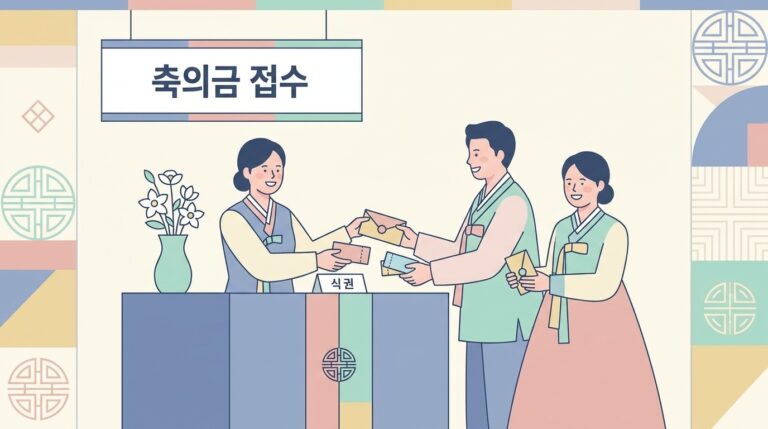
안녕하세요! 매일한글 (Daily Hangul) editor here! Imagine this: You just received a gorgeous golden invitation to your Korean coworker’s wedding in Seoul. You dress to impress, arrive at the bustling wedding hall, and find yourself in front of the reception desk (접수대). You hand over your congratulatory money envelope with both hands, feeling proud of your manners. But suddenly, the groom’s cousin behind the desk smiles, points toward a stack of colorful paper coupons, and asks: “식권 몇 장 드릴까요?” (How many meal tickets should I give you?)
Panic sets in! You didn’t study this in your beginner textbook. Do you just say “One” in English? Hold up your fingers? Or walk away empty-handed and miss the legendary wedding buffet? Don’t worry—many of our global learners have frozen at this exact moment. Today, we will master the simple, foolproof A1-level phrases you need to exchange your envelope, claim your meal ticket with total confidence, and head straight to the feast like a seasoned local!
Phase 2: Top 3 Core Expressions Deep-Dive
1. 식권 한 장 주세요 (Sik-gwon han jang ju-se-yo)
- Pronunciation: [Sik-gwon han jang ju-se-yo] (Sounds like “Seek-gwon han jahng joo-seh-yo” – think of ‘seek’ing your dinner!)
- Meaning: Literal: “Meal ticket, one sheet, please give me.” / Natural: “One meal ticket, please.”
- K-Culture Moment: Seen at every Korean wedding hall reception desk immediately after handing over the cash envelope.
- Editor’s Insight: 식권 means meal ticket, 한 장 means one flat sheet, and 주세요 is the universal beginner magic key for “please give me”. If you need two, just swap 한 장 for 두 장 (du jang)!
- Situation Spectrum: Casual ⚠️ | Semi-formal ✅ | Formal ✅
- 🤔 Think About It: In Korea, counting words change depending on the object’s shape (장 for flat paper, 개 for generic items). Does your native language have counter words like “a sheet of” or “a slice of”?
2. 축하합니다 (Chuk-ha-ham-ni-da)
- Pronunciation: [Chuk-ha-ham-ni-da] (Sounds like “Chook-ha-hahm-nee-da” – crisp and bright)
- Meaning: Literal & Natural: “Congratulations!”
- K-Culture Moment: The mandatory opening line you say with a gentle bow to the family or receptionists at the desk.
- Editor’s Insight: This is the most standard, polite way to congratulate someone. Even if you don’t know the reception staff personally, saying this establishes warm respect right away.
- Situation Spectrum: Casual 🚫 | Semi-formal ✅ | Formal ✅
- 🤔 Think About It: Koreans prioritize offering shared celebration (축하) before asking for anything personal (like a meal voucher). Why is greeting first so critical in collectivist cultures?
3. 감사합니다 (Gam-sa-ham-ni-da)
- Pronunciation: [Gam-sa-ham-ni-da] (Sounds like “Gahm-sah-hahm-nee-da”)
- Meaning: Literal & Natural: “Thank you.”
- K-Culture Moment: Spoken when receiving the meal voucher and parking stamp with both hands.
- Editor’s Insight: You can never say this too much. When receiving items from staff or family, pairing this with a 15-degree nod makes you look exceptionally well-mannered.
- Situation Spectrum: Casual 🚫 | Semi-formal ✅ | Formal ✅
- 🤔 Think About It: In Korean culture, a polite “Thank you” accompanied by two hands creates an instant impression of high cultural awareness.
Phase 3: Textbook Korean vs. Real-Life Korean
Situation 1: Asking for your meal ticket
- 📖 교과서 한국어 (Textbook): 식권을 저에게 주시겠습니까? (Sik-gwon-eul jeo-e-ge ju-si-get-seum-ni-kka? – “Would you be willing to grant me the meal coupon?”)
- 🗣️ 진짜 한국어 (Real-life): 식권 한 장 주세요! (Sik-gwon han jang ju-se-yo! – “One meal ticket, please!”)
- 💡 왜 다를까 (Why the difference?): Textbook forms can be overly rigid and lengthy. At a bustling wedding desk with dozens of guests waiting in line, concise and standard polite Korean (-주세요) is both natural and respectful.
Situation 2: Stating you are with a group
- 📖 교과서 한국어 (Textbook): 저희 일행은 세 명입니다. (Jeo-hui il-haeng-eun se myeong-im-ni-da. – “Our party consists of three persons.”)
- 🗣️ 진짜 한국어 (Real-life): 세 명이요! 식권 세 장 주세요. (Se myeong-i-yo! Sik-gwon se jang ju-se-yo. – “Three of us! Three meal tickets, please.”)
- 💡 왜 다를까 (Why the difference?): Adding ~이요 (~i-yo) to numbers turns quick spoken responses into polite spoken Korean without clumsy grammatical baggage.
Phase 4: K-Culture Deep-Dive & Non-Verbal Manners
4-1. 눈치 (Nunchi) & Hand Gestures at the Reception Desk
- The Two-Hand Rule (두 손): When handing over the congratulatory envelope (축의금 봉투) and when receiving the meal ticket (식권), always use both hands (or support your right forearm with your left hand). Handing or grabbing paper with a single hand can appear dismissive.
- Eye Contact & Micro-Bow: Make brief, warm eye contact, say “축하합니다”, and perform a slight head nod (15 degrees). Don’t stare intensely—a polite smile is gold!
4-2. Cultural Code: The Legendary Wedding Buffet (뷔페)
In Korea, treating guests to a lavish meal is the host family’s way of returning gratitude for your presence and gift money. The phrase “국수 언제 먹여줄 거야?” (When will you feed us noodles?) is a classic idiom meaning “When are you getting married?” Today, noodles have evolved into grand 100-dish buffets with sushi, galbi-tang, and desserts. Your 식권 is literally your passport to this feast!
Phase 5: Real-Life Roleplay Scenario
Setting: Gangnam Grand Wedding Hall. The reception desk is decorated with white lilies. The groom’s cousin, Min-su (민수), is smiling behind the registration ledger.
- Turn 1 (You): 안녕하세요! 축하합니다. (An-nyeong-ha-se-yo! Chuk-ha-ham-ni-da.)
🎭 [Smile warmly and hand over the envelope with both hands]
“Hello! Congratulations!” - Turn 2 (Min-su): 아, 와주셔서 감사합니다! 성함이 어떻게 되세요? (A, wa-ju-syeo-seo gam-sa-ham-ni-da! Seong-ham-i eo-tteo-ke doe-se-yo?)
🎭 [Bows politely and opens the guest logbook]
“Ah, thank you for coming! What is your name?” - Turn 3 (You): 제임스입니다. 신랑 친구예요. (Je-im-seu-im-ni-da. Sin-rang chin-gu-ye-yo.)
🎭 [Points gently to your own chest]
“I am James. I am the groom’s friend.” - Turn 4 (Min-su): 네, 제임스 님, 확인했습니다! 식권 필요하세요? (Ne, Je-im-seu nim, hwak-in-haet-seum-ni-da! Sik-gwon pil-yo-ha-se-yo?)
🎭 [Picks up the stack of colorful meal tickets]
“Yes, James, verified! Do you need a meal ticket?” - Turn 5 (You): 네, 식권 한 장 주세요. (Ne, sik-gwon han jang ju-se-yo.)
🎭 [Holds up one index finger with a polite nod]
“Yes, please give me one meal ticket.” - Turn 6 (Min-su): 여기 있습니다. 식당은 지하 1층이에요. (Yeo-gi it-seum-ni-da. Sik-dang-eun ji-ha il-cheung-i-e-yo.)
🎭 [Hands the ticket with two hands and points toward the elevator]
“Here you go. The dining hall is on the B1 floor.” - Turn 7 (You): 감사합니다! (Gam-sa-ham-ni-da!)
🎭 [Takes the ticket with both hands and bows slightly]
“Thank you!” - Turn 8 (Min-su): 맛있게 드세요! (Mas-it-ge deu-se-yo!)
🎭 [Smiles brightly]
“Enjoy your meal!”
🔀 Interactive Choice Point
What should you do if your partner is also with you at the desk?
* Option A: Say “식권 두 장 주세요” (Sik-gwon du jang ju-se-yo) with two hands open. -> [Best Choice ✅: Clear, polite, and guarantees 2 tickets!]
* Option B: Say nothing and take 2 tickets off the desk yourself. -> [Bad Choice 🚫: Very impolite; receptionists must hand them to you according to the guest count!]
* Option C: Say “식권 많이 주세요” (Sik-gwon man-i ju-se-yo – Give me lots of tickets). -> [Risk Choice ⚠️: Might sound greedy or confusing since tickets match your gift envelope!]
Phase 6: 10-Second Emotion Shadowing Drill
Practice matching these rhythm breaks (/) with the emotional cues:
[😊 Bright & Congratulatory]
안녕하세요! / 축하합니다!
(An-nyeong-ha-se-yo! / Chuk-ha-ham-ni-da!)-
[🎯 Calm & Clear Request]
네, / 식권 한 장 / 주세요.
(Ne, / sik-gwon han jang / ju-se-yo.) -
[🙏 Grateful & Polite]
감사합니다! / 맛있게 먹겠습니다.
(Gam-sa-ham-ni-da! / Mas-it-ge meok-get-seum-ni-da.)
Phase 7: K-Culture Mini Dictionary
- 식권 (Sik-gwon) | Meal ticket / Dining voucher | Given at weddings, company conferences, and university cafeterias to exchange for a buffet entry.
- 축의금 (Chug-ui-geum) | Congratulatory cash gift | Clean cash placed in a white envelope to support the newlywed couple’s fresh start.
- 방명록 (Bang-myeong-nok) | Guestbook / Registry | The formal book where you write your name and relationship to the bride/groom at the desk.
- 뷔페 (Bwip-he) | Buffet | The most common dining style at Korean wedding halls featuring Korean, Western, and Japanese dishes.
Phase 8: Survival Kit for Travelers
-
Top 3 Survival Expressions:
- 식권 어디서 받아요? (Sik-gwon eo-di-seo bad-a-yo?) – “Where do I get the meal ticket?” (Pro tip: Ask hall staff if you missed the desk).
- 식당이 어디예요? (Sik-dang-i eo-di-ye-yo?) – “Where is the dining hall/buffet?”
- 주차권 있어요? (Ju-cha-gwon iss-eo-yo?) – “Is there a parking validation coupon?”
- Editor’s Travel Note: Finding the banquet hall inside giant convention centers can be tricky. Use the [Naver Map app download for English navigation] to check the exact floor and hall name in advance!
Phase 9: Think Deeper (한 발 더 깊이)
In Korean culture, food has always been deeply communal. In the past, entire villages gathered to prepare 잔치국수 (banquet feast noodles) to wish the newlyweds long life and enduring happiness. While modern celebrations feature high-tech halls and extensive buffets, the core spirit remains unchanged: sharing a hearty meal is how hosts share their blessings with everyone who came to honor them.
💬 Your Turn: In your home country, how are wedding meals served? Do you have paper vouchers, assigned table seating, or an open table? Drop a comment below!
Phase 10: FAQ & Common Mistakes
Q: Can I ask for a meal ticket if I didn’t bring cash in an envelope?
A: If you attended as an invited guest, the family will gladly provide you with a meal ticket regardless. However, the polite social standard in Korea is to present a congratulatory gift envelope (축의금) at the desk first.
Q: What if I have to leave early and cannot eat at the buffet?
A: At many Korean weddings, if you cannot stay to eat, you can inform the reception desk (“식사 안 해요” – I won’t eat). Some halls will exchange your ticket for a small gift box (답례품, like cookies, red ginseng, or wine).
Q: What counter word should I use if I need 2 tickets?
A: Use 두 장 (du jang). Simply say: “식권 두 장 주세요” (Sik-gwon du jang ju-se-yo).
🚨 Common Mistakes Warning Board
- Mistake: Handing cash notes directly without an envelope. -> Correct Action: Always put clean cash into the white envelopes provided on the counter table with your name written vertically on the back.
- Mistake: Grabbing tickets off the desk with one hand. -> Correct Action: Wait for the attendant to hand them to you, and receive with both hands.
- Mistake: Leaving without your parking voucher. -> Correct Action: Ask for 주차권 (ju-cha-gwon) right at the reception desk before heading down to eat.
Phase 11: Action Missions
- 🥉 Bronze Mission (Solo Practice): Practice saying “식권 한 장 주세요” out loud 3 times in front of your mirror with a two-handed gesture.
- 🥈 Silver Mission (Social Share): Share our Korean counting numbers (한 장, 두 장, 세 장) on Instagram or TikTok and tag
@DailyHangul! - 🥇 Gold Mission (Real Life): When you next attend a Korean wedding or visit a Korean cafeteria, order using “[Item] + 한 장 주세요” with confidence!
- 🎮 K-Culture Mission: Watch a wedding scene in a K-drama (like Crash Landing on You or Business Proposal) and spot the reception desk and meal vouchers!
Phase 12: Interactive Quiz Challenge
Question 1 (Fill in the blank):
Fill in the blank to say “Please give me one meal ticket”:
식권 _____ _____ 주세요.
👉 Click to reveal Answer & Explanation
Answer: 한 장 (han jang)
Explanation: 한 means ‘one’ and 장 is the counter word for flat paper items like tickets, sheets, and cards!
Question 2 (Culture True/False):
True or False: In Korea, it is considered polite to hand over your congratulatory envelope with just your left hand while drinking coffee.
👉 Click to reveal Answer & Explanation
Answer: False (X)
Explanation: Always hand over and receive wedding envelopes and meal tickets using both hands (or supporting your right arm with your left hand) as a sign of respect.







