

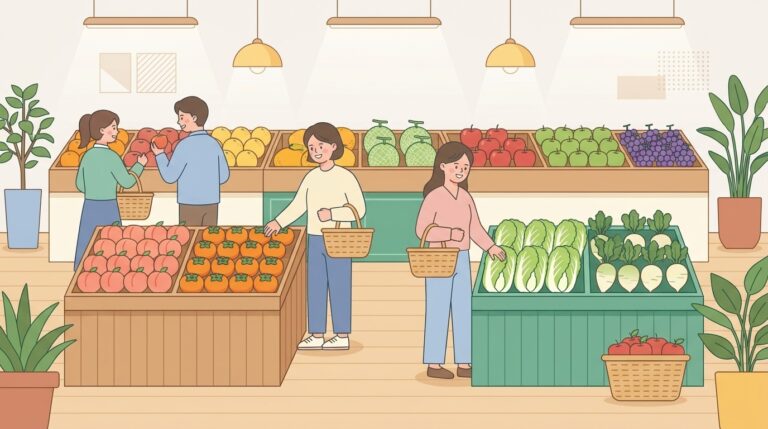
Master Korean Grocery Shopping: Essential Phrases for Supermarkets and Local Marts
Phase 1: Empathy & Storytelling Opening
안녕하세요! Welcome back to Daily Hangul. Have you ever walked into a bustling Korean supermarket like E-Mart, or a cozy neighborhood mart (dongne-mart), clutching your shopping list, only to freeze when an energetic clerk asks, “봉투 필요하세요?” (Do you need a plastic bag?) or points at a yellow sign that says “1+1”?
Picture this: You are trying to recreate the mouthwatering Kimchi Jjigae you saw in your favorite K-Drama. You step into the vibrant produce aisle, surrounded by rows of shiny Asian pears, fresh tofu packs, and seasoned side dishes (banchan). But when you want to ask where the sesame oil is, or whether an item is on sale, your mind goes blank. Don’t worry at all! Based on feedback from over 500 beginner learners, grocery shopping (jangbogi) is one of the most rewarding real-life tasks you can conquer. Today, I will be your cultural navigator to turn supermarket anxiety into pure fun!
Phase 2: Top 3 Core Expressions Breakdown
1. 이거 얼마예요? (Igeo eolmayeyo?)
- Pronunciation: I-geo eol-ma-ye-yo? (Think of: “E-gear all-ma-yay-yo?”)
- Meaning: Literal: “How much is this?” | Nuance: The friendly, universal pricing inquiry across all stores.
- K-Culture Moment: You will see characters in slice-of-life K-Dramas pointing directly at fresh strawberries at a local cart and asking this with a warm smile.
- Editor’s Insight: Igeo means “this item.” In supermarkets where price tags are occasionally missing or confusing, pointing while saying this phrase will save your day instantly.
- Situation Spectrum: Casual ⚠️ | Semi-formal ✅ | Formal ✅
- 🤔 Think About It: In English, we often say “How much does this cost?”. In Korean, the verb “to be” (-yeyo) is attached directly to “how much” (eolma), showing Korean preference for concise, predicate-focused questions.
2. [물건] 어디에 있어요? ([Item] eodie isseoyo?)
- Pronunciation: [Item] eo-di-e is-seo-yo? (Think of: “uh-dee-air eat-saw-yo?”)
- Meaning: Literal: “Where is [Item]?” | Nuance: “Could you tell me where to find [Item]?”
- K-Culture Moment: Wandering through massive mega-marts like Homeplus, looking for gochujang (red chili paste) just like in variety shows like I Live Alone.
- Editor’s Insight: Just drop the item name right at the beginning. For example, “Dubu eodie isseoyo?” (Where is the tofu?). Short, polite, and crystal clear.
- Situation Spectrum: Casual ⚠️ | Semi-formal ✅ | Formal ✅
- 🤔 Think About It: Notice how Korean places the location topic right before the question particle. How does your native language structure directional questions?
3. 봉투 하나 주세요. (Bongtu hana juseyo.)
- Pronunciation: Bong-tu ha-na ju-se-yo. (Sounds like: “Bohng-too hah-nah joo-say-yo.”)
- Meaning: Literal: “Please give me one bag.” | Nuance: “I would like to buy a shopping bag, please.”
- K-Culture Moment: At checkout counters across Korea, cashiers will ask if you need a bag since plastic bags cost a tiny fee (around 100~500 KRW) by environmental law.
- Editor’s Insight: You can get a recyclable plastic bag, or a standard regional garbage bag (jongnyangje bongtu) which you can later use at home to dispose of trash!
- Situation Spectrum: Casual ⚠️ | Semi-formal ✅ | Formal ✅
- 🤔 Think About It: Korea has very strict recycling laws. Paying for disposable shopping bags has shaped everyday shopping habits into bringing eco-bags (jangbaguni).
Phase 3: Textbook Korean vs. Real-life Korean
Situation 1: Asking about promotions
- 📖 Textbook Korean: 이 물건은 할인 품목입니까? (I mulgeon-eun harin pummok-imnikka? – Is this item a discounted product?)
- 🗣️ Real-life Korean: 이거 세일해요? (Igeo se-il-hae-yo? – Is this on sale?)
- 💡 Why is it different? Native speakers rarely use stiff words like pummok (item category) in daily spoken Korean. The loanword se-il (sale) paired with hada is the natural, everyday standard.
Situation 2: Choosing payment method
- 📖 Textbook Korean: 신용카드로 결제하고자 합니다. (Sinyongkadeu-ro gyeoljehagoja hamnida. – I desire to pay by credit card.)
- 🗣️ Real-life Korean: 카드로 할게요. (Kadeu-ro halgeyo. – I will do card.)
- 💡 Why is it different? Koreans prefer snappy, active conversational endings like -rgeyo (I will do…) rather than heavy formal declarations during quick retail transactions.
Phase 4: K-Culture Deep Dive & Non-verbal Etiquette
4-1. Nunchi & Gestures at the Register
- Two-Hand Rule: When handing your payment card or receiving receipts and change, always hold the card with both hands or support your right forearm with your left hand. This demonstrates respect and good manners.
- Free Sample Table Manners: In large marts, sisik-koneo (tasting corners) are legendary! When accepting a toothpick with sizzling dumplings or Korean beef, give a slight nod and say “Gamsahamnida!” (Thank you).
4-2. Cultural Code: The Magic of “1+1” (Won Plus Won)
In Korea, promotions are commonly written as 1+1 (won-peulleoseu-won) or 2+1 (tu-peulleoseu-won). If an item has this tag, you must grab both items yourself and bring them to the checkout counter to receive the discount! The cashier won’t usually fetch the free extra item for you.
Phase 5: Real-Life Roleplay Scenario
Setting: A vibrant neighborhood supermarket (Dongne Mart) on a weekend afternoon.
Characters: You (The energetic shopper) and Mart Staff (Mart Imo / Mart Uncle).
- You: 저기요, 두부 어디에 있어요? (Jeogiyo, dubu eodie isseoyo?)
🎭 Action: Lightly raise one hand and make friendly eye contact.- “Excuse me, where is the tofu?”
- Clerk: 두부는 저쪽 신선 코너에 있어요. (Dubu-neun jeojjok sinseon koneo-e isseoyo.)
🎭 Action: Points towards the back left refrigerated section.- “Tofu is over there in the fresh food corner.”
- You: 감사합니다! 그리고 계란 이거 세일해요? (Gamsahamnida! Geurigo gyeran igeo se-il-hae-yo?)
🎭 Action: Walking to the section and picking up a carton of eggs with a yellow sticker.- “Thank you! And are these eggs on sale?”
- Clerk: 네, 오늘 1+1 행사예요! (Ne, oneul won-peulleoseu-won haengsa-yeyo!)
🎭 Action: Smiles and holds up two fingers.- “Yes, it’s a 1+1 promo today!”
- You: 와, 좋아요! 두 개 가져갈게요. (Wa, joayo! Du gae gajyeogalgeyo.)
🎭 Action: Happily places two cartons into the shopping basket.- “Wow, great! I’ll take two.”
- Clerk (at Cashier): 봉투 필요하세요? (Bongtu piryohaseyo?)
🎭 Action: Scanning barcodes quickly.- “Do you need a plastic bag?”
- You: 네, 종량제 봉투 하나 주세요. (Ne, jongnyangje bongtu hana juseyo.)
🎭 Action: Nodding politely.- “Yes, please give me one standard garbage bag.”
- Clerk: 12,000원입니다. (Man-icheon-won-imnida.)
🎭 Action: Hands over card reader terminal.- “That will be 12,000 won.”
🔀 Interactive Choice Point
The clerk asks: “영수증 드릴까요?” (Yeongsujeung deurilkkayo? – Would you like a receipt?)
* Choice A: “네, 버려주세요.” (Ne, beoryeojuseyo. – Yes, please throw it away.)
👉 Feedback (Best!): Extremely natural! Most locals say this if they don’t need a paper receipt.
* Choice B: “싫어요!” (Sireoyo! – I hate it / No!)
👉 Feedback (Bad): Too blunt and aggressive. It sounds rude to retail staff.
* Choice C: “괜찮아요, 영수증 주세요.” (Gwaenchannayo, yeongsujeung juseyo. – It’s okay, give me receipt.)
👉 Feedback (Risk): Slightly conflicting (gwaenchannayo usually implies ‘no thanks’). Better to just say: “네, 주세요.” (Yes, please).
Phase 6: 10-Second Emotion Shadowing Drill
Practice these with real emotion, respecting pauses marked by /:
[😊 Cheerful & Curious]
저기요! / 계란 / 어디에 있어요? (Jeogiyo! / gyeran / eodie isseoyo?)[🤩 Excited & Delighted]
이거 / 오늘 / 1+1 행사예요? (Igeo / oneul / won-peulleoseu-won haengsa-yeyo?)[🤝 Polite & Natural]
네, / 카드로 / 계산해 주세요! (Ne, / kadeu-ro / gyesanhae juseyo!)
Phase 7: K-Culture Mini Dictionary
- 장바구니 (Jangbaguni) | Reusable Shopping Bag | Eco-bags used to avoid paying for plastic bags.
- 시식 코너 (Sisik Koneo) | Food Tasting Station | In-store food sampling counters famous in Korean supermarkets.
- 1+1 (Won-peulleoseu-won) | Buy One Get One Free | The most popular promotional sale mechanism in Korea.
- 종량제 봉투 (Jongnyangje Bongtu) | Government Trash Bag | Official waste disposal bags sold at checkout counters that double as shopping bags.
Phase 8: Traveler’s Survival Kit
Top 3 Supermarket Phrases:
- 계산해 주세요. (Gyesanhae juseyo.) – Please check this out.
- Pro Tip: Use this at the counter or small convenience stalls.
- 박스 포장 어디서 해요? (Bakseu pojang eodiseo haeyo?) – Where can I pack cardboard boxes?
- Pro Tip: Most large Korean marts have a free self-packaging station with cardboard boxes and tape near the exit.
- 영수증 버려주세요. (Yeongsujeung beoryeojuseyo.) – Please discard the receipt.
Editor’s Travel Note
- App Tip: For finding nearest marts and checking closing dates (many Korean hypermarts close on the 2nd and 4th Sunday each month), check via Naver Map App Download.
- Payment Tip: Korea is virtually cashless. International Visa/Mastercard credit cards and mobile payment (T-Money/Apple Pay at supported marts) work seamlessly.
Phase 9: A Step Deeper (Reflection Essay)
Korean grocery shopping reflects the culture of Jeong (warm communal affection) and efficiency. From generous free food samples (sisik) to the clever system of jongnyangje waste-management shopping bags, every corner of a Korean supermarket balances community responsibility with vibrant hospitality. Speaking just a few polite words to local mart staff will instantly bridge the cultural gap.
💬 Your Turn: What is the first Korean grocery item you would hunt for in a mart? Kimchi, Shin Ramyun, or Banana Milk? Share in the comments below!
Phase 10: FAQ & Common Mistakes
Q: Why did the cashier not put my groceries in a bag automatically?
A: By South Korean environmental regulation, supermarkets and convenience stores cannot give free plastic bags. You must bring your own bag or purchase a plastic/waste bag at checkout.
Q: What should I do if an item has a “2+1” sign?
A: Make sure you bring all 3 items to the register together! The register system will automatically calculate the 3rd item as free.
Q: How do I call a grocery store worker politely?
A: Simply say “Jeogiyo” (Excuse me). For friendly older ladies working at neighborhood marts, Koreans often affectionately say “Imo-nim” (Auntie), but “Jeogiyo, sajangnim” or just “Jeogiyo” is safest for learners.
🚨 Common Mistakes TOP 3
- Mistake: Saying “Dangsin” when asking a worker.
❌ Dangsin, dubu eodie isseoyo?
✅ Correct Action: Never use dangsin (you). Just say “Jeogiyo!” (Excuse me!). - Mistake: Taking only one item during a 1+1 promo.
✅ Correct Action: Pick up both matching items before heading to the cashier. - Mistake: Forgetting to weigh loose produce before checkout.
✅ Correct Action: In produce sections, take loose fruits/vegetables to the weighing scale counter nearby to get a barcode sticker before going to the main cashier.
Phase 11: Action Mission & Engagement
- 🥉 Bronze Mission: Practice saying “Dubu eodie isseoyo?” (Where is tofu?) 3 times aloud in front of your mirror.
- 🥈 Silver Mission: Write down your weekend grocery list using Korean vocabulary (gyeran, uyu, sagwa) and share it on Instagram with tag
#DailyHangul. - 🥇 Gold Mission: Visit a local Korean or Asian supermarket this week and speak only Korean during checkout (“Kadeu-ro halgeyo!”).
- 🎮 K-Culture Mission: Watch an episode of a Korean cooking variety show and spot when they mention grocery shopping (jangbogi)!
Phase 12: Interactive Quiz Challenge
Q1. You want to ask where the milk is located. What should you say?
a) 우유 얼마예요? (Uyu eolmayeyo?)
b) 우유 어디에 있어요? (Uyu eodie isseoyo?)
c) 우유 버려주세요. (Uyu beoryeojuseyo.)
👉 Click to see the Answer & Explanation
Correct Answer: b) 우유 어디에 있어요?
Explanation: Eodie isseoyo? means “Where is [Item]?”. Option (a) asks for the price, and option (c) asks to throw it away.
Q2. True or False: In Korean supermarkets, single-use plastic bags are always provided for free.
👉 Click to see the Answer & Explanation
Correct Answer: False
Explanation: Korean environmental regulations mandate charging a small fee for bags, or shoppers bring their own reusable bags (jangbaguni).







