

Phase 1: Empathy & Opening
안녕하세요! 매일한글 에디터입니다. (Hello! This is your Daily Hangul editor.)
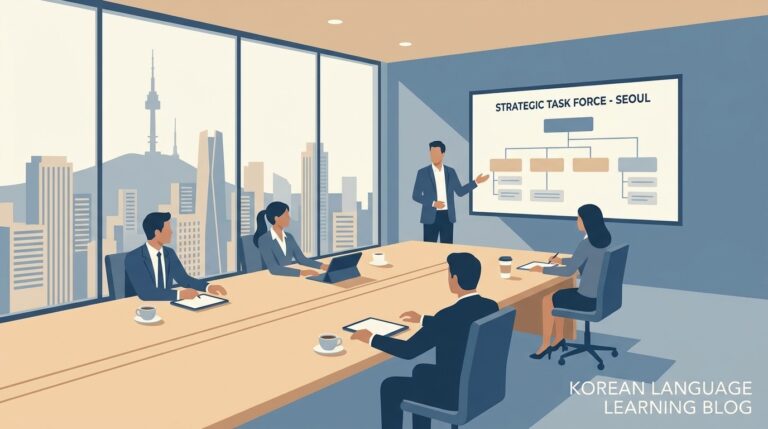
Imagine standing in an executive boardroom on the 28th floor in Yeouido or Teheran-ro. You are about to present an organizational culture innovation blueprint to C-suite executives and skeptical department heads. If you’ve watched hit corporate K-dramas like Misaeng (Incomplete Life) or Agency, you know this exact tension: junior employees crave psychological safety and horizontal communication, while senior executives (kkondae or seasoned directors) demand measurable ROI, hierarchical respect, and seamless execution. Navigating corporate restructuring in Korean requires far more than just polite verb endings—it demands master-level executive rhetoric (C2).
At this level, misplacing a single honorific nuance or using overly generic textbook terms can make your Task Force (TF) proposal sound naive or confrontational. Based on actual coaching sessions with multinational country managers and Korean corporate strategists, this guide delivers the exact strategic vocabulary, diplomatic nuance, and non-verbal composure required to lead organizational transformation with authority and empathy.
Phase 2: Core Expressions Deep Dive
1. 사일로 효과를 타파하고 전사적 시너지를 창출하다
- Pronunciation: [Sailo hyogwareul tapahago jeonsajeok sineojireul changchulhada] (Sounds like sye-lo hyo-gwa-reul tah-pah-ha-go jun-sah-jeok see-nuh-ji-reul chahng-chul-ha-da)
- Meaning: Literal: To break down silo effects and generate company-wide synergy. | Real Nuance: Executive-level strategic framing to dismantle departmental egoism without directly accusing specific teams.
- K-Culture Moment: Heard in corporate boardroom showdowns in dramas like Agency (대행사) when a newly appointed TF leader justifies cross-functional authority over entrenched vertical departments.
- Editor’s Insight: 타파하다 (Tapahada – to break down/abolish) conveys decisive, institutional reform rather than casual problem-solving. Paired with 전사적 (Jeonsajeok – enterprise-wide), it establishes high-level strategic alignment.
- Situation Spectrum: Casual 🚫 | Semi-formal ⚠️ | Formal/Executive ✅
- 🤔 Think About It: How does your native language handle cross-departmental politics without alienating team leaders?
2. 단계적 연착륙을 유도하는 로드맵을 구축하겠습니다
- Pronunciation: [Dangyejeok yeonchangnyugeul yudohaneun rodeumaebeul guchukhagesseumnida] (Sounds like dahn-gye-juck yun-chahng-nyu-geul yoo-doh-hah-neun road-map-eul goo-chook-ha-get-sum-ni-dah)
- Meaning: Literal: We will build a roadmap that induces a phased soft landing. | Real Nuance: Reassuring senior stakeholders that radical cultural change will not disrupt immediate business operations.
- K-Culture Moment: Used by crisis management specialists in Misaeng or Reborn Rich when pitching disruptive operational pivots to conservative boards.
- Editor’s Insight: 연착륙 (Yeonchangnyuk – soft landing) is an aviation metaphor widely adopted in Korean macroeconomic and corporate governance discourse to signal controlled risk mitigation.
- Situation Spectrum: Casual 🚫 | Semi-formal ⚠️ | Formal/Executive ✅
- 🤔 Think About It: Why is the metaphor of ‘landing’ (착륙) preferred over ‘acceleration’ when proposing disruptive cultural changes to executive boards?
3. 현장 구성원들의 심리적 안전감을 최우선 가치로 내재화하겠습니다
- Pronunciation: [Hyeonjang guseongwondeurui simnijeok anjeongameul choeuseon gachiro naejaehwahagesseumnida] (Sounds like hyun-jahng goo-sung-won-deul-eui shim-ni-juck ahn-jung-gahm-eul choe-oo-sun gah-chee-ro nae-jae-hwa-ha-get-sum-ni-dah)
- Meaning: Literal: We will internalize on-site members’ psychological safety as our top priority value. | Real Nuance: Modern HR philosophy synthesized into formal Korean corporate governance parlance.
- K-Culture Moment: Typical line spoken by forward-thinking HR directors in contemporary workplace webtoons and K-dramas attempting to bridge the Gen Z / Millennial (MZ) gap.
- Editor’s Insight: 내재화하다 (Naejaehwahada – to internalize) goes beyond mere implementation (도입하다); it implies embedding the value deep into corporate DNA.
- Situation Spectrum: Casual 🚫 | Semi-formal ⚠️ | Formal/Executive ✅
- 🤔 Think About It: How does psychological safety translate in a traditionally hierarchical Korean Confucian workspace?
Phase 3: Textbook Korean vs. Real Executive Korean
Situation 1: Explaining the necessity of TF team formation
- 📖 교과서 한국어 (Textbook): 우리 회사의 문화를 바꾸기 위해 새로운 팀을 만들었습니다. (We made a new team to change our company culture.)
- 🗣️ 진짜 한국어 (Real Executive): 급변하는 대내외 경영 환경에 기민하게 대응하고자 본 TF를 발족하게 되었습니다. (Geupbyeonhaneun daenaeoe gyeongyeong hwangyeonge gimin-hage daeeunghagoja bon TF-reul baljokhage doe-eosseumnida.)
- 💡 왜 다를까? (Why the difference?): C2 executive presentations require Sino-Korean vocabulary (대내외 경영 환경, 기민하게 대응, 발족) to establish authoritative strategic justification.
Situation 2: Asking for executive sponsorship and cross-team cooperation
- 📖 교과서 한국어 (Textbook): 각 부서장님들이 많이 도와주시면 감사하겠습니다. (It would be appreciated if department heads help a lot.)
- 🗣️ 진짜 한국어 (Real Executive): 본 혁신안이 유의미한 결실을 맺을 수 있도록 각 본부장님들의 전폭적인 지지와 협조를 당부드립니다. (Bon hyeoksin-ani yu-uimihan gyeolsireul maejeul su itdorok gak bonbujangnimdeurui jeonpokjeogin jijihwa hyeopjoreul dangbudeurimnida.)
- 💡 왜 다를까? (Why the difference?): Using 당부드리다 (respectfully request duty/commitment) alongside 전폭적인 지지 (unconditional backing) honors senior leadership while securing formal commitment.
Phase 4: K-Culture Deep Dive & Non-Verbal Manners
4-1. 눈치 (Nunchi), Micro-Gestures & Posture in the Boardroom
When presenting organizational culture change in Korea, your non-verbal cues must balance firm conviction with deep organizational respect:
* Two-Handed Laser Pointer / Clicker Handover: When advancing slides or gesturing towards executive tables, avoid pointing with a single index finger. Use an open palm facing slightly upward (손바닥을 위로 향한 제스처).
* Eye-Tracking Hierarchy (시선 배분): Allocate roughly 50% of your visual engagement to the highest decision-maker (CEO/Managing Director), 30% across skeptical team leads, and 20% to the TF members seated beside you to demonstrate leadership unity.
* Strategic Pausing (침묵의 미학): Before answering a tough executive counter-question, pause for 1.5 seconds with a deliberate slight nod (경청의 끄덕임). This signals deliberation and emotional composure (의연함).
4-2. Cultural Code: Modernizing the Hoesik (회식) & Generational Bridge
Korean corporate culture is undergoing massive realignment. Traditional top-down collective bonding (such as mandatory late-night hoesik drinking sessions) is being replaced by micro-mentoring, asynchronous communication tools, and agile retrospectives. A modern TF leader must honor the legacy efforts of senior executives while systematically introducing psychological safety for younger employees.
Phase 5: Live Role-Play Scenario
Setting: Boardroom of a leading K-Tech conglomerate in Pangyo.
Characters:
* Executive Director Kang (강 전무): A traditional, results-oriented senior executive.
* TF Lead Alex (알렉스 팀장 – You): The C2-fluent organizational innovation head.
- Turn 1 (Alex):
안녕하십니까, 조직문화혁신 TF 팀장 알렉스입니다. 지금부터 전사 소통 구조 혁신을 위한 운영 계획을 보고드리겠습니다.
(Annyeonghasimnikka, jojikmunhwahyeoksin TF timjang Alex-imnida. Jigeumbuteo jeonsa sotong gujo hyeoksineul wihan unyeong gyehoegeul bogodeurigessemnida.)
“Good morning. I am Alex, Head of the Organizational Culture Innovation Task Force. I will now present our operational blueprint for enterprise communication reform.”
🎭 Standing tall with hands clasped below the waistline, projecting a calm and resonant voice. -
Turn 2 (Director Kang):
알렉스 팀장, 취지는 좋은데 현업 부서의 업무 로드가 가중된다는 우려가 벌써부터 나와요.
(Alex timjang, chwijineun joeunde hyeoneop buseoui eommu rodeuga gajungdoendaneun uryeoga beolsseobuteo nawayo.)
“Team Lead Alex, your intention is commendable, but concerns are already emerging that operational workloads on existing teams will intensify.”
🎭 Leaning back, arms crossed, maintaining a sharp analytical gaze. -
Turn 3 (Alex):
충분히 우려하실 수 있는 대목입니다. 따라서 저희 TF는 업무 가중을 최소화하고자 파일럿 테스트 방식을 채택했습니다.
(Chungbunhi uryeohasil su inneun daemogimnida. Ttaraseo jeohui TF-neun eommu gajungeul choesohwahagoja pailleot teseuteu bangsigeul chaetaekhaesseumnida.)
“That is an entirely valid concern. Therefore, our TF has adopted a pilot testing framework to minimize operational strain.”
🎭 Nodding politely before answering, gesturing smoothly toward the slide timeline. -
Turn 4 (Director Kang):
파일럿 부서의 저항이나 생산성 저하는 어떻게 통제할 계획입니까?
(Pailleot buseoui jeohang-ina saengsanseong jeohaneun eotteoke tongjehal gyehoegimnikka?)
“How do you plan to control resistance or potential drops in productivity within the pilot departments?”
🎭 Furrowing eyebrows slightly, tapping pen on the table. -
Turn 5 (Alex):
정량적 KPI 평가와 심층 인터뷰를 병행하여, 업무 몰입도를 저해하는 요소를 즉각 리밸런싱할 예정입니다.
(Jeongnyangjeok KPI pyeong-gahwa simcheung inteobyureul byeonghaenghayeo, eommu moripdoreul jeohaehaneun yosoreul jeukgak ribaelleon-singhal yejeong-imnida.)
“By conducting both quantitative KPI evaluations and in-depth qualitative interviews, we will immediately rebalance factors that hinder work engagement.”
🎭 Making steady eye contact, speaking in a firm, measured tempo. -
Turn 6 (Director Kang):
음… 리밸런싱 메커니즘이 구체적으로 가동된다면 반발을 줄일 수 있겠군요.
(Eum… ribaelleon-sing mekeonijeumi guchejeoguro gadongdoendamyeon banbareul juril su itgetgunyo.)
“Hmm… If that rebalancing mechanism operates specifically as planned, resistance could indeed be minimized.”
🎭 Arms uncrossing, taking notes with a subtle approving nod. -
Turn 7 (Alex):
네, 전무님. 구성원들이 변화를 ‘부담’이 아닌 ‘성장의 기회’로 체감할 수 있도록 치밀하게 모니터링하겠습니다.
(Ne, jeonmunim. Guseongwondeuri byeonhwareul ‘budam’-i anin ‘seongjang-ui gihwe’-ro chegaml hal su itdorok chimilhage moniteoringhagesseumnida.)
“Yes, Executive Director. We will rigorously monitor the process so employees perceive this change not as a ‘burden’ but as an ‘opportunity for growth’.”
🎭 Delivering the closing reassurance with open palm gesture. -
Turn 8 (Director Kang):
좋습니다. 추진 일정대로 1분기 파일럿 결과 보고를 올려보세요.
(Joeusseumnida. Chujin iljeongdaero ilbungi pailleot gyeolgwa bogoreul ollyeoboseyo.)
“Very well. Proceed according to schedule and submit the Q1 pilot results report.”
🎭 Nodding decisively with pen poised to sign off on the agenda.
🔀 Interactive Decision Point
How would you handle Director Kang if he demanded cutting the pilot phase by half?
* Option A: “전무님 말씀대로 일정을 절반으로 단축하여 속도감 있게 밀어붙이겠습니다.”
Feedback (Bad): High operational risk. Conceding without data undermines your authority as a strategic TF lead.
* Option B: “속도 경영에 대한 전무님의 혜안에 공감하며, 핵심 부서 1곳에 한해 Fast-track 모델을 병행 검증하겠습니다.”
Feedback (Best): Strategic diplomacy. Acknowledges executive vision while safeguarding the broader methodological integrity.
* Option C: “현실적으로 불가능하며 기존 계획대로 가지 않으면 TF 운영 자체가 무의미합니다.”
Feedback (Risk): Overly rigid and confrontational. Destroys executive rapport (라포) in a Korean boardroom.
Phase 6: 10-Second Emotion Shadowing Drill
Master the cadence of high-stakes corporate communication. Follow the slashes / for natural pacing.
[👔 단호하고 확신에 찬 어조로 / Firm and Confident]
본 혁신안은 / 단순한 조직 개편이 아닌 / 지속 가능한 성장의 토대입니다.
(Bon hyeoksin-aneun / dansunhan jojik gaepyeoni anin / jisok ganeunghan seongjang-ui todae-imnida.)-
[🤝 유연하고 공감대를 형성하며 / Diplomatic and Reassuring]
현업의 혼선을 최소화하기 위해 / 단계별 연착륙 프로그램을 / 가동하겠습니다.
(Hyeoneobui honseoneul choesohwahagi wihae / dangyebyeol yeonchangnyuk peurogeuraemeul / gadonghagesseumnida.) -
[🎯 결의를 다지며 묵직하게 / Resolute and Visionary]
경영진과 현장 실무진 사이의 / 가교 역할을 / 충실히 수행하겠습니다.
(Gyeong-yeongjingwa hyeonjang silmujin sai-ui / gagyo yeokhwareul / chungsilhi suhaenghagesseumnida.)
Phase 7: K-Culture Mini Dictionary
- 태스크포스 발족 (TF Baljok) | Official launching of a strategic cross-functional Task Force.
- 거버넌스 확립 (Geobeoneonseu Hwagnip) | Establishing transparent organizational decision-making governance.
- 공감대 형성 (Gonggamdae Hyeongseong) | Building consensus and psychological buy-in across diverse stakeholders.
- 현장 밀착형 피드백 (Hyeonjang Milchak-hyeong Pideubaek) | Field-tailored, ground-level feedback gathered directly from front-line employees.
Phase 8: Traveler & Expat Survival Kit
Survival Expressions for Corporate Navigation
- 회의 어젠다를 리마인드해 드리겠습니다. (Hoeui eojendareul rimaindeuhae deurigessemnida.)
Pro Tip: Elegant way to gently pull straying senior executives back to the official presentation deck. - 유관 부서와 사전 조율을 완료했습니다. (Yugwan buseowa sajeon joyureul wallyeohaesseumnida.)
Pro Tip: Magic sentence that dissipates executive fear of inter-departmental conflicts. - 추후 서면으로 상세 보고서를 송부하겠습니다. (Chuhu seomyeon-euro sangse bogoseoreul songbuhagesseumnida.)
Pro Tip: Perfect exit ramp when an executive asks an hyper-detailed numerical question off the cuff.
Editor’s Travel & Expat Note
If you are commuting between business hubs like Gangnam, Pangyo, and Yeouido for boardroom meetings, streamline your transit with real-time navigation via 네이버 지도 앱 다운로드. Always keep a Kakao T corporate profile handy for rapid transit between multinational client offices.
Phase 9: A Step Deeper (한 발 더 깊이)
In Korean corporate philosophy, genuine organizational reform is fundamentally relational rather than purely contractual. While Western management models prioritize structural redesign and clear swimlanes, Korean business dynamics (경영 철학) hinge upon 화합 (Harmony) and 명분 (Justified Legitimacy). When proposing a TF initiative, senior leaders are not just evaluating your slide metrics; they are observing whether you possess the cultural wisdom to honor organizational legacy while gently paving the path toward modern innovation.
💬 Your Turn: How does your native business culture balance respect for veteran managers with rapid operational transformation? Share your thoughts below!
Phase 10: FAQ & Common Mistakes
Q: Can I use the term ‘우리 팀 (Our team)’ when presenting to C-suite executives?
A: In an executive presentation, it is much more authoritative and respectful to refer to your team as 저희 TF (Jeohui TF) or 본 추진단 (Bon chujindan). ‘우리’ is inclusive but can sound overly informal in formal corporate governance reports.
Q: What is the most respectful way to disagree with a director’s counter-argument?
A: Never start with ‘아닙니다 (No)’. Use the validation pivot: “말씀해 주신 우려 사항에 전적으로 공감하며, 그 점을 보완하기 위해…” (I completely resonate with the concern you mentioned, and to reinforce that exact aspect…).
Q: When is it appropriate to use English corporate buzzwords (KPI, Agile, OKR) in a Korean presentation?
A: English corporate acronyms are widely accepted in Korean tech and multinational hubs, provided you pair them with precise Sino-Korean contextual verbs (e.g., OKR을 도입하다, 애자일 방법론을 내재화하다).
🚨 Common Mistakes Warning Board
- ❌ Mistake 1: Using 바꾸겠습니다 (We will change it) -> ✅ Correct Action: Use 혁신하겠습니다 (We will innovate) or 개선해 나가겠습니다 (We will continuously improve).
- ❌ Mistake 2: Addressing the CEO as 대표님 (Daepyocall without title) in formal 3rd-person text -> ✅ Correct Action: Write 대표이사 (CEO) or verbally state 대표이사님.
- ❌ Mistake 3: Ending sentences abruptly with ~했습니다 -> ✅ Correct Action: Maintain formal executive honorific rhythm: ~보고드리겠습니다, ~추진하고자 합니다.
Phase 11: Action Missions
- 🥉 Bronze Mission (Solo Mastery): Record yourself reading the Phase 6 Shadowing Drill. Ensure crisp articulation of Sino-Korean consonants without pitch fluctuations.
- 🥈 Silver Mission (Social / Peer Review): Draft a 2-sentence formal TF mission statement in Korean and post it in your professional study group or LinkedIn summary.
- 🥇 Gold Mission (Live Application): Use the validation pivot phrase (말씀해 주신 대목에 깊이 공감하며…) in your next business meeting or Korean conversation exchange.
- 🎮 K-Culture Mission: Watch Episode 3 of Agency (대행사) or Misaeng (미생) and identify at least three non-verbal boardroom gestures used during project pitches.
Phase 12: Interactive Quiz Challenge
1. [Situational Judgment] Which expression is most appropriate when reassuring conservative directors that cultural change will not harm current quarterly revenue?
* (A) 그냥 믿고 맡겨주시면 다 알아서 하겠습니다.
* (B) 본 혁신안은 기존 핵심 업무의 안정성을 담보하며 단계적 연착륙을 유도하도록 설계되었습니다.
* (C) 과거의 방식을 버리지 않으면 우리 회사는 망합니다.
🔍 Click to Reveal Answer & Feedback
- Correct Answer: (B)
- Explanation: (B) delivers balanced strategic assurance using executive terms (담보하며, 단계적 연착륙). (A) is unprofessionally casual, and (C) is unacceptably blunt and aggressive for Korean corporate etiquette.
2. [Fill in the Blank] Fill in the formal Sino-Korean phrase:
“사일로 효과를 ______하고 전사적 시너지를 창출하겠습니다.”
* (A) 청소
* (B) 타파
* (C) 구경
🔍 Click to Reveal Answer & Feedback
- Correct Answer: (B) 타파 (Tapahada)
- Explanation: 사일로 효과를 타파하다 is the standard executive collocation for breaking down organizational silos.
3. [True / False Cultural Nuance] In a formal Korean boardroom presentation, using two hands to point at a projection screen or hand over handouts is considered unnecessary if you are already a Team Lead.
🔍 Click to Reveal Answer & Feedback
- Correct Answer: False
- Explanation: Regardless of leadership rank, demonstrating two-handed composure (공손한 손짓) towards executive stakeholders reinforces professional humility and executive poise in Korean corporate culture.







