

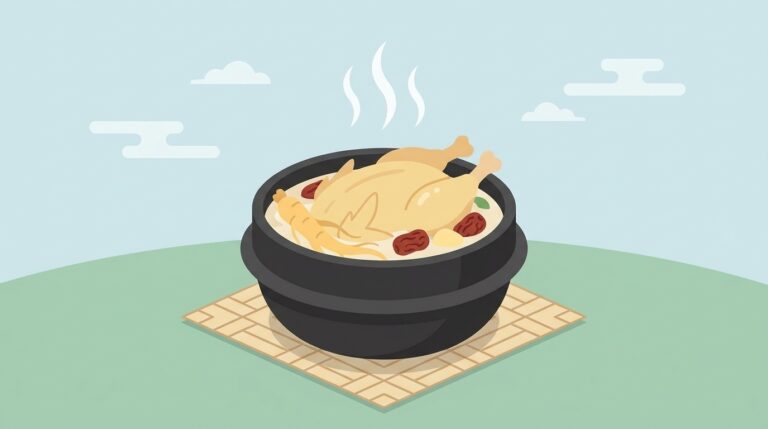
Phase 1: Empathy — Conquering the Boiling Earthen Pot
안녕하세요! 매일한글 에디터입니다. (Hello! This is your Daily Hangul editor.)
Imagine walking into a legendary Samgyetang (ginseng chicken soup) restaurant in Seoul on a sweltering July afternoon. The humid air clings to your skin, yet the restaurant is packed with locals happily sweating over bubbling black earthenware pots (ttukbaegi). The server sets a scalding bowl in front of you—steam billowing, a whole plump young chicken glistening amidst golden broth, stuffed with medicinal aromatics.
Panic kicks in: Do I eat the whole ginseng root? Where do the bones go? Why did they give me a tiny cup of clear liquor? How on earth do I pull the chicken apart without splashing boiling broth on my white shirt?
You are not alone. Countless Korean learners and travelers freeze in this exact moment, terrified of looking awkward or burning their tongues. Master this guide, and you won’t just eat like a tourist—you’ll effortlessly navigate traditional Korean dining rituals, master nuanced B2 intermediate food conversation, and earn nods of respect from restaurant owners (imo-nim). Let’s dive in!
Phase 2: Core Expressions Deep Dive
1. 뼈를 발라 먹다 (Ppyeo-reul bal-la meok-da)
- Pronunciation: [Ppyeo-reul bal-la meok-da] (Sounds like “pyuh-reul bahl-lah meok-dah”)
- Meaning:
- Literal: To separate the bone and eat.
- Nuanced: To skillfully debone meat using chopsticks and spoon while eating.
- K-Culture Moment: In food reality shows like Delicious Guys (맛있는 녀석들), hosts praise someone’s dexterity when they separate tender chicken meat from the cartilage cleanly in one bite: “와, 뼈 진짜 잘 바른다!”
- Editor’s Insight: In Korean cuisine, bal-la-meokda is a compound verb (bareuda to peel/separate + meokda to eat). It conveys culinary finesse. Instead of biting into a whole piece awkwardly, you separate the tender meat onto your side plate (apjeopsi).
- Situation Spectrum:
- Casual: ✅ 뼈 발라 먹기 귀찮아. (It’s a hassle deboning.)
- Semi-formal: ✅ 살이 부드러워서 뼈가 잘 발라져요. (The meat is tender, so the bones come right off.)
- Formal: ⚠️ 뼈를 발라 드시면 편합니다. (Better to use formal honorifics in corporate dining).
- 🤔 Think About It: Western dining often serves pre-filleted cuts to avoid visible bones at the table. Why do you think Korean culinary culture values serving whole birds/bone-in stews?
2. 소금에 찍어 드세요 (So-geum-e jji-geo deu-se-yo)
- Pronunciation: [So-geum-e jji-geo deu-se-yo] (Sounds like “so-goo-meh jjee-gaw deu-seh-yo”)
- Meaning:
- Literal: Please dip [it] in salt and eat.
- Nuanced: “The broth is intentionally served pure and unsalted, so season the chicken by dipping each piece into your seasoned salt plate.”
- K-Culture Moment: The moment an Imo (restaurant auntie) serves your steaming bowl, she points to the small saucer with coarse roasted salt and black pepper and says this exact line with a warm, caring smile.
- Editor’s Insight: Intermediate learners often make the mistake of dumping all the salt directly into the soup broth. Authentic Samgyetang broth is subtly herbal; locals prefer dipping meat piece by piece (jjikmeok style) rather than over-salting the entire pot.
- Situation Spectrum:
- Casual: ✅ 소금에 찍어 먹어 봐. (Try dipping it in salt.)
- Semi-formal: ✅ 소금에 살짝 찍어 드세요. (Please dip it lightly in salt.)
- Formal: ✅ 준비된 소금에 찍어 드시면 풍미가 살아납니다. (Dipping in the provided salt enhances the flavor.)
- 🤔 Think About It: How does personal flavor customization (dadaegi, salt dip, kimchi pairing) reflect Korean diner autonomy compared to pre-seasoned Western soups?
3. 찹쌀을 국물에 풀다 (Chap-ssal-eul gung-mul-e pul-da)
- Pronunciation: [Chap-ssal-eul gung-mul-e pul-da] (Sounds like “chahp-ssahl-eul goong-moo-reh pool-dah”)
- Meaning:
- Literal: To untie/loosen the glutinous rice into the broth.
- Nuanced: To break open the chicken cavity and mix the stuffed sweet rice into the hot broth to transform it into rich porridge (juk).
- K-Culture Moment: In K-Dramas featuring family weekend lunches, an elder parent will lovingly break open the chicken belly for their kids, saying: “찹쌀 국물에 잘 풀어서 깍두기 올려 먹어라.”
- Editor’s Insight: Pulda means to untangle or dissolve. Once you finish eating the main chicken meat, releasing the dense glutinous rice (chapssal) thickens the broth into a hearty finale.
- Situation Spectrum:
- Casual: ✅ 찹쌀 풀어서 죽처럼 먹자. (Let’s break the rice and eat it like porridge.)
- Semi-formal: ✅ 닭 안의 찹쌀을 국물에 풀어서 드시면 돼요. (You can loosen the sweet rice inside the chicken into the soup.)
- Formal: ⚠️ 찹쌀을 국물에 풀어 드시는 방식이 일반적입니다. (Descriptive explanation).
- 🤔 Think About It: The dual-phase meal structure (first tender protein, second soothing carbohydrate porridge) is ubiquitous in Korean stews and BBQ (bokkeumbap). What does this reveal about Korean meal pacing?
Phase 3: Textbook Korean vs. Real Korean
Situation 1: Describing the temperature and deep restorative flavor
- 📖 Textbook Korean: 이 삼계탕은 매우 뜨겁고 건강에 좋습니다. (I samgyetangeun maeu tteugeopgo geongange joeusseumnida. – This samgyetang is very hot and good for health.)
- 🗣️ Real Korean (B2 Level): 와, 국물이 엄청 진하고 시원하네요! 속이 싹 풀려요. (Wa, gungmuri eomcheong jinhago siwonhaneyo! Sogi ssak pullyeoyo. – Wow, this broth is remarkably rich and deeply comforting! My stomach feels totally soothed.)
- 💡 Why is it different? Native Koreans rarely just say “뜨겁다” (hot). Instead, they exclaim “시원하다” (siwonhada—refreshingly soothing/restorative) even for boiling stews, and use expressive idioms like sogi pullyeoda (relieving inner tension/fatigue).
Situation 2: Asking if you should eat the medicinal ingredients (Ginseng & Jujube)
- 📖 Textbook Korean: 대추와 인삼을 먹어야 합니까? (Daechuwa insameul meogeoya hamnikka? – Must I eat jujube and ginseng?)
- 🗣️ Real Korean (B2 Level): 이모님, 삼계탕에 든 대추랑 인삼은 보통 다 드시나요? (Imo-nim, samgyetange deun daechurang insameun botong da deusinayo? – Auntie, do people usually eat the jujube and ginseng inside the soup?)
- 💡 Why is it different? Calling the server Imo-nim builds instant rapport. Asking botong da deusinayo? (do people usually eat it?) sounds much more natural and socially nuanced than asking for a strict grammatical obligation (meogeoya hamnikka).
Phase 4: K-Culture Deep Dive & Non-Verbal Manners
4-1. Nunchi & Dining Table Gestures
- The Bone Bowl (Ppyeotong 뼈통) Rule: Every Samgyetang table features an empty metallic cylinder. Never drop your chicken bones onto the table napkin or back into your stone pot. Transfer bones directly into the ppyeotong using chopsticks.
- The Mini Ladle & Plate Strategy (Apjeopsi 앞접시): The stone bowl (ttukbaegi) retains bubbling heat for up to 15 minutes. Eating directly from it guarantees a scalded roof of your mouth. Cultured diners transfer chicken thighs or wings onto their side plate first, let them cool slightly, then dip into salt.
- Handling the Ginseng Liquor (Insam-ju 인삼주): Traditional shops serve a tiny shot of ginseng wine before the soup arrives. You have two cultural choices: drink it as an aperitif to stimulate digestion, or pour it directly into the boiling soup broth to deepen the herbal aroma.
4-2. Cultural Code: I-yeol-chi-yeol (이열치열 — Fighting Heat with Heat)
In the West, hot summer days call for chilled beverages and cold salads. Korea, however, celebrates Sambok (삼복)—the three hottest days of lunar summer: Chobok, Jungbok, and Malbok. Millions of Koreans queue around city blocks under the scorching sun to consume steaming, piping hot Samgyetang.
This philosophy, known as I-yeol-chi-yeol (이열치열, 以熱治熱), posits that sweating out thermal stress while replenishing vital energy (Gi 기) through medicinal herbs (ginseng, garlic, jujube, milkvetch root) regulates internal body temperature far better than ice-cold drinks.
Phase 5: Real-Life Roleplay Scenario
Setting: A bustling, aromatic 40-year-old Samgyetang eatery near Gyeongbokgung Palace during the peak lunch rush. You are seated at a wooden table across from a jovial owner, Imo-nim.
- Imo-nim: 어서 오세요! 몇 분이세요? 삼계탕 바로 준비해 드릴까?
(Eoseo oseyo! Myeot bun-iseyo? Samgyetang baro junbihae deurilkka?)
“Welcome! How many in your party? Shall I prepare the Samgyetang right away?”
🎭 Wipes down the table energetically and places side dishes (kkakdugi*, seasoned pepper paste, and garlic cloves).* -
Learner: 네, 이모님! 삼계탕 한 그릇 부탁드려요.
(Ne, imo-nim! Samgyetang han geureut butakdeuryeoyo.)
“Yes, Imo-nim! One bowl of Samgyetang, please.”
🎭 Politely places hands on lap and nods with a bright smile. -
Imo-nim: 여기 인삼주 한 잔 먼저 드시고 계셔. 몸에 아주 좋은 거야!
(Yeogi insamju han jan meonjeo deusigo gyesyeo. Mome aju joeun geoya!)
“Here, have a shot of ginseng wine first. It’s fantastic for your health!”
🎭 Sets down a tiny ceramic cup filled with golden, herbal-scented liquor. -
Learner: 감사합니다! 이 인삼주는 그냥 마셔도 되고, 국물에 넣어도 되나요?
(Gamsahamnida! I insamjuneun geunyang masyeodo doego, gungmure neoeodo doenayo?)
“Thank you! Can I drink this ginseng liquor straight, or should I pour it into the broth?”
🎭 Examines the cup with respectful curiosity. -
Imo-nim: 아이고, 한국 사람 다 됐네! 취향대로 하면 돼. 자, 펄펄 끓는 삼계탕 나왔다! 뜨거우니까 조심해!
(Aigo, hanguk saram da dwaenne! Chwihyangdaero hamyeon dwae. Ja, peolpeol kkeulneun samgyetang nawatta! Tteugeounikka josimhae!)
“Oh my, you’re practically Korean! Do whichever you prefer. Here comes your boiling Samgyetang! Careful, it’s scorching!”
🎭 Places a roaring, bubbling black ttukbaegi safely between wooden pot holders. -
Learner: 우와, 비주얼 대박이네요! 국물이 정말 뽀얗고 진해요.
(Uwa, bijueol daebagineyo! Gungmuri jeongmal pboyako jinhaeyo.)
“Wow, this visual is incredible! The broth is so milky and rich.”
🎭 Uses chopsticks to gently pierce the tender breast meat onto the side plate. -
Imo-nim: 고기는 소금 살짝 찍어서 깍두기랑 먹고, 찹쌀은 국물에 싹 풀어서 먹어!
(Gogineun sogeum saljjak jjigeoseo kkakdugirang meokgo, chapssareun gungmure ssak pureoseo meok-eo!)
“Dip the chicken lightly in salt with radish kimchi, then loosen the sweet rice into the soup!”
🎭 Gives an encouraging thumbs-up before rushing to the kitchen. -
Learner: 네! 뼈 잘 발라서 맛있게 먹겠습니다!
(Ne! Ppyeo jal ballaseo masitge meokgetseumnida!)
“Yes! I’ll debone it cleanly and enjoy every bite!”
🎭 Claps hands together politely before taking the first dipped bite.
🔀 Interactive Choice Point
You notice a large dried red jujube (daechu) and a piece of ginseng root floating in your soup. Your Korean friend asks, “대추 먹을 거야?” (Are you going to eat the jujube?) How do you respond?
- Choice A: “대추가 국물의 불순물을 흡수했다는 말이 있어서 보통 안 먹는 사람도 많대요. 그래도 전 달달해서 좋아요!”
(Feedback: BEST! Shows deep cultural literacy about the popular folk belief regarding jujubes absorbing toxins, while expressing personal preference gracefully.) - Choice B: “이거 독약 들어있어서 절대 먹으면 안 돼요! 버려주세요!”
(Feedback: BAD. Calling it ‘poison’ is overly dramatic and factually incorrect; jujubes are healthy, even if modern myth claims they absorb fats/impurities.) - Choice C: “한약 냄새가 너무 심해서 그냥 국물만 마실게요.”
(Feedback: RISK. Perfectly understandable if you dislike herbal notes, but phrased a bit bluntly. Better to say: *한방 향이 진해서 고기 위주로 먹어볼게요.)*
Phase 6: 10-Second Emotional Shadowing Drill
Practice these natural rhythm phrases aloud with emotional inflection! / represents a natural micro-pause.
- [😋 군침 돌며 담백하게 — Anticipatory & Craving]
와 / 닭고기 살이 진짜 연해서 / 뼈가 쏙 빠지네요!
(Wa / dalkgogi sari jinjja yeonhaeseo / ppyeoga ssok ppajineyyo!)
“Wow, the chicken meat is so tender that the bones slide right out!” -
[😌 감탄하며 깊은 톤으로 — Deeply Impressed & Soothed]
뜨거운 국물 마시니까 / 속까지 따뜻해지는 / 기분이에요.
(Tteugeoun gungmul masinikka / sokkkaji ttatteuthaejineun / gibunieyo.)
“Drinking this hot broth feels like warmth is spreading all the way down into my soul.” -
[😊 감사하며 싹싹하게 — Bright & Polite]
이모님 / 깍두기 리필 / 조금만 더 부탁드려요!
(Imo-nim / kkakdugi ripil / jogeumman deo butakdeuryeoyo!)
“Auntie, could we please have a small refill of the radish kimchi?”
Phase 7: K-Culture Mini Dictionary
-
뚝배기 (Ttukbaegi)
Definition: Traditional unglazed/glazed earthenware bowl known for superior heat retention.
Usage: In daily dining, Koreans say “뚝배기째로 나온다” (served boiling right in the stone pot), symbolizing rustic authenticity and peak temperature. -
이열치열 (I-yeol-chi-yeol)
Definition: Four-character idiom (四字成語) meaning “controlling heat with heat.”
Usage: Used in conversation when ordering boiling spicy stews or Samgyetang in midsummer: “오늘 진짜 덥다! 이열치열하러 가자!” -
복날 (Bongnal)
Definition: The three designated energetic dog days of summer (Chobok, Jungbok, Malbok).
Usage: Major workplace conversation topic. Colleagues ask: “오늘 초복인데 점심에 삼계탕 드셨어요?” (Today is Chobok; did you eat Samgyetang for lunch?) -
겉절이 (Geotjeori)
Definition: Freshly dressed, unfermented crisp kimchi tossed with chili, garlic, and fish sauce.
Usage: Samgyetang pairs better with sweet-spicy fresh geotjeori or crunchy kkakdugi than with sour aged kimchi (mugeunji).
Phase 8: Survival Kit for Travelers
Survival Expressions TOP 3
-
앞접시 하나 더 주실 수 있나요?
(Ap-jeop-si ha-na deo ju-sil su in-na-yo?)
Pro Tip: Essential when you want a clean plate to separate chicken meat from the bones without cluttering your existing side plate. -
인삼주는 어떻게 마셔요?
(In-sam-ju-neun eo-tteo-ke ma-syeo-yo?)
Pro Tip: Asks the server whether their specific house recipe recommends drinking it straight or pouring it into the boiling pot. -
닭 안에 찹쌀 더 들어있나요?
(Dak an-e chap-ssal deo deul-eo-in-na-yo?)
Pro Tip: Good to know before ordering extra rice (gonggibap). 99% of Samgyetang already contains a generous pouch of glutinous sweet rice inside!
Editor’s Travel Note
- Finding Authentic Spots: Skip tourist traps and look up legendary restaurants on Naver Map App Download. Search for terms like “원조 삼계탕” or “한방 삼계탕” near Jongno, Tosokchon, or Sinchon.
- Ordering Solo: Unlike Korean BBQ which often requires a minimum 2-person order, Samgyetang is individual-portion friendly (honbap 혼밥 approved!). You can confidently walk in alone and say “한 그릇이요” (One bowl, please).
Phase 9: Going One Step Deeper
In contemporary Western dining, food is frequently categorized by macro-nutrients: calories, proteins, and carbohydrates. In Korea, however, cuisine has historically operated under the ancient medical maxim 약식동원 (藥食同源)—“Food and medicine spring from the exact same source.”
When a Korean friend takes you out for Samgyetang, they are rarely just offering a casual meal; they are actively administering hospitality and health preservation (bo-yang 보양). The act of picking meat from the bone, patiently spooning hot broth, and sweating communally in an energetic dining hall reinforces an ethic of collective vitality.
💬 Your Turn: Have you ever tried Samgyetang or a similar restorative herbal stew in your home culture? What was your initial impression of eating piping hot soup in the heat of summer? Let us know in the comments below!
Phase 10: FAQ & Common Mistakes
Q: Should I eat the jujube (대추) inside the Samgyetang?
A: It is completely up to your preference! An old urban myth claims jujubes absorb all toxins from the chicken, so many older Koreans discard them. In reality, food scientists have verified that jujubes are totally safe and delicious to eat if you enjoy their sweet, broth-infused flavor.
Q: What is the correct order to eat the chicken and rice?
A: Step 1: Transfer pieces of chicken meat to your side plate and dip into salt/pepper.
Step 2: Discard bones cleanly into the bone pot (ppyeotong).
Step 3: Break open the chicken belly with your spoon and disperse the sweet glutinous rice (chapssal) into the broth.
Step 4: Finish your meal by eating the soothing, thickened chicken porridge topped with crunchy kkakdugi!
Q: What if the broth tastes very bland when it first arrives?
A: Do not panic! Premium traditional Samgyetang places do not pre-salt the broth so that diners with high blood pressure or subtle palates can adjust it themselves. Simply add half a spoonful of the coarse salt provided on your table into the soup, or dip the chicken meat in the salt saucer bite by bite.
🚨 Common Mistakes Alert Board
| ❌ What NOT to do | ⚠️ Why it’s a mistake | ✅ Correct Action |
|---|---|---|
| Dumping bones on the table napkin | Makes the table messy and soggy for servers to clean. | Drop all stripped bones directly into the metal 뼈통 (Ppyeotong). |
| Drinking soup directly from the stone pot rim immediately | The ttukbaegi can cause severe 2nd-degree burns to your lips. | Spoon broth and meat onto your 앞접시 (side plate) first to cool down. |
| Ordering an extra bowl of white rice immediately | Samgyetang already contains dense glutinous sweet rice inside the chicken. | Finish the chicken first; break open the stuffed rice before deciding if you need more. |
Phase 11: Action Mission & Engagement
🥉 Bronze Mission (Solo Practice)
Say aloud 3 times in front of your mirror: “살이 부드러워서 뼈가 잘 발라져요!” (The meat is tender, so the bones debone easily!) focusing on smooth linking between bal-la and jyeo-yo.
🥈 Silver Mission (Social Share)
Snap a picture of your next Korean soup or chicken dish, post it to your Instagram Story with the caption: “오늘 날씨엔 역시 이열치열! #DailyHangul #삼계탕” and tag our community.
🥇 Gold Mission (Real-World Execution)
Visit a Korean restaurant in your area or in Korea. When the server brings your stew, greet them warmly and politely ask: “이모님, 앞접시 하나만 더 부탁드려도 될까요?”
🎮 K-Culture Mission
Watch an episode of the K-Drama Weightlifting Fairy Kim Bok-joo or variety show I Live Alone (나 혼자 산다). Spot a scene where characters eat bone-in stews (Baeksuk, Gamjatang, or Samgyetang) and observe how they use their side plates and bone bins!
Phase 12: Interactive Quiz Challenge
1. Situational Judgment
Your Samgyetang has just arrived at the table, bubbling furiously in its ttukbaegi. What is the most culturally adept and safest next step?
* A) Pick up the heavy earthenware bowl with your bare hands and chug the broth.
* B) Transfer a piece of chicken meat to your side plate (apjeopsi) using chopsticks and let it cool before dipping in salt.
* C) Pour cold tap water into the bowl to immediately stop the bubbling.
👉 Click to reveal Answer & Explanation
Correct Answer: B
Explanation: Earthenware pots retain dangerous amounts of heat. Transferring chicken pieces to the side saucer allows safe eating without watering down the herbal broth or risking severe burns!
2. Fill in the Blank
Complete the sentence using the natural B2 intermediate verb for deboning meat:
“닭고기가 푹 익어서 젓가락으로 뼈를 __________ 먹기 편해요.”
(The chicken is fully simmered, so it’s easy to debone and eat with chopsticks.)
👉 Click to reveal Answer & Explanation
Correct Answer: 발라 (발라내어 / 발라)
Explanation: The base verb is 바르다 (to separate/debone). In connective form before meokda, it conjugates irregularly into 발라 (bal-la).
3. True / False Culture Check
- Statement: The term 이열치열 (I-yeol-chi-yeol) means Koreans only eat cold noodles (Naengmyeon) during the hottest days of summer to lower body heat.
👉 Click to reveal Answer & Explanation
Correct Answer: FALSE
Explanation: I-yeol-chi-yeol literally means “conquering heat with heat.” It describes the custom of eating steaming hot, invigorating stews like Samgyetang on the hottest summer days (Sambok) to revitalize bodily energy through perspiration and nutrients!







