

Phase 1: Empathy (Story-Driven Opening)
안녕하세요! This is your Daily Hangul editor.
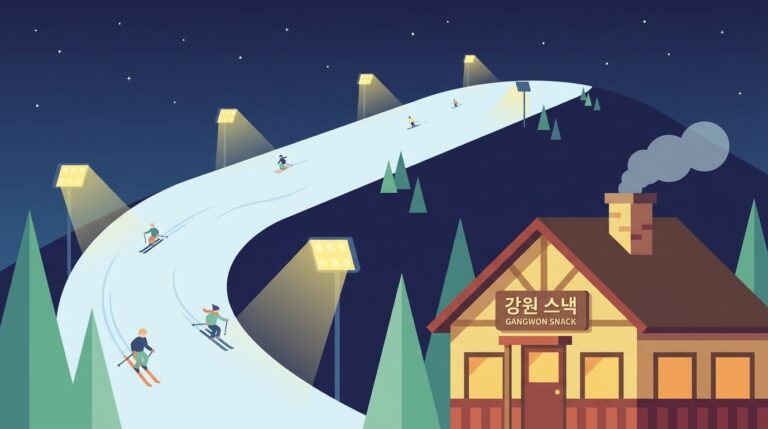
Imagine this scene: It’s 1:30 AM in the snow-draped mountains of Gangwon-do. Giant floodlights illuminate the slopes, reflecting off the crisp powder under a pitch-black winter sky. There are virtually no lift queues. You just completed an exhilarating run, but as soon as you stop at the bottom of the slope, reality hits: the sub-zero Korean mountain wind hits your face, your fingertips are numb, and every breath looks like thick steam. You want to tell your Korean friends how magical yet brutally freezing this night ski run is—beyond just saying a simple “추워요” (It’s cold).
Night skiing (심야 스키) is one of Korea’s most thrilling winter subcultures, beloved by university students, office workers blowing off weekend steam, and winter sports enthusiasts who crave empty slopes. Mastering B2-level natural winter expressions will transform you from an awkward tourist freezing on the chairlift into a savvy local ski buddy who knows exactly when to shred and when to retreat for steaming fishcake soup.
Phase 2: Core 3 Expressions In-Depth
1. 뼈가 시릴 정도로 추워요 (Bbyeo-ga si-ril jeong-do-ro chu-wo-yo)
- Pronunciation: [Ppyeo-ga shi-ril jung-doh-roh choo-wuh-yo] (Think: “Ppyeo” sounds like the snap of a twig, “si-ril” sounds like a piercing chill)
- Meaning: Literally “It’s cold to the point my bones ache,” meaning bone-chillingly, piercingly freezing.
- K-Culture Moment: Seen in winter travel variety shows like 2 Days & 1 Night when cast members face mountain wind chills during night penalty games.
- Editor’s Insight: Standard textbook Korean teaches “매우 춥습니다”, but native speakers use “뼈가 시리다” when the cold isn’t just surface-level skin chill, but deep, penetrating wind chill typical of Korean mountain resorts.
- Situation Spectrum: Casual (✅ with 반말: 뼈가 시려), Semi-formal (✅), Formal (⚠️)
- 🤔 Think About It: Notice how Korean uses internal anatomical sensations (bones, stomach, heart) to express external weather intensity. How does your language express cold that pierces through layers?
2. 오늘 완전 황제 스키네! (O-neul wan-jeon hwang-je seu-ki-ne!)
- Pronunciation: [Oh-neul wan-jun hwang-jeh seu-kee-neh]
- Meaning: Literally “Today is totally emperor skiing!”, meaning the slopes are so empty and wide open that you feel like royalty with your own private resort.
- K-Culture Moment: Skiers and snowboarders in K-vlogs cheering late at night when the slopes clear out after midnight.
- Editor’s Insight: 황제 (Emperor) is added as a prefix in Korean sports slang (e.g., 황제 골프, 황제 헬스) to describe having an entire facility exclusively to yourself without crowding.
- Situation Spectrum: Casual (✅), Semi-formal (✅ with ~네요), Formal (🚫)
- 🤔 Think About It: Why do Koreans prize empty leisure spaces so much that they coin terms like “Emperor Skiing”? It reflects the dense, fast-paced nature of daily urban life.
3. 몸 좀 녹이고 다시 타자 (Mom jom nog-i-go da-si ta-ja)
- Pronunciation: [Mom jom noh-ghee-goh dah-shi tah-jah]
- Meaning: Literally “Let’s melt our bodies a bit and ride again,” meaning let’s go inside to warm up and defrost before the next run.
- K-Culture Moment: In K-Dramas set in ski resorts (like Winter Sonata or Goblin), characters step inside a cozy ski lounge clutching warm canned coffee to thaw their frozen hands.
- Editor’s Insight: Koreans do not say “warm up the body” (몸을 따뜻하게 하다) as casually as they say “몸을 녹이다” (to melt/thaw the body). It vividly conveys that your frozen muscles need defrosting.
- Situation Spectrum: Casual (✅), Semi-formal (✅ with ~녹이고 가요), Formal (⚠️)
- 🤔 Think About It: Treating the human body as something that literally “melts” from ice highlights the Korean penchant for vivid physical metaphors.
Phase 3: Textbook vs. Real Korean
Scenario 1: Describing the Freezing Mountain Wind
- 📖 Textbook Korean: “바람이 많이 불고 날씨가 매우 춥습니다.” (The wind blows a lot and the weather is very cold.)
- 🗣️ Real Korean: “칼바람 때문에 귀 떨어져 나갈 것 같아!” (The knife-like wind makes it feel like my ears are gonna fall off!)
- 💡 Why is it different? Koreans personify biting winter gusts as 칼바람 (knife wind). Expressing extreme cold through exaggerated physical consequences (ears falling off, freezing solid) is the native way to show emotional resonance.
Scenario 2: Suggesting a Break at the Lodge
- 📖 Textbook Korean: “실내 휴게실로 들어가서 휴식을 취합시다.” (Let us enter the indoor lounge and take a rest.)
- 🗣️ Real Korean: “우리 어묵 국물 마시면서 몸 좀 녹이자.” (Let’s drink hot fishcake broth and thaw ourselves out.)
- 💡 Why is it different? Natural Korean conversation connects the purpose of a rest directly to warm comfort food (어묵 국물, 라면) rather than clinical abstract terms like 휴식을 취하다.
Phase 4: K-Culture Deep Dive & Non-Verbal Manners
4-1. Nunchi & Lift Manners
- The Shared Hot Pack Courtesy: When standing in line or riding the chairlift, offering one of your activated heat packs (핫팩) to a friend or shivering companion with both hands is a peak 정 (Jeong) and 눈치 (Nunchi) gesture.
- Fogged Goggles & Face Mask Etiquette: In freezing night winds, your neck warmer (바라클라바) will frost over. Before speaking up close on the lift, pull down your mask slightly so your voice isn’t muffled, but keep your back turned toward the wind.
4-2. Midnight Culture: The Night Ski Phenomenon
In Korea, skiing isn’t just a daytime retreat—it’s a 24-hour lifestyle. Many major resorts in Gangwon and Gyeonggi offer 심야권 (Midnight Pass, 10 PM – 2 AM) or even 백야권 (All-Night Pass, up to 4 AM). Young Koreans drive out on Friday night after work, ski till the early morning hours, crash in an ondol (heated floor) room, and eat steaming 신라면 or 떡볶이 at 3 AM. It blends sports with Korea’s signature vibrant night culture.
Phase 5: Real-World Roleplay Scenario
Setting: 1:45 AM at Yongpyong Resort. You and your Korean ski buddy, Min-su, are sitting on a 4-person chairlift ascending through sub-zero fog.
- Min-su: “와, 심야라 리프트 대기 줄 1도 없는 거 실화냐?”
(Wa, sim-ya-ra ri-peu-teu dae-gi jul il-do eomp-neun geo sil-hwa-nya?)
(English: Wow, is it for real that there is literally zero lift line since it’s midnight?)
🎭 Shivering with excitement, adjusting his tinted goggles -
You: “진짜 대박이다. 사람 없어서 완전 황제 스키네!”
(Jin-jja dae-bak-i-da. Sa-ram eop-seo-seo wan-jeon hwang-je seu-ki-ne!)
(English: Totally awesome. No people at all, it’s pure emperor skiing!)
🎭 Tapping your skis together in mid-air -
Min-su: “그치? 근데 정상 쪽 올라갈수록 바람이 장난 아닌데?”
(Geu-chi? Geun-de jeong-sang jjok ol-la-gal-su-rok ba-ram-i jang-nan a-nin-de?)
(English: Right? But the wind toward the summit is no joke, isn’t it?)
🎭 Hunching shoulders against the biting alpine breeze -
You: “맞아, 칼바람 때문에 볼이랑 귀가 떨어져 나갈 것 같아.”
(Maj-a, kal-ba-ram ddae-mun-e bol-i-rang gwi-ga tteol-eo-jyeo na-gal geot gat-a.)
(English: Yeah, this knife-wind feels like my cheeks and ears are going to fall off.)
🎭 Rubbing your padded ski gloves over your ear-covers -
Min-su: “이번 슬로프 롱턴으로 시원하게 쏘고 쉼터 갈까?”
(I-beon seul-ro-peu rong-teon-eu-ro si-won-ha-ge sso-go swim-teo gal-kka?)
(English: Shall we carve down this slope with long turns and hit the shelter?)
🎭 Pointing ski poles down toward the empty illuminated run -
You: “좋아! 한 번 신나게 달리고 몸 좀 녹이자.”
(Joh-a! Han beon sin-na-ge dal-ri-go mom jom nog-i-ja.)
(English: Sounds great! Let’s do an energetic run and then thaw ourselves out.)
🎭 Lowering the chairlift safety bar as the top terminal approaches -
Min-su: “매점에서 어묵 국물이랑 떡볶이 내가 쏠게!”
(Mae-jeom-e-seo eo-muk guk-mul-i-rang tteok-bok-ki nae-ga ssol-ge!)
(English: Fishcake soup and tteokbokki at the snack bar are on me!)
🎭 Giving a thumb up while sliding off the chairlift ramp -
You: “오예! 뼈가 시렸는데 국물 얘기 들으니까 힘이 난다!”
(O-ye! Bbyeo-ga si-ryeot-neun-de guk-mul ye-gi deul-eu-ni-kka him-i nan-da!)
(English: Oh yeah! My bones were freezing, but hearing about soup gives me energy!)
🎭 Gliding smoothly onto the snow terrace
🔀 Interactive Decision Point
At the summit shelter, your friend asks if you want to ski non-stop until 4 AM. How do you respond?
- Option A: “새벽 4시까지 안 쉬고 타면 동상 걸려! 어묵 먹고 30분만 몸 녹였다 가자.” (If we ride till 4 AM without stopping, we’ll get frostbite! Let’s eat fishcakes and defrost for 30 minutes first.)
👉 [Best Choice]: Perfectly balances intermediate banter, safety sense, and warm camaraderie. - Option B: “저는 매우 피곤합니다. 스키를 그만 타겠습니다.” (I am very tired. I will cease skiing.)
👉 [Too Stiff/Bad]: Grammatically correct but kills the playful midnight ski mood with rigid textbook speech. - Option C: “야, 그냥 패딩 벗고 맨몸으로 타자!” (Hey, let’s just take off our padded jackets and ski bare-chested!)
👉 [High Risk]: A humorous joke, but at -15°C midnight conditions, your Korean friend might take your extreme bravery too literally!
Phase 6: 10-Second Emotional Shadowing Drill
[🥶 이빨을 덜덜 떨며 / Shivering & teeth chattering]
“와… / 칼바람이 불어서 / 뼈가 시릴 정도로 추워요!”
(Wa… / kal-ba-ram-i bul-eo-seo / bbyeo-ga si-ril jeong-do-ro chu-wo-yo!)-
[⛷️ 짜릿하고 신나게 / Thrilled & ecstatic]
“슬로프에 사람이 없어서 / 완전 황제 스키네요!”
(Seul-ro-peu-e sa-ram-i eop-seo-seo / wan-jeon hwang-je seu-ki-ne-yo!) -
[😋 따뜻한 음식을 기대하며 / Craving cozy comfort]
“이번 판 타고 / 매점 가서 / 몸 좀 녹이고 가요!”
(I-beon pan ta-go / mae-jeom ga-seo / mom jom nog-i-go ga-yo!)
Phase 7: K-Culture Mini Dictionary
- 황제 스키 (Hwang-je Seu-ki) | Noun | “Emperor Skiing” — Slang for enjoying wide, deserted ski slopes during quiet night or dawn hours without waiting in lines.
- 붙이는 핫팩 (Bu-chi-neun Hat-paek) | Noun | Adhesive heating pads stuck directly onto base layers (undershirts/socks) to withstand freezing lift rides.
- 새벽권 / 백야권 (Sae-byeok-kwon / Baek-ya-kwon) | Noun | Lift ticket categories covering late-night ski windows (typically 11 PM to 3 AM or 4 AM).
- 칼바람 (Kal-ba-ram) | Noun | “Razor / Knife Wind” — Piercing, icy sub-zero winds typical of Korean mountain peaks in January and February.
Phase 8: Traveler’s Survival Kit
Survival Top 3 Expressions
- 리프트권 심야권으로 교환해주세요. (Ri-peu-teu-gwon sim-ya-gwon-eu-ro gyo-hwan-hae-ju-se-yo. – Please exchange my lift ticket for a midnight pass.)
Pro Tip: Use this at the ticketing booth when upgrading your afternoon pass. - 핫팩 어디서 팔아요? (Hat-paek eo-di-seo pal-a-yo? – Where do you sell heat packs?)
Pro Tip: Buy adhesive ones for your toes—ski boot toe-boxes get freezing quickly. - 따뜻한 어묵 국물 좀 더 주실 수 있나요? (Tta-tteut-han eo-muk guk-mul jom deo ju-sil su it-na-yo? – Could I get a little more hot fishcake broth?)
Pro Tip: At resort cafeterias, refilling broth is generally free and warmly welcomed.
Editor’s Travel Note
- Ski Resort Shuttle Buses: Don’t worry about driving late on icy roads. You can reserve official resort shuttle buses from major Seoul stations (Hongdae, Myeongdong, Gangnam) directly via [Naver Map App Download and Route Booking].
- Gear Rental Tips: External rental shops (사설 렌탈샵) along the mountain roads often offer better gear and warmer high-end ski suits (스키복 렌탈) at cheaper rates than inside the resort.
Phase 9: One Step Deeper (Reflective Insight)
Night skiing highlights the unique Korean rhythm of turning harsh conditions into collective celebrations. Despite freezing mountain temperatures that drop well below -10°C, Koreans transform the biting cold into an atmosphere of 낭만 (cozy romance and camaraderie). Enduring the piercing chill on the chairlift together makes the warm broth, shared laughs, and late-night talks at the lodge all the more memorable.
💬 Your Turn: Have you ever participated in a late-night sport or outdoor activity in freezing winter weather? Share your experience or favorite cold-weather comfort food in the comments below!
Phase 10: FAQ & Common Mistakes
Q: Can I use “뼈가 시리다” to describe cold drinks or ice cream?
A: No! 뼈가 시리다 is specifically used for deep environmental cold (freezing weather, icy wind) or physiological aches caused by cold exposure / aging. For cold drinks, use “머리가 띵할 정도로 차가워요” (It’s brain-freeze cold).
Q: What is the difference between 심야 (Sim-ya) and 새벽 (Sae-byeok)?
A: 심야 refers to deep night hours (around 10 PM to 2 AM), whereas 새벽 refers to early dawn/morning hours (2 AM to 6 AM). In ski resorts, midnight passes are labeled 심야권 and dawn passes 새벽권.
Q: Is “황제 스키” used in formal newspaper articles or only in slang?
A: While it originated as skier slang, it is widely recognized and frequently used even in winter travel headlines to describe empty, luxury-like ski conditions.
🚨 Common Mistakes (경고판)
- ❌ “제 몸을 따뜻하게 녹여요.” (Awkward literal translation)
👉 Correct: “몸 좀 녹이자 / 몸 좀 녹일게요.” (Natural idiomatic defrosting) - ❌ “바람이 칼이에요.” (Directly translating ‘knife wind’)
👉 Correct: “칼바람이 불어요.” (Use the compound noun 칼바람) - ❌ “리프트가 너무 춥습니다, 멈춰주세요!” (Demanding the lift stop due to cold)
👉 Correct: “너무 추워서 이번 슬로프만 타고 내려갈게요.” (Finish the run and warm up safely inside)
Phase 11: Action Missions
- 🥉 Bronze Mission (Solo Practice): Practice the shadowing drill phrase “칼바람 때문에 뼈가 시려요!” three times with dramatic shivering expressions.
- 🥈 Silver Mission (Social Connection): Leave a comment below using the slang “황제 [activity]” with another hobby you enjoy (e.g., “황제 수영”, “황제 영화관”).
- 🥇 Gold Mission (Real Life Execution): Next time you step into cold air or enter a warm cafe, tell your friend or barista: “몸 좀 녹이고 갈게요!”
- 🎮 K-Culture Mission: Watch a winter scene from a K-Variety show (like Running Man or I Live Alone winter episodes) and spot whenever cast members say “몸 녹이다” or “칼바람”.
Phase 12: Interactive Quiz Challenge
1. [Situational Judgment] You are riding a freezing lift at 2 AM with a Korean coworker. Which phrase sounds most natural and polite?
* (A) “선생님, 날씨가 매우 시원해서 좋습니다.”
* (B) “바람이 칼바람이라 정말 뼈가 시리네요! 내려가서 따뜻한 것 좀 마셔요.”
* (C) “너무 차가워서 내 뼈가 죽었습니다.”
2. [Fill in the Blank] When the slopes are blissfully empty at night, you can shout:
“오늘 사람 진짜 없다, 완전 ______ 스키네!”
3. [True / False] True or False: “몸을 녹이다” literally means to melt butter on your body.
🔍 Click here to reveal Answers & Explanations
-
Answer: (B)
Explanation: (B) naturally utilizes B2-level terms 칼바람 and 뼈가 시리다 with polite -네요 endings. (A) incorrectly uses 시원하다 (refreshingly cool) for sub-zero winter winds, and (C) is an unidiomatic broken literal translation. -
Answer: 황제 (Hwang-je)
Explanation: 황제 스키 means “emperor skiing”—having the whole slope to yourself. -
Answer: False
Explanation: 몸을 녹이다 is a natural idiomatic expression meaning “to thaw out / warm up one’s frozen body after being in the cold.”







