

Mastering Korea’s Unmanned Convenience Stores: A C1 Guide to Self-Checkout Etiquette and Tech Slang
Phase 1: Empathy (Story-Driven Opening)
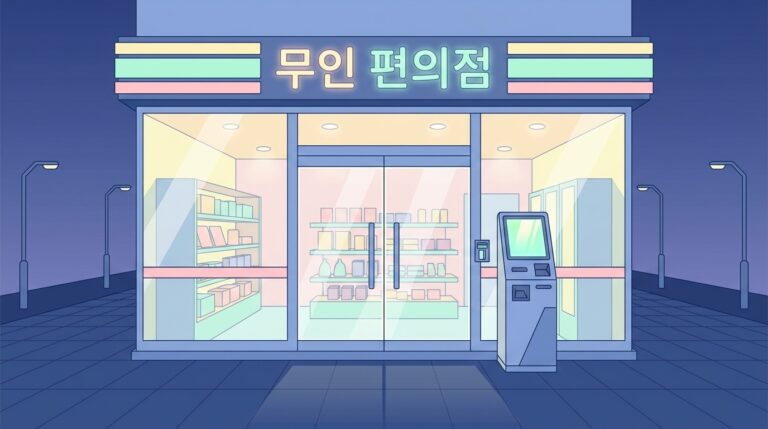
안녕하세요! It’s your Daily Hangul editor and cultural navigator. Picture this: It is 2:15 AM in Seoul. You’ve just finished a vibrant karaoke session in Hongdae or a late-night stroll along the Han River. You crave a piping-hot bowl of Shin Ramyun and an iced pouch coffee. You spot the familiar glowing neon sign of a convenience store, but the lights inside are dimmed to an ambient glow, the glass sliding door is firmly locked, and there isn’t a single human clerk in sight.
A glowing terminal beside the door flashes: 출입 인증 (Entry Verification). You reach into your pocket, bewildered. Why is the door locked? How do you scan your foreign payment card? What if the kiosk errors out or you need to dispose of food waste properly? For intermediate and advanced learners, unmanned convenience stores (무인 편의점) represent the ultimate crossroad of hyper-modern Korean tech, unique social trust dynamics, and real-time situational problem-solving. This guide is curated from genuine learner struggles to elevate your Korean from textbook accuracy to culturally nuanced, C1-level fluency.
Phase 2: Deep-Dive into 3 Core Expressions
1. 출입 인증을 위해 카드를 태그해 주세요 (Chul-ip in-jeung-eul wi-hae ka-deu-reul tae-geu-hae ju-se-yo)
- Pronunciation: [Chul-ip in-jeung-eul wi-hae ka-deu-reul tae-geu-hae ju-se-yo] (Think: “Chool-ip” like ‘tulip’ with a ‘ch’, “In-jeung” like ‘engine’ without the ‘en’, “Tag” as in laser tag)
- Meaning: Literal: “Please tag your card for entry verification.” | Nuance: The mandatory security check required to unlock automated doors during late-night hours in unmanned establishments.
- K-Culture Moment: Seen on security terminals in web dramas depicting modern solo-living youth (1인 가구) navigating late-night convenience store runs.
- Editor’s Insight: At a C1 level, notice the Sino-Korean noun compound 출입(出入 – exit/entry) + 인증(認證 – authentication). In modern vernacular, the English loanword ‘태그하다 (to tag/tap)’ has fully replaced 접촉하다 (to touch/contact) in digital UI contexts.
- Situation Spectrum: Casual ⚠️ | Semi-formal ✅ | Formal ✅
- 🤔 Think About It: Why does Korea rely on credit card verification rather than biometric ID or human security guards for late-night safety?
2. 바코드가 잘 안 찍히는데 수량 수정을 어떻게 하나요? (Ba-ko-deu-ga jal an jjik-hin-deu-ne su-ryang su-jeong-eul eo-tteo-ke ha-na-yo?)
- Pronunciation: [Ba-ko-deu-ga jal an jjik-hin-deu-ne soo-ryang soo-jeong-eul eo-tteo-kay ha-na-yo?]
- Meaning: Literal: “The barcode isn’t scanning well; how do I adjust the quantity?” | Nuance: A natural, polite query directed either to a fellow shopper or via a customer intercom when the automated scanner misfires.
- K-Culture Moment: The relatable comedic scene where a character accidentally scans an item three times and nervously scrambles before the line behind them grows.
- Editor’s Insight: The passive verb 찍히다 (to get stamped/scanned) combined with ~는데 sets an indirect, polite context rather than placing blame on the machine. C1 speakers leverage ~는데 to sound conversational rather than robotic.
- Situation Spectrum: Casual ⚠️ | Semi-formal ✅ | Formal ✅
- 🤔 Think About It: How does phrasing technical issues with passive verbs (찍히다 vs 찍다) soften social friction in Korean public spaces?
3. 신분증 미소지 시 주류 및 담배 결제가 제한됩니다 (Sin-bun-jeung mi-so-ji si ju-ryu mit dam-bae gyeol-je-ga je-han-doem-ni-da)
- Pronunciation: [Shin-boon-jeung mee-so-jee shee joo-ryoo meet dahm-bae gyul-je-ga je-hahn-doem-nee-dah]
- Meaning: Literal: “If identification is not held, settlement for alcohol and tobacco is restricted.” | Nuance: Automated compliance notice stating that unmanned kiosks will strictly lock age-restricted transactions without mobile or physical ID verification.
- K-Culture Moment: A classic trope where young adults look mature but get blocked by the kiosk’s strict digital age verification scanner.
- Editor’s Insight: Note the formal Sino-Korean prefix 미- (未, non-/un-) attached to 소지 (possession). High-level learners must master how public automation systems deliver legal warnings via dense Sino-Korean noun phrases.
- Situation Spectrum: Casual 🚫 | Semi-formal ⚠️ | Formal ✅
- 🤔 Think About It: How does digital identity verification reflect Korea’s rapidly digitizing administrative culture (e.g., PASS, Mobile Driver’s License)?
Phase 3: Textbook Korean vs. Real Korean
Situation 1: Asking someone how to open the unmanned locked door
- 📖 교과서 한국어: 문을 열기 위해서 신용카드를 단말기에 대십시오. (Please place your credit card on the terminal in order to open the door.)
- 🗣️ 진짜 한국어: 카드 여기 띡 찍고 들어가시면 돼요! (Just tap your card right here and you can head in!)
- 💡 왜 다를까? Native speakers frequently employ onomatopoeic contractions like ‘띡 찍다’ (to make a quick beep-scan) and conversational conditional endings (~면 돼요) instead of stiff instructional imperatives (~십시오).
Situation 2: Correcting a double-scanned item at the kiosk
- 📖 교과서 한국어: 상품이 중복되어 스캔되었으니 삭제 버튼을 누르십시오. (As the item has been redundantly scanned, push the deletion button.)
- 🗣️ 진짜 한국어: 아, 두 번 찍혔네. 전체 취소 누르고 다시 찍는 게 빠르겠어요. (Ah, it scanned twice. It’d be faster to just hit cancel-all and rescan.)
- 💡 왜 다를까? In real life, Korean kiosk interfaces use pragmatic terms like ‘전체 취소’ (cancel all) or ‘수량 변경’ (change quantity), and locals talk to themselves or companions using natural evaluative structures (~는 게 빠르다).
Phase 4: K-Culture Deep Dive & Non-Verbal Manners
4-1. 눈치 (Nunchi) & Unspoken Etiquette at Unmanned Stores
Unmanned stores operate on an implicit social contract rooted in collective vigilance and high mutual trust. While nobody is watching you in person, tens of high-resolution CCTV cameras are. Demonstrating good Nunchi involves:
1. Barcode Angle: Keep barcodes facing straight toward the stationary infrared beam; waving items erratically triggers error chimes that turn heads.
2. Counter Cleanliness: If making instant ramyeon or microwaving lunchboxes (도시락), clean every spill immediately using the designated wipe station (행주/물티슈). Leaving trash unattended is considered a major breach of public etiquette.
3. Bag Declaration: If you take a plastic or paper bag, you must scan the bag’s barcode on the kiosk counter before taking it.
4-2. Cultural Code: The Evolution of “Honbap” (혼밥) & 24/7 Safety Culture
Unmanned convenience stores reflect Korea’s booming solo-living culture (1인 가구) and demand for zero-contact (언택트) convenience. They are safe havens equipped with direct 112 emergency intercom hotlines integrated into the card reader or kiosk. The seamless blend of high-tech surveillance and civil trust creates an environment where people comfortably leave laptops or bags unattended at the window counter while brewing noodles.
Phase 5: Real-Life Roleplay Scenario
Setting: 1:30 AM at an unmanned convenience store near Gangnam Station. Min-jun (a helpful late-night local student) notices you hesitating at the self-checkout kiosk.
- 민준: 저기요, 혹시 결제 창에서 막히셨어요?
(Jeo-gi-yo, hok-si gyeol-je chang-e-seo mak-hi-syeoss-eo-yo?)
“Excuse me, did you perhaps get stuck on the payment screen?”
🎭 행동 지문: Polite head tilt, pointing helpfully toward the touchscreen. - 당신: 네, 바코드를 찍었는데 화면에 두 개가 올라갔어요.
(Ne, ba-ko-deu-reul jjik-eoss-neun-de hwa-myeon-e du gae-ga ol-la-gass-eo-yo.)
“Yes, I scanned the barcode, but two items showed up on the screen.” - 민준: 아, 스캐너 센서가 민감해서 그래요. 화면에서 마이너스 버튼 누르시면 돼요.
(A, seu-kae-neo sen-seo-ga min-gam-hae-seo geu-rae-yo. Hwa-myeon-e-seo ma-i-neo-seu beot-eun nu-reu-si-myeon dwae-yo.)
“Ah, the scanner sensor is sensitive. You can just hit the minus button on the screen.” - 당신: 아, 수정됐네요! 그런데 봉투는 어디서 결제하나요?
(A, su-jeong-dwaess-ne-yo! Geu-reon-de bong-tu-neun eo-di-seo gyeol-je-ha-na-yo?)
“Ah, it’s corrected! By the way, where do I pay for a bag?” - 민준: 화면 하단에 ‘봉투 추가’ 누르시거나 바코드 스캔대 옆에 걸린 봉투 바코드 찍으시면 돼요.
(Hwa-myeon ha-dan-e ‘bong-tu chu-ga’ nu-reu-si-geo-na ba-ko-deu seu-kaen-dae yeop-e geol-lin bong-tu ba-ko-deu jjik-eu-si-myeon dwae-yo.)
“You can press ‘Add Bag’ at the bottom of the screen, or scan the bag’s barcode hanging next to the scanner.” - 당신: 정말 감사합니다. 해외 카드 결제도 여기서 바로 되죠?
(Jeong-mal gam-sa-hap-ni-da. Hae-oe ka-deu gyeol-je-do yeo-gi-seo ba-ro doe-jyo?)
“Thank you so much. Overseas card payments work directly here too, right?” - 민준: 네, 신용카드 버튼 누르고 IC칩 방향 맞춰서 끝까지 꽂아두세요. 영수증 나올 때까지 빼시면 안 돼요!
(Ne, sin-yong-ka-deu beot-eun nu-reu-go IC-chip bang-hyang mat-chwo-seo kkeut-kka-ji kkoj-a-du-se-yo. Yeong-su-jeung na-ol ttae-kka-ji bpae-si-myeon an dwae-yo!)
“Yes, press the ‘Credit Card’ button and insert it all the way facing the IC chip. Don’t remove it until the receipt prints!” - 당신: 친절하게 알려주셔서 다행이에요. 좋은 밤 보내세요!
(Chin-jeol-ha-ge al-ryeo-ju-syeo-seo da-haeng-i-e-yo. Jo-eun bam bo-nae-se-yo!)
“I’m so relieved you explained it so kindly. Have a great night!”
🔀 Interactive Decision Branching
What would you do if your card gets declined at the unmanned kiosk?
* Option A: Call out loudly inside the store to see if an employee is sleeping in the back room.
* Feedback: ❌ Bad: Unmanned stores genuinely do not have overnight staff. Calling out will only startle other quiet shoppers or trigger noise warnings.
* Option B: Check if your card has international IC payment enabled, press “신용카드” again, and ensure the chip is firmly inserted into the bottom reader.
* Feedback: 🏆 Best: Flawless C1 problem-solving! Most kiosk errors stem from card reading timeouts or pressing the domestic simple pay option (간편결제) instead of standard credit card.
* Option C: Leave the cash on the counter corresponding to the item’s price tag and walk out.
* Feedback: ⚠️ Risk: Severe legal hazard. Unmanned stores are cash-free and monitored by CCTV. Leaving cash without a registered kiosk receipt is treated as theft (절도) by automated inventory systems.
Phase 6: 10-Second Emotion Shadowing Drill
[😟 당황스럽고 조심스럽게 / Confused & Hesitant]
저기요… / 출입문에 카드를 댔는데 / 문이 안 열려요.
(Jeo-gi-yo… / chul-ip-mun-e ka-deu-reul daess-neun-de / mun-i an yeol-ryeo-yo.)-
[💡 깨달음을 얻고 신속하게 / Enlightened & Prompt]
아! / 결제 수단 선택에서 / 신용카드를 먼저 눌러야 / 인식되는 거군요!
(A! / gyeol-je su-dan seon-taek-e-seo / sin-yong-ka-deu-reul meon-jeo nul-leo-ya / in-sik-doe-neun geo-gun-yo!) -
[😊 정중하고 감사한 태도로 / Polite & Grateful]
수량 수정하는 법 / 알려주셔서 / 정말 감사합니다.
(Su-ryang su-jeong-ha-neun beop / al-ryeo-ju-syeo-seo / jeong-mal gam-sa-hap-ni-da.)
Phase 7: K-Culture Mini Dictionary
- 무인점포 (Mu-in-jeom-po) | Unmanned / Autonomous Store
Usage: Refers to fully automated retail outlets (convenience stores, ice cream shops, self-laundromats, print cafes) operating without on-site staff. - 출입인증단말기 (Chul-ip-in-jeung-dan-mal-gi) | Entry Authentication Terminal
Usage: The outdoor credit card/QR scanner beside entrance doors to filter late-night visitors. - 셀프 계산대 / 무인 키오스크 (Sel-peu gye-san-dae / Mu-in ki-o-seu-keu) | Self-Checkout Kiosk
Usage: The interactive touchscreen station where users scan barcodes, apply discounts/points, and process payment. - 분리수거대 (Bun-ri-su-geo-dae) | Waste Sorting Station
Usage: The recycling zone inside/outside the store categorized strictly into plastic (플라스틱), food waste/ramyeon broth (음식물/국물 버리는 곳), and general trash (일반쓰레기).
Phase 8: Survival Kit for Travelers
TOP 3 Survival Phrases
- 한글: 결제가 안 넘어가는데 어떻게 하나요?
Romanization: Gyeol-je-ga an neom-eo-ga-neun-de eo-tteo-ke ha-na-yo?
Pro Tip: Use when the screen freezes during payment processing. It literally means “The payment won’t transition to the next step.” - 한글: 봉투 결제 바코드 어디 있어요?
Romanization: Bong-tu gyeol-je ba-ko-deu eo-di iss-eo-yo?
Pro Tip: Essential when looking for the plastic/paper bag purchasing barcode tag. - 한글: 영수증 재출력 버튼 어디 있나요?
Romanization: Yeong-su-jeung jae-chul-ryeok beot-eun eo-di iss-na-yo?
Pro Tip: Crucial if you need an itemized receipt for tax refunds or proof of purchase for store security.
Editor’s Travel Note
- Check Naver Map App Download and Route Guide to easily filter 24-hour unmanned branches nearby using the keyword
무인편의점. - Overseas credit cards (Visa, Mastercard, Amex) work seamlessly on most modern entry terminals and kiosks; always select 신용카드 (Credit Card) instead of domestic QR mobile pay (카카오페이/네이버페이).
Phase 9: Go One Step Deeper (Humanities Thought)
Korea’s flourishing unmanned store culture is a remarkable byproduct of a hyper-connected, high-trust society reinforced by omnipresent CCTVs and real-time electronic authentication. It strikes a fascinating philosophical balance: while personal interaction is eliminated to maximize operational efficiency and customer solitude, civic responsibility becomes even more demanding. Society trusts that you will scan every single item and clean your noodle table, while the system quietly records every transaction. It represents an evolving form of communal trust mediated by digital architecture.
💬 Your Turn: Would unmanned convenience stores thrive in your home country? What social or technical adjustments would be necessary? Share your thoughts below in Korean or English!
Phase 10: FAQ & Common Mistakes
Q: Can foreign tourists enter late-night unmanned stores without a Korean resident card?
A: Yes! Most entrance verification scanners accept physical foreign credit cards (Visa/Mastercard) with IC chips. Simply insert or tap your foreign card into the outdoor terminal. No personal identity data is deducted; it merely validates active card status to unlock the door.
Q: What should I do if the kiosk double-scans an item?
A: Look for the - (minus) icon next to the item name on the touchscreen, or tap 선택 취소 (Cancel Selection) / 전체 취소 (Cancel All) to reset the scanning list. Do not leave the item unscanned if you restart.
Q: Can I purchase beer or soju at an unmanned convenience store at night?
A: In most unmanned stores, alcohol and tobacco display cases are automatically locked late at night. You can only purchase them if the kiosk features a dedicated mobile government ID scanner (PASS or registered resident card); standard foreign passports are often not recognized by automated alcohol kiosks.
🚨 Common Mistakes Alert (Top 3)
- Leaving Cash on the Kiosk: Unmanned stores are 100% cashless. Leaving cash will trigger inventory loss alerts and potential police reports.
- Correct Action: Use physical credit/debit cards, T-Money, or Apple Pay (if supported).
- Throwing Ramyeon Soup into the General Bin: Emptying hot broth into plastic trash creates severe sanitary issues.
- Correct Action: Pour liquid food waste into the designated sink-hole labeled
국물 버리는 곳and discard the paper bowl separately.
- Correct Action: Pour liquid food waste into the designated sink-hole labeled
- Pulling the Card Out Too Early: Kiosks process data over network protocols that take 2-4 seconds.
- Correct Action: Leave the IC chip inserted until the screen says
카드를 뽑아주세요(Please remove card) and the paper receipt prints.
- Correct Action: Leave the IC chip inserted until the screen says
Phase 11: Action Mission & Engagement
- 🥉 Bronze Mission: Practice shadowing the 3 emotion sentences in Phase 6 with natural intonation.
- 🥈 Silver Mission: Write a comment below describing your favorite late-night Korean convenience store snack using the grammar pattern
~는 게 빠르겠어요. - 🥇 Gold Mission: On your next trip to Korea, visit an unmanned convenience store (무인편의점), enter via card tap, complete a self-checkout without staff assistance, and clean up your table!
- 🎮 K-Culture Mission: Watch a contemporary K-drama set in Seoul (such as My Liberation Notes or Extraordinary Attorney Woo) and spot how characters interact in convenience stores or self-service spaces!
Phase 12: Interactive Quiz Challenge
1. Situation Judgment: You accidentally scanned an iced tea twice at the self-checkout. What is the most appropriate action?
* A) Just pay the double amount and take two bottles from the shelf.
* B) Tap the - button on the screen to adjust the item quantity to 1.
* C) Unplug the kiosk power cord to reset the transaction.
2. Fill-in-the-Blank:
* “심야 시간에는 출입문을 열기 위해 카드를 단말기에 (____)해야 합니다.”
* (a) 버려야
* (b) 태그
* (c) 청소
3. True or False:
* Foreign tourists can buy soju at all unmanned convenience store kiosks at 3 AM using a paper photocopy of their passport. (True / False)
🔍 Click here to reveal the answers and explanations!
- Answer: B | Tapping the quantity reduction button (
-or수량 수정) adjusts the cart cleanly without disrupting store inventory. - Answer: (b) 태그 | “태그(Tag)” is the standard verb for tapping or scanning cards against access terminals.
- Answer: False | Paper copies or foreign passports are generally not compatible with automated late-night alcohol vending locks, which require physical domestic IDs or integrated digital authentication (PASS).







