

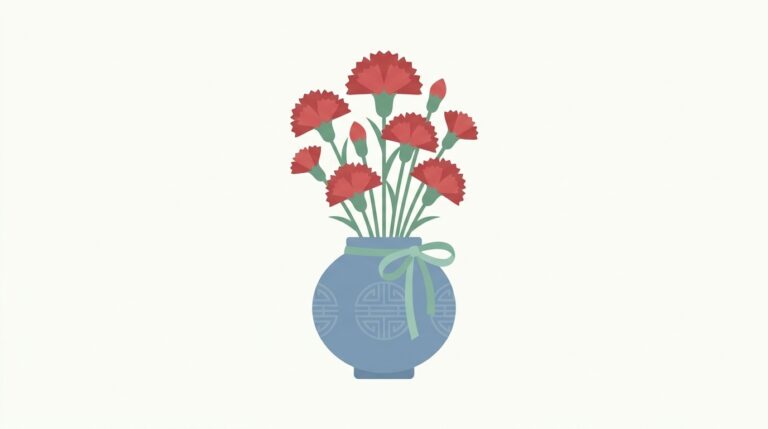
How to Celebrate Korean Parents’ Day: Gifting Carnations with Warm Heart
Phase 1: Empathy (A Story from Seoul)
안녕하세요! 매일한글 에디터입니다. (Hello! This is your Daily Hangul editor.)
Imagine this: It is early May in Seoul. You walk past local flower stalls, bakery windows, and convenience store displays, and suddenly the entire city turns into a sea of bright red carnations and elegant ribbon-wrapped gift boxes. You are invited to dinner with your Korean host family, your partner’s parents, or Korean mentors on May 8th—어버이날 (Parents’ Day). You clutch a small potted carnation, your heart pounding. You want to say more than just a quick “Thank you,” but honorifics feel intimidating and you are worried about clumsy etiquette. Do you hand it with both hands? What do you say when pinning a flower brooch?
Don’t worry! This comprehensive guide is built directly from real student experiences and local etiquette tips. By the end of this lesson, you will comfortably present carnations, use sweet honorific expressions, and touch your Korean parents’ hearts with absolute confidence.
Phase 2: 3 Essential Expressions for Parents’ Day
1. 낳아 주시고 키워 주셔서 감사합니다. (Na-a jusigo kiwo jusyeoseo gamsahamnida.)
- Pronunciation: [Na-ah joo-she-go kee-wo joo-shyeo-seo gahm-sa-hahm-nee-da] (Think of ‘Na-ah’ like a soft sigh of gratitude, followed by smooth rhythmic honorifics)
- Meaning: Literal: “Thank you for giving birth to me and raising me.” / Real Nuance: “Thank you for your devoted love and for raising me into who I am today.”
- K-Culture Moment: Every Korean schoolchild writes this exact sentence in hand-folded origami carnation letters during art class in early May.
- Editor’s Insight: Even if they aren’t your biological parents (such as host parents or in-laws), Koreans deeply appreciate the dedication behind “raising” (키워 주셔서). For in-laws, you can tweak it to “예쁘게 키워 주셔서 감사합니다” (Thank you for raising my partner so beautifully).
- Situation Spectrum: Casual 🚫 | Semi-formal ⚠️ | Formal ✅
- 🤔 Think About It: In English, we often say “Happy Parents’ Day!” Why do you think Korean centers the message around deep filial gratitude and personal sacrifice?
2. 항상 건강하시고 행복하세요. (Hangsang geonganghasigo haengbokhaseyo.)
- Pronunciation: [Hahng-sahng gun-gahng-hah-she-go haeng-bohk-hah-seh-yo] (Flows like ‘gun-gang’ for health, followed by a warm wish)
- Meaning: Literal: “Always be healthy and be happy.” / Real Nuance: “Wishing you lasting good health and happiness.”
- K-Culture Moment: Seen printed in gold foil across gift ribbons on flower baskets across Seoul.
- Editor’s Insight: Korean honorific grammar attaches
-시-to health and happiness when wishing well for elders. It sounds polite, soothing, and emotionally mature.- Situation Spectrum: Casual 🚫 | Semi-formal ✅ | Formal ✅
- 🤔 Think About It: Notice how health (건강) comes before happiness (행복). In Korean culture, an elder’s health is considered the cornerstone of family peace.
3. 카네이션 마음에 드셨으면 좋겠어요. (Kaneisyeon maeume deusyeosseumyeon jokgesseoyo.)
- Pronunciation: [Kah-neh-ee-shyun mah-eum-eh deu-shyeot-seum-yeon johe-get-seh-yo] (Pronounce ‘maeum’ softly like ‘mah-oom’)
- Meaning: Literal: “It would be good if the carnation entered your heart.” / Real Nuance: “I really hope you like these carnations!”
- K-Culture Moment: A nervous son-in-law handing over a lavish carnation cake in a classic K-drama family dinner scene.
- Editor’s Insight: “마음에 들다” literally means “to enter one’s mind/heart.” Using the honorific form “마음에 드시다” shows humility and consideration when offering a gift.
- Situation Spectrum: Casual ⚠️ | Semi-formal ✅ | Formal ✅
- 🤔 Think About It: Rather than asking directly “Do you like it?” Korean etiquette favors expressing gentle hope that the recipient enjoys it.
Phase 3: Textbook Korean vs. Real-Life Korean
Situation 1: Expressing Love to Elders
- 📖 Textbook Korean: 사랑합니다, 부모님. (Saranghamnida, bumonim. – “I love you, parents.”)
- 🗣️ Real-Life Korean: 엄마, 아빠 사랑해요! 오래오래 건강하세요~ (Eomma, appa saranghaeyo! Orae-orae geonganghaseyo~ – “Mom, Dad, love you! Please stay healthy for a long, long time!”)
- 💡 Why is it different? While 부모님 (parents) is formal, real Korean families address their parents warmly as 엄마 (Mom) and 아빠 (Dad) while maintaining respectful verb endings, adding cute warmth with 오래오래 (for a long, long time).
Situation 2: Handing over the Carnation Box / Gift
- 📖 Textbook Korean: 이것은 선물입니다. 받으십시오. (Igeoseun seonmurimnida. Badeusipsio. – “This is a present. Please receive it.”)
- 🗣️ Real-Life Korean: 약소하지만 제 마음이에요. (Yaksokhajiman je maeumimieyo. – “It’s a humble gift, but it comes from my heart.”)
- 💡 Why is it different? Korean culture values humility (겸양). Calling one’s own gift modest (약소하지만) emphasizes genuine sincerity (마음) rather than material value.
Phase 4: K-Culture Deep Dive & Non-Verbal Manners
4-1. Nunchi & Physical Gestures
- The Two-Hand Rule: Always present carnations, flower boxes, or gift envelopes using both hands. Hold the item with two hands or support your right wrist/forearm lightly with your left hand.
- Head Bow (목례): Make eye contact first with a warm smile, then bow your head at approximately a 30-degree angle as you present the flower.
- Pinning Carnations: If presenting a traditional brooch carnation, ask gently: “달아 드려도 될까요?” (May I pin this on you?) and wait for their nod before leaning in respectfully.
4-2. Cultural Code: Red Carnations & Cash Gifts
Unlike Mother’s Day and Father’s Day which are separated in many Western countries, Korea combines both into 어버이날 (May 8th). Historically, students pinned red paper carnations on their parents’ left chest over the heart. Today, modern trends include “Money Carnations” (용돈 카네이션), where 50,000 KRW yellow bills are artistically rolled around real flowers, and elegant “Carnation Lettering Cakes” (레터링 케이크).
Phase 5: Real-Life Roleplay Scenario
Setting: You are visiting your Korean host mother, Mrs. Park (박 어머님), at her home in Mapo-gu on Parents’ Day evening. The dining table is filled with fragrant Korean home dishes.
- Host Mom: 어서 와요! 바쁜데 이렇게 와 줘서 고마워요. (Eoseo wayo! Bappeunde ireohge wa jwoseo gomawoyo. / “Welcome! Thank you for coming when you’re so busy.”)
- You:
🎭 [Handing a beautiful carnation flower pot using both hands with a slight bow] - You: 어머님, 어버이날 축하드려요! 카네이션 마음에 드셨으면 좋겠어요. (Eomeonim, eobeoinal chukhadeuryeoyo! Kaneisyeon maeume deusyeosseumyeon jokgesseoyo. / “Mother, Happy Parents’ Day! I hope you like these carnations.”)
- Host Mom:
🎭 [Holding the flowers with both hands, eyes wide with a touched smile] - Host Mom: 아이고, 세상에! 카네이션이 너무 예쁘네요. 고마워요. (Aigo, sesange! Kaneisyeoni neomu yeppeuneyo. Gomawoyo. / “Oh my goodness! The carnations are so pretty. Thank you so much.”)
- You: 항상 따뜻하게 챙겨 주셔서 정말 감사해요. (Hangsang ttatteuthage chaenggyeo jusyeoseo jeongmal gamsahaeyo. / “Thank you so much for always warmly looking after me.”)
- Host Mom: 별말씀을요. 우리 집에 있어 줘서 내가 더 고맙지. (Byeolmalsseumeullyo. Uri jibe isseo jwoseo naega deogomapjyo. / “Don’t mention it. I am more grateful to have you in our home.”)
- You: 항상 건강하시고 오래오래 행복하세요! (Hangsang geonganghasigo orae-orae haengbokhaseyo! / “Please always stay healthy and be happy for a long, long time!”)
- Host Mom: 고마워요! 자, 맛있는 저녁 차렸으니 어서 밥 먹어요. (Gomawoyo! Ja, masinneun jeonyeok charyeosseuni eoseo bap meogeoyo. / “Thank you! Now, I prepared a delicious dinner, let’s eat.”)
🔀 Interactive Choice Point
Host Mom asks if you’ve already eaten. What is your response?
* Option A: “배고파요! 어머님 밥이 제일 맛있어요!” (I’m hungry! Your cooking is the best!)
* Option B: “아니요, 아직 안 먹었어요. 빨리 밥 주세요.” (No, haven’t eaten. Give me food quickly.)
* Option C: “이미 밖에서 먹고 왔어요.” (I already ate outside.)
- Choice Feedback:
- Option A (Best): Perfect! It compliments her cooking with enthusiasm and gratitude.
- Option B (Risk): “빨리 밥 주세요” sounds demanding and childish unless used between very young kids and parents.
- Option C (Bad): Korean parents spend hours preparing special holiday feasts; saying you already ate can dampen the festive mood.
Phase 6: 10-Second Emotion Shadowing Drill
Practice these lines out loud with the designated rhythm (/) and feeling:
[😊 Grateful and Respectful]
낳아 주시고 / 키워 주셔서 / 진심으로 / 감사드립니다.
(Na-a jusigo / kiwo jusyeoseo / jinsimeuro / gamsadeurimnida.)-
[🌸 Warm and Cheerful]
어머님, 아버님 / 카네이션 / 예쁘게 봐주세요!
(Eomeonim, abeonim / kaneisyeon / yeppeuge bwajuseyo!) -
[🥺 Heartfelt and Affectionate]
아프지 마시고 / 항상 / 건강하셔야 해요~
(Apeuji masigo / hangsang / geonganghasyeoya haeyo~)
Phase 7: K-Culture Mini Dictionary
- 어버이날 (Eobeoinal): Korean Parents’ Day, celebrated annually on May 8th as a unified day of honor for both mother and father.
- 카네이션 (Kaneisyeon): Carnation; the symbolic flower of love, gratitude, and longevity gifted to parents and teachers.
- 용돈 박스 (Yongdon Bakseu): “Pocket Money Box”; a trendy floral gift box containing fresh carnations paired with cash envelopes.
- 효도 (Hyodo): Filial piety; the fundamental Korean cultural value of honoring, supporting, and bringing joy to one’s parents.
Phase 8: Survival Kit for Travelers
Top 3 Survival Expressions
- 카네이션 포장해 주세요. (Kaneisyeon pojanghae juseyo.) – “Please wrap these carnations for a gift.” (Pro Tip: Florists offer pre-made ribbon tags with printed messages!)
- 부모님 선물로 뭐가 좋아요? (Bumonim seonmullo mwoga joayo?) – “What is good as a gift for parents?”
- 카드도 하나 살 수 있을까요? (Kadeudo hana sal su isseulkkayo?) – “Can I also buy a mini message card?”
Editor’s Travel Note
Around May 1st to May 8th, major floral pop-ups appear around subways and department stores. To find local boutique florists with English-friendly booking, check the Naver Map App Download Page and search for 꽃집 (Flower Shop). Most flower shops accept standard foreign credit cards and T-money transit card pop-ups.
Phase 9: A Step Deeper (Reflection)
In Korea, Parents’ Day is not simply about an obligatory gift exchange; it represents 효(孝, Hyo), an ancient philosophy woven into everyday speech. Notice how we rarely say “Happy Parents’ Day” alone without appending prayers for good health (건강하세요). In a culture that weathered rapid economic transitions within one generation, taking care of one’s elders’ physical wellness is the ultimate act of respect and mutual reassurance.
💬 Your Turn: How does your home culture express gratitude to parents? Do you have a special flower or tradition like Korean carnations? Share with us in the comments below!
Phase 10: FAQ & Common Mistakes
Q: Can I give white carnations on Korean Parents’ Day?
A: Avoid white carnations! In Korean tradition, white flowers (especially white chrysanthemums and white carnations) are strictly reserved for funerals and mourning. Always choose red, pink, coral, or bright pastel arrangements.
Q: What is the most popular modern Parents’ Day gift in Korea?
A: Surveys consistently show that Cash (현금/용돈) alongside carnations ranks #1, followed by health supplements (such as Korean Red Ginseng 홍삼) and dining vouchers.
Q: What title should I use for a partner’s or friend’s parents?
A: Address them politely as 아버님 (Abeonim – Father) and 어머님 (Eomeonim – Mother) rather than plain 아저씨 or 아줌마.
🚨 Common Mistakes Warning Board
- Mistake: Handing flowers with one hand while keeping the other hand in your pocket.
- Correct Action: Always hold the flower with both hands and make a polite head bow.
- Mistake: Calling in-laws or host parents “엄마!” immediately on the first meeting.
- Correct Action: Use honorific titles “어머님” and “아버님” until they warmly ask you to be more casual.
- Mistake: Forgetting to write a short handwritten message.
- Correct Action: Even a two-sentence Korean handwritten card (항상 감사합니다, 건강하세요) leaves a massive emotional impression!
Phase 11: Action Missions
- 🥉 Bronze Mission (Solo Practice): Write down “항상 건강하시고 행복하세요” three times on a notepad and speak it aloud in under 5 seconds.
- 🥈 Silver Mission (Social Connection): Send a message with a flower emoji to a Korean mentor or language exchange partner wishing them a happy May.
- 🥇 Gold Mission (Real Life): Visit a local flower shop, order a carnation using “카네이션 포장해 주세요”, and hand it over using both hands!
- 🎮 K-Culture Mission: Search for a clip of a Korean variety show (like The Return of Superman) during May and spot how kids make carnations for their parents.
Phase 12: Interactive Quiz Challenge
Q1. Which color carnation should you NEVER gift on Korean Parents’ Day?
1. Red (빨간색)
2. Pink (분홍색)
3. White (하얀색)
4. Peach (살구색)
Q2. Fill in the blank:
“낳아 주시고 ____ 주셔서 감사합니다.” (Thank you for giving birth to me and raising me.)
1. 먹여 (meog-yeo)
2. 키워 (ki-wo)
3. 웃겨 (ut-gyeo)
4. 놀아 (nol-a)
Q3. True or False:
In Korea, Mother’s Day and Father’s Day are celebrated on two completely different months.
(True / False)
🔍 Click here to reveal Answers & Explanations!
- Q1 Answer: 3. White (하얀색)
- Explanation: White flowers represent funerals and grief in Korean culture.
- Q2 Answer: 2. 키워 (ki-wo)
- Explanation: 키우다 means “to raise/nurture.” 키워 주셔서 is the polite form for “raising me.”
- Q3 Answer: False
- Explanation: Korea combines both into one single celebration called 어버이날 (Parents’ Day) on May 8th!
- Explanation: Korea combines both into one single celebration called 어버이날 (Parents’ Day) on May 8th!






