

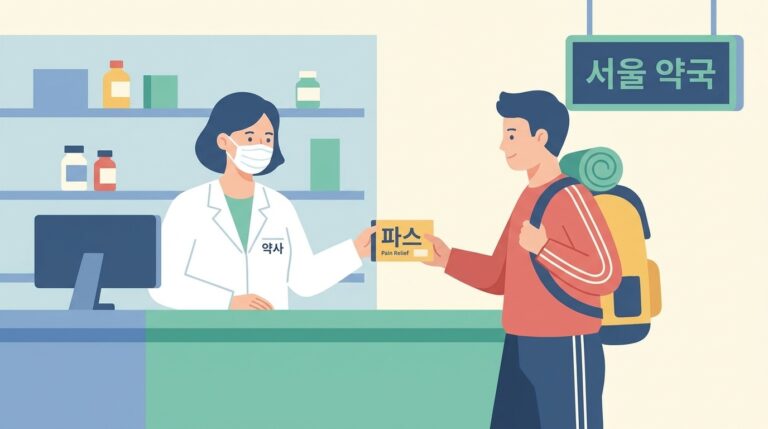
Soothing Post-Workout Soreness in Korea: How to Master ‘Paseu’ and Pharmacy Talk
Phase 1: Empathy & Cultural Hook
안녕하세요! This is your Daily Hangul editor and Korean culture navigator!
Have you ever climbed Bukhansan on a crisp autumn morning or joined a high-intensity K-pop dance workshop in Hongdae, only to wake up the next day feeling like your entire body was hit by a truck? You try to roll out of bed, let out a dramatic “Aigo!”, and realize your legs refuse to cooperate. In Korea, this muscle soreness is a badge of honor for gym lovers, but it also means one vital mission: getting your hands on a 파스 (Paseu – pain relief patch).
Walking into a local Korean pharmacy (약국) when you’re in pain can feel overwhelming if you don’t know whether you need a cooling patch, a warming patch, or how to explain that your calves are knotted. Don’t worry! Based on real experiences from our learners in Seoul, this guide will give you the exact conversational tools to talk about muscle aches like a native, survive leg day, and navigate Korean pharmacies with total confidence.
Phase 2: 3 Core Expressions In-Depth
1. 근육통이 심해서 파스 좀 붙여야겠어요.
- Pronunciation: Geun-yuk-tong-i sim-hae-seo pa-seu jom bu-chyeo-ya-get-seo-yo. (Sounds like: Goon-yook-tong-ee seem-hae-saw pah-soo jom boo-chaw-yah-get-saw-yo)
- Meaning: Literal: “Because muscle pain is severe, I must stick a patch.” ➔ Nuance: “My muscles are aching so badly, I really need to put on a pain patch.”
- K-Culture Moment: Seen in countless slice-of-life K-Dramas where a character overworks at a part-time job or finishes sports day, slumping on the sofa asking for a patch.
- Editor’s Insight: 근육통 (muscle soreness) is the formal term, while 파스 붙이다 (to apply/stick a patch) is the go-to action verb.
- Situation Spectrum: Casual ✅ | Semi-formal ✅ | Formal ⚠️
- 🤔 Think About It: In English, we usually say “take painkillers” or “use a heating pad,” whereas Koreans immediately reach for a topical transdermal patch (파스). Why do you think targeted topical relief is so iconic in Korea?
2. 종아리에 알이 배겨서 걷기 힘들어요.
- Pronunciation: Jong-a-ri-e al-i bae-gyeo-seo geot-gi him-deul-eo-yo. (Sounds like: Jong-ah-ree-eh ahl-ee beh-gyaw-saw gut-gee heem-deul-aw-yo)
- Meaning: Literal: “An egg has nested in my calves, so walking is difficult.” ➔ Nuance: “My calves are so tight and sore that it hurts to walk.”
- K-Culture Moment: Variety shows like Running Man where cast members grab their calves after a sprint mission complaining about 알 (eggs/knots) in their legs.
- Editor’s Insight: 알이 배기다 is a vivid idiomatic expression. The “egg” (알) represents the tight, swollen muscle knot that forms after unaccustomed exercise.
- Situation Spectrum: Casual ✅ | Semi-formal ✅ | Formal 🚫
- 🤔 Think About It: Does your native language compare sore muscle knots to food or objects like an “egg”?
3. 시원한 쿨파스랑 따뜻한 핫파스 중에 뭐가 좋아요?
- Pronunciation: Si-won-han kul-pa-seu-rang tta-tteut-han hat-pa-seu jung-e mwo-ga jo-a-yo?
- Meaning: Literal: “Between a cool patch and hot patch, which is good?” ➔ Nuance: “Which one is better for this: a cooling patch or a warming patch?”
- K-Culture Moment: At a pharmacy counter when you describe an acute sports injury vs. chronic stiffness to a friendly local pharmacist.
- Editor’s Insight: 쿨파스 (Cool Paseu) is for acute swelling, sprains, and fresh inflammation (first 24-48 hours), while 핫파스 (Hot Paseu) promotes blood circulation for chronic stiffness and dull aches.
- Situation Spectrum: Casual ✅ | Semi-formal ✅ | Formal ✅
- 🤔 Think About It: How does clarifying product types proactively empower your self-care routine abroad?
Phase 3: Textbook Korean vs. Real-World Korean
Situation 1: Describing full-body post-workout aches
- 📖 Textbook Korean: “운동을 해서 근육이 매우 아픕니다.” (Because I exercised, my muscles hurt very much.)
- 🗣️ Real-World Korean: “어제 하체 운동했더니 온몸이 쑤셔요!” (I did leg day yesterday and my whole body aches throbbingly!)
- 💡 Why the difference? Textbooks use rigid, descriptive adjectives, but native speakers use dynamic verbs like 쑤시다 (to ache/throb) and modern fitness slang like 하체 운동 (lower-body workout / leg day).
Situation 2: Asking a roommate or friend to stick a patch on your back
- 📖 Textbook Korean: “제 등에 파스를 부착해 주시겠습니까?” (Would you please adhere a patch onto my back?)
- 🗣️ Real-World Korean: “등에 손이 안 닿는데, 파스 한 장만 붙여줄래?” (I can’t reach my back, could you stick a patch on for me?)
- 💡 Why the difference? Asking for help with a patch is a warm, everyday interaction. Native speakers naturally mention the physical limitation (손이 안 닿다 – hands can’t reach) before asking.
Phase 4: K-Culture Deep Dive & Non-Verbal Manners
4-1. 눈치 (Nunchi) & Body Gestures at the Pharmacy
When entering a Korean pharmacy (약국), you don’t just speak—body language speaks volumes:
* Point and Pat: Gently touch or pat the sore spot (e.g., your shoulder, lower back, or calf) while saying where it hurts. It helps the pharmacist instantly assess the required patch size (large sheet, joint-type, or mini coin-patch).
* Two-Handed Etiquette: When receiving your medication and handing over your payment card, use both hands or support your right elbow with your left hand. This shows mutual respect.
4-2. The Cultural Phenomenon: Korea’s “Paseu” & Fitness Culture
In Korea, fitness is trending like never before with hashtags like #오운완 (Today’s Workout Complete) dominating social media. Along with gym culture, 파스 is considered an absolute household essential. You will smell that refreshing menthol herbal scent in locker rooms, university dorms, and saunas (찜질방). Furthermore, Koreans view asking someone to apply a 파스 on their back as an act of casual affection and solidarity.
Phase 5: Real-World Roleplay Scenario
Setting: A neighborhood pharmacy near Gangnam Station after a grueling gym session.
Characters: Pharmacist (약사님) & You (User).
- You: 안녕하세요, 약사님! 어제 무리해서 운동을 했더니 온몸이 쑤셔요.
(An-nyeong-ha-se-yo, yak-sa-nim! Eo-je mu-ri-hae-seo un-dong-eul haet-deo-ni on-mom-i ssu-syeo-yo.)
“Hello, pharmacist! I overdid my workout yesterday and my whole body is aching.”🎭 Massaging your own shoulder with a tired smile -
Pharmacist: 아이고, 어디가 제일 불편하세요? 관절 쪽이에요, 아니면 근육이에요?
(A-i-go, eo-di-ga je-il bul-pyeon-ha-se-yo? Gwan-jeol jjog-i-e-yo, a-ni-myeon geun-yug-i-e-yo?)
“Oh dear, where is it bothering you the most? Around your joints, or muscle soreness?” -
You: 허벅지랑 종아리에 알이 심하게 배겼어요.
(Heo-beok-ji-rang jong-a-ri-e al-i sim-ha-ge bae-gyeot-seo-yo.)
“My thighs and calves have severe muscle knots.”🎭 Pointing down toward your legs -
Pharmacist: 붓기나 열감은 없으시고요?
(But-gi-na yeol-gam-eun eop-seu-si-go-yo?)
“Do you have any swelling or heat in the area?” -
You: 네, 붓지는 않았는데 그냥 뻐근하고 당겨요.
(Ne, but-ji-neun an-at-neun-de geu-nyang ppeo-geun-ha-go dang-gyeo-yo.)
“No, it’s not swollen, it’s just stiff and pulling.” -
Pharmacist: 그러면 뭉친 근육을 풀어주는 핫파스가 좋겠네요. 피부가 예민하신 편인가요?
(Geu-reo-myeon mung-chin geun-yug-eul pul-eo-ju-neun hat-pa-seu-ga jok-get-nae-yo. Pi-bu-ga ye-min-ha-sin pyeon-in-ga-yo?)
“Then a warming patch that relaxes tight muscles will be good. Do you have sensitive skin?” -
You: 아니요, 괜찮아요. 잘 안 떨어지는 걸로 주세요!
(A-ni-yo, gwaen-chan-a-yo. Jal an tteol-eo-ji-neun geol-ro ju-se-yo!)
“No, it’s fine. Please give me one that doesn’t fall off easily!”🎭 Nodding reassuringly -
Pharmacist: 네, 신축성 좋은 파스 여기 있습니다. 하루에 한 번만 붙이세요.
(Ne, sin-chuk-seong jo-eun pa-seu yeo-gi it-seum-ni-da. Ha-ru-e han beon-man bu-chi-se-yo.)
“Here is an elastic patch. Apply it just once a day.”
🔀 Interactive Decision Branching
What if the pharmacist asks: “먹는 근육이완제도 같이 드릴까요?” (Shall I give you muscle relaxant pills to take as well?)
- Option A: “네, 파스만으로 부족할 것 같으니 같이 주세요.” (Yes, patches alone might not be enough, so please give me pills too.)
👉 Verdict: [BEST] You get both rapid topical relief and internal muscle relaxation for faster recovery. - Option B: “아니요, 약은 무서우니까 그냥 아무거나 주세요.” (No, medicine is scary so just give me whatever.)
👉 Verdict: [BAD] Ambiguous and overly dramatic; the pharmacist will be confused by “whatever.” - Option C: “그거 먹으면 바로 운동할 수 있어요?” (If I take that, can I work out immediately?)
👉 Verdict: [RISK] Muscle relaxants cause drowsiness; working out right after may lead to injury.
Phase 6: 10-Second Emotion Shadowing Drill
Read aloud focusing on natural rhythm stops (/) and emotional tone:
[😫 끙끙 앓으며 / Groaning in pain]
아이고… / 어제 스쿼트를 너무 많이 했더니 / 다리에 알이 제대로 배겼네.
(Aigo… / eo-je seu-kwa-teu-reul neo-mu man-i haet-deo-ni / da-ri-e al-i je-dae-ro bae-gyeon-ne.)
“Ouch… / Did way too many squats yesterday / my legs are totally knotted up.”-
[🥺 간절하고 뻐근하게 / Needy & Stiff]
저기 미안한데… / 등에 손이 안 닿아서 그런데 / 파스 한 장만 붙여줄 수 있어?
(Jeo-gi mi-an-han-de… / deung-e son-i an da-a-seo geu-reon-de / pa-seu han jang-man bu-chyeo-jul su it-seo?)
“Excuse me, sorry to bother you… / but I can’t reach my back / could you stick a patch on for me?” -
[💡 명쾌하고 확신에 차서 / Bright & Inquiring]
약사님! / 삐끗한 데에는 / 쿨파스를 붙이는 게 맞죠?
(Yak-sa-nim! / ppi-kkeut-han de-e-neun / kul-pa-seu-reul bu-chi-neun ge mat-jyo?)
“Pharmacist! / For a fresh sprain / it’s right to put on a cool patch, right?”
Phase 7: K-Culture Mini Dictionary
- 파스 (Paseu): Transdermal analgesic patch (derived from the German word Paster). An indispensable household staple in Korea for sprains, stiff necks, and soreness.
- 알이 배기다 (Al-i baegida): The sensation of severe lactic acid build-up / knotting in muscles after strenuous physical activity.
- 뻐근하다 (Ppeogeunhada): To feel stiff or heavy in muscles and joints (frequently used for stiff necks and shoulders after desk work or lifting weights).
- 오운완 (O-un-wan): Popular abbreviation for “오늘 운동 완료” (Today’s Workout Complete), ubiquitous across Korean fitness social media.
Phase 8: Survival Kit for Travelers
Survival Expressions TOP 3
- “붙이는 파스 있어요?” (Do you have adhesive pain patches?)
Pro Tip: Specify 붙이는 파스 (adhesive patch) vs 바르는 파스 (liquid roll-on gel) or 뿌리는 파스 (aerosol spray). - “동전 파스 주세요.” (Please give me coin-sized patches.)
Pro Tip: Coin patches (동전파스) are tiny circular patches ideal for pinpoint aches on wrists or finger joints. - “피부에 자극이 덜한 걸로 주세요.” (Please give me one that is less irritating to the skin.)
Pro Tip: Crucial if you have sensitive skin that gets red from strong adhesives.
Editor’s Travel Note
- Where to buy: Pharmacies (약국) offer the strongest medicinal patches. If it’s late at night and pharmacies are closed, head to convenience stores (CU, GS25, 7-Eleven) which carry designated “Safety Emergency Medicines” (안전상비의약품).
- Digital Tool: Use the official Holiday Emergency Pharmacy Search on Naver Map typing “휴일지킴이약국” or “24시 약국” to locate late-night open pharmacies near you.
Phase 9: Step Deeper (Reflection Essay)
In Korean culture, pain relief is rarely an isolated, solitary experience. Asking a friend, partner, or family member to stick a 파스 on your back or shoulder blade is an intimate cultural gesture of mutual care (정 – Jeong). It represents letting down your guard, acknowledging physical vulnerability, and trusting someone else to patch you up. When someone sticks a patch on your back and pats it firmly with both hands, saying “다 됐다, 힘내!” (All done, hang in there!), the soothing effect is both medicinal and emotional.
💬 Your Turn: Have you ever experienced muscle soreness during your travels or workouts? How do people in your home country usually soothe body aches? Share your stories in the comments below!
Phase 10: FAQ & Common Mistakes
Q: What is the medical difference between 쿨파스 (Cool) and 핫파스 (Hot)?
A: 쿨파스 (Cool) contains menthol and camphor to cool down tissue, constrict blood vessels, and reduce swelling for acute sprains and fresh sports injuries. 핫파스 (Hot) contains capsaicin or warming agents to dilate blood vessels, improve blood flow, and relieve chronic muscle stiffness.
Q: Can I buy Paseu at convenience stores in Korea?
A: Yes! Convenience stores carry standard basic pain patches (such as Shinshin Pas) in their emergency medicine section. However, specialized sizes, roll-ons, and muscle relaxant tablets are only sold at pharmacies (약국).
Q: How long should I leave a Korean patch on?
A: Most modern patches are designed for 8 to 12 hours. Leaving a patch on for longer than 24 hours can irritate your skin and cause contact dermatitis.
🚨 Common Mistakes Alert
- ❌ Mistake 1: Putting a Hot Patch on a freshly swollen ankle.
Correct Action: Always use a Cool Patch (쿨파스) or ice for fresh sprains to prevent worsening the inflammation. - ❌ Mistake 2: Ripping the patch off dry skin at lightning speed.
Correct Action: Wet the patch slightly with lukewarm water in the shower before peeling it off gently to avoid skin tears. - ❌ Mistake 3: Sticking a patch immediately after taking a hot shower.
Correct Action: Pores are open after hot showers; applying a strong patch immediately can cause intense burning sensations. Wait 30 minutes.
Phase 11: Action Missions
- 🥉 Bronze Mission (Self Practice): Stand in front of a mirror, gently massage your shoulder, and say aloud: “어제 운동했더니 온몸이 쑤셔요!” three times.
- 🥈 Silver Mission (Social/Study): Share this guide with your gym buddy or Korean study partner and roleplay asking for a patch on your back.
- 🥇 Gold Mission (Real Life): Visit a Korean pharmacy or convenience store and successfully purchase a box of 파스 using only Korean.
- 🎮 K-Culture Mission: Watch an episode of a Korean sports or physical variety show (like Physical: 100 or A Clean Sweep) and spot when contestants use spray or patch Paseu.
Phase 12: Interactive Quiz Challenge
Q1. You twisted your ankle 1 hour ago during a basketball game and it is warm and swollen. Which phrase should you say at the pharmacy?
(A) 따뜻한 핫파스 주세요.
(B) 붓기를 가라앉히는 시원한 쿨파스 주세요.
(C) 파스는 필요 없고 커피 주세요.
👉 Click to reveal Answer & Explanation
Correct Answer: (B)
Explanation: For acute injuries with heat and swelling, you must use a cooling patch (쿨파스) to constrict blood vessels and calm inflammation. Hot patches (핫파스) are for chronic stiffness.
Q2. Fill in the blank:
“등에 손이 안 ( ), 파스 좀 붙여줄래?” (I can’t reach my back, could you stick a patch on for me?)
(A) 닿아서
(B) 닿는데
(C) 닿지 않아서 / 닿는데
👉 Click to reveal Answer & Explanation
Correct Answer: (C) / 닿지 않아서 or 닿는데
Explanation: 손이 안 닿다 means “hands do not reach.” In conversation, 손이 안 닿아서 (because my hands don’t reach) or 손이 안 닿는데 (my hands don’t reach, but…) connects the phrase naturally.
Q3. True or False: In Korean slang, saying “종아리에 알이 배겼어요” literally means an actual bird laid an egg in your leg.
(A) True
(B) False
👉 Click to reveal Answer & Explanation
Correct Answer: (B) False
Explanation: It is an idiomatic metaphor where 알 (egg) describes the tight, rounded knot of muscle soreness in your calves.







