

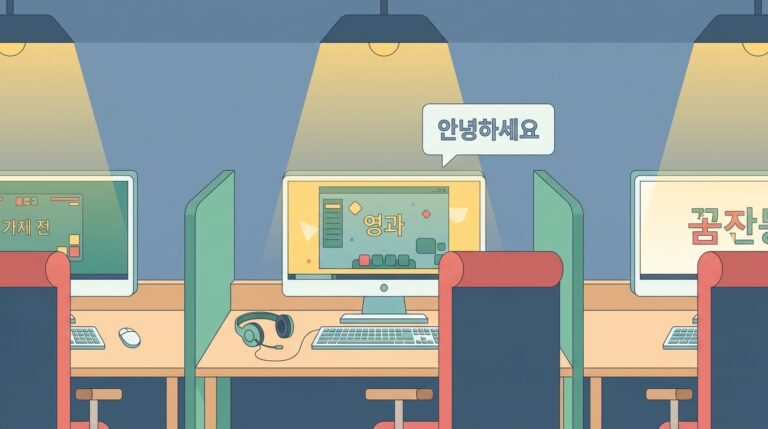
Phase 1: Empathy (Welcome to the K-PC Bang World!)
안녕하세요! 매일한글 에디터입니다. (Hello! I’m your Daily Hangul editor.)
Picture this: You just landed in Seoul, dropped off your luggage, and rushed straight to a famous K-PC Bang in Hongdae to experience high-speed gaming and legendary PC bang snacks like ramyeon and tteokbokki. The neon lights glow, the curved monitors stretch endlessly, and mechanical keyboards click in rhythm. You finally spot an empty gaming seat with the perfect high-end headset. But as you step closer, your heart sinks: the previous gamer left behind an empty iced tea cup, crumpled snack wrappers, and greasy keyboard marks.
You see a busy staff member walking by with a tray of food, but your mind goes blank. Should you wait? Should you throw the trash away yourself? How do you ask them nicely to clean it without sounding rude or awkward? Many of our A1 beginner learners tell us that interacting with busy service staff in Korea is their biggest fear. But don’t worry! With just one simple, magic phrase—“여기 자리 좀 치워주세요”—you will navigate Korean PC Bangs like a seasoned local pro. This guide is crafted directly from real student experiences and local etiquette norms to give you total confidence!
Phase 2: Top 3 Essential Expressions for PC Bang
1. 여기 자리 좀 치워주세요 (Yeogi jari jom chiwojuseyo)
- Pronunciation: yuh-gi jah-ri johm chee-woh-joo-seh-yo (Think “yummy” without ‘m’, “jaw-ree”, “chome”, “chew-war-joo-seh-yo”)
- Meaning: Direct: “Here seat a little clean please.” / Natural: “Could you please clean this seat for me?”
- K-Culture Moment: You often see this in K-dramas when a character enters a crowded restaurant or internet cafe and politely flags down the part-time worker (알바생).
- Editor’s Insight: The tiny word 좀 (jom) literally means “a little,” but in Korean requests, it acts as a magical softener. Leaving it out sounds like a strict command; adding it turns your sentence into a polite, warm request.
- Situation Spectrum: Casual 🚫 | Semi-formal ✅ | Formal ✅
- 🤔 Think About It: Why do Koreans use words meaning “a little” (좀) even when they want a full task done? Reflect on how indirectness shows politeness in Korean culture.
2. 몇 번 자리예요? (Myeot beon jarieyo?)
- Pronunciation: myut bun jah-ree-eh-yo
- Meaning: Direct: “Which number seat is it?” / Natural: “Which seat number are you at?”
- K-Culture Moment: The standard question every PC bang clerk asks when you approach the counter or summon them for assistance.
- Editor’s Insight: PC Bangs operate on seat numbers (e.g., 42번). You don’t need to point across the room; simply check the illuminated sticker on your monitor and say the number + 번 (beon).
- Situation Spectrum: Casual ⚠️ | Semi-formal ✅ | Formal ✅
- 🤔 Think About It: In your hometown, do internet cafes identify users by name or numbered terminals? Notice how Korean PC bangs prioritize numeric terminal efficiency.
3. 저기요, 결제 도와주세요 (Jeogiyo, gyeolje dowajuseyo)
- Pronunciation: juh-gee-yoh, gyuhl-jeh doh-wah-joo-seh-yo
- Meaning: Direct: “Excuse me over there, payment help please.” / Natural: “Excuse me, could you help me with payment?”
- K-Culture Moment: Seen in webtoons and vlogs where first-time visitors struggle with the automated kiosk (키오스크) screen interface.
- Editor’s Insight: 저기요 (Jeogiyo) is the universal Korean call-out for service staff in cafes, diners, and PC rooms. It is completely polite and expected.
- Situation Spectrum: Casual ⚠️ | Semi-formal ✅ | Formal ✅
- 🤔 Think About It: Calling out “Excuse me!” loudly to waitstaff can feel awkward in some Western cultures. How does Korean restaurant culture view vocal call-outs differently?
Phase 3: Textbook Korean vs. Real Native Korean
Situation 1: Calling the Staff
- 📖 교과서 한국어 (Textbook): 실례합니다, 이 좌석을 청소해 주시겠습니까? (Excuse me, would you please clean this seat? – Extremely stiff and robotic)
- 🗣️ 진짜 한국어 (Real Native): 저기요, 여기 자리 좀 치워주세요! (Excuse me, could you clean this seat please?)
- 💡 Why is it different?: In real daily life, native speakers use casual-polite endings (-요) and words like 자리 (seat) instead of Sino-Korean formal terms like 좌석.
Situation 2: Telling your seat number
- 📖 교과서 한국어 (Textbook): 저의 좌석 번호는 25번입니다. (My seat number is number 25.)
- 🗣️ 진짜 한국어 (Real Native): 25번 자리요! (Seat 25, please!)
- 💡 Why is it different?: Korean culture values speed (빨리빨리). Dropping unnecessary subjects like “저의” (my) and using short sentence fragments with “-요” is natural and polite.
Phase 4: K-Culture Deep Dive & Non-Verbal Manners
4-1. 눈치 (Nunchi) & Gestures
When calling a staff member in a loud PC Bang with game audio playing, verbal calls might be missed. Lightly raise one hand at shoulder height (palm facing down or slightly outward—never snap your fingers or wave aggressively) and make brief eye contact before saying “저기요!” (Jeogiyo). When they approach your seat with a cleaning spray and cloth, step slightly aside into the aisle to give them physical space to wipe the desk and mousepad.
4-2. K-Food Culture Inside the PC Bang
PC Bangs in Korea have evolved into full-fledged gourmet kitchens! Modern seats feature built-in ordering software on your screen. You can order hot tteokbokki, crispy spam mayo rice bowls, and iced Americano directly to your desk while playing. Keeping your desk clean ensures staff can quickly place your food tray when your order arrives.
Phase 5: Real-Life Roleplay Scenario
Setting: A vibrant, neon-lit PC Bang in Gangnam on a Friday evening. You found an awesome curved monitor at Seat 18, but a leftover noodle cup sits on the desk. You head to the main counter to speak with Min-woo (민우), a friendly university student working the night shift.
- You: 저기요! (Jeogiyo!) – 🎭 (Raise one hand politely at shoulder level) – “Excuse me!”
- Min-woo: 네! 무슨 일이세요? (Ne! Musedun iriseyo?) – 🎭 (Looks up with a warm smile) – “Yes! How can I help you?”
- You: 여기 자리 좀 치워주세요. (Yeogi jari jom chiwojuseyo.) – 🎭 (Politely points towards the row) – “Could you please clean a seat for me?”
- Min-woo: 아, 네! 몇 번 자리예요? (Ah, ne! Myeot beon jarieyo?) – 🎭 (Picks up a sanitizing spray bottle and microfiber cloth) – “Ah, yes! Which seat number is it?”
- You: 18번 자리요. (Sip-pal-beon jariyo.) – 🎭 (Speaks clearly and nods) – “Seat number 18.”
- Min-woo: 네, 지금 바로 치워드릴게요! (Ne, jigeum baro chiwodeurilgeyo!) – 🎭 (Walks over to seat 18 briskly) – “Okay, I’ll clean it up for you right away!”
- You: 감사합니다! (Gamsahamnida!) – 🎭 (Steps aside with a light 15-degree bow) – “Thank you!”
- Min-woo: 다 됐습니다. 편하게 이용하세요! (Da dwaessumnida. Pyeonhage iyonghaseyo!) – 🎭 (Wipes down the desk and bows back) – “All done. Enjoy your time!”
🔀 Interactive Branching Choice
What will you say after Min-woo finishes cleaning your seat?
- Option A: “감사합니다! 맛있게 드세요!” (Thank you! Bon appetit!)
- Feedback (Risk): “맛있게 드세요” is only said before eating food! Saying it to someone cleaning a desk creates a funny, awkward moment.
- Option B: “야! 치워.” (Hey! Clean.)
- Feedback (Bad): Extremely rude banmal (informal speech)! Never use this with service staff.
- Option C: “감사합니다! 수고하세요!” (Thank you! Keep up the great work!)
- Feedback (Best): Perfect native etiquette! “수고하세요” acknowledges the worker’s effort warmly.
Phase 6: 10-Second Emotion Shadowing Drill
Repeat these sentences with the exact emotional rhythm! / marks a brief micro-pause.
[🙋♂️ Polite & Clear]저기요! / 여기 자리 좀 / 치워주세요. (Jeogiyo! / yeogi jari jom / chiwojuseyo.)[🔢 Confident & Precise]18번 / 자리예요. (Sip-pal-beon / jarieyo.)[😊 Grateful & Cheerful]감사합니다! / 수고하세요! (Gamsahamnida! / sugohaseyo!)
Phase 7: K-Culture Mini Dictionary
- 알바생 (Alba-saeng) | Part-time worker | Refers to student or hourly workers at cafes, PC rooms, and convenience stores.
- 키오스크 (Ki-o-seu-keu) | Self-service Kiosk | The automated touchscreen terminal where you buy PC Bang game hours and log in.
- 자리 (Jari) | Seat / Spot | Used everywhere in daily life: on the subway, at restaurants, or at PC desks.
- 수고하세요 (Sugo-haseyo) | Keep up the good work / Goodbye | The gold-standard farewell phrase when leaving a store or thanking service staff.
Phase 8: Traveler Survival Kit
Top 3 Survival Expressions
- 자리 있어요? (Jari isseoyo?) – Is there an open seat? (Pro Tip: Use this when the PC bang looks packed!)
- 키오스크 어디예요? (Ki-o-seu-keu eodiyeyo?) – Where is the kiosk? (Pro Tip: Essential for buying prepaid hours.)
- 화장실 어디예요? (Hwajangsil eodiyeyo?) – Where is the restroom? (Pro Tip: The PC room receipt often has the bathroom passcode printed on the bottom.)
Editor’s Travel Note
Before visiting local spots in Seoul, make sure to read our guide on [Naver Map app download and navigation tips] to find top-rated PC bangs with English kiosk support. Most Korean PC bangs require credit cards with IC chips or local T-money cards at the kiosk.
Phase 9: Think Deeper (한 발 더 깊이)
In Korean service culture, politeness is built into linguistic rhythm rather than lengthy apologies. Using small linguistic softeners like “좀” (jom) and sentence-ending honorifics like “-주세요” (juseyo) bridges the gap between quick efficiency and deep respect. Korean PC bangs are community gaming hubs where respect for shared public spaces creates a seamless experience for everyone.
💬 Your Turn: Have you ever visited an internet cafe in Korea or your own country? What is the first K-snack you want to order to your PC desk? Drop your thoughts in the comments below!
Phase 10: FAQ & Common Mistakes
Q: Can I clean the PC bang desk myself with wet wipes?
A: You can, but it is standard for staff to sanitize the desk properly with commercial cleaner and empty the trash bin. Asking them politely is completely normal and expected!
Q: How do I say my seat number if it’s over 100?
A: Use Sino-Korean numbers: 100 is 백 (baek). So seat 105 is “백오 번 자리요” (baek-o-beon jariyo).
Q: Can I call the staff directly through the computer screen?
A: Yes! Most Korean PC bang computer interfaces have a “Call Staff” (카운터 문의 / 호출) button on top of the screen where you can select “자리 정돈 요청” (Request desk cleanup).
🚨 Common Mistakes Warning Board
- Mistake: Snapping fingers and saying “이봐요” (Hey you).
- Correct Action: Raise hand softly and say “저기요” (Jeogiyo).
- Mistake: Forgetting the softener “좀” (“자리 치워요”).
- Correct Action: Always say “자리 좀 치워주세요”.
- Mistake: Throwing leftover food into the general desk bin.
- Correct Action: Leave food trays on the desk or carry them to the designated Return Tray (식기 반납대).
Phase 11: Action Mission Challenge
- 🥉 Bronze Mission (Solo Practice): Stand in front of your mirror and practice saying “저기요, 여기 자리 좀 치워주세요” 5 times with a hand gesture.
- 🥈 Silver Mission (Social Share): Share this phrase on your Instagram Story or X and tag a gaming buddy you want to visit a Korean PC room with!
- 🥇 Gold Mission (Real-Life Mastery): Visit a Korean PC bang or restaurant and successfully use “저기요” and “수고하세요” during your visit.
🎮 K-Culture Mission: Watch an episode of a modern K-drama (like Start-Up or Itaewon Class) and spot how characters address restaurant or PC bang staff using “저기요!”
Phase 12: Interactive Quiz Challenge
Question 1 (Situational): You find a messy desk at seat 34. What is the most natural sentence to say at the counter?
* A) 여기 빨리 청소해라.
* B) 저기요, 34번 자리 좀 치워주세요.
* C) 실례지만 34번 좌석 청소를 진행해 주시겠습니까?
Question 2 (Fill in the Blank): Fill in the politeness softener: “여기 자리 ( ) 치워주세요.”
Question 3 (True/False): Saying “수고하세요” to the worker when they finish cleaning is polite and natural. (True / False)
👉 Click here to check the Answers & Explanations!
- Q1 Answer: B (Natural, polite, and includes the softener ‘좀’ and seat number).
- Q2 Answer: 좀 (jom) (The magic word that makes any Korean request polite and friendly).
- Q3 Answer: True (“수고하세요” is the ultimate polite sign-off for hardworking staff!)







