

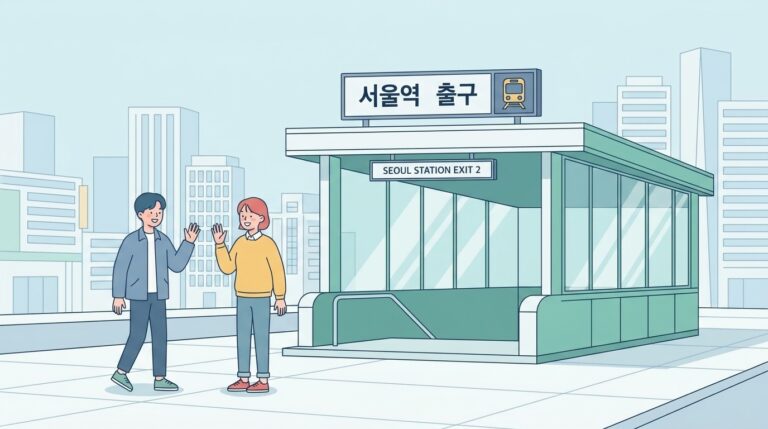
Phase 1: Empathy (Story-Driven Opening)
안녕하세요! This is your Daily Hangul editor and your personal Korean culture navigator! Imagine this: You just landed in Seoul, you made a wonderful new Korean friend or arranged to meet your favorite language exchange buddy, and your phone buzzes with a KakaoTalk notification. You open it, and your heart races when you see a question about meeting up. You want to ask where to meet, but your mind freezes. Should you suggest a specific subway exit? A famous cafe? What if you say something too formal or use a translation app that makes you sound like a robot from the 1990s Joseon dynasty?
If you have ever felt nervous about making plans in Korean, take a deep breath—you are not alone. In our Daily Hangul tutoring sessions, over 80% of A1 beginners tell us that figuring out where and how to set up a meetup is their single biggest anxiety trigger when traveling in Korea. The great news? You only need a few simple, natural phrases to sound confident, polite, and completely at home in any Seoul neighborhood. This practical guide is crafted directly from real learner feedback to help you master meeting up like a true local!
Phase 2: Top 3 Core Expressions Deep Dive
1. 어디서 볼까요? (Eodiseo bolkkayo?)
- Pronunciation: [Eo-di-seo bol-kka-yo?] (Think of ‘eo’ like the ‘u’ in ‘umbrella’, and ‘bol-kka-yo’ like ‘ball-kah-yo’)
- Meaning: Literal: “Where shall we see each other?” | Natural: “Where should we meet?”
- K-Culture Moment: You hear this in almost every K-Drama when two leads finish a phone call and decide to meet for late-night tteokbokki.
- Editor’s Insight: Koreans frequently use the verb 보다 (boda, to see) instead of 만나다 (mannada, to meet) when making plans with friends. It sounds warmer and much more conversational!
- Situation Spectrum: Casual: ⚠️ (Use ‘어디서 볼까?’ without -yo) | Semi-formal: ✅ | Formal: ✅
- 🤔 Think About It: Why do you think Korean uses the word “see” (보다) to imply meeting someone in person? How does your native language express the same warmth?
2. 홍대입구역 9번 출구에서 만나요 (Hongdae-ipguyeok gubon chulgu-eseo mannayo)
- Pronunciation: [Hong-dae-ip-gu-yeok gu-beon chul-gu-e-seo man-na-yo]
- Meaning: Literal: “Let’s meet at Hongik University Station Exit 9.” | Natural: “Let’s meet at Hongdae Station Exit 9.”
- K-Culture Moment: Hongdae Exit 9 is the legendary, bustling meeting spot in Seoul known to everyone who loves youth culture, street food, and indie busking.
- Editor’s Insight: In Korea, subway station exit numbers (출구 – chulgu) are the ultimate coordinates for meeting anyone. Always specify the exit number!
- Situation Spectrum: Casual: ⚠️ (Drop -yo) | Semi-formal: ✅ | Formal: ✅
- 🤔 Think About It: In your hometown, do people meet at station exits or street intersections? Why are numbered exits so convenient in Seoul?
3. 카페 앞에서 봐요 (Kape ap-eseo bwayo)
- Pronunciation: [Ka-pe ap-e-seo bwa-yo] (Sounds like ‘Kah-peh ah-peh-suh bwah-yo’)
- Meaning: Literal: “See you in front of the cafe.” | Natural: “Let’s meet outside the cafe.”
- K-Culture Moment: The classic line used before heading into a cozy themed cafe in Seongsu-dong or Yeonnam-dong.
- Editor’s Insight: The word 앞 (ap, front) + 에서 (eseo, at/in) is a magical formula. You can replace 카페 (kape) with any place: 역 앞 (yeok ap, front of the station) or 편의점 앞 (pyeon-ui-jeom ap, front of the convenience store)!
- Situation Spectrum: Casual: ⚠️ (Use ‘앞에서 봐’) | Semi-formal: ✅ | Formal: ✅
- 🤔 Think About It: Notice how Korean places the location before the preposition ‘in front of’ (Cafe + Front + at). How does this word order change your perspective?
Phase 3: Textbook Korean vs. Real Korean
Situation 1: Asking where to meet
- 📖 교과서 한국어 (Textbook): 우리 어디에서 만납니까? (Uri eodieseo mannamnikka? – Where do we meet?)
- 🗣️ 진짜 한국어 (Real-life): 우리 어디서 볼까요? (Uri eodiseo bolkkayo? – Where shall we meet?)
- 💡 왜 다를까? (Why the difference?): The textbook version uses ultra-formal business verb endings (-ㅂ니까) which sound like a military briefing. Real Koreans soften the tone with -ㄹ까요? (shall we?) and use 어디서 instead of 어디에서 for a smooth rhythm.
Situation 2: Confirming a spot near a landmark
- 📖 교과서 한국어 (Textbook): 저는 스타벅스 건물 앞쪽에 위치하고 있겠습니다. (I will be positioned in front of the Starbucks building.)
- 🗣️ 진짜 한국어 (Real-life): 스타벅스 앞에서 봐요! (Let’s meet in front of Starbucks!)
- 💡 왜 다를까? (Why the difference?): Natural Korean conversation thrives on brevity and clear relational words like 앞 (ap, front) rather than rigid spatial descriptions.
Phase 4: K-Culture Deep Dive & Non-Verbal Manners
4-1. 눈치 (Nunchi) & Gestures
When meeting up in crowded Korean hotspots like Gangnam or Hongdae, eye contact and subtle body language are key. If you arrive first and spot your friend, a slight head nod accompanied by a small two-handed wave shows both enthusiasm and respect. Holding your phone in one hand while waving gently with the other signals: “I see you! Let’s connect!”
4-2. The Culture of the “Station Exit Rendezvous”
Korea’s public transit is among the world’s most sophisticated. Because mega-stations can have upwards of 14 exits spanning several city blocks, never just say “Meet me at Gangnam Station.” Locals always specify: Station Name + Exit Number (e.g., 강남역 11번 출구). If the weather is freezing or rainy, a courteous follow-up is: “안에서 기다릴게요” (I will wait inside the exit). This small act of consideration shows great Nunchi!
Phase 5: Real-Life Roleplay Scenario
Setting: It’s Friday evening in the vibrant alleys of Yeonnam-dong. You are meeting Min-ji (민지), a friendly local college student, for coffee and street snacks.
- Turn 1 (Min-ji): 오늘 날씨 진짜 좋네요! 우리 어디서 볼까요? (The weather is so nice today! Where shall we meet?)
🎭 Smiling warmly over KakaoTalk text - Turn 2 (You): 홍대입구역 3번 출구 어때요? (How about Hongdae Station Exit 3?)
🎭 Typing enthusiastically - Turn 3 (Min-ji): 좋아요! 3번 출구 쪽 연트럴파크 알아요? (Sounds good! Do you know Yeontral Park near Exit 3?)
🎭 Sending a cheerful animated sticker - Turn 4 (You): 네, 알아요! 공원 입구 카페 앞에서 봐요. (Yes, I know it! Let’s meet in front of the cafe at the park entrance.)
🎭 Nodding with confidence - Turn 5 (Min-ji): 완벽해요! 몇 시에 만날까요? 6시 괜찮아요? (Perfect! What time shall we meet? Is 6 o’clock okay?)
🎭 Checking her watch - Turn 6 (You): 네, 6시에 만나요. 제가 먼저 가면 기다릴게요. (Yes, see you at 6. If I arrive first, I will wait.)
🎭 Sending a thumbs-up emoji - Turn 7 (Min-ji): 네! 조심히 오세요. 곧 봐요! (Okay! Take care on your way. See you soon!)
🎭 Sending a friendly wave emoji - Turn 8 (You): 네, 조금 이따가 봐요! (Yes, see you in a little bit!)
🎭 Putting phone in pocket and heading out
🔀 Interactive Choice Branch:
Min-ji texts: “지금 출구 앞에 사람 너무 많아요!” (There are so many people in front of the exit right now!) What do you reply?
- Option A: 어디서 만납니까? (Where do we meet?)
- Feedback [Bad]: Too formal and cold; it ignores her immediate problem.
- Option B: 그럼 3번 출구 안쪽 편의점 앞에서 봐요! (Then let’s meet in front of the convenience store inside Exit 3!)
- Feedback [Best]: Proactive, polite, specific, and keeps both of you out of the crowd!
- Option C: 그냥 집으로 가세요. (Just go home then.)
- Feedback [Risk]: A humorous misunderstanding that could accidentally cancel your plan!
Phase 6: 10-Second Emotion Shadowing Drill
Practice reading these out loud with rhythm and authentic emotion!
[😊 Cheerful & Curious]우리 / 어디서 / 볼까요? (U-ri / eo-di-seo / bol-kka-yo?)[🎯 Confident & Clear]홍대입구역 / 3번 출구에서 / 만나요! (Hong-dae-ip-gu-yeok / sam-beon chul-gu-e-seo / man-na-yo!)[☕ Friendly & Relaxed]카페 / 바로 앞에서 / 기다릴게요! (Ka-pe / ba-ro ap-e-seo / gi-da-ril-ge-yo!)
Phase 7: K-Culture Mini Dictionary
- 출구 (Chulgu) | Exit (Subway/Building) | Used with numbers (e.g., 1번 출구 = Exit 1) to pinpoint exact rendezvous locations.
- 역 (Yeok) | Station / Subway Stop | Attached to neighborhood names like 강남역 (Gangnam Station) or 명동역 (Myeongdong Station).
- 앞 (Ap) | In front of / Ahead | Added after nouns (카페 앞, 은행 앞) to establish a clear waiting spot.
- 약속 (Yakgwa / Yaksok) | Plan / Appointment / Promise | Essential for saying “I have plans” (약속 있어요 – yaksok isseoyo).
Phase 8: Survival Kit for Travelers
Top 3 Survival Phrases
- 1. 몇 번 출구예요? (Myeot beon chulgu-yeyo?) — Which exit number is it? (Pro Tip: Use this when you are lost inside complex multi-level underground malls like COEX).
- 2. 저기 도착했어요! (Jeogi dochakaesseoyo!) — I have arrived over there! (Pro Tip: Send this KakaoTalk message with a quick photo of your surroundings).
- 3. 5분만 기다려 주세요 (O-bun-man gidaryeo juseyo) — Please wait just 5 minutes. (Pro Tip: The ultimate polite savior if your subway transfer is slightly delayed).
Editor’s Travel Note
Before heading out, make sure to complete your Naver Map App installation and setup guide. Unlike Google Maps, Naver Map and KakaoMap provide real-time updates on which subway train car puts you closest to your specific exit number!
Phase 9: “One Step Deeper” (Cultural Reflection)
In Korean society, making plans is not merely about exchanging logistical time and place data; it is an exercise in mutual consideration (배려 – baeryeo). When Koreans suggest a meeting spot, they carefully consider which subway line is more convenient for the other person and whether the location has shelter from the weather. The simple question “어디서 볼까요?” opens a gentle space for compromise and connection.
💬 Your Turn: Where is your dream meetup spot in Korea? Would you prefer a trendy cafe in Seongsu-dong, a river park picnic by the Han River, or a bustling street food market in Busan? Share in the comments below!
Phase 10: FAQ & Common Mistakes
Q: What is the difference between 보다 (boda) and 만나다 (mannada) when setting up plans?
A: Both mean to meet in this context, but 보다 literally means “to see.” In everyday speech, “어디서 볼까요?” sounds more casual, warm, and natural than “어디서 만날까요?”, though both are grammatically correct.
Q: Can I just say the name of the cafe or store when suggesting a place?
A: Yes, but always add 앞에서 (ap-eseo – in front of) or 안에서 (an-eseo – inside). Saying “스타벅스 만나요” is understood, but “스타벅스 앞에서 만나요” is natural and grammatically complete.
Q: How do I say exit numbers in Korean?
A: Use Sino-Korean numbers (일, 이, 삼, 사, 오…) before 번 출구 (beon chulgu). For example: 1번 출구 (il-beon chulgu), 2번 출구 (i-beon chulgu), 3번 출구 (sam-beon chulgu).
🚨 Common Mistakes Alert
- Mistake: Saying “어디 만나요?” (Missing particles).
- Correct Action: Always include the location particle: 어디서 (or 어디에서) 만나요?
- Mistake: Using Native Korean numbers for exits (e.g., 하나번 출구).
- Correct Action: Always use Sino-Korean numbers: 1(일)번 출구.
- Mistake: Forgetting to specify inside or outside in cold weather.
- Correct Action: Specify: 출구 안에서 (inside the exit) or 출구 밖에서 (outside the exit).
Phase 11: Action Mission & Engagement
- 🥉 Bronze Mission: Speak “우리 어디서 볼까요?” aloud three times in front of a mirror with a bright smile.
- 🥈 Silver Mission: Write a mock KakaoTalk message in your study notes proposing to meet a friend at your local city’s main station using [Place] + 번 출구에서 만나요.
- 🥇 Gold Mission: Leave a comment below suggesting a meetup spot in Seoul in pure Korean!
- 🎮 K-Culture Mission: Watch an episode of your favorite K-Drama this week and listen for characters saying “어디서 봐?” or “앞에서 기다릴게!”
Phase 12: Interactive Quiz Challenge
Question 1 (Situation): You want to suggest meeting outside Gangnam Station Exit 11 in polite Korean. Which sentence is best?
* A) 강남역 11번 출구에서 만납니다.
* B) 강남역 11번 출구 앞에서 봐요.
* C) 강남역 11번 출구 어디예요?
Question 2 (Fill in the Blank): 우리 내일 [______] 볼까요? (Where shall we meet tomorrow?)
* A) 언제 (when)
* B) 누구 (who)
* C) 어디서 (where)
Question 3 (True/False): In Korea, specifying a subway exit number (출구) is the most standard way to designate a meeting spot.
* A) True
* B) False
👉 Click here to reveal the Quiz Answers & Explanations!
- Q1 Answer: B) 강남역 11번 출구 앞에서 봐요. (Natural, polite, and clearly designates ‘in front of exit 11’.)
- Q2 Answer: C) 어디서 (어디서 means ‘where at’, completing the phrase ‘우리 내일 어디서 볼까요?’).
- Q3 Answer: A) True (Seoul subway stations are huge hubs; naming the exit number avoids getting separated!).







