

Phase 1: Empathy (Narrative Opening)
안녕하세요! 매일한글 에디터입니다.
Picture this: You are at an after-work hoesik (회식) with your Korean colleagues in Euljiro, or perhaps actively participating in a bustling KakaoTalk group chat with your university peers. The banter is flowing effortlessly, and you decide to share a quirky anecdote about your morning routine—right down to the exact brand of digestive supplements you took, the existential dread you felt while tying your shoelaces, and how your neighbor’s cat stared at you. Suddenly, the lively chat grinds to a momentary halt. A polite colleague drops a single sweating emoticon (;;), while your closest peer smirks and quips, “아, 진짜 TMI 대방출이네!” (Ah, pure TMI unleash!).
At a C2 mastery level, you already know standard Korean grammar inside out. However, mastering the high-context, ultra-fast landscape of contemporary Korean internet slang and informal discourse requires a profound understanding of interpersonal boundaries. In Korean digital culture, the line between charming candor and socially exhausting oversharing (TMI 남발) is razor-thin. When used tactfully, calling out TMI or self-deprecatingly framing your own story as TMI creates intimate social bonding. Misjudge the room, however, and you risk sounding dismissive, abrasive, or self-absorbed. This guide draws upon real conversational feedback and high-level linguistic socioculture to help you navigate Korean digital banter like an authentic insider.
Phase 2: 3 Core Expressions In-Depth
1. 안물안궁 (An-mul-an-gung)
- Pronunciation: [An-mu-ran-gung] (Sounds like “Ahn-mool-ahn-goong”—crisp, snappy cadence)
- Meaning: Literal: “Didn’t ask, not curious” (안 물어봤고 안 궁금해) | Real Nuance: “Did I ask?”, “Nobody asked!” A sharp, playful, but potentially biting dismissal of unprompted information.
- K-Culture Moment: Frequently seen in YouTube variety show captions (like Workman or Going SEVENTEEN) when a member starts rambling about an irrelevant personal anecdote during a mission.
- Editor’s Insight: This portmanteau (축약어) became a defining staple of Gen Z and millennial net slang. At C2 level, note the pragmatic risk: using this with someone socially senior or in a semi-formal setting is considered insolent (무례함). Among close friends (찐친), it acts as the ultimate rapid-fire reality check.
- Situation Spectrum: Casual ✅ | Semi-formal ⚠️ | Formal 🚫
- 🤔 Think About It: How does your native language handle unsolicited trivia? Compare the bluntness of “Nobody asked” with the rhythmic, comedic symmetry of four-character Korean portmanteaus (사자성어형 신조어).
2. TMI 방출 (TMI Bang-chul)
- Pronunciation: [TMI bang-chul] (Bang-chul rhymes with “rule” with a soft ‘ch’)
- Meaning: Literal: “Discharging/Releasing TMI” | Real Nuance: “Oversharing mode activated” or “Dropping random, unprompted trivia about myself.”
- K-Culture Moment: K-Pop idols constantly use this during Weverse Live or Bubble chats: “오늘의 TMI 방출: 아침에 양말 짝짝이로 신음” (Today’s TMI release: I wore mismatched socks this morning).
- Editor’s Insight: Notice the semantic shift: in Western internet culture, “TMI” often implies gross or overly intimate sexual/bodily details. In Korea, TMI predominantly means harmless, utterly mundane personal trivia that nobody specifically requested. Using the dynamic noun 방출 (discharge/unleash) gives it a humorous, self-aware flavor.
- Situation Spectrum: Casual ✅ | Semi-formal ✅ | Formal ⚠️
- 🤔 Think About It: Why did Korean culture soften the definition of TMI from “grotesque overshare” to “cute personal micro-trivia”?
3. 투머치토커 (Tu-meo-chi-to-keo)
- Pronunciation: [Too-meo-chi-toh-keo] (Korean phonology of “Too Much Talker”)
- Meaning: Literal: “Too Much Talker” | Real Nuance: A chronic, unstoppable long-winded talker who dominates conversations with endless digressions.
- K-Culture Moment: Born from the iconic pop-culture meme surrounding legendary MLB pitcher Park Chan-ho, who is famous for giving hours-long motivational speeches to unsuspecting junior players and fans.
- Editor’s Insight: It is often used as a gentle, teasing label (별명) rather than a harsh insult. You can use it on yourself (“제가 오늘 완전 투머치토커 모드네요”) to apologize gracefully when you realize your monologue has gone on for too long.
- Situation Spectrum: Casual ✅ | Semi-formal ✅ | Formal 🚫
- 🤔 Think About It: Reflect on how honorific culture makes cutting off a senior speaker difficult in Korea, making a meme like 투머치토커 a safe satirical escape valve.
Phase 3: Textbook Korean vs. Real Korean
Situation 1: Letting a close friend know their story is straying into unnecessary territory
- 📖 교과서 한국어: 그 이야기는 굳이 알 필요가 없을 것 같아요. (I don’t think it is necessary to know that story.)
- 🗣️ 진짜 한국어: 아, 방금 건 좀 뇌절/TMI 아니냐? 안물안궁이거든! (Ah, wasn’t that a bit of an overreach/TMI? Didn’t ask, don’t care!)
- 💡 왜 다를까?: Textbook phrasing sounds cold, clinical, and emotionally detached. Native speakers use witty modern slang like TMI or 안물안궁 with a playful grin to deflate the oversharing without creating genuine social hostility.
Situation 2: Acknowledging your own tendency to over-explain in a group discussion
- 📖 교과서 한국어: 제가 불필요한 사견을 너무 많이 진술했습니다. (I have stated too many unnecessary personal opinions.)
- 🗣️ 진짜 한국어: 죄송해요, 제가 잠깐 투머치토커 빙의해서 사설이 길었네요. (Sorry, I momentarily channeled my inner Too-Much-Talker and got carried away.)
- 💡 왜 다를까?: Rather than treating self-expression as a grave protocol error, Koreans use cultural memes (투머치토커 빙의) to display high social intelligence (눈치) and humility while lightening the atmosphere.
Phase 4: K-Culture Deep Dive & Non-Verbal Manners
4-1. Nunchi (눈치) & Micro-Cues in Digital & In-Person Spaces
When you sense TMI overload in a Korean setting, observe non-verbal signals before speaking:
* The Virtual Pause: If you post a wall of text in a KakaoTalk group and receive only single-vowel acknowledgments like ㅇㅇ (okay) or a solitary ㅋ, you have overshared. The golden rule is: match the chat’s textual length.
* The Eye Shift & Hand Flutter: In face-to-face interaction, a listener lightly tapping the rim of their drink or glancing sideways with a wry smile (씁쓸한 미소) is your cue that you are entering 투머치토커 territory. Soften your exit immediately by saying, “아무튼 요점은요…” (Anyway, the point is…).
4-2. Cultural Code: The Paradox of Idol Weverse vs. Real-Life Nunchi
Korean media thrives on parasocial intimacy. K-Pop fandom culture actively craves TMI—fans delight in knowing an idol’s favorite boba topping or bedtime routine. However, real-world Korean social dynamics operate on collectivist harmony (조화) and cognitive pacing. In daily corporate or social circles, dumping unstructured personal narrative disrupts the relational equilibrium. Advanced speakers must discern when TMI builds intimacy (e.g., late-night rooftop beers with a confidant) versus when it places an emotional tax (감정 소모) on the listener.
Phase 5: Real-World Roleplay Scenario
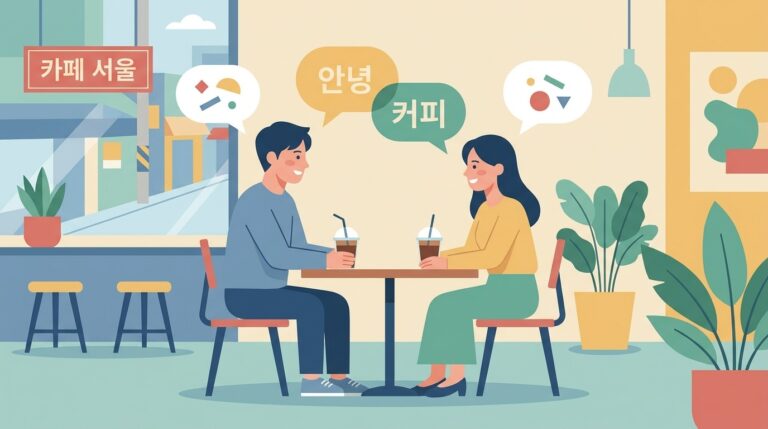
Setting: A trendy cafe in Seongsu-dong. Min-woo (민우, 28, product designer) and Sarah (사라, C2 Korean learner) are catching up over iced Americanos.
- 민우: 사라야, 프로젝트 준비하느라 요즘 완전 바빴지? 피곤해 보여. (🎭 걱정스러운 눈빛으로 아메리카노를 저으며)
(Sarah, you’ve been swamped preparing the project, right? You look exhausted.) - 사라: 말도 마. 어제 새벽 3시에 잤는데, 그 와중에 갑자기 방 청소 꽂혀서 서랍 정리까지 싹 다 했잖아. (🎭 과장되게 한숨을 쉬며)
(Don’t even start. I went to bed at 3 AM, and in the middle of that, I got obsessed with room cleaning and organized every single drawer.) - 민우: ㅋㅋㅋ 시험 기간에 공부 빼고 다 재밌는 거랑 똑같네. (🎭 턱을 괴고 쿡쿡 웃으며)
(Haha, that’s just like when everything except studying is fun during exam season.) - 사라: 그리고는 서랍에서 초등학교 때 잃어버린 일기장을 발견했는데, 3학년 때 짝사랑했던 이야기부터 쭉 읽느라… (🎭 눈을 반짝이며 끝없이 말을 이어가려 함)
(And then I found my elementary school diary in the drawer, and I was reading all about my 3rd-grade crush…) - 민우: 워워, 사라 씨! 거기서 첫사랑 썰까지 가면 완전 TMI 대방출인데? 안물안궁 각이야! (🎭 손바닥을 펼쳐 장난스럽게 막아서며)
(Whoa whoa, Sarah! If you go all the way into first-love stories, that’s full TMI unleash mode! Total ‘didn’t ask, not curious’ territory!) - 사라: 앗, 미안! 내가 순간 추억에 취해서 투머치토커 됐네. 요점은 그래서 늦잠 잤다는 거지! (🎭 머리를 긁적이며 멋쩍게 웃음)
(Ah, my bad! I got drunk on nostalgia and became a Too Much Talker for a second. The point is, that’s why I overslept!) - 민우: ㅋㅋㅋ 역시 사라답다. 커피 마시고 얼른 정신 차려. (🎭 빨대를 건네며)
(Haha, classic Sarah. Drink your coffee and snap out of it.) - 사라: 그래, 우리 본론으로 들어가서 오늘 갈 맛집이나 정하자! (🎭 메뉴판을 펼치며)
(Right, let’s get down to business and pick the restaurant for today!)
🔀 Interactive Branching Point
If Min-woo had playfully teased you with “안물안궁 각이야!”, how would you respond?
- Choice A: “뭐라고? 내 이야기가 재미없어? 기분 나쁘네.” (Literal offense)
- Feedback (Bad): Escalates a self-deprecating joke into genuine tension. Misses the conversational banter code.
- Choice B: “인정! TMI 셀프 차단할게. 그래서 본론은…” (Accept with self-awareness & pivot)
- Feedback (Best): Demonstrates flawless conversational agility, acknowledging the playful boundary with humor.
- Choice C: “안물안궁이어도 끝까지 들으셔야 합니다, 고객님.” (Overly theatrical counter-banter)
- Feedback (Risk): Very funny between intimate best friends (찐친), but potentially domineering if the relationship is newer.
Phase 6: 10-Second Emotional Shadowing Drill
Master the subtle intonation curves that make slang sound native rather than robotic:
[🤪 자조적이고 능청스럽게](Self-deprecating & playful)- “앗, / 제가 말이 너무 길었죠? / 완전 투머치토커 모드였네요!”
- [Ah, / did I talk for too long? / I was in total Too-Much-Talker mode!]
[😎 장난기 넘치고 얄밉게](Playful & cheekily teasing)- “거기까지! / 더 말하면 / 빼도 박도 못하는 TMI인 거 알지?”
- [Stop right there! / You know that if you say any more, / it’s undeniable TMI, right?]
[🤫 가볍게 비밀 털어놓듯](Casually dropping a mini-trivia)- “오늘의 소소한 TMI 하나 방출하자면, / 저 오늘 양말 짝짝이예요.”
- [If I may unleash one small TMI today, / I’m wearing mismatched socks.]
Phase 7: K-Culture Mini Dictionary
- 뇌절 (Noe-jeol) | Taking a joke/trope way too far
- Originating from anime/gaming communities, this denotes repeating a joke or narrative until it becomes cringey and unbearable. Usage: “그 드립은 1절만 해야지, 뇌절하면 노잼이야” (You should stop after stanza one; taking it too far ruins the fun).
- 핑프 (Ping-peu) | Finger Princess/Prince (Lazy Googler)
- Short for 핑거 프린세스/프린스. Refers to people who ask basic questions in chats instead of typing one query into a search engine. Usage: “초록창에 검색하면 바로 나오는데 핑프 짓 하지 말자.” (Search it on Naver; don’t be a lazy Googler).
- 과몰입 (Gwa-mol-ip) | Hyper-fixation / Over-immersion
- Becoming emotionally over-invested in a drama plot, MBTI discussion, or someone else’s dating life. Usage: “환승연애 보면서 과몰입해서 밤샜잖아.” (I got so over-invested watching EXchange that I pulled an all-nighter).
- 안사요 (An-sa-yo) | No thanks, not buying it
- Borrowed from door-to-door sales rejections; playfully used in comment sections when someone tries to force an unappealing opinion or excessive TMI onto others.
Phase 8: Survival Kit for Travelers & Expats
Top 3 Survival Phrases
- 한글: 혹시 제가 사설이 너무 길었나요?
Romanization: [Hoksi jega saseori neomu gireonnayo?]
Pro Tip: Elegant C2 phrase for business/formal meetings when you notice you have digressed. - 한글: 여기서부터는 가볍게 TMI로 들어주세요.
Romanization: [Yeogiseobuteoneun gabyeopge TMI-ro deureojuseyo.]
Pro Tip: Perfect preface when introducing non-critical contextual info during a casual team presentation. - 한글: 오늘은 딱 용건만 간단히 공유할게요!
Romanization: [Oneureun ttak yonggeonman gandanhui gongyuhalgeyo!]
Pro Tip: Great opener for group project chats to signal high productivity and zero fluff.
Editor’s Travel & Expat Note
When messaging Korean service staff, hosts, or delivery drivers via the official KakaoTalk messenger app settings, keep all initial inquiries hyper-concise. Avoid detailing why your plane landed late before asking for a late check-in. State your reservation number and direct request first—Korean digital communication values 속도 (speed) and clarity over narrative preambles.
Phase 9: Going Deeper (Humanities Essay)
In Western linguistic pragmatics, self-disclosure is often viewed as the fastest shortcut to authenticity and rapport. In Korean sociocultural dynamics, however, conversational intimacy is governed by a delicate dance of 눈치 (nunchi) and 거리감 (relational distance). When someone shares uninvited personal trivia, it subtly imposes an emotional burden on the listener to validate, react, and respond enthusiastically (리액션의 의무). Therefore, the emergence of terms like TMI and 안물안궁 in the Korean lexicon is not merely a linguistic trend—it is a modern collective defense mechanism designed to establish healthy personal boundaries in an hyper-connected society.
💬 Your Turn: How does your culture signal that a conversation has gone into excessive detail without causing offense? Drop your thoughts below!
Phase 10: FAQ & Common Mistakes
Q: Can I use “안물안궁” toward an older colleague if we are close?
A: Absolutely not. Even with a close older colleague (선배 or 직장 동료), 안물안궁 carries an inherent lack of honorific deference. Instead, use a smiling, softened phrase like “선배님, 그거 비밀로 해주셔도 될 것 같아요!” (Sunbae-nim, you could have kept that a secret!).
Q: Is Korean TMI always negative?
A: No! In casual friendship and fandom culture, stating “오늘의 TMI” before sharing a cute, quirky detail about your day is an established social ritual to spark lighthearted conversation without self-importance.
Q: What is the difference between ‘뇌절’ and ‘TMI’?
A: TMI refers to the content being unnecessary or unprompted trivia. 뇌절 refers to the action of repeating an action, joke, or story past the point of social tolerance.
🚨 Common Mistakes Warning Board
- Mistake: Using TMI only to mean gross/vulgar stories.
- Correct Action: Use it freely for harmless, mundane trivia (e.g., what you had for lunch, what shoe size you wear).
- Mistake: Typing 안물안궁 in a semi-formal Slack channel to tease a coworker.
- Correct Action: Written text lacks tone; it will read as aggressive. Stick to face-to-face vocal banter.
- Mistake: Over-apologizing when someone says “TMI!”.
- Correct Action: Treat it as playful banter. Laugh it off with “아, 인정!” (Ah, fair enough!) and transition smoothly.
Phase 11: Action Missions
- 🥉 Bronze Mission (Solo Drill): Record a 15-second voice memo introducing yourself, intentionally inserting one quirky detail using the sentence frame: “참고로 제 오늘의 TMI는…”
- 🥈 Silver Mission (Social Share): The next time you post a photo of food or daily life on Instagram/Threads, caption it with a bilingual Korean tag: “(안물안궁 TMI 방출) 오늘 먹은 디저트 🍰”.
- 🥇 Gold Mission (Real Encounter): In your next Korean conversation (online or offline), gracefully stop your own digression with “앗, 제가 말이 너무 길었죠? 투머치토커 모드 해제할게요!”.
- 🎮 K-Culture Mission: Watch an episode of a Korean web variety show (e.g., Pinggyego on YouTube) and spot at least two instances where the subtitles use TMI or 투머치토커.
Phase 12: Interactive Quiz Challenge
1. Situational Judgment
Your Korean language exchange partner suddenly sends a 500-word paragraph detailing what their cousin’s friend bought at the grocery store yesterday. You want to tease them affectionately like a close friend. What is the most natural phrase?
* A) 불필요한 서술을 중단해 주십시오.
* B) ㅋㅋㅋ 야 완전 TMI 대방출이네! 안물안궁이거든?
* C) 그것은 너무 길어서 읽을 수 없습니다.
🔍 Click to reveal the answer & explanation
Correct Answer: B
Explanation: Option B uses authentic modern slang with a playful tone (ㅋㅋㅋ, TMI 대방출, 안물안궁). Options A and C sound unnaturally robotic, cold, and confrontational.
2. Fill in the Blank
Complete the self-aware apology:
* “제가 옛날이야기만 나오면 흥분해서 자꾸 ( ) 빙의하네요. 죄송합니다!”
🔍 Click to reveal the answer & explanation
Correct Answer: 투머치토커 (Too Much Talker)
Explanation: The meme phrase 투머치토커 빙의 (channeling one’s inner Too-Much-Talker) is the ultimate natural expression for acknowledging one’s own verbosity.
3. True / False Cultural Check
- Statement: In Korean internet slang, sharing a “TMI” always implies that the speaker is talking about confidential or NSFW (Not Safe For Work) private matters.
🔍 Click to reveal the answer & explanation
Correct Answer: False
Explanation: In Korean everyday culture, TMI is widely utilized for harmless, lighthearted daily trivia (e.g., “Today’s TMI: I dropped my toast”).






