

Phase 1: Empathy (Story-Driven Opening)
안녕하세요! 매일한글 에디터입니다. (Hello! I’m your Daily Hangul editor.)
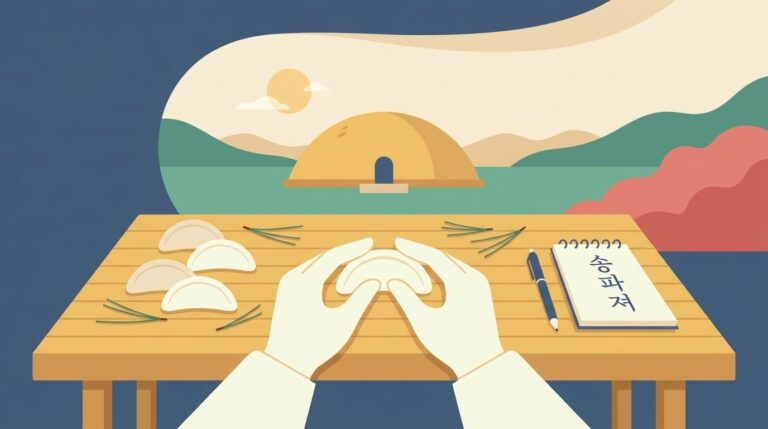
Picture this: You are sitting cross-legged on a polished wooden floor surrounded by pine needles, fragrant steamed rice dough, and sweet sesame fillings. Your Korean host mother or partner’s grandmother is meticulously pinching dough into pristine, crescent-shaped songpyeon, smiling warmly as she passes you a lump of dough. Suddenly, all eyes are on your hands. Later that morning, you find yourself hiking up a lush, misty hillside for seongmyo (visiting ancestral graves), holding a bottle of cheongju wine, wondering: Where do I stand? How deep should I bow? What do I say without sounding like a robotic textbook?
Chuseok is Korea’s grandest harvest festival, but for advanced learners navigating family gatherings, it can feel like a high-stakes cultural performance. You already know how to say “추석 잘 보내세요” (Have a good Chuseok), but at the C1 level, true fluency lies in understanding the collective emotional fabric—demonstrating nunchi around the kitchen table, using elegant idioms while shaping rice cakes, and showing profound, natural respect during ancestral rites. Based on real-world feedback from hundreds of advanced expats and heritage learners, this guide is your blueprint to mastering the authentic language, subtle etiquette, and emotional warmth of Chuseok.
Phase 2: Core 3 Expressions Deep-Dive
1. 송편을 예쁘게 빚어야 예쁜 딸을 낳는다면서요? (한글)
- Pronunciation: Songpyeoneul yeppeuge bijeoya yeppeun ttareul nanneundamyeonseo-yo? (Pronounce bijeoya like “bee-juh-yah” and nanneun with a smooth nasal “nan-neun”)
- Meaning: Literal: “They say you have to shape songpyeon prettily to give birth to a pretty daughter, right?” / Nuance: A warm, witty icebreaker used while crafting songpyeon to lighten the mood and flatter the family’s culinary skills.
- K-Culture Moment: Seen in weekend family K-Dramas whenever the younger generation sits with elders to make holiday food, provoking hearty laughter from the in-laws.
- Editor’s Insight: Using the indirect quotation ending
-다면서요?signals cultural insider knowledge. Even if you don’t plan on having children, saying this with a playful smile shows you understand Korean folklore.- Situation Spectrum: Casual: ✅ | Semi-formal: ✅ | Formal: ⚠️
- 🤔 Think About It: Why do many Korean proverbs link kitchen dexterity and aesthetic food preparation directly to family blessings and future lineage?
2. 조상님 덕분에 올 한 해도 무탈하게 보냈습니다. (한글)
- Pronunciation: Josangnim deokbune ol han haedo mutal-hage bonaessseumnida. (Flow mutal-hage like “moo-tal-ha-geh”, meaning without trouble/incident)
- Meaning: Literal: “Thanks to our ancestors, we spent this year without misfortune.” / Nuance: A reverent, mature phrase said during or right after seongmyo to express gratitude for familial peace.
- K-Culture Moment: Uttered solemnly by family heads before pouring libations over the ancestral burial mound (bongbun).
- Editor’s Insight: 무탈하다 (mutal-hada) is a sophisticated C1-level adjective meaning “free from accidents or illness.” It sounds far more authentic than simply saying “좋은 한 해였습니다” (It was a good year).
- Situation Spectrum: Casual: ⚠️ | Semi-formal: ✅ | Formal: ✅
- 🤔 Think About It: How does attributing current personal stability to ancestors differ from harvest celebrations in your home culture?
3. 손맛이 정성이라 모양은 서툴러도 맛은 깊네요. (한글)
- Pronunciation: Sonmasi jeongseong-ira moyang-eun seotulleodo maseun gimnēyo. (Link son-mat-i to sound like son-mah-shee)
- Meaning: Literal: “A cook’s touch is pure devotion, so even if the shape is clumsy, the flavor is deep.” / Nuance: Self-deprecating yet poetic praise when your handmade songpyeon looks uneven, or when complimenting homemade holiday dishes.
- K-Culture Moment: Often heard on Korean food variety shows when hosts taste traditional delicacies made by village elders.
- Editor’s Insight: 손맛 (sonmat, the unique touch/flavor of one’s hands) and 정성 (jeongseong, heartfelt sincerity) are essential philosophical concepts in Korean gastronomy.
- Situation Spectrum: Casual: ✅ | Semi-formal: ✅ | Formal: ✅
- 🤔 Think About It: Is there an equivalent concept in your native language that elevates imperfect cooking into an act of heartfelt emotional care?
Phase 3: Textbook Korean vs. Real Korean
Situation 1: Praising the festive spread or songpyeon at the table
- 📖 교과서 한국어 (Textbook): “음식이 정말 맛있고 송편 모양이 아름답습니다.” (The food is very delicious and the songpyeon shape is beautiful.)
- 🗣️ 진짜 한국어 (Real-Life C1): “깨소도 듬뿍 들어가고 쫄깃한 게 완전 파는 것보다 훨씬 맛있어요!” (It’s packed with sesame filling and so chewy—way better than store-bought!)
- 💡 Why the difference? Textbook phrases sound stiff and clinical. Native speakers praise specific textures (쫄깃하다) and ingredients (깨소), contrasting homemade warmth with commercial food.
Situation 2: Reflecting on the ancestral grave visit (Seongmyo)
- 📖 교과서 한국어 (Textbook): “산소에 다녀와서 보람이 있었습니다.” (It was rewarding to visit the grave.)
- 🗣️ 진짜 한국어 (Real-Life C1): “벌초도 말끔히 되어 있고, 조상님 뵈러 오니 마음이 한결 차분해지네요.” (The weeding was done so neatly; visiting our ancestors makes my mind feel noticeably at peace.)
- 💡 Why the difference? C1 fluency utilizes refined domain-specific vocabulary like 벌초 (tending grave grass) and sensory emotional reflections (마음이 한결 차분해지다).
Phase 4: K-Culture Deep Dive & Non-Verbal Manners
4-1. 눈치 (Nunchi) & Grave/Table Etiquette
- The Two-Handed Pour (주도/음복): When pouring or receiving cheongju (clear rice wine) at the grave mound, always support your right forearm or wrist with your left hand. Avoid direct direct eye contact while drinking during eombok (communal sharing of food/drink after the rite); turn slightly to the side out of reverence for the senior family members present.
- Bowing Depth (Jeol): During seongmyo, two full deep floor bows (cheol) are performed for the deceased, followed by a slight standing bow. Keep your hands clasped together (gongsu)—for men, the right hand over the left at ancestral graves (the reverse of celebratory occasions); for women, left over right.
- Pine Needle Placement: When steaming songpyeon, layering fresh pine needles (sol-ip) between cakes keeps them from sticking and imparts a crisp antiseptic aroma. Do not pluck the needles away aggressively; gently peel them off when cooled.
4-2. Cultural Code Analysis: The Soul of Chuseok
In modern Korean dramas like Reply 1988 or My Unfamiliar Family, Chuseok represents a bittersweet crossroads between intense communal labor and restorative belonging. While younger urbanites occasionally opt for holiday staycations, the collective ritual of Gwisung-gil (the nationwide homecoming journey) remains the emotional heartbeat of the season. Participating in songpyeon making is an invitation into the inner circle (woori), transforming an outsider into family.
Phase 5: Real-Life Roleplay Scenario
Setting: Chuseok afternoon at Grandma’s house in Gyeongju. You are sitting around a low table with Grandmother (Halmeoni) and your partner’s aunt (Komo), finishing the songpyeon before heading to the family hill for seongmyo.
- Turn 1 (할머니 – Halmeoni): “어디 보자, 우리 외국인 손님 송편 솜씨가 어떠려나?” (Let’s see, how are our guest’s songpyeon making skills?)
- Turn 2 (You): 🎭 Smiling bashfully, holding up a crescent-shaped rice cake “송편을 예쁘게 빚어야 예쁜 딸을 낳는다길래 숨도 안 쉬고 집중했습니다!” (Songpyeoneul yeppeuge bijeoya yeppeun ttareul nanneundagillae sumdo an swigo jipjunghaessseumnida! / They said pretty songpyeon brings a pretty daughter, so I focused without even breathing!)
- Turn 3 (고모 – Komo): 🎭 Laughs and claps hands “어머나! 말하는 것 좀 봐. 모양도 반달처럼 아주 곱게 잘 빚었네!” (Oh my! Look how sweetly you speak. The shape is so elegant, just like a half moon!)
- Turn 4 (You): 🎭 Politely dusting sesame flour from the table edge “고모님이 옆에서 반죽 치대는 법을 잘 알려주신 덕분이에요.” (Gomonimi yeop-eseo banjuk chidaeneun beobeul jal allyeojusin deokbun-ieyo. / It’s all thanks to auntie teaching me how to knead the dough properly beside me.)
- Turn 5 (할머니 – Halmeoni): “이제 찜기에 찌는 동안 차려입고 선산에 성묘 다녀오자꾸나.” (Now while these steam in the pot, let’s get dressed and visit the family graves on the hill.)
- Turn 6 (You): 🎭 Standing up immediately to offer a steadying arm to Halmeoni “네, 할머니. 제사주랑 돗자리는 제가 챙겨서 들고 가겠습니다.” (Ne, halmeoni. Jesajurang dotjarineun jega chaenggyeoseo deulgo gagessseumnida. / Yes, Grandmother. I’ll pack and carry the ceremonial wine and mat.)
- Turn 7 (할머니 – Halmeoni): 🎭 Patting your arm warmly “기특하기도 하지. 조상님들도 참 기뻐하시겠어.” (How commendable. Our ancestors will surely be delighted.)
- Turn 8 (You): 🎭 Bowing head gently with warm composure “조상님 뵈러 가는 길이라 마음이 경건해지네요. 천천히 조심히 올라가세요.” (Josangnim boereo ganeun girira maeumi gyeonggeonhaejineyo. Cheoncheonhi josimhi ollagaseyo. / Heading to greet the ancestors makes my heart feel reverent. Please watch your step going up.)
🔀 Interactive Decision Point
Grandma is setting down the heavy tray of fruits for the grave. What do you do and say?
- Option A: (Take the tray instantly) “할머니, 무거우신데 제가 들겠습니다. 산소에 올릴 배랑 사과 맞지요?”
- Option B: (Bow deeply right now on the road) “조상님 은혜에 감사드립니다!”
- Option C: (Whip out your smartphone to take a family selfie) “할머니, 명절 기념으로 셀카 한 장 찍을까요?”
[Feedback on Choices]
* Choice A (Best): Perfect Nunchi! Relieving an elder of heavy ceremonial items while verifying the ritual offerings shows physical courtesy and situational awareness.
* Choice B (Risk): Timing error. Bowing on an asphalt pathway or mountain path before the ceremonial mat (*dotjari*) is laid down appears clumsy and overly dramatic.
* Choice C (Bad): Grave visits are solemn memorial moments. Snapping casual selfies before the ritual rites conclude can come across as trivializing family heritage.
Phase 6: 10-Second Emotion Shadowing Drill
Practice matching rhythm, pauses (/), and genuine affective vocal tone:
[😊 Playful & Endearing]
“송편 모양은 / 조금 삐뚤빼뚤하지만, / 속은 깨랑 꿀로 / 꽉 채웠습니다!”
(Songpyeon moyang-eun / jogeum ppittul-ppaettul-hajiman, / sogeun kkaerang gullo / kkwak chaewossseumnida! / The songpyeon shapes are a bit crooked, but the inside is packed full with sesame and honey!)-
[🌿 Reverent & Composed]
“조상님 덕분에 / 올 한 해도 무탈하게 보냈으니 / 내년에도 / 온 가족이 건강했으면 좋겠습니다.”
(Josangnim deokbune / ol han haedo mutal-hage bonaesseuni / naenyeonedo / on gajogi geonganghaesseumyeon jokesseumnida. / Having spent this year peacefully thanks to our ancestors, I hope our whole family stays healthy next year too.) -
[🤝 Heartfelt & Warm]
“손맛이 깃든 명절 음식을 / 함께 나누니까 / 진짜 한 가족이 된 기분이에요.”
(Sonmasi gitdeun myeongjeol eumsigeul / hamkke nanunikka / jinjja han gajogi doen gibun-ieyo. / Sharing holiday food filled with personal care truly makes me feel like family.)
Phase 7: K-Culture Mini Dictionary
- 한가위 (Hangawi) | The pure Korean name for Chuseok
- Usage: Often utilized in elegant holiday greetings (e.g., “풍성한 한가위 되세요”), derived from “Han” (great) and “Gawi” (middle/autumn).
- 성묘 (Seongmyo) | Visiting and paying respects at ancestral graves
- Usage: Specific to the act of bowing, clearing grass, and pouring wine at the burial site during Chuseok and Lunar New Year.
- 벌초 (Beolcho) | Trimming weeds and wild grass around the ancestral burial mound
- Usage: Performed in the weeks leading up to Chuseok; a major family obligation signifying filial piety (hyo).
- 음복 (Eombok) | Partaking in the sacrificial food and wine after ancestral rites
- Usage: Symbolizes receiving the ancestors’ blessings by sharing the consecrated offerings with everyone gathered.
Phase 8: Survival Kit for Travelers
Survival Expressions TOP 3
- “남은 송편은 냉동 보관했다가 쪄 먹으면 되나요?” (Nameun songpyeoneun naengdong bogwanhaetdaga jjeo meogeumyeon doenayo?)
- Pro Tip: Raw songpyeon spoils quickly due to moisture. Asking this shows practical culinary intelligence!
- “절은 두 번 반 드리면 될까요?” (Jeoreun du beon ban deurimyeon doelkkayo?)
- Pro Tip: Clarifies ritual etiquette smoothly. Two deep floor bows + one half standing bow is the traditional protocol.
- “귀경길 차가 많이 막힐 텐데 조심히 올라가세요.” (Gwigyeonggil chaga mani makil tende josimhi ollagaseyo.)
- Pro Tip: The ultimate closing etiquette when parting ways as relatives return to Seoul (Gwigyeong).
Editor’s Travel Note
- Navigation & Traffic: During Chuseok, intercity highways turn into parking lots. Check real-time congestion via Naver Map navigation or download the official KORAIL Talk app months in advance if booking holiday KTX train tickets.
- Attire: When attending seongmyo, avoid overly bright activewear or flip-flops. Neat, muted slacks and hiking shoes are optimal for mountain slopes and tick prevention.
Phase 9: “A Step Deeper” (Reflective Essay)
In Western individualistic frameworks, holidays often center on immediate personal joy and gift exchanges. Chuseok, however, operates as a temporal bridge connecting past ancestors with future descendants through the visceral medium of grain and soil. Kneeling before a mountain mound (bongbun) to sweep away weeds is not merely an archaic chore; it is an annual grounding ritual where living descendants physically acknowledge that their modern lives stand on the sacrifices of those before them.
💬 Your Turn: Does your culture celebrate an autumn harvest or ancestral memorial? How does your family honor shared lineage? Share your story in the comments below!
Phase 10: FAQ & Common Mistakes
Q: Can I wear hanbok during Seongmyo?
A: While hanbok was traditionally standard, modern families rarely wear full hanbok up mountain paths due to dirt and steep trails. Neat, dark or earthy-toned smart-casual clothing is universally preferred today.
Q: Why are songpyeon shaped like half-moons instead of full moons?
A: Korean folklore teaches that a full moon can only wane, whereas a half-moon (bandal) holds infinite potential to grow full, symbolizing endless abundance and family prosperity.
Q: What if I have dietary restrictions and cannot eat songpyeon fillings (like sesame or beans)?
A: Express gratitude for the effort first (“정성껏 만드셨는데…”), then politely specify your allergy or preference (“제가 깨 알레르기가 있어서 콩송편 위주로 맛보겠습니다”). Korean hosts deeply appreciate clear, respectful honesty.
🚨 Common Mistakes TOP 3
- ❌ Mistake 1: Bowing only once at the grave.
- 👉 Correct Action: For living elders, you bow once; for ancestral grave rites (jesa/seongmyo), you must perform two full bows (du-beon jeol).
- ❌ Mistake 2: Sticking chopsticks vertically into rice or songpyeon bowls.
- 👉 Correct Action: This mirrors incense placed at altars and is considered an omen of bad luck. Rest chopsticks flat on the table or side plate.
- ❌ Mistake 3: Saying “생일 축하해요” style casual tones to in-laws during rites.
- 👉 Correct Action: Maintain polite haeyo-che or formal hapsio-che throughout festive ceremonies.
Phase 11: Action Missions & Engagement
- 🥉 Bronze Mission (Self Practice): Record yourself reciting Expression #1 (“송편을 예쁘게 빚어야…”) matching the shadowing cadence in Phase 6.
- 🥈 Silver Mission (Social Share): Post a picture of your favorite Asian dumpling or pastry on Instagram/Threads and caption it using “손맛이 정성이라…” tag
@DailyHangul. - 🥇 Gold Mission (Real-Life Mastery): The next time you share holiday food with Korean friends or family, compliment them using 무탈하다 or 쫄깃하다 instead of a generic 맛있어요.
- 🎮 K-Culture Mission: Watch a Chuseok holiday special clip of any Korean variety show (e.g., I Live Alone or 2 Days & 1 Night) and identify how many times they say 한가위 vs 추석.
Phase 12: Interactive Quiz Challenge
1. [Situational Judgment] You are sitting with your Korean elders making songpyeon, and your rice cake breaks open, spilling sesame seeds. What is the most culturally charming response?
* A) “어머, 송편이 터졌네요. 저 요리 진짜 못하죠?”
* B) “속을 너무 넉넉하게 넣었나 봐요! 조상님 복이 터진 것 같습니다.”
* C) “이 반죽이 불량품인 것 같아요.”
👉 Click to view Answer & Explanation
Correct Answer: B
Explanation: Option B blends wit, self-awareness, and auspicious holiday cheer (복이 터지다 – blessings overflowing), demonstrating premier C1 conversational charm. Option C blames the host/ingredients, while Option A is overly self-critical without warmth.
2. [Fill in the Blank] Fill in the missing C1 vocabulary word:
“조상님 덕분에 올 한 해도 아무 사고 없이 (________)하게 보냈습니다.”
👉 Click to view Answer & Explanation
Correct Answer: 무탈 (mutal)
Explanation: 무탈하게 (without trouble/illness) is the exact advanced expression suited for holiday reflections and ancestral greetings.
3. [True / False Cultural Check] In traditional Korean ancestral grave etiquette, you perform one single floor bow just like greeting elders on New Year’s Day.
👉 Click to view Answer & Explanation
Correct Answer: FALSE
Explanation: Living elders receive one bow (il-bae), but ancestral spirits and memorial rites (seongmyo/jesa) require two full floor bows (i-bae).







