

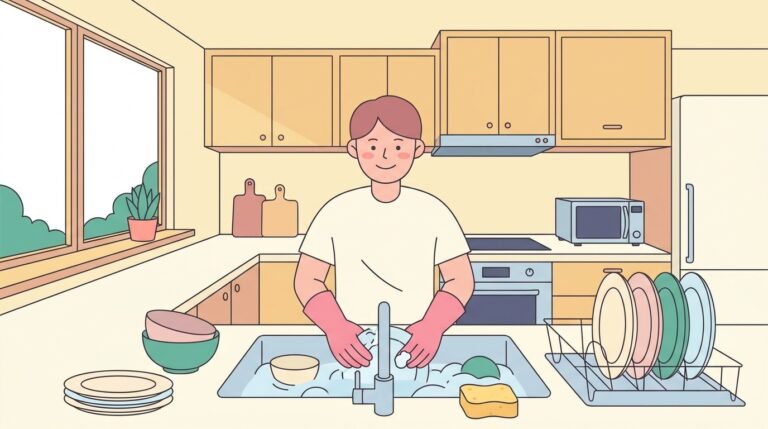
Phase 1: Empathy & Immersion
안녕하세요! I’m your Daily Hangul editor. Imagine this: You just finished an incredible home-cooked Korean dinner at your Korean friend’s apartment. The samgyeopsal was sizzling, the doenjang-jjigae was bubbling, and the hospitality was 10/10. But as soon as the meal ends, your host stands up and begins gathering the mountain of greasy bowls toward the kitchen sink.
You sit there freezing up. Should I just sit here and say thank you? Should I run to the kitchen and grab the sponge? What do I say so I don’t look rude or pushy?
In Korean culture, offering to do the dishes—설거지 (seolgeoji)—is not just about cleaning dirty plates; it’s a profound cultural dance of gratitude, mutual respect, and jeong (warm affection). If you simply sit back on the sofa, you might feel awkwardly guilty. But if you try to take over their kitchen too aggressively, your host might feel embarrassed! Today, based on real feedback from intermediate learners who navigated house visits in Seoul, we are breaking down the exact phrases, body language, and cultural etiquette you need to master the art of offering to do the dishes like a true local.
Phase 2: Top 3 Core Expressions
1. 제가 설거지할게요!
- Pronunciation: [Je-ga seol-geo-ji-hal-ge-yo] (Sounds like: Jeh-gah soul-guh-jee hal-geh-yo)
- Meaning: Literal: “I will do the dishes!” / Nuance: A proactive, cheerful offer to take care of the cleanup.
- K-Culture Moment: In variety shows like Three Meals a Day (삼시세끼), when a younger guest jumps up right after eating to tackle the dishes before the senior cast members can touch them.
- Editor’s Insight: Using the subject marker 제가 (je-ga) emphasizes “I, rather than you” will do it. It shows immediate initiative.
- Situation Spectrum: Casual (⚠️ with close friends, use 내가 할게!), Semi-formal (✅ perfect for friends’ parents or polite social circles), Formal (✅ use 제가 하겠습니다 for formal occasions).
- 🤔 Think About It: In your culture, do guests actively offer to wash dishes right after dinner, or is clearing the table enough?
2. 밥도 맛있게 먹었는데, 이건 제가 할게요.
- Pronunciation: [Bap-do ma-sit-ge meog-eon-neun-de, i-geon je-ga hal-ge-yo] (Sounds like: Bahp-doh mah-sheet-geh mug-un-deh, ee-gohn jeh-gah hal-geh-yo)
- Meaning: Literal: “I ate such a delicious meal, so I will do this.” / Nuance: “You treated me to great food, so at least let me do the dishes to repay your kindness!”
- K-Culture Moment: Classic K-Drama scene where the boyfriend visits the girlfriend’s family home for the first time and politely tries to win over the parents with sweet, considerate manners.
- Editor’s Insight: The phrase 밥도 맛있게 먹었는데 serves as the perfect polite justification, making it almost impossible for your host to feel burdened by your help.
- Situation Spectrum: Casual (✅), Semi-formal (✅ ideal for peer visits), Formal (⚠️ change end to 제가 하겠습니다).
- 🤔 Think About It: Notice how Korean politeness often ties back to reciprocating a food blessing—sharing food is the ultimate sign of closeness.
3. 그냥 편하게 계세요, 제가 금방 끝낼게요!
- Pronunciation: [Geu-nyang pyeon-ha-ge gye-se-yo, je-ga geum-bang kkeun-nael-ge-yo] (Sounds like: Geu-nyang pyun-hah-geh gyeh-seh-yoh, jeh-gah goom-bahng kkeun-nehl-geh-yoh)
- Meaning: Literal: “Just stay comfortable, I’ll finish it quickly!” / Nuance: “Please relax, go sit down! I’ve got this handled in no time.”
- K-Culture Moment: In slice-of-life K-dramas like Hospital Playlist, when close doctor friends fight over the dish rack after sharing late-night tteokbokki in the lounge.
- Editor’s Insight: 편하게 계세요 shows deep consideration for the host who spent hours preparing the meal.
- Situation Spectrum: Casual (⚠️ use 너 편하게 있어), Semi-formal (✅), Formal (🚫 too conversational for strict corporate dinners).
- 🤔 Think About It: How does telling someone to relax reflect your role as a considerate guest?
Phase 3: Textbook Korean vs. Real Korean
Scenario 1: Offering to wash dishes
- 📖 Textbook Korean: “제가 설거지를 담당하겠습니다.” (Je-ga seol-geo-ji-reul dam-dang-ha-get-seum-ni-da. – I will take charge of the dishwashing duties.)
- 🗣️ Real Korean: “설거지는 제가 할게요! 가만히 계세요~” (Seol-geo-ji-neun je-ga hal-ge-yo! Ga-man-hi gye-se-yo~ – I’ll do the dishes! Just stay right there~)
- 💡 Why the difference?: Real conversations between friends or acquaintances don’t sound like military duty reports. Adding playful care like 가만히 계세요 (just stay resting) adds warmth.
Scenario 2: Refusing the host’s polite pushback
- 📖 Textbook Korean: “아닙니다, 제가 설거지를 하고 싶습니다.” (A-nim-ni-da, je-ga seol-geo-ji-reul ha-go sip-seum-ni-da. – No, I want to do the dishes.)
- 🗣️ Real Korean: “에이, 맛있는 거 해주셨는데 이 정도는 제가 해야죠!” (E-i, ma-sin-neun geo hae-ju-syeon-neun-de i jeong-do-neun je-ga hae-ya-jyo! – Oh come on, you made such delicious food, this is the least I can do!)
- 💡 Why the difference?: The exclamation 에이 (Ey~) and the rhetorical suffix -해야죠 (-of course I should) create an endearing, natural rapport.
Phase 4: K-Culture Deep Dive & Non-Verbal Manners
4-1. 눈치 (Nunchi) & The Polite Kitchen Tango
When you offer to do the dishes in Korea, 9 out of 10 hosts will instinctively say: “아니에요! 손님인데 그냥 두세요!” (No way! You’re a guest, leave it!).
* First Offer: Don’t back off immediately. Korean etiquette involves a gentle, polite tug-of-war (밀당 – mildang). Offer at least twice with a warm smile.
* Body Language: Roll up your sleeves, stand up right away, and bring a plate toward the sink to demonstrate true willingness.
* The Final Read (Nunchi): If the host looks genuinely protective of their kitchen space or gently nudges you back toward the living room, smile and offer a sweet alternative: “그럼 제가 식탁 정리랑 분리수거라도 도와드릴게요!” (Then let me at least help clear the table and organize the recycling!).
4-2. Cultural Code: 손님 대접 (Treating Guests) & Jeong (정)
In Korean home culture, serving a guest is an honor and a sign of ultimate hospitality. However, letting the host do 100% of the cooking and 100% of the cleanup alone makes the guest feel like a burden. Stepping up to wash the dishes bridges the gap between being a formal “stranger guest” and becoming an “insider friend” (우리 식구).
Phase 5: Real-Life Roleplay Scenario
Setting: Minho’s cozy studio apartment in Mapo-gu after enjoying homemade Kimchi-jjigae together.
Characters: Minho (Host), You (Guest)
- You: 잘 먹었습니다! 찌개 진짜 최고였어요. (That was delicious! The stew was truly the best.)
🎭 Claps hands together gratefully - Minho: 입에 맞았다니 다행이다! 배부르지? (I’m glad it suited your taste! You full?)
🎭 Smiles and stacks the bowls - You: 네! 밥도 맛있게 먹었는데, 설거지는 제가 할게요! (Yes! You made such delicious food, I will do the dishes!)
🎭 Stands up immediately and reaches for the stack - Minho: 에이, 무슨 소리야! 손님인데 그냥 앉아 있어. (Ey, what are you talking about! You’re a guest, just stay seated.)
🎭 Waves his hands playfully refusing - You: 아니에요, 민호 씨가 요리했으니까 뒷정리는 제가 해야죠. (No, you cooked, so I should definitely handle the cleanup.)
🎭 Rolls up sleeves and heads to the sink - Minho: 진짜 괜찮은데… 고마워! 그럼 고무장갑 저기 있어. (You really don’t have to… but thank you! The rubber gloves are over there.)
🎭 Points gratefully to the pink gloves - You: 네, 편하게 쉬고 계세요! 금방 끝낼게요. (Yes, just relax! I’ll finish this up in no time.)
🎭 Turns on the faucet with a smile - Minho: 고마워! 다 끝나면 맛있는 과일 깎아줄게. (Thanks a lot! When you’re done, I’ll cut some fresh fruit for dessert.)
🎭 Opens the fridge cheerfully
🔀 Interactive Choice Point
What do you say when Minho tries to take the sponge out of your hand at turn 4?
* Choice A: “네, 그럼 전 TV 보고 있을게요!” (Okay, then I’ll just go watch TV!)
* 🚫 Feedback (Bad): A bit too blunt! Even if accepted, it makes you look indifferent.
* Choice B: “안 돼요! 이 정도는 제가 진짜 하고 싶어요. 얼른 앉으세요~” (No way! I really want to do at least this much. Go sit down~)
* ✅ Feedback (Best): Perfect! Friendly, proactive, and establishes warm emotional bonding.
* Choice C: “주방 세제 어디 있어요? 제가 다 청소해 드릴게요.” (Where is the detergent? I will deep-clean your whole place.)
* ⚠️ Feedback (Risk): A little too intense. Cleaning personal spaces beyond the dinner dishes can feel intrusive.
Phase 6: 10-Second Emotion Shadowing Drill
Practice mimicking these sentences with the exact emotional pitch marks ( / = breath pause):
[😊 Cheerful & Proactive]- 밥도 맛있게 먹었는데 / 설거지는 제가 할게요!
- (Bap-do ma-sit-ge meog-eon-neun-de / seol-geo-ji-neun je-ga hal-ge-yo!)
[🤗 Insistent yet Polite]- 에이, 편하게 계세요! / 이건 제가 금방 끝낼게요.
- (E-i, pyeon-ha-ge gye-se-yo! / i-geon je-ga geum-bang kkeun-nael-ge-yo.)
[🤝 Helpful & Considerate]- 그럼 제가 / 식탁 정리라도 도와드릴게요!
- (Geu-reom je-ga / sik-tak jeong-ni-ra-do do-wa-deu-ril-ge-yo!)
Phase 7: K-Culture Mini Dictionary
- 설거지 (Seol-geo-ji) | Dishwashing | The act of cleaning dirty dishes and utensils after a meal.
- 뒷정리 (Dwit-jeong-ni) | Cleanup / Tidying up | Broadly refers to clearing the table, packing leftovers, and wiping surfaces after an activity or meal.
- 손님 대접 (Son-nim dae-jeop) | Hosting / Treating guests | The traditional Korean virtue of preparing generous food and drinks to welcome visitors warmly.
- 고무장갑 (Go-mu-jang-gap) | Rubber dishwashing gloves | The iconic, usually bright pink rubber gloves found beside virtually every Korean kitchen sink!
Phase 8: Traveler’s Survival Kit
Top 3 Survival Phrases
- 고무장갑 어디 있어요? (Go-mu-jang-gap eo-di it-seo-yo? – Where are the rubber gloves?)
- 💡 Pro Tip: Shows you mean business and are ready to wash without getting your sleeves wet!
- 행주 어디에 둘까요? (Haeng-ju eo-di-e dul-kka-yo? – Where should I put the dishcloth?)
- 💡 Pro Tip: Use this after wiping down the table cleanly.
- 쓰레기 어디에 버리면 돼요? (Sseu-re-gi eo-di-e beo-ri-myeon dwae-yo? – Where should I throw away the trash?)
- 💡 Pro Tip: Essential for respecting Korea’s strict recycling and food waste (음식물 쓰레기) sorting system.
Editor’s Travel Note
If you’re invited to a friend’s house in Korea, never arrive empty-handed! Stop by a nearby bakery or fruit market. Use the 네이버 지도 (Naver Map App Download) to search for nearby 베이커리 (bakeries) or 과일 가게 (fruit shops) along your route to pick up a small box of roll cake or seasonal shine muscat grapes.
Phase 9: A Step Deeper (Reflection Essay)
In many individualistic cultures, kitchen spaces are considered strictly private zones where guests are expected to wait in the parlor. However, in Korean culture, stepping into the kitchen cleanup represents the transition from a formal guest into a trusted family-like companion (식구 – those who share meals together). It is an exchange of mutual effort: “You gifted your cooking time, so I gift my cleaning labor.”
💬 Your Turn: Have you ever visited a Korean home, or hosted a Korean friend? How did you handle the dishwashing dilemma? Let us know in the comments below!
Phase 10: FAQ & Common Mistakes
Q: What if my Korean friend strictly forbids me from washing the dishes?
A: Respect their boundary! If they insist more than two or three times, don’t force it. Instead, switch to clearing empty side-dish bowls (반찬 그릇) to the counter or wiping the dinner table with a dishcloth (행주).
Q: Can I use 반말 (informal speech) when offering dishes to friends?
A: If they are the same age or a close younger peer, say “내가 설거지할게!” or “내가 치울게!”. If they are older or it’s your first visit, always stick to polite존댓말 (“제가 할게요”).
Q: Where do Korean homes put leftover food scrapings?
A: Korea has strict separate bins for food waste (음식물 쓰레기). Do not dump leftover soup solids or bones into the general sink drain; ask your host where to dispose of food scraps before washing.
🚨 Common Mistakes Warning Board
- Mistake 1: Walking away to sit on the couch immediately after finishing food.
- Correct Action: Always wait until everyone finishes, say 잘 먹었습니다, and stand up to help clear plates.
- Mistake 2: Throwing chicken bones or clam shells into the food waste bin.
- Correct Action: In Korea, hard bones, eggshells, and seafood shells belong in regular trash (일반 쓰레기).
- Mistake 3: Forgetting to wear rubber gloves (고무장갑).
- Correct Action: While optional, most Korean hosts appreciate you using them to protect your skin and keep grease contained.
Phase 11: Action Mission & Engagement
- 🥉 Bronze Mission: Stand in front of your mirror and practice saying “밥도 맛있게 먹었는데, 설거지는 제가 할게요!” 5 times with a bright smile.
- 🥈 Silver Mission: Share this expression in your Instagram/X story or study notes, tagging your favorite Korean study buddy.
- 🥇 Gold Mission: Use this exact sentence next time you share a meal with a Korean friend, classmate, or roommate!
- 🎮 K-Culture Mission: Watch an episode of a Korean reality show (like I Live Alone / 나 혼자 산다) and spot how guests behave right after a shared home meal.
Phase 12: Interactive Quiz Challenge
Q1. Situational Judgment
You had dinner at your Korean friend’s parents’ house. After dinner, what is the most polite and natural action?
* A) Say goodbye immediately and leave.
* B) Say “제가 설거지하겠습니다!” and bring your empty bowl to the kitchen sink.
* C) Start reorganizing their kitchen cabinets.
🔍 Reveal Answer & Explanation
Correct Answer: B
Explanation: Offering polite help (제가 설거지하겠습니다 / 도와드리겠습니다) and clearing the table shows exemplary etiquette (예의). Option C is an invasion of privacy, and Option A is impolite.
Q2. Fill in the Blank
Fill in the blank with the correct phrase:
* “밥도 맛있게 먹었는데, 설거지는 ( ____ ) 할게요!”
🔍 Reveal Answer & Explanation
Correct Answer: 제가 (Je-ga)
Explanation: 제가 is the humble and polite pronoun for “I” with the subject marker, used to take initiative courteously.
Q3. True / False Cultural Quiz
In Korea, food waste (음식물 쓰레기) and general trash (일반 쓰레기) can be washed down the sink drain together as long as you use soap.
🔍 Reveal Answer & Explanation
Correct Answer: False
Explanation: Korea enforces strict waste separation laws. Food waste must be separated into designated bins, and hard bones or shells go into regular trash bags.
“,







