

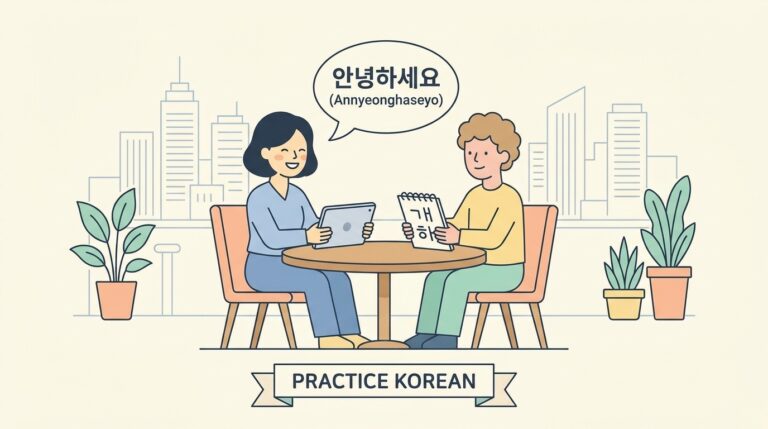
Master Korean Pronunciation: Fix Your Accent and Speak Naturally
Phase 1: Empathy (Story Opening)
안녕하세요! 매일한글 에디터입니다. (Hello! I’m your Daily Hangul editor.)
Picture this: You are sitting in a hip café in Hongdae. You have been practicing your Korean for months, binge-watching K-dramas, and humming along to your favorite K-pop tracks. Confidently, you walk up to the barista and say, “커피 주세요 (Please give me coffee).” But instead of brewing your latte, the barista looks startled, pauses, and gently asks if you are okay. Why? Because a tiny slip in your vowels turned “커피” (coffee – keopi) into “코피” (nosebleed – kopi)!
We have all been there. Korean pronunciation can feel like an intimidating puzzle, especially with subtle vowel differences (ㅓ vs ㅗ) and the tricky trio of plain, aspirated, and tense consonants (ㄱ, ㅋ, ㄲ). But do not worry! Having an accent is totally normal, and native speakers genuinely love when you try. This guide is built on real learner feedback and classroom-tested techniques designed specifically for A2 beginners. By the end of this post, you will have the exact phrases, cultural nuances, and confidence to ask native speakers to check your pronunciation without feeling shy.
Phase 2: Top 3 Core Expressions
1. 제 발음 어때요? (Je baleum eottaeyo?)
- Pronunciation: [Je ba-reum eo-ttae-yo?] (Think: ‘Je’ like jet, ‘baleum’ rhymes with volume, and ‘eottaeyo’ sounds like ‘uh-tae-yo’)
- Meaning: Literal: “How is my pronunciation?” | Actual Nuance: “Does this sound natural to you?”
- K-Culture Moment: Seen frequently on YouTube language exchange vlogs and idol live streams when idols ask fans if their foreign language sounds cute or correct.
- Editor’s Insight: This is the most natural, friendly way to invite quick feedback from a language partner or tutor.
- Situation Spectrum: Casual: ✅ | Semi-formal: ✅ | Formal: ⚠️ (Use ‘제 발음이 괜찮습니까?’ in formal presentations)
- 🤔 Think About It: In English, we often ask “Did I say that right?” while Korean focuses on the overall acoustic impression (“How does it sound?”). How does this reflect the musical rhythm of Korean?
2. 다시 한번 천천히 말해 줄 수 있어요? (Dasi hanbeon cheoncheonhi malhae jul su isseoyo?)
- Pronunciation: [Da-si han-beon cheon-cheon-hi mal-hae jul su iss-eo-yo?]
- Meaning: Literal: “Can you speak slowly one more time?” | Actual Nuance: “Could you repeat that slowly so I can catch the mouth shape?”
- K-Culture Moment: Used by travel show hosts when trying local dialects in Busan or Jeju Island.
- Editor’s Insight: Adding ‘천천히’ (slowly) prevents native speakers from repeating at lightning speed!
- Situation Spectrum: Casual: ✅ (to friends: 천천히 말해줘) | Semi-formal: ✅ | Formal: ⚠️
- 🤔 Think About It: Politeness in Korean often involves softening requests with ‘~줄 수 있어요?’ (Can you give the favor of…). Notice how kindness is built into grammar.
3. 이거 어떻게 발음해요? (Igeo eotteoke baleumhaeyo?)
- Pronunciation: [I-geo eo-tteo-ke ba-reum-hae-yo?]
- Meaning: Literal: “How do you pronounce this?” | Actual Nuance: “What is the correct way to read/say this word?”
- K-Culture Moment: Often heard on reality shows when cast members read difficult tongue twister menu items or rare Korean words.
- Editor’s Insight: Pointing directly at a menu, sign, or text while using ‘이거’ (this) makes your intention crystal clear.
- Situation Spectrum: Casual: ✅ | Semi-formal: ✅ | Formal: ✅
- 🤔 Think About It: Korean spelling and actual sound often change due to sound liaison (연음). Asking this shows you respect how words truly live in conversation.
Phase 3: Textbook Korean vs. Real Korean
- Situation 1: Asking someone to fix your pronunciation
- 📖 Textbook Korean: 제 발음을 교정해 주십시오. (Please calibrate my pronunciation.)
- 🗣️ Real Korean: 제 발음 어색해요? 조금만 봐주세요! (Does my pronunciation sound awkward? Could you take a quick look/listen?)
- 💡 Why is it different?: ‘교정’ sounds like clinical dental correction or formal editing. Everyday speakers use ‘봐주다’ (to look over / check warmly).
- Situation 2: Asking how to read a word aloud
- 📖 Textbook Korean: 이 단어의 표준 발음을 알려주시기 바랍니다. (Please inform me of the standard pronunciation of this word.)
- 🗣️ Real Korean: 이거 소리 내서 어떻게 읽어요? (How do you read this out loud?)
- 💡 Why is it different?: Real Korean favors sensory descriptive verbs like ‘소리 내다’ (make a sound) over rigid Sino-Korean vocabulary.
Phase 4: K-Culture Deep Dive & Non-Verbal Manners
4-1. Nunchi (눈치) & Body Gestures
When asking for pronunciation correction in Korea, non-verbal cues build immense goodwill:
1. The Gentle Head Tilt & Open Ears: Lean in slightly with a soft, bright smile. This shows you are eager to learn and receptive to feedback.
2. The Two-Handed Phone Show: If you are asking about a written word on your phone, hold your screen with both hands slightly below chest level. It shows respect and modesty.
3. Active Nodding (고개 끄덕이기): When the native speaker demonstrates the sound, nod gently rhythmically saying “아~ (Aha~)” to indicate you hear the nuance.
4-2. Cultural Code: The ‘Aegyo’ vs. Clarity in K-Pop & K-Dramas
Have you noticed how K-Pop idols in behind-the-scenes recording studios repeat a single lyric dozens of times? Producers focus heavily on 받침 (Batchim – final consonants) and mouth tension. In Korean culture, precise diction is appreciated, but foreigners making sincere, expressive attempts are met with immense warmth and encouragement (known as 칭찬 폭격 – a storm of compliments!).
Phase 5: Real-Life Roleplay Scenario
- Setting: A quiet university study café in Sinchon. You are practicing Korean dialogue with your language buddy, Min-ho (민호).
-
Min-ho: 오늘 배운 대화 한번 읽어볼래요? (Shall we read the dialogue we learned today?)
- You: 네! 제가 먼저 읽어볼게요. 제 발음 어때요? (Yes! I’ll read first. How is my pronunciation?) 🎭 [Reading with deep focus]
- Min-ho: 음, 다 좋은데 ‘불고기’ 발음할 때 입술을 조금 더 둥글게 해보세요. (Um, everything is good, but when saying ‘Bulgogi’, try rounding your lips a bit more.) 🎭 [Demonstrating with exaggerated lip shape]
- You: 불고기… 풀고기? 이거 어떻게 발음해요? (Bulgogi… Pulgogi? How do you pronounce this?) 🎭 [Tilting head with curious eyes]
- Min-ho: ‘ㅂ’은 바람을 세게 뱉지 말고 부드럽게 ‘b’와 ‘p’ 중간으로 내야 해요. (Don’t puff out strong air for ‘ㅂ’; make it softly between ‘b’ and ‘p’.)
- You: 다시 한번 천천히 말해 줄 수 있어요? (Could you speak slowly one more time?) 🎭 [Leaning in attentively]
- Min-ho: [천천히] 불. 고. 기. ( [Slowly] Bul. Go. Gi. ) 🎭 [Smiling encouragingly]
- You: 불고기! 이제 자연스러워요? (Bulgogi! Is it natural now?) 🎭 [Grinning with excitement]
- Min-ho: 대박! 완전 한국인 같아요! (Awesome! You sound totally like a native!)
🔀 Interactive Branching Moment
After Min-ho compliments you, how will you respond?
* Option A: “감사합니다! 제가 받침 발음이 특히 어려워요. 더 연습할게요!” (Thank you! Final consonants are especially tough for me. I’ll practice more!)
* 👉 Feedback (Best): Perfect! It expresses gratitude and pinpoints your learning goal with great humility.
* Option B: “아니에요, 당신의 발음도 틀렸어요.” (No, your pronunciation is also wrong.)
* 👉 Feedback (Bad): Yikes! Using ‘당신’ sounds confrontational and rude in spoken Korean.
* Option C: “네, 저 천재예요.” (Yes, I am a genius.)
* 👉 Feedback (Risk): Only use this if you have an ultra-close comedic friendship; otherwise, it might sound overly boastful.
Phase 6: 10-Second Emotion Shadowing Drill
Practice reading these out loud with rhythm pauses (/) and feeling the target emotion:
[🤔 Curious & Soft]저기요, / 이거 어떻게 / 발음해요? (Excuse me, / how do you / pronounce this?)[🥺 Wondering & Modest]제 발음 / 조금 어색한가요? / 솔직하게 말해 주세요! (Is my pronunciation / a bit awkward? / Please tell me honestly!)[😊 Proud & Bright]다시 한번 / 천천히 들려주셔서 / 감사합니다! (Thank you / for letting me hear it slowly / one more time!)
Phase 7: K-Culture Mini Dictionary
- 억양 (Eogyang) | Intonation / Melody | Refers to the pitch contour of your sentence. Standard Seoul Korean has a relatively flat, gentle wave compared to rhythmic English.
- 받침 (Batchim) | Final Consonants | The bottom consonants in Korean syllable blocks. Mastering silent releases in 받침 is the #1 secret to removing foreign accents.
- 입모양 (Ipmoyang) | Mouth Shape | Korean vowels depend heavily on static lip rounding vs. spread lips (like distinguishing ㅓ and ㅗ).
- 꿀팁 (Kkool-tip) | Golden Pro-Tip | Literally ‘honey tip’. Essential insider advice used in student and social media circles.
Phase 8: Survival Kit for Learners & Travelers
Top 3 Pronunciation Survival Phrases
발음 맞아요?[Ba-reum ma-ja-yo?] – Is my pronunciation correct? (Pro Tip: Use this immediately after ordering food).한국어로 말해볼게요![Han-guk-eo-ro mal-hae-bol-ge-yo!] – I’ll try saying it in Korean! (Pro Tip: Signals to staff not to instantly switch to English).소리 내서 연습 중이에요.[So-ri nae-seo yeon-seup jung-i-e-yo.] – I am practicing speaking aloud. (Pro Tip: Great icebreaker in language cafes).
Editor’s Travel Note
Before heading out, make sure to do a Naver Papago translation app download. Use Papago’s voice microphone feature: speak your Korean sentences into the microphone. If the AI recognizes your speech correctly in Korean, your pronunciation is 100% on point for everyday travel!
Phase 9: One Step Deeper
In Korean linguistic culture, communication is an act of communal harmony (정, Jeong). When you ask someone to correct your pronunciation, you are not showing weakness—you are offering them an opportunity to connect and support you. Koreans deeply value the effort foreigners make to articulate their mother tongue. Every time you ask for feedback, you bridge cultural worlds.
💬 Your Turn: Which Korean word or sound has given you the biggest headache so far? (Is it 육개장, 의사, or 떡볶이?) Drop your story in the comments below!
Phase 10: FAQ & Common Mistakes
Q: Why do Koreans keep saying my pronunciation is good even when I know it is wrong?
A: In Korean culture, encouraging effort through polite praise (칭찬) is customary. If you want strict feedback, specifically ask: “어색한 부분 있으면 편하게 고쳐주세요!” (If there’s anything awkward, please feel free to correct me!)
Q: What is the fastest way to master ㅓ (eo) vs ㅗ (o)?
A: For ㅓ (eo), drop your jaw down like you are at the dentist saying ‘ah’ with relaxed lips. For ㅗ (o), make your lips a tight circle like you are whistling.
Q: How do I stop pronouncing the final consonants (받침) like extra syllables?
A: English speakers tend to add an ‘uh’ sound at the end (e.g., saying ‘Bap-uh’ for 밥). In Korean, stop the airflow at the end without releasing a puff of air.
🚨 Common Mistakes Alert
- ❌ Mistake 1: Pronouncing ㄱ, ㅋ, ㄲ with the same breath.
- ✔️ Correct Action: Hold a tissue in front of your mouth. ㄱ should barely move it; ㅋ should blow it hard; ㄲ should have zero breath but high throat tension.
- ❌ Mistake 2: Using English upward question intonation on every word.
- ✔️ Correct Action: Keep sentence bodies steady and only raise the pitch slightly on the final question syllable (e.g., ~요?↗).
- ❌ Mistake 3: Saying ‘당신’ when asking a stranger for help.
- ✔️ Correct Action: Avoid ‘당신’. Simply omit the pronoun or use ‘선생님’ / ‘저기요’.
Phase 11: Action Missions
- 🥉 Bronze Mission (Solo Practice): Stand in front of a mirror and say “어 / 오 / 으 / 이” 5 times while observing your lip shape.
- 🥈 Silver Mission (Social Media): Record an Instagram Story or TikTok audio saying “제 발음 어때요?” and tag your Korean-learning buddies.
- 🥇 Gold Mission (Real-Life Action): On your next café visit or language exchange, say “이거 어떻게 발음해요?” before placing your order.
- 🎮 K-Culture Mission: Watch a K-Pop idol live stream and spot the moment they say “천천히” or “발음” in chat interaction.
Phase 12: Interactive Quiz Challenge
Test what you have learned today! Click below to check your answers.
- Situational Judgment: You ordered a drink at a café, but the clerk looks confused. What should you politely ask?
- (a) 당신 귀가 어두워요?
- (b) 다시 한번 천천히 말해 줄 수 있어요? 제 발음 맞아요?
- (c) 발음을 교정하십시오.
- Fill in the Blank: “이 단어 소리 내서 ________ 발음해요?” (How do you pronounce this word out loud?)
-
True / False Culture Quiz: Koreans consider it impolite if you ask them how to pronounce a word during casual conversation. (T / F)
👉 Click here to reveal answers & explanations!
- Answer: (b)
- Explanation: Option (b) is polite and asks whether your pronunciation was understood. Option (a) is offensive, and (c) is unnaturally formal.
- Answer: 어떻게 (eotteoke)
- Explanation: ‘어떻게’ means ‘how’ and pairs with ‘발음해요’ to form ‘How do you pronounce…?’
- Answer: False (F)
- Explanation: Koreans love sharing their language and will happily model the correct pronunciation for you!
- Explanation: Koreans love sharing their language and will happily model the correct pronunciation for you!







