

Phase 1: Empathy (Story Immersion Opening)
안녕하세요! Welcome back to Daily Hangul. It’s your editor and resident Korean cultural navigator here with a warm cup of barley tea for your study break.
Picture this classic K-Drama scene: It’s a rainy evening outside a small Pojangmacha (street food tent). The neon signs reflect softly off wet pavement. Your best friend sits across from you, staring silently at an untouched skewer of Eomuk (fish cake). They just received their exam results—and unfortunately, they didn’t pass. You want to offer comfort, but your textbook phrases like “Cheer up” feel awkwardly robotic, or worse, toxic positivity.
In Korean culture, consoling someone isn’t about lecturing them or rushing them to look on the bright side. It’s about Nunchi (social intuition) and standing beside them in solidarity. Today, we are breaking down real, natural Korean phrases used by natives to offer sincere comfort when things don’t go according to plan—so you’ll never feel tongue-tied when someone you care about needs a shoulder to lean on.
Phase 2: Top 3 Core Expressions in Depth
1. 그동안 고생 많았어 (Geu-dong-an go-saeng man-a-sseo)
- Pronunciation: [Geu-dong-an go-saeng mahn-ah-sseo] (Sounds like “good-song-on go-sang mahn-ah-so”)
- Meaning: “You worked so hard all this time” / “You’ve been through a lot.”
- K-Culture Moment: The heartfelt hug shared between exhausted study buddies after leaving the Noryangjin civil service exam center.
- Editor’s Insight: Notice that this phrase validates the effort rather than the outcome. In Korea, acknowledging someone’s toil (gosaeng) is the ultimate form of emotional validation.
- Situation Spectrum: Casual: ✅ | Semi-formal: ✅ (add 요 -> 고생 많았어요) | Formal: ⚠️
- 🤔 Think About It: In English, we often say “Better luck next time!” Why does Korean prioritize acknowledging the physical and mental exhaustion of the journey first?
2. 너무 자책하지 마 (Neo-mu ja-chaek-ha-ji ma)
- Pronunciation: [Nuh-moo jah-chaek-hah-jee mah] (Think of “no-moo ja-check-ha-jee-mah”)
- Meaning: “Don’t blame yourself too much” / “Don’t be so hard on yourself.”
- K-Culture Moment: A scene from Twenty-Five Twenty-One where a mentor gently tells a crying athlete that one defeat doesn’t define their worth.
- Editor’s Insight: Jachaek (자책) means blaming oneself. Koreans frequently use this to prevent a friend from spiraling into self-criticism.
- Situation Spectrum: Casual: ✅ | Semi-formal: ✅ (너무 자책하지 마세요) | Formal: 🚫
- 🤔 Think About It: How does telling someone not to self-blame shift focus from external failure to internal healing?
3. 맛있는 거 먹으러 가자, 내가 살게 (Ma-sin-neun geo meog-eu-reo ga-ja, nae-ga sal-ge)
- Pronunciation: [Mah-sheen-neun guh mug-eu-ruh gah-jah, neh-gah sahl-geh]
- Meaning: “Let’s go eat something delicious, my treat.”
- K-Culture Moment: Friends grabbing spicy Tteokbokki or crispy Samgyeopsal right after a crushing job interview rejection.
- Editor’s Insight: Food is the primary love language in Korea. Offering to buy a comforting meal signals, “I am here to physically nourish and care for you right now.”
- Situation Spectrum: Casual: ✅ | Semi-formal: ⚠️ | Formal: 🚫
- 🤔 Think About It: Why is food-sharing such a powerful therapeutic gesture in collective cultures compared to verbal analysis?
Phase 3: Textbook Korean vs. Real Korean
Situation A: Wanting to say “Don’t be sad!”
- 📖 Textbook Korean: 슬퍼하지 마세요. (Seul-peo-ha-ji ma-se-yo.)
- 🗣️ Real Korean: 마음 많이 안 좋지? 속상하겠다. (Ma-eum man-i an jot-ji? Sok-sang-ha-get-da. – “You must feel really down, right? It must hurt.”)
- 💡 Why the difference? Telling an adult not to feel sad can sound dismissive. Validating their heartache (soksanghada) builds deeper emotional intimacy.
Situation B: Telling someone “You can do it next time!”
- 📖 Textbook Korean: 다음에는 성공할 수 있습니다. (Daeum-e-neun seong-gong-hal su it-seum-ni-da.)
- 🗣️ Real Korean: 이번이 끝이 아니잖아. 훌훌 털어버리자! (I-beon-i kkeut-i a-ni-jan-a. Hul-hul teol-eo-beo-ri-ja! – “This isn’t the end! Let’s shake it off!”)
- 💡 Why the difference? Casual onomatopoeia like Hul-hul (shaking off dust) feels warm and conversational rather than overly solemn.
Phase 4: K-Culture Deep Dive & Non-Verbal Etiquette
4-1. Nunchi & Silent Gestures
When a Korean friend fails a major test (like the CSAT/Suneung, TOEIC, or civil service exams), do not immediately ask for their exact score (몇 점 나왔어?). That breaks social etiquette. Instead, give them space to speak first. A warm pat on the shoulder or simply pouring a glass of water without asking shows profound Nunchi.
4-2. Comfort Food Culture (위로 푸드)
In Korea, sweet or intensely spicy foods are regarded as instant stress-relievers (스트레스 해소). Taking a depressed friend out for extra-spicy Maeun Tteokbokki or grilled pork belly with a small toast of soju allows them to sweat out their frustration.
Phase 5: Real-Life Roleplay Scenario
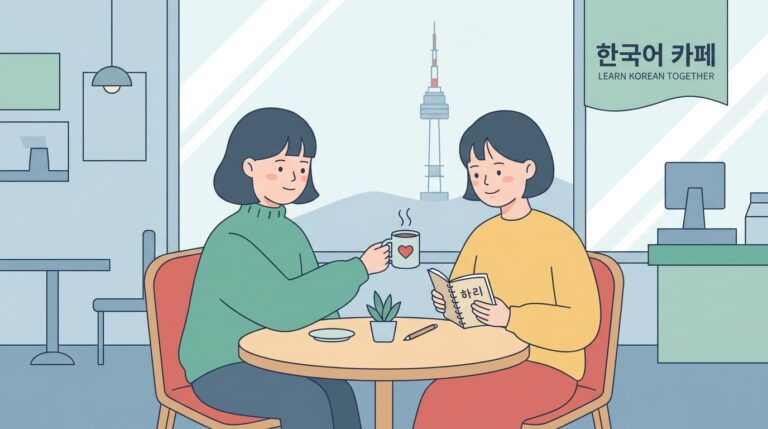
Setting: A quiet cafe near Sinchon Station. Minho is staring down at his phone with a heavy sigh.
- Minho: 하… 나 이번 공무원 시험 또 떨어졌어. 진짜 끝인가 봐. (Ha… I failed the civil service exam again. I guess I’m done for.)
- You: 정말? 속상하겠다… 그동안 준비하느라 진짜 고생 많았는데. (Really? That must hurt so much… You worked so hard preparing all this time.)
- Minho: 1년 동안 독서실에서만 살았는데 허탈해. (I lived in the study room for a whole year. I feel so empty.)
- You: 🎭 [Gently tapping his forearm] 당연히 허탈하지. 그래도 너무 자책하지 마. 네 노력이 부족했던 건 아니잖아. (Of course you feel empty. But don’t blame yourself too much. It’s not like you didn’t try your best.)
- Minho: 친구들은 다 취업하고 나만 제자리걸음인 것 같아. (Everyone else is getting hired and I feel like I’m the only one stuck in place.)
- You: 남들이랑 비교하지 마. 네 페이스대로 가면 돼. (Don’t compare yourself to others. You just need to go at your own pace.)
- Minho: 위로해 줘서 고마워… (Thanks for comforting me…)
- You: 오늘 공부 생각은 다 접고, 맛있는 거 먹으러 가자. 내가 쏠게! (Let’s put study thoughts away for today and eat something delicious. My treat!)
🔀 Interactive Decision Branch
What should you say next when Minho hesitates?
- Option A: “빨리 내일부터 다시 공부 계획 세우자!” (Let’s plan your study schedule for tomorrow right away!)
- Option B: “매운 거 먹고 오늘 하루만 푹 쉬자. 응?” (Let’s eat spicy food and get some good rest just for today. Okay?)
- Option C: “왜 떨어졌는지 오답 노트 같이 볼까?” (Shall we look at your incorrect answer notes together to see why you failed?)
Branch Feedback:
* Option A (Risk): Too rushed! They need time to process emotions before diving into logistics.
* Option B (Best!): Perfect balance of empathy and Korean comfort culture.
* Option C (Bad): Never act like a tutor when your friend is grieving a defeat!
Phase 6: 10-Second Emotion Shadowing Drill
Practice these lines focusing on natural intonation and pauses marked with /:
[🥺 Empathic & Soft]- 마음 많이 / 안 좋지? / 속상하겠다…
- Maeum man-i / an jot-ji? / Sok-sang-ha-get-da…
[💪 Reassuring & Warm]- 그동안 / 진짜 고생 많았어. / 너무 자책하지 마.
- Geu-dong-an / jin-jja go-saeng man-a-sseo. / Neo-mu ja-chaek-ha-ji ma.
[😋 Cheerful & Uplifting]- 오늘은 다 잊고 / 맛있는 거 먹으러 가자! / 내가 살게!
- Oneul-eun da it-go / ma-sin-neun geo meog-eu-reo ga-ja! / Nae-ga sal-ge!
Phase 7: K-Culture Mini Dictionary
- 수고했어 (Su-go-haess-eo): “You did well / Good job.” Used universally among close peers after finishing any challenging task.
- 멘탈 붕괴 (Men-tal bung-goe / 멘붕 Men-bung): “Mental breakdown.” A popular slang term used when an unexpected failure leaves someone in shock.
- 당 충전 (Dang chung-jeon): “Sugar recharge.” The act of eating sweet desserts (like macarons or boba) to recover emotional energy.
- 토닥토닥 (To-dak-to-dak): Onomatopoeia for gently patting someone on the back or shoulder to comfort them.
Phase 8: Traveler’s Survival Kit
Survival Expressions Top 3
- 괜찮아, 다 잘될 거야. (Gwaen-chanh-a, da jal-doel geo-ya. – It’s okay, everything will turn out fine.) -> Pro tip: Use a low, calm voice tone.
- 기운 내! (Gi-un nae! – Keep your chin up / Gain some strength!) -> Pro tip: Best accompanied with a light fist pump.
- 내가 항상 응원하는 거 알지? (Nae-ga hang-sang eung-won-ha-neun geo al-ji? – You know I’m always rooting for you, right?)
Editor’s Travel Note
If you want to take your friend to a quiet place to chat, explore serene rooftop cafes around Mangwon or Yeonnam-dong using the Naver Map app download guide rather than generic foreign map apps. Also, keep KakaoTalk Gift (카카오톡 선물하기) handy—sending a small coffee voucher with the message “힘내!” is the standard Korean way of sending long-distance cheer.
Phase 9: A Step Deeper (Reflection)
In Korean society, academic and career evaluations often carry intense community expectations. When someone fails, they frequently feel as though they let down their entire circle. Understanding this collective pressure allows you to offer comforting words that heal not just the disappointment of failure, but the isolation that follows.
💬 Your Turn: How do people around you usually comfort someone after a major disappointment in your country? Leave a comment below and share your culture!
Phase 10: FAQ & Common Mistakes
Q: Can I use “화이팅 (Fighting!)” when a friend just failed an exam?
A: It is better to avoid it immediately after bad news. “Fighting!” is an encouraging cheer before or during a battle, but right after a loss, it can sound tone-deaf. Stick to “고생 많았어” first.
Q: What is the difference between 수고했어 and 고생했어?
A: Sugo-haesseo focuses on general task completion, while Gosaeng-haesseo specifically empathizes with the difficulty, hardship, and emotional pain endured.
Q: Can I say “힘내세요” to a senior colleague who missed a promotion?
A: Yes! “힘내세요, 과장님. 이번에 고생 많으셨습니다” is polite, considerate, and appropriate for workplace settings.
🚨 Common Mistakes Alert
- Mistake: Asking “왜 떨어졌어?” (Why did you fail?)
- Correct Action: Wait for them to explain on their own terms.
- Mistake: Saying “별일 아니야” (It’s no big deal).
- Correct Action: Acknowledge the gravity of their effort with “속상하겠다”.
- Mistake: Using casual Banmal (고생했어) to an older acquaintance.
- Correct Action: Use polite honorifics: “고생 많으셨어요.”
Phase 11: Action Missions
- 🥉 Bronze: Record yourself shadowing the 3 emotion drills in Phase 6 on your voice memo app.
- 🥈 Silver: Send a supportive Korean message (“오늘 하루도 고생 많았어!”) to a study partner or on social media.
- 🥇 Gold: Use “내가 살게, 맛있는 거 먹으러 가자” next time you hang out with a Korean friend who is feeling down.
- 🎮 K-Culture Mission: Watch an episode of a slice-of-life drama (like Misaeng or Hospital Playlist) and spot how colleagues comfort each other after a tough day.
Phase 12: Interactive Quiz Challenge
1. Which phrase is most comforting right after hearing a friend failed a test?
* A) 시험 왜 못 봤어?
* B) 그동안 고생 많았어, 너무 자책하지 마.
* C) 다음엔 열심히 해.
2. Fill in the blank:
* “오늘 맛있는 거 먹으러 가자. 내가 _____!” (I’ll pay / treat!)
3. True or False:
* Asking for detailed test scores right after a friend fails is considered good etiquette in Korea.
🔍 Click here to reveal the answers & explanations!
- Answer: B (Acknowledges effort and prevents self-blame without judgment).
- Answer: 살게 (or 쏠게) (내가 살게 = My treat!).
- Answer: False (Nunchi dictates giving the friend space without prying into test scores).







