

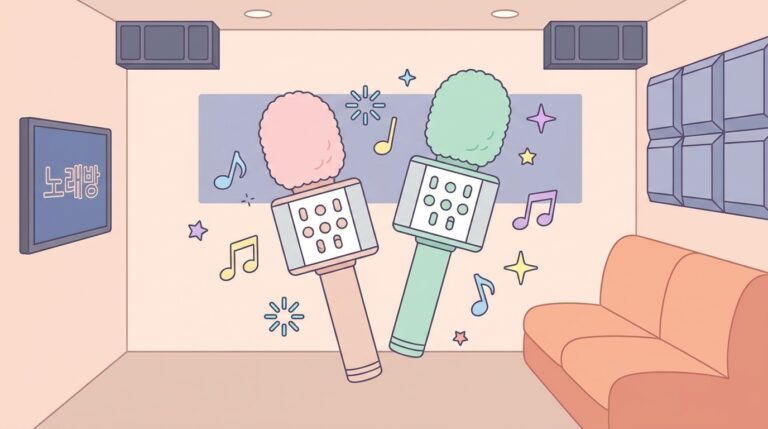
Mastering Korean Noraebang Etiquette: How to Handle Mic Hygiene Covers Like a Local
Phase 1: Empathy (Story-Driven Opening)
안녕하세요! I’m your Daily Hangul editor and your 10-year local culture navigator.
Picture this: you and your Korean colleagues or friends finally wrap up a hearty Korean BBQ dinner and someone shouts, “2차는 노래방 가자!” (Let’s hit the karaoke for round two!). You step into a neon-lit, private Noraebang room with a spinning disco ball. The beat starts thumping, tambourines are rattling, and you grab one of the heavy wireless microphones. But wait—on the table sits a tiny crinkly plastic pouch containing two stretchy, mesh-like caps that look suspiciously like miniature shower caps. Everyone is eyeing the mics, waiting for someone to do the honors.
Do you tear the pouch open immediately? Do you stretch it over both mics? What if you drop it on the sticky floor? In Korean social outings, small moments like handling the 마이크 위생 커버 (mic hygiene cover) reveal a ton about your nunchi (social intuition) and consideration for others. If you’ve ever felt frozen in a Noraebang trying to figure out who covers what and how to say it naturally in Korean, you are in the right place. Based on hundreds of real expat karaoke experiences, this B2-level guide will transform you from an awkward bystander into the smoothest, most considerate singing buddy in the room!
Phase 2: Top 3 Core Expressions Deep Dive
1. 마이크 커버 좀 씌워 줄래? (Ma-i-keu keo-beo jom ssui-wo jul-rae?)
- Pronunciation: mah-ee-keu kuh-buh jom shee-wo jool-leh? (Sounds like English “mic cover” followed by she-war-jool-leh)
- Meaning: Literal: “Can you put the mic cover on?” | Actual Nuance: “Hey, could you pop the hygiene cover on the mic for us?”
- K-Culture Moment: Seen frequently in K-Dramas like Work Later, Drink Now, when someone takes charge of the song selection while delegating mic prep to their bestie.
- Editor’s Insight: The verb 씌우다 (to cover/put over) is specific to placing a cap, hat, or cover over an object. Adding 좀 (a little/please) softens the command into a warm, natural request.
- Situation Spectrum: Casual ✅ | Semi-formal ⚠️ (마이크 커버 좀 씌워 주실래요?) | Formal 🚫
- 🤔 Think About It: Why do Koreans prioritize covering shared items together before starting an activity? How does shared physical preparation build group rapport in your culture?
2. 위생 커버 카운터에서 더 받아올게. (Wi-saeng keo-beo ka-un-teo-e-seo deo bad-a-ol-ge.)
- Pronunciation: wee-seng kuh-buh kah-oon-tuh-eh-suh duh bah-dah-ohl-geh
- Meaning: Literal: “I will receive more hygiene covers from the counter.” | Actual Nuance: “I’ll run to the front desk and grab extra mic covers for us.”
- K-Culture Moment: A classic move in variety shows like Hangout with Yoo when extra guests crash the private room and there aren’t enough covered mics to go around.
- Editor’s Insight: The grammar ending -(으)ㄹ게 signals an immediate personal commitment or voluntary action done for the group’s benefit.
- Situation Spectrum: Casual ✅ | Semi-formal ✅ (받아올게요) | Formal ⚠️ (받아오겠습니다)
- 🤔 Think About It: Offering to fetch supplies without being asked is the pinnacle of Korean social etiquette. What small voluntary actions carry similar weight in your hometown?
3. 마이크 소독 다 된 건가? (Ma-i-keu so-dok da doen geon-ga?)
- Pronunciation: mah-ee-keu soh-dok dah dwen geon-gah
- Meaning: Literal: “Has the mic sanitization all been done?” | Actual Nuance: “I wonder if these mics are already sanitized? (Let’s check before singing.)”
- K-Culture Moment: In modern slice-of-life dramas, health-conscious characters check the UV sterilizer rack on the wall before grabbing a mic.
- Editor’s Insight: Using -ㄴ 건가? forms a self-directed wondering question, which prevents you from sounding accusatory toward the venue staff or your companions.
- Situation Spectrum: Casual ✅ | Semi-formal ⚠️ (소독 다 된 건가요?) | Formal 🚫
- 🤔 Think About It: How does phrasing a concern as a soft rhetorical question reduce social friction compared to direct statements?
Phase 3: Textbook Korean vs. Real-Life Korean
Situation 1: Preparing the Microphones Before the First Song
- 📖 Textbook Korean: 마이크에 위생 커버를 장착한 후에 노래를 부르십시오. (Please sing after attaching the hygiene cover to the microphone.)
- 🗣️ Real-Life Korean: 커버 먼저 씌우고 시작하자! (Let’s cap the mics first before we start!)
- 💡 Why is it different? Real Korean speakers avoid rigid bureaucratic verbs like 장착하다 (to equip/install) in casual party settings and favor breezy suggestions like 씌우고 시작하자.
Situation 2: Asking the Noraebang Counter Staff for Extra Covers
- 📖 Textbook Korean: 마이크 위생 덮개를 추가로 제공해 주실 수 있습니까? (Could you provide additional microphone hygiene coverings?)
- 🗣️ Real-Life Korean: 사장님, 여기 마이크 커버 하나만 더 챙겨주세요~ (Boss, could you hook us up with one more mic cover pack?)
- 💡 Why is it different? The friendly honorific 사장님 (Boss/Owner) combined with the warm verb 챙겨주다 (to kindly provide/look after) builds instant goodwill with local shopkeepers.
Phase 4: K-Culture Deep Dive & Non-Verbal Manners
4-1. Nunchi & Mic Gestures
When opening the sanitary cover pouch, rip it open cleanly and stretch the elastic ring over the metal mesh head of the mic. Crucial etiquette tip: Never stretch just your own mic while leaving your singing partner’s mic bare! Always cover both microphones provided in the room. Once covered, hand the second mic to your friend with both hands (or one hand lightly supporting your wrist/forearm). This shows respect, cleanliness, and seamless teamwork.
4-2. The Cultural Code of Hygiene in Shared Spaces
Karaoke in Korea is an explosive, high-energy collective ritual where people belt high notes inches away from the mic grille. Post-pandemic Noraebang culture treats the 마이크 위생 커버 not as an optional accessory, but as fundamental mutual respect (배려). Even high-end coin Noraebangs (코인노래방) supply free sealed covers at the entrance. Skipping the cover can make Korean peers subtly uncomfortable, so capping the mic unprompted instantly earns you “honorary local” status.
Phase 5: Real-Life Roleplay Scenario
Setting: A vibrant, neon-lit Hongdae Noraebang. You are with your Korean coworker Minwoo (민우), who is frantically flipping through the songbook remote.
- 민우: (리모컨으로 인기 차트를 넘기며) 와, 오늘 스트레스 다 풀고 가자! 뭐 부를래?
(Looking through the popular chart with the remote) Wow, let’s blow off all our stress today! What do you wanna sing? - You: 🎭 Tearing open the plastic pouch on the table with a smile
You: 일단 마이크 커버 먼저 씌우자. 여기 네 거야!
(Let’s put the mic covers on first. Here’s yours!) - 민우: 🎭 Receiving the mic with both hands and nodding
민우: 오, 센스 대박! 땡큐. 근데 이거 커버 씌우니까 소리 안 줄어드나?
(Oh, amazing sense! Thank you. But does putting this cover on dampen the sound?) - You: 🎭 Tapping the mic lightly to check the echo
You: 전혀 안 줄어들어! 음질 깔끔하게 잘 나와.
(Not at all! The sound quality comes out super clean.) - 민우: (마이크를 쥐고 흔들며) 나 첫 곡으로 버즈 노래 예약했다? 같이 떼창 가자!
(Shaking the mic) I just reserved a Buzz song for the first track. Let’s do a group sing-along!) - You: 🎭 Grabbing the tambourine on the sofa
You: 좋아, 간주 점프하고 바로 달리자!
(Nice, let’s jump the intro and dive right in!) - 민우: (웃으며) 오케이, 탬버린 털기 장전 완료!
(Laughing) Okay, tambourine shake fully loaded!) - You: 🎭 Raising your covered mic like a rockstar
You: 오늘 보너스 시간 끝날 때까지 목 쉬도록 부르는 거야!
(We’re singing until our voices go hoarse till the bonus time runs out!)
🔀 Interactive Branching Point
What do you do if you notice the mic hygiene cover has a tear in the mesh?
* Option A: Silently ignore it and sing anyway to avoid disrupting the vibe.
👉 Feedback (Bad): Spittle and moisture will get through, and your friend might notice and feel uneasy.
* Option B: Say, “어, 이거 찢어졌다. 카운터 가서 새로 하나 받아올게!” and fetch a fresh pack.
👉 Feedback (Best): Perfect B2 conversational fluency and ultimate consideration (센스 만점)!
* Option C: Ask Minwoo to sing without a cover while you take the intact one.
👉 Feedback (Risk): Extremely awkward and ruins group harmony instantly (눈치 제로).
Phase 6: 10-Second Emotional Shadowing Drill
Practice reading these out loud, pausing briefly at the / marks to mirror native speech rhythm:
[🎤 자신감 넘치고 배려 깊게]
“마이크 커버 / 양쪽에 다 씌웠으니까 / 이제 첫 곡 시작하자!”
(Since I covered both mics, let’s start the first song!)-
[🏃 친절하고 빠른 행동]
“어? 커버가 모자라네? / 내가 카운터에서 / 얼른 더 받아올게!”
(Huh? We’re short on covers? I’ll quickly grab more from the counter!) -
[😆 장난기 가득하고 신나게]
“위생 커버 장착 완료! / 오늘 마이크 / 절대 안 놓칠 거야!”
(Hygiene covers fully installed! I’m definitely not letting go of the mic today!)
Phase 7: K-Culture Mini Dictionary
- 위생 커버 (Wi-saeng keo-beo) | Hygiene Cover
Disposable non-woven fabric cap placed over microphones in Noraebangs, coin karaoke booths, and corporate presentation halls to prevent the spread of droplets. - 탬버린 털기 (Taem-beo-rin teol-gi) | Tambourine Tremolo / Shaking
A high-energy party skill where you rapidly shake and roll the tambourine against your knuckles or hip to hype up whoever is singing. - 서비스 / 보너스 시간 (Seo-bi-seu / Bo-neo-su si-gan) | Free Bonus Time
Free extra minutes (often +20 or +30 mins) added to your karaoke room clock by kind venue owners when your session is near expiration. - 간주 점프 (Gan-ju jeom-peu) | Intro / Interlude Skip
Pressing the remote’s 간주점프 button to skip long instrumental breaks and jump straight to the next vocal verse to maximize song time.
Phase 8: Survival Kit for Travelers
Top 3 Survival Phrases
- 한글: “마이크 커버 새 거 있어요?”
Romanization: Ma-i-keu keo-beo sae geo it-seo-yo?
Pro Tip: Use this at coin Noraebang kiosks if the dispenser basket near the entrance is empty. - 한글: “무선 마이크 배터리 다 됐어요.”
Romanization: Mu-seon ma-i-keu bae-teo-ri da dwaet-seo-yo.
Pro Tip: If the red light blinks and sound cuts out, hand the mic to the staff with this line. - 한글: “서비스 시간 좀 더 주실 수 있나요?”
Romanization: Seo-bi-seu si-gan jom deo ju-sil su it-na-yo?
Pro Tip: Ask politely when ordering drinks at the counter for a chance at free bonus minutes!
Editor’s Travel Note
When hunting for clean, top-tier karaoke rooms in Seoul, avoid random basement bashes and search for franchise coin Noraebangs like TJ Coin Noraebang or RockQ Coin using the [Naver Map app download for foreign travelers]. Most self-service coin Noraebangs place hygiene covers right by the automated payment machine—take exactly one two-pack per room so you don’t deplete supplies for other singers!
Phase 9: Step Deeper (Reflection)
In Korean society, sharing items like communal stew pots (찌개) or shared microphones carries a dual tension: a deep desire for communal warmth (정) balanced against a strict code of mutual hygiene (청결). The humble microphone cover is a cultural bridge—it allows everyone to scream their hearts out into the same device without an ounce of germ anxiety. Putting the cover on for someone else is a silent micro-gesture of affection that says, “I care about your health as much as our fun.”
💬 Your Turn: What small hygiene or dining habits in your country show unspoken respect for the group? Share your thoughts in the comments below!
Phase 10: FAQ Schema & Common Mistakes
Q: Do I have to pay extra for microphone hygiene covers in Korea?
A: No! In 99% of regular Noraebangs and coin karaoke venues, hygiene covers are complimentary. They are either placed inside the room on the table, handed to you at check-in, or kept in a dispenser near the entrance kiosk.
Q: Does putting a cover over the microphone muffle your singing voice?
A: Not noticeably. They are made from ultra-thin, acoustically transparent non-woven fabric designed to let sound waves pass while blocking moisture and spit droplets.
Q: What should I do with the used covers when our karaoke time ends?
A: Pull them off the microphones and toss them into the wastebasket inside your room before leaving. Leaving dirty covers on the mics makes cleanup harder for the staff.
🚨 Common Mistakes TOP 3
- Mistake: Tearing open the pouch and only covering your own mic.
Correct Action: Always cover both mics at the same time and hand the second one to your friend. - Mistake: Throwing away the cover after just one song.
Correct Action: Keep the same cover on the mic for your entire session; change it only if it rips. - Mistake: Confusing the sanitizing UV stand with a standard storage dock.
Correct Action: If the mic sits in a glowing blue/purple cradle, make sure you put it back upright between songs to keep it charged and sanitized.
Phase 11: Action Missions
- 🥉 Bronze Mission (Solo): Practice saying “마이크 커버 먼저 씌우고 시작하자!” smoothly in front of a mirror three times in 10 seconds.
- 🥈 Silver Mission (Social): Share your favorite K-pop song you’d belt out at Noraebang on Instagram/TikTok using
#DailyHangulNoraebang. - 🥇 Gold Mission (Real Life): Next time you visit a karaoke room with friends, proactively grab the cover pouch, prep both mics, and pass one with two hands!
- 🎮 K-Culture Mission: Watch any backstage variety show clip (like Idol Room or Run BTS) and spot the moment the idols fit the mesh covers onto their handheld mics.
Phase 12: Interactive Quiz Challenge
Q1. (Situational Judgment) You enter a coin Noraebang room and see two bare microphones on the stand. Where do you most likely find the hygiene covers?
1. You must buy them at a convenience store outside.
2. In a small paper or plastic basket next to the payment machine/entrance.
3. You have to bring your own cloth from home.
🔍 Click here to reveal the answer & explanation!
Correct Answer: 2
Explanation: In Korean coin Noraebangs, complimentary two-pack hygiene covers are provided in small baskets or wall dispensers right by the check-in counter or kiosk!
Q2. (Fill in the Blank) Complete the considerate phrase to tell your friend you will get more covers from the counter:
“내가 카운터에서 커버 더 ________ (받아올게 / 씻어올게).”
🔍 Click here to reveal the answer & explanation!
Correct Answer: 받아올게 (bad-a-ol-ge)
Explanation: 받아오다 means to go fetch/receive and bring back. 씻어오다 means to wash and bring back, which doesn’t apply to disposable covers!
Q3. (True or False) It is considered polite in Korea to leave used mic covers attached to the microphone when you leave the room so the next person knows they were used.
🔍 Click here to reveal the answer & explanation!
Correct Answer: False (X)
Explanation: Used mic covers should be stripped off and discarded into the trash can (쓰레기통) before you exit the room as basic courtesy (매너) for the cleaning staff and next customers.







