

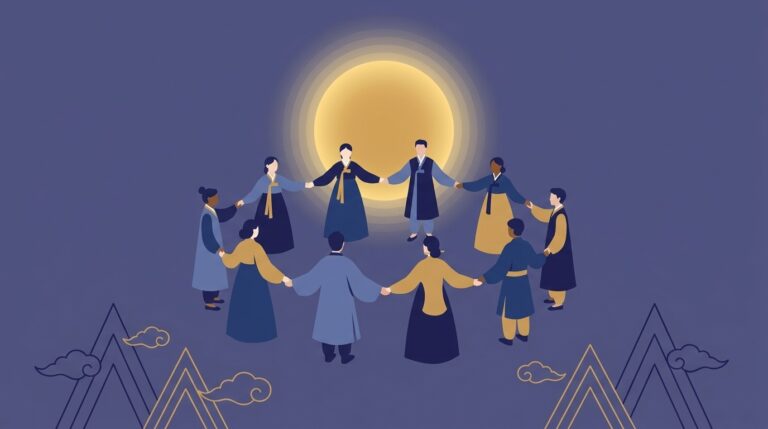
Phase 1: Empathy & Immersion
안녕하세요! 매일한글 에디터입니다. (Hello! I’m your Daily Hangul editor.)
Imagine standing under a glowing full moon on a crisp Chuseok autumn evening. Around you, hundreds of people link hands, beginning with a slow, hypnotic hum that gradually escalates into a swirling, breathless crescendo of shared laughter and resonant stomping. This is Ganggangsullae (강강술래)—inscribed by UNESCO as an Intangible Cultural Heritage of Humanity in 2009. But if you have ever tried to discuss this profound tradition with Korean friends or cultural historians at an advanced level, you might have felt stuck using elementary phrases like “한국의 전통 춤이에요” (It is a traditional Korean dance).
To truly grasp and articulate Korea’s heritage at a C1 proficiency, you need the language of communal emotion, historical resonance, and rhythmic synergy. This guide is crafted directly from our advanced tutoring archives to help you navigate cultural discussions, academic exchanges, and real-life festival moments with nuanced, authentic phrasing that native speakers respect.
Phase 2: Core C1 Expressions Breakdown
1. 손에 손을 잡고 흥을 돋우다 (Son-e son-eul japgo heung-eul doduda)
- Pronunciation: [Sohn-eh sohn-eul jahp-go heung-eul doh-doo-da] (Think of “heung” as an energetic ‘hung’ sound voiced from the chest)
- Meaning: Literal: “Holding hand in hand and raising the excitement.” Nuance: Building a shared, electrifying communal momentum where individual boundaries dissolve.
- K-Culture Moment: Frequently heard in historical dramas (사극) or travel documentaries when festival participants transition from the slow opening (Jinyangjo) to rapid (Hwimori) circular dancing.
- Editor’s Insight: Heung (흥) is untranslatable as simple “fun”; it signifies an intrinsic cultural joy. Pair it with doduda (to stoke/raise) to describe creating communal synergy.
- Situation Spectrum: Casual ⚠️ | Semi-formal ✅ | Formal ✅
- 🤔 Think About It: How does English articulate shared emotional escalation compared to the singular concept of heung (흥)?
2. 어깨를 나란히 하며 호흡을 맞추다 (Eokkaereul naranhi hamyeo hoheub-eul matchuda)
- Pronunciation: [Uh-kkae-reul nah-rahn-hee hah-myeo hoh-heub-eul maht-choo-da]
- Meaning: Literal: “Aligning shoulders and synchronizing breathing.” Nuance: Establishing profound solidarity, egalitarian collaboration, and rhythmic harmony.
- K-Culture Moment: Used by Korean art critics and choreographers when discussing the egalitarian circular structure of Ganggangsullae, where there is no single lead soloist.
- Editor’s Insight: Hoheup (breathing/tempo) combined with matchuda (to match) is a standard advanced idiom used across arts, business mergers, and team projects.
- Situation Spectrum: Casual ✅ | Semi-formal ✅ | Formal ✅
- 🤔 Think About It: Notice how physical proximity and synchronized physiological rhythm symbolize social unity in Korean thought.
3. 한(恨)을 흥(興)으로 승화시키다 (Han-eul heung-euro seunghwasikida)
- Pronunciation: [Hahn-eul heung-eu-ro seung-hwah-shee-kee-da]
- Meaning: Literal: “Sublimating sorrow/unresolved grief into collective joy.” Nuance: Transforming historical trauma and hardship into vibrant artistic resilience.
- K-Culture Moment: Heard in UNESCO heritage lectures, Korean literature debates, and introspective talk shows dissecting Korean performing arts.
- Editor’s Insight: This phrase represents the quintessential philosophical axis of traditional Korean aesthetics. Using seunghwasikida (to sublimate) instantly elevates your speech to an intellectual tier.
- Situation Spectrum: Casual 🚫 | Semi-formal ✅ | Formal ✅
- 🤔 Think About It: Does your native culture possess an artistic mechanism specifically designed to convert collective historical pain into public celebration?
Phase 3: Textbook Korean vs. Real Korean
Scenario 1: Suggesting people join in the traditional circle dance
- 📖 교과서 한국어: “이 놀이는 원형으로 서서 참여하는 놀이입니다.” (This game is played by standing in a circle.)
- 🗣️ 진짜 한국어: “주저하지 마시고 다 같이 손잡고 한 바퀴 돌며 흥 좀 내볼까요?” (Don’t hesitate—shall we all hold hands, spin around, and get into the groove?)
- 💡 왜 다를까?: Textbook phrasing is instructional and detached; native Korean engagement relies on invitational mood (-ㄹ까요?) and sensory verbs (흥을 내다).
Scenario 2: Highlighting why Ganggangsullae gained UNESCO status
- 📖 교과서 한국어: “강강술래는 유네스코 인류무형문화유산이라 가치가 큽니다.” (Ganggangsullae has high value because it is a UNESCO Intangible Cultural Heritage.)
- 🗣️ 진짜 한국어: “단순한 민속놀이를 넘어 공동체 연대의식을 오롯이 담아낸 게 유네스코 등재의 결정적 이유죠.” (Beyond a simple folk game, its complete embodiment of communal solidarity is the definitive reason for its UNESCO inscription.)
- 💡 왜 다를까?: C1 speakers replace generic words like 가치가 크다 with precise terminology like 공동체 연대의식 (communal solidarity) and 오롯이 담아내다 (wholly embody).
Phase 4: K-Culture Deep Dive & Non-verbal Manners
4-1. Nunchi & Physical Etiquette in Collective Rituals
When participating in or observing Ganggangsullae at folk villages or national holiday events:
1. Grip Pressure: Do not squeeze adjacent hands tightly with your fingers; rather, cup your fingers gently over the next person’s palm to allow circular rotation without friction.
2. The Gaze (시선 처리): Avoid staring intently at individual feet. Direct your gaze toward the center of the ring or across the circle to maintain collective visual balance.
3. Rhythmic Adaptation: Pay close nunchi to the leading vocalist (seosori); adjust your walking step from slow heel-to-toe pacing to quick leaping ball-of-the-foot steps only as the tempo dictates.
4-2. Cultural Code Analysis: The Naval Defense & Women’s Resistance
While Ganggangsullae originated in agricultural rituals celebrating fertility and harvest, popular history links its widespread adoption to Admiral Yi Sun-sin during the Imjin War (1592). Women wore military garments and circled Mount Okmae to deceive enemy Japanese forces into overestimating Korean military strength. It is simultaneously an agrarian harvest ritual and a historic symbol of female collective defense.
Phase 5: Real-world Roleplay Scenario
- Setting: The National Gugak Center’s open courtyard during the Autumn Eve Festival.
- Characters: You (Advanced Korean learner) & Curator Min-ji (National Heritage Specialist).
-
[Turn 1] Curator Min-ji: “선생님, 오늘 강강술래 공연 보시니까 어떠세요? 생각보다 템포 변화가 역동적이죠?”
(Teacher, how do you find the Ganggangsullae performance today? The tempo change is more dynamic than expected, right?)
🎭 Gesturing towards the spinning circle with a proud smile. -
[Turn 2] You: “네, 느린 진양조로 시작해서 휘모리로 몰아칠 때 전율이 돋더라고요. 한을 흥으로 승화시킨다는 말이 절로 와닿았습니다.”
(Yes, when it began in slow Jinyangjo and drove into rapid Hwimori, I got chills. The saying about sublimating sorrow into joy resonated instantly.)
🎭 Nodding rhythmically while maintaining eye contact. -
[Turn 3] Curator Min-ji: “어머, 전통 장단 용어까지 꿰고 계시네요! 맞아요, 군무 속에서 느껴지는 카타르시스가 남다르죠?”
(Oh, you even know traditional rhythmic terms inside out! Exactly, the catharsis felt in the group dance is extraordinary, isn’t it?) -
[Turn 4] You: “개인의 독무가 아니라 어깨를 나란히 하며 호흡을 맞추는 평등한 구조라 더 감동적이에요.”
(Rather than a solo dance, the egalitarian structure of standing shoulder-to-shoulder and matching breaths makes it even more moving.) -
[Turn 5] Curator Min-ji: “정확한 통찰이세요. 유네스코 위원회에서도 바로 그 공동체적 가치와 포용성을 높이 평가했거든요.”
(That is an accurate insight. The UNESCO committee evaluated precisely that communal value and inclusivity very highly.) -
[Turn 6] You: “단순한 옛 놀이가 아니라 현대 사회의 단절을 치유하는 힘도 지닌 것 같아요.”
(It is not just an ancient game; it seems to possess the power to heal the disconnections of modern society too.) -
[Turn 7] Curator Min-ji: “마침 관객 참여 순서인데, 같이 원 안으로 들어가서 직접 흥을 돋워보실래요?”
(It happens to be audience participation time—shall we step into the circle together and build up the excitement?)
🎭 Extending an open hand invite. -
[Turn 8] You: “좋습니다! 백문이 불여일견이니 온몸으로 한국의 얼을 느껴봐야죠.”
(Sounds wonderful! Seeing is believing, so I must experience Korea’s spirit with my whole body.)
🔀 Interactive Decision Point
How will you respond to Min-ji’s invitation in Turn 7?
* Option A: “좋습니다! 백문이 불여일견이니 온몸으로 한국의 얼을 느껴봐야죠.” (Best: Culturally adept, demonstrates high-level proverb usage and enthusiastic participation)
* Option B: “저는 외국인이라 춤을 잘 못 춰서 구경만 할게요.” (Bad: Creates unnecessary social distance and breaks the communal atmosphere)
* Option C: “네, 그런데 저 발 아픈데 잠깐만 들어가도 괜찮을까요?” (Risk: Grammatically acceptable, but dampens the shared momentum and energy)
Phase 6: 10-Second Emotional Shadowing Drill
- [😊 고조되는 환희 / Thrilled & Energized]
느린 장단에서 / 점점 빨라지면서 / 손에 땀을 쥘 만큼 / 엄청난 흥이 솟구쳐요!
(Nurin jangdan-eseo / jeomjeom ppallajimyeonseo / sone ttameul jwil mankeum / eomcheongnan heungi sotguchyeoyo!) -
[🧐 학술적 감탄 / Deeply Impressed & Analytical]
누구 하나 튀지 않고 / 어깨를 나란히 하며 / 호흡을 맞추는 모습에서 / 진정한 공동체 정신이 느껴집니다.
(Nugu hana twiji anko / eokkaereul naranhi hamyeo / hoheubeul matchuneun moseubeseo / jinjeonghan gongdongche jeongsini neukkyeojimnida.)
Phase 7: K-Culture Mini Dictionary
- 인류무형문화유산 (Inryu Muhyeong Munhwa Yusan) | UNESCO Intangible Cultural Heritage of Humanity | Formal term used in cultural administration, journalism, and academic discussions.
- 선소리와 뒷소리 (Seosori & Dwitsori) | Lead Call and Response Singing | The dynamic structure of Ganggangsullae where a lead singer improvises verses and the circle sings the communal refrain.
- 원무 (Wonmu) | Circular Group Dance | The structural choreographic term representing unity and equality without hierarchical placement.
- 대동단결 (Daedong-dangyeol) | Great Unity / Solidarity | Advanced socio-political idiom describing large groups overcoming differences to unite for a singular purpose.
Phase 8: Traveler’s Survival Kit
Survival Expressions TOP 3
- “강강술래 체험 프로그램은 현장 접수도 가능한가요?” (Can I register on-site for the Ganggangsullae experience program?)
Pro Tip: Useful at folk villages (민속촌) or regional festival booths. - “이 놀이의 유래에 대해 외국어 해설을 들을 수 있을까요?” (Could I listen to a foreign language commentary about the origin of this game?)
Pro Tip: National heritage sites provide free audio guides or QR codes in English. - “대열 중간에 합류해도 괜찮을까요?” (Is it okay if I join in the middle of the dance formation?)
Pro Tip: Polite phrasing before breaking into an existing circle.
Editor’s Travel Note
When visiting traditional performing arts venues like the National Gugak Center or Namsangol Hanok Village, confirm event schedules via the Visit Korea Official Portal before departure. For seamless subway transfers to cultural heritage performances across Seoul and Jeollanam-do, ensure you keep your T-Money balance loaded.
Phase 9: One Step Deeper
In Western performance paradigms, the boundary between spectator and performer is traditionally stark. In Korean folk performance, specifically within Ganggangsullae, this boundary systematically collapses. The performance attains its highest aesthetic state only when the spectator steps across the threshold into the active circle. This cultural ethos demonstrates that Korean tradition views art not as a display to be evaluated from afar, but as a living emotional vessel (heung) meant to be co-created in real time.
💬 Your Turn: What traditional celebration in your home country removes the barrier between performer and audience in a similar way? Share your thoughts below in Korean!
Phase 10: FAQ & Common Mistakes
Q: Is Ganggangsullae only performed during Chuseok?
A: While historically rooted in harvest and full-moon rituals such as Chuseok and Jeongwol Daeboreum, today it is actively showcased year-round at cultural festivals, international exhibitions, and performing arts centers.
Q: Can men participate in Ganggangsullae?
A: Traditionally, Ganggangsullae was an exclusively female communal ritual. However, in modern festival adaptations, educational workshops, and open public celebrations, anyone can participate regardless of gender.
Q: What is the main musical instrument accompanying Ganggangsullae?
A: Pure Ganggangsullae is primarily a cappella, relying on the human voice (Seosori and Dwitsori), rhythmic foot stomping, and clapping, occasionally accented by the Janggu (hourglass drum) or Buk.
🚨 Common Mistakes (흔한 실수)
- ❌ Mistake: Using “강강술래를 플레이하다” (Mixing English loanwords).
- Correct Action: Use “강강술래를 하다” or “강강술래 놀이에 참여하다/동참하다”.
- ❌ Mistake: Calling it simply “민속 춤” (folk dance) in formal analytical settings.
- Correct Action: Refer to it as “종합 예술 형태의 인류무형문화유산” (comprehensive artistic intangible cultural heritage).
- ❌ Mistake: Assuming the tempo is static throughout.
- Correct Action: Reference the progression: 긴강강술래 (Slow) → 중강강술래 (Medium) → 자진강강술래 (Fast).
Phase 11: Action Mission & Engagement
- 🥉 Bronze Mission: Record yourself reading the Phase 6 Shadowing Drill with accurate pauses (
/) and appropriate emotional inflection. - 🥈 Silver Mission: Write a 3-sentence commentary on a Korean cultural video using the term 한을 흥으로 승화시키다.
- 🥇 Gold Mission: Visit a Korean heritage festival or class and politely ask: “저도 원무 대열에 합류해서 호흡을 맞춰봐도 될까요?”
- 🎮 K-Culture Mission: Search for modern K-Pop choreographies or stage adaptations that incorporate circular motifs reminiscent of Ganggangsullae and analyze them.
Phase 12: Interactive Quiz Challenge
1. Situational Judgment
Which phrase is most appropriate when writing an analytical essay on why Ganggangsullae fosters communal unity?
* A) 사람들이 그냥 둥글게 서서 뛰니까 재밌다.
* B) 어깨를 나란히 하고 호흡을 맞추며 신분과 계층을 초월한 연대를 다졌다.
* C) 손을 잡고 돌면서 심심함을 달래기 위해 노래를 불렀다.
2. Fill in the Blank
전통 예술에서 조상들은 역사적 슬픔과 고난인 ( )을/를 신명 나는 ( )(으)로 승화시켰습니다.
3. True / False
Ganggangsullae features a strict, rigid solo performance hierarchy where one master dancer performs while others sit silently. (True / False)
🔍 Click here to reveal Quiz Answers & Explanations
- Answer: B | Explanation: Choice B employs formal C1 lexicon (호흡을 맞추다, 신분과 계층을 초월한 연대) suitable for cultural analysis.
- Answer: 한(恨), 흥(興) | Explanation: Sublimating collective sorrow (Han) into vibrant joy (Heung) is central to Korean aesthetic philosophy.
- Answer: False | Explanation: Ganggangsullae is an egalitarian circular group dance (Wonmu) without isolated solo hierarchies.







