

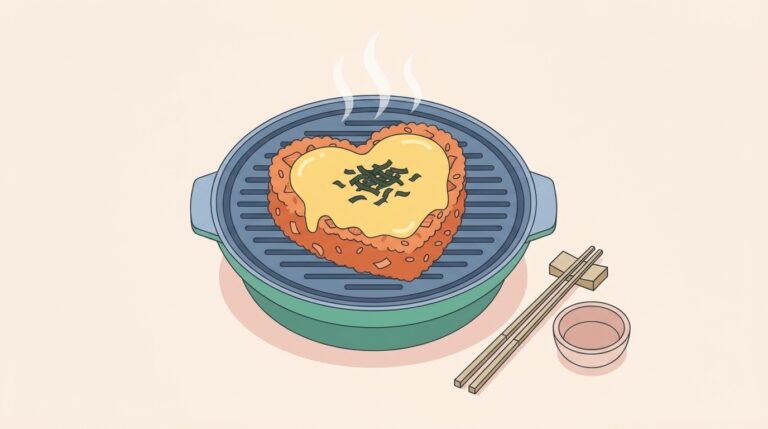
Phase 1: Empathy — Welcome to the Real Korean Finale!
안녕하세요! 매일한글 에디터입니다! (Hello! It’s your Daily Hangul editor!)
Picture this: You’re in a sizzling Dakgalbi (spicy stir-fried chicken) or Samgyeopsal (pork belly) restaurant in Hongdae with Korean friends. You’ve eaten until your waistband is begging for mercy. You lean back, satisfied, thinking the feast is over. Suddenly, your Korean friend catches the server’s eye and proclaims with sparkling excitement, “사장님, 여기 밥 두 개 볶아주세요!” (Boss, please fry two servings of rice here!).
Wait, what?! You thought dessert meant bingsu, ice cream, or an iced Americano. In Korea, however, the ultimate climax to any savory pan-cooked meal is unapologetically rice. We affectionately call this the “K-Dessert” (K-디저트). If you put down your spoon before the fried rice hits the grill, you haven’t truly experienced Korean dining culture.
Mastering this ritual is your golden ticket to transitioning from a mere tourist to a true insider who understands the soul of Korean dining. Based on feedback from hundreds of intermediate learners, this guide will equip you with the exact B2-level phrases, nuanced dining etiquette, and confidence to claim your rightful portion of the crispy pan-bottom goodness!
Phase 2: 3 Core Expressions Deep Dive
1. 밥 볶아 주세요 (Bap bokk-a ju-se-yo)
- Pronunciation: [Bahp bok-kah joo-seh-yo] (Rhymes loosely with pop and mocca)
- Meaning: Literal: “Please fry the rice” | Real Nuance: “We are ready for the grand finale—bring on the K-Dessert!”
- K-Culture Moment: You’ll see this in almost every food variety show like Delicious Rendezvous or K-Dramas whenever characters wrap up a heavy meal of Gopchang (grilled intestines) or Tteokbokki.
- Editor’s Insight: Timing is everything. Don’t eat all your meat and veggies down to a bare pan! Koreans deliberately leave 10-15% of the sauce and toppings behind so the server can chop them into the rice for flavor.
- Situation Spectrum: Casual: ✅ | Semi-formal: ✅ | Formal: ⚠️ (In ultra-fine dining, courses are pre-set, but in casual/business BBQ spots, this is 100% standard)
- 🤔 Think About It: In many Western food cultures, starch/carbs are served alongside protein. Why do you think Korean cuisine saves the ultimate carb rush for the very end of the meal?
2. 배불러도 볶음밥 배는 따로 있어요 (Bae-bul-leo-do bokk-eum-bap bae-neun tta-ro iss-eo-yo)
- Pronunciation: [Bae-bool-luh-doh bok-eum-bahp bae-noon ttah-roh ees-uh-yoh]
- Meaning: Literal: “Even if I’m full, there is a separate stomach for fried rice” | Real Nuance: “There’s always room for dessert—and by dessert, I mean fried rice!”
- K-Culture Moment: A witty reaction when your dining companions ask, “Can you really eat more?” and you show your unwavering dedication to rice.
- Editor’s Insight: This plays on the universal phrase 디저트 배는 따로 있다 (There’s a separate stomach for dessert), cleverly subbing in 볶음밥 to establish your street credibility.
- Situation Spectrum: Casual: ✅ | Semi-formal: ✅ | Formal: 🚫
- 🤔 Think About It: How does humor play a role in breaking social barriers around dining tables in your culture compared to Korea?
3. 바닥까지 싹싹 긁어 먹어야 제맛이에요 (Ba-dak-kka-ji ssak-ssak geul-geo meog-eo-ya je-mat-i-e-yo)
- Pronunciation: [Bah-dahk-kkah-jee sahk-sahk gool-guh mawg-uh-yah jeh-maht-ee-eh-yoh]
- Meaning: Literal: “It only tastes right if you scrape it clean down to the bottom” | Real Nuance: “The crispy crust at the bottom is the absolute prize.”
- K-Culture Moment: Characters fighting playfully over the scorched bottom layer (누룽지, Nurungji) using their flat metal spoons.
- Editor’s Insight: 싹싹 (ssak-ssak) is an onomatopoeia for vigorous scraping. Saying this shows you genuinely appreciate the texture and flavor contrast that Koreans obsess over.
- Situation Spectrum: Casual: ✅ | Semi-formal: ✅ | Formal: ⚠️
- 🤔 Think About It: Does your native cuisine celebrate slightly burned/crispy textures (like Spanish socarrat in paella or Persian tadig)? How does language highlight these culinary treasures?
Phase 3: Textbook Korean vs. Real Korean
Situation 1: Ordering fried rice after finishing the meat
- 📖 Textbook Korean: “여기 볶음밥을 주문하고 싶습니다.” (I would like to order fried rice here.)
- 🗣️ Real Korean: “사장님, 여기 밥 하나 볶아주세요! 치즈 추가도 되나요?” (Boss, please fry one bowl of rice here! Can we add cheese too?)
- 💡 Why is it different? Native speakers rarely say “order fried rice” as a noun object; they use the active verb phrase 밥을 볶다 (fry the rice) and frequently customize it with cheese or seaweed flakes (김가루).
Situation 2: Expressing amazement at how much everyone is eating
- 📖 Textbook Korean: “우리는 음식을 정말 많이 먹었습니다.” (We have eaten a lot of food.)
- 🗣️ Real Korean: “완전 탄수화물 폭탄인데 멈출 수가 없네요!” (This is a total carb bomb, but I seriously can’t stop!)
- 💡 Why is it different? B2 speakers use trendy compound expressions like 탄수화물 폭탄 (carb bomb) with playful self-deprecation about overeating during social bonding.
Phase 4: K-Culture Deep Dive & Non-Verbal Manners
4-1. Nunchi (눈치) & Table Gestures
- The Holy Wait (인내의 시간): When the server spreads the rice thinly across the hot griddle, do not touch it immediately. The collective Nunchi rule is to let it sit undisturbed for 1 to 2 minutes on low heat so the bottom develops a golden, crunchy crust (누룽지).
- The Spoon Angle: Hold your metal spoon at a 45-degree angle to scrape the pan. Avoid using chopsticks—it marks you as a novice! When scraping, hold the pan handle with a thick napkin so the pan doesn’t slide around.
4-2. Cultural Code: The Philosophy of Rice (밥심)
In Korea, rice is not merely a side dish; it represents vitality and care—expressed in the concept of 밥심 (the strength derived from rice). Greeting someone with “밥 먹었어?” (Have you eaten?) is equivalent to asking “How are you?”. Turning leftover savory sauces from Dakgalbi, Gamjatang, or Tteokbokki into fried rice is the ultimate culmination of communal eating—everyone dips their spoons into the same single pan, sharing warmth and closure.
Phase 5: Interactive Roleplay Scenario
Setting: A bustling Dakgalbi restaurant in Sinchon with sizzling aromas and clinking glasses. You are dining with your Korean coworker, Min-su.
- Min-su: “와, 닭갈비 거의 다 먹었네요. 배부르시죠?” (Wow, the dakgalbi is almost gone. You’re full, right?)
🎭 Puts down his chopsticks and wipes his hands with a wet wipe - You: “배는 부른데… 한국에서는 볶음밥으로 마무리해야 한다면서요?” (I am full, but… didn’t you say in Korea we have to finish with fried rice?)
🎭 Smirks and points at the remaining sauce on the pan - Min-su: “오! 역시 한국 문화 제대로 아시네요! 사장님 부를까요?” (Oh! You truly know Korean culture! Shall we call the owner?)
🎭 Eyes light up with genuine excitement - You: “네! 저기요, 사장님! 여기 밥 두 개만 볶아주세요!” (Yes! Excuse me, Boss! Please fry two portions of rice here!)
🎭 Raises hand slightly with a friendly tone - Owner (Server): “네~ 치즈나 날치알 추가해 드릴까요?” (Sure~ Would you like to add cheese or flying fish roe?)
🎭 Approaches with a metal bowl of rice, seaweed, and sesame oil - You: “치즈 추가해 주세요! 바닥 바삭하게 볶아주시면 감사하겠습니다.” (Please add cheese! We’d appreciate it if you fry it nice and crispy on the bottom.)
🎭 Smiles politely - Owner (Server): “네, 1분 뒤에 불 끄고 드시면 제일 맛있어요!” (Okay, turn off the heat in 1 minute and eat, that’s when it tastes best!)
🎭 Expertly flattens the rice across the pan and sprinkles cheese - Min-su: “자, 숟가락 장전하시고… 바닥까지 싹싹 긁어 먹어봅시다!” (Now, lock and load spoons… let’s scrape it clean to the bottom!)
🎭 Holds spoon ready like a sword
🔀 Interactive Choice Point
The cheese is melted and the bottom is sizzling. What will you do next?
- Choice A: Turn off the stove immediately, stir the rice vigorously right away so it doesn’t stick at all, and serve it into individual bowls.
- Choice B: Wait patiently for about a minute until you hear a gentle crackling sound, then say, “누룽지 생길 때까지 조금만 더 기다려요!” (Let’s wait a little longer until the crust forms!).
- Choice C: Tell Min-su you’re on a low-carb diet and ask the server to pack the fried rice in a doggy bag without touching it.
::: Feedback
- Choice A (Risk): Turning it off immediately prevents the coveted 'nurungji' (crispy bottom) from forming! You lose 50% of the delicious texture.
- Choice B (Best!): Spot-on Korean dining master! Waiting for the sizzle shows elite patience and deep respect for the art of fried rice.
- Choice C (Bad): While boundaries are respected, bringing up strict keto during the sacred finale of a group dinner might deflate the collective high-spirited mood.
:::
Phase 6: 10-Second Emotion Shadowing Drill
Practice matching the rhythm and intonation indicated by /.
[😋 신나고 기대감 가득하게 / Excited & Expectant]- “배불러도 / 볶음밥 배는 / 따로 있는 거 아시죠?”
- (Bae-bul-leo-do / bokk-eum-bap bae-neun / tta-ro iss-neun geo a-si-jyo?)
[🔥 비장하고 당당하게 / Determined & Confident]- “사장님! / 여기 밥 하나 볶아주시고 / 치즈 꼭 추가해 주세요!”
- (Sa-jang-nim! / Yeo-gi bap ha-na bokk-a-ju-si-go / chi-jeu kkok chu-ga-hae ju-se-yo!)
[🤤 감탄하며 만족스럽게 / Relishing & Deeply Satisfied]- “역시 / 바닥에 눌어붙은 밥을 / 긁어먹어야 제맛이에요.”
- (Yeok-si / ba-dak-e nul-eo-buteun bap-eul / geul-geo-meog-eo-ya je-mat-i-e-yo.)
Phase 7: K-Culture Mini Dictionary
- 누룽지 (Nu-rung-ji): Scorched, crispy rice formed at the bottom of a hot pot or pan. Highly prized as a delicacy, snack, or savory aftertaste.
- K-디저트 (K-Di-jeo-teu): Slang referring to the cultural phenomenon of eating fried rice (or noodles) as the mandatory “dessert” course after a savory Korean meal.
- 후식 (Hu-sik): Formal Korean word for dessert or post-meal course. In casual restaurants, menus often list 후식 볶음밥 or 후식 냉면 at a discounted price.
- 탄수화물 폭탄 (Tan-su-hwa-mul Pok-tan): “Carbohydrate bomb.” A playful term used when indulging in a carb-heavy meal without regrets.
Phase 8: Survival Kit for Travelers
Top 3 Survival Phrases
- “밥 몇 개 볶을까요?” (Bap myeot gae bokk-eul-kka-yo?)
- Meaning: “How many servings of rice shall we fry?”
- Pro Tip: If you are a party of 3, order 밥 두 개 (2 servings). Fried rice portions expand heavily on the grill!
- “치즈 사리 추가해 주세요.” (Chi-jeu sa-ri chu-ga-hae ju-se-yo.)
- Meaning: “Please add cheese topping.”
- Pro Tip: 사리 (sari) refers to add-on toppings like noodles, rice cakes, or cheese.
- “불 꺼도 돼요?” (Bul kkeo-do dwae-yo?)
- Meaning: “Can I turn off the heat now?”
- Pro Tip: Ask this if the rice is smoking too much and you’re worried about burning it.
Editor’s Travel Note
- When hunting for authentic pan-fry BBQ or Dakgalbi places in Seoul, download the Naver Map navigation application instead of standard global map apps to read real, unfiltered local reviews containing the keyword 볶음밥 맛집 (Fried Rice Hotspot).
- Payment Tip: When splitting the bill (N-ppang / 엔빵), fried rice and added drinks are tallied together at the counter on your main table slip.
Phase 9: “One Step Deeper” (Cultural Reflection)
In Western dining, individuality is celebrated through separate plated dishes. Korean cuisine, however, is built on the spirit of 정 (Jeong)—affectionate communal bonding. Eating fried rice right out of the shared pan with multiple spoons clinking against each other reflects an unspoken intimacy. It signals: We are close enough to share this meal down to the very last grain. The act of scraping the bottom together is more than eating; it is the final punctuation mark on shared camaraderie.
💬 Your Turn: What is that one “cannot-skip” dining ritual in your home culture that foreign visitors often find surprising? Drop your thoughts in the comments below! Let’s chat! 👇
Phase 10: FAQ & Common Mistakes
Q: Can I order fried rice at any Korean restaurant?
A: No. Fried rice as a dessert is specifically available at restaurants where food is cooked in a wide tabletop grill, skillet, or pot (e.g., Dakgalbi, Samgyeopsal with iron plates, Gopchang, Gamjatang, Ddeokbokki, or Shabu-shabu). Traditional soup shops (Gukbap) or charcoal-grill establishments usually offer bowls of plain steamed rice instead.
Q: How much leftover meat/sauce should I leave in the pan before ordering?
A: Leave about 3 to 4 spoonfuls of sauce and a few pieces of meat or veggies. If your pan is completely bone-dry and burned, the server might not be able to infuse rich flavor into the rice.
Q: What if I don’t want spicy fried rice?
A: You can ask: “안 맵게 볶아주실 수 있나요?” (Could you fry it without making it spicy?). The server can reduce the red paste (Gochujang) and add extra sesame oil and seaweed.
🚨 Common Mistakes Warning Board
| Mistake | Why It’s Awkward | Correct Action |
|---|---|---|
| Scraping with chopsticks | Inefficient, bends the chopsticks, and marks you as an outsider. | Use the flat stainless-steel spoon at a firm angle. |
| Eating it immediately | The rice will be soggy and mushy without that crispy crust. | Wait 1–2 minutes on low heat for the 누룽지 to set. |
| Leaving no sauce behind | Server won’t have enough flavor base to coat the grains. | Keep a modest palm-sized portion of sauce and meat bits in the pan. |
Phase 11: Action Missions
- 🥉 Bronze Mission (Solo Mastery): Practice saying “사장님, 여기 밥 하나 볶아주시고 치즈 추가해 주세요!” smoothly in front of a mirror in under 5 seconds.
- 🥈 Silver Mission (SNS Sharing): Next time you watch a K-Drama or mukbang where fried rice appears, screenshot the moment and post it on your Instagram Story with the caption: “K-디저트는 역시 볶음밥! #DailyHangul #KoreanFood”.
- 🥇 Gold Mission (Real Life Execution): Visit a Korean restaurant this week, eat a stir-fry meal, and boldly order 볶음밥 using our Phase 5 roleplay phrases without reverting to English!
- 🎮 K-Culture Bonus Mission: Watch an episode of Street Alcohol Fighter or I Live Alone (나 혼자 산다) and tally how many times celebrities fight over the scorched pan crust!
Phase 12: Interactive Quiz Challenge
1. Situational Judgment: You are at a Gamjatang (pork backbone stew) restaurant. The soup is almost finished. What is the most natural way to order the finale?
* (A) 사장님, 디저트 메뉴판 주세요. (Boss, please give me the dessert menu.)
* (B) 사장님, 여기 밥 볶아주세요! (Boss, please fry rice here!)
* (C) 사장님, 케이크 하나 주세요. (Boss, please give me a cake.)
🔍 Click to view the Answer & Explanation
- Correct Answer: (B)
- Explanation: In Korean hot pot and skillet cuisine, 밥 볶아주세요 is the authentic cultural equivalent of ordering the post-meal finale!
2. Fill-in-the-Blank: Complete the iconic foodie saying:
“배불러도 __________ 배는 따로 있어요!”
* (A) 김치 (Kimchi)
* (B) 볶음밥 (Fried rice)
* (C) 물 (Water)
🔍 Click to view the Answer & Explanation
- Correct Answer: (B) 볶음밥
- Explanation: While “디저트 배” is traditional, saying “볶음밥 배” is the quintessential modern food joke in Korea.
3. True or False: In Korea, it is considered bad manners to scrape the scorched crispy rice (누룽지) off the pan.
* (A) True
* (B) False
🔍 Click to view the Answer & Explanation
- Correct Answer: (B) False
- Explanation: Scraping the bottom pan clean is the highest compliment you can pay to the meal and is universally encouraged!







