

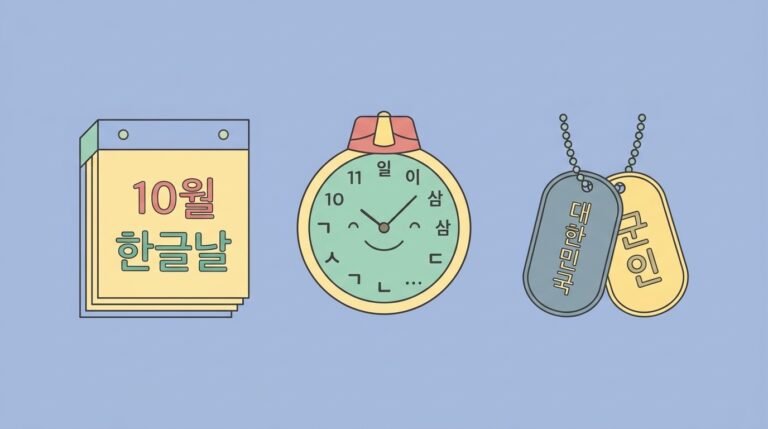
Phase 1: Empathy & Story Immersion
안녕하세요! It is your Daily Hangul editor and your Korean culture bestie! Have you ever followed a K-Pop idol or a K-Drama actor only to be heartbroken by the dreaded enlistment announcement? Suddenly, your social media feed turns into a daily countdown timer, tracking percentages like “D-342 (41.2%)” and posting photos of them with a buzz cut. Or maybe you have a close Korean friend who just enlisted, and when you ask them, “How are you doing?”, they reply with cryptic phrases about counting the days backward.
Counting down to military discharge (전역 날짜 세기) is practically an art form and an emotional national pastime in Korea. For active soldiers, their friends, partners (gomshin), and global fans alike, tracking military service time involves distinct vocabulary, social etiquette, and funny cultural quirks. If you use textbook phrases, you will sound like a 1980s radio broadcaster. But when you master the real phrases, you can genuinely comfort a friend or connect deeply with fellow fans. Let us break down the exact expressions and cultural nuance you need at an intermediate (B1) level!
Phase 2: Top 3 Core Expressions Deep-Dive
1. 전역일 언제야? (Jeonyeok-il eonjeya?)
- Pronunciation: [Jeon-yeok-il eon-je-ya] (Sounds like: John-yeok-eel un-jeh-yah)
- Meaning: “When is your discharge date?” (Direct: Discharge day when is it?)
- K-Culture Moment: Asking a friend or celebrity on a live broadcast when they will finally return to civilian life.
- Editor’s Insight: 전역 (Jeonyeok) is the official and most natural term for finishing active mandatory military service. While 제대 (Jedae) is also correct, 전역 is used much more frequently in daily conversation among young people.
- Situation Spectrum: Casual (✅) / Semi-formal (전역일이 언제예요? ✅) / Formal (전역일이 언제이십니까? ⚠️)
- 🤔 Think About It: In many countries without mandatory service, asking for someone’s discharge date is rare. Why do you think asking this in Korea instantly builds solidarity and shows care?
2. 국방부 시계는 돌아간다 (Gukbangbu sigyeneun doraganda)
- Pronunciation: [Guk-bang-bu shi-gye-neun do-ra-gan-da] (Sounds like: Gook-bahng-boo she-gyeh-noon doh-rah-gahn-dah)
- Meaning: “The Ministry of Defense clock still ticks.” / “Time eventually passes, hang in there.”
- K-Culture Moment: Said as a lighthearted, comforting proverb to a soldier complaining about how slowly time moves.
- Editor’s Insight: Even if life inside the base feels completely frozen, calendar days are still crossing off. It is an empathetic yet funny reminder that discharge day is inevitable.
- Situation Spectrum: Casual (✅) / Semi-formal (국방부 시계는 돌아가요 ✅) / Formal (🚫)
- 🤔 Think About It: How does humor play a role in coping with challenging, restrictive life situations across different cultures?
3. 며칠 남았어? / 디데이 얼마야? (Myeochil namasseo? / D-day eolmaya?)
- Pronunciation: [Myeo-chil na-ma-sseo? / Dee-deh-ee eol-ma-yah?]
- Meaning: “How many days do you have left?” / “What is your D-Day count?”
- K-Culture Moment: Checking a military progress mobile widget (Goondori) on a phone with your friend during their weekend leave.
- Editor’s Insight: Koreans love D-Day countdowns for everything from exam days to anniversaries, but military countdowns are tracked almost down to the exact percentage (e.g., “I am at 78%!”).
- Situation Spectrum: Casual (✅) / Semi-formal (며칠 남으셨어요? ✅) / Formal (얼마나 남으셨습니까? ⚠️)
- 🤔 Think About It: Why is breaking down a 18-month journey into daily milestones psychologically comforting?
Phase 3: Textbook Korean vs. Real Korean
Situation 1: Asking when someone finishes service
- 📖 Textbook Korean: 언제 군 복무를 마칩니까? (Eonje gun bongmureul machimnikka? – When do you finish military service?)
- 🗣️ Real Korean: 전역 언제 해? / 언제 나와? (Jeonyeok eonje hae? / Eonje nawa? – When is your discharge? / When do you get out?)
- 💡 Why is it different? 군 복무를 마치다 sounds like a news anchor script. Real friends simply ask “전역 언제 해?” or colloquially “언제 나와?” (When do you come out into society?).
Situation 2: Sympathizing with a long remaining service time
- 📖 Textbook Korean: 아직 많은 시간이 남아있군요. 힘내세요. (Ajik maneun sigani namaitgunyo. Himnaeseyo. – There is still much time left. Cheer up.)
- 🗣️ Real Korean: 아직 까마득하네… 그래도 시간 금방 가! (Ajik kkamadeukhane… geuraedo sigan geumbang ga! – Still feels like forever… but time will fly!)
- 💡 Why is it different? The slang adjective 까마득하다 (so far off that it makes you dizzy) captures the exact emotion soldiers feel when looking at the calendar.
Phase 4: K-Culture Deep-Dive & Non-Verbal Manners
4-1. Nunchi & Gestures
- Don’t mock their shaved hair: Korean men often feel awkward about their short hair (kkakk-eun meori). Avoid staring directly at their buzz cut or making teasing remarks.
- The Salute Gesture (충성/단결): Do not casually mock-salute an active-duty soldier in public unless they initiate a joke. To them, the base protocol is serious.
- Buying the Meal: If an active soldier comes out on leave (hyuga), the unspoken Korean social rule is that civilians (friends or older acquaintances) pay for the food and coffee!
4-2. Cultural Code: The World of Gomshin & Military Apps
In Korea, waiting for someone in the military gave birth to the term 곰신 (Gomshin), derived from Gomusin (rubber shoes) based on the old proverb about not wearing your shoes backward (cheating while waiting). Today, loved ones and global fans use popular countdown apps like 군돌이 (Goondori) to track real-time promotion steps (Private -> Corporal -> Sergeant) and discharge percentages!
Phase 5: Real-Life Roleplay Scenario
Setting: You are having iced Americanos at a cafe in Hongdae with your Korean university classmate, Min-ho (민호), who is currently out on weekend leave (hyuga).
- Turn 1 (Min-ho): 오랜만에 사회 공기 마시니까 진짜 살 것 같다! 🎭 (Takes a big sip of coffee and smiles brightly)
- (It feels so good to breathe civilian air after so long!)
- Turn 2 (You): 민호야, 나와서 정말 좋다! 요즘 군 생활은 할 만해? 🎭 (Warm eye contact, offering a snack)
- (Min-ho, it is so great you are out! Is military life manageable these days?)
- Turn 3 (Min-ho): 처음보단 적응했는데, 시간이 진짜 안 가. 🎭 (Sighs dramatically)
- (I adapted better than before, but time really does not pass.)
- Turn 4 (You): 진짜 고생 많다. 지금 전역까지 며칠 남았어? 🎭 (Nodding sympathetically)
- (You are really working hard. How many days do you have left until discharge?)
- Turn 5 (Min-ho): 나 이제 230일 남았어. 아직 50% 겨우 넘겼네. 🎭 (Shows his phone screen with a countdown widget)
- (I have 230 days left now. I barely passed 50%.)
- Turn 6 (You): 벌써 반이나 넘었네! 국방부 시계는 돌아가니까 조금만 더 힘내! 🎭 (Pats his shoulder encourageingly)
- (You are already past halfway! The defense clock still ticks, so hang in there a bit more!)
- Turn 7 (Min-ho): 고맙다 진짜. 네 말 들으니까 위로가 된다. 오늘 커피는 내가 살게! 🎭 (Reaches for his wallet)
- (Thanks so much. Hearing your words is really comforting. I’ll buy coffee today!)
- Turn 8 (You): 무슨 소리야! 군인한테 커피를 어떻게 얻어먹어. 내가 낼게! 🎭 (Quickly taps your card first with a smile)
- (What are you talking about! How could I let a soldier buy me coffee. My treat!)
🔀 Interactive Choice Point
When Min-ho shows you his 50% progress widget, what do you say?
* Option A: “와, 아직 반이나 남았어? 230일이면 까마득하다… 언제 기다려?” (Feedback: BAD. Pointing out how brutally long it feels will only deflate his spirits!)
* Option B: “벌써 반이나 넘었네! 국방부 시계는 돌아가니까 시간 금방 갈 거야.” (Feedback: BEST. Acknowledging the 50% milestone and using the classic proverb provides maximum encouragement!)
* Option C: “군대 편하잖아? 핸드폰도 쓰는데 시간 금방 가지 않아?” (Feedback: RISK. Even with modern phone privileges, mandatory service is still physically and mentally exhausting. Never say military life is “easy”!)
Phase 6: 10-Second Emotion Shadowing Drill
Practice reading these out loud by feeling the natural pauses (/) and emotions:
[😊 다정하게 격려하며]전역까지 / 며칠 남았어? / 시간 진짜 금방 갈 거야!
(How many days left until discharge? / Time will fly by really fast!)[😎 쿨하고 든든하게]걱정하지 마, / 국방부 시계는 / 오늘도 돌아간다!
(Don’t worry, / the Ministry of Defense clock / keeps on ticking today too!)[🥳 신나게 축하하며]와! / 드디어 다음 달 전역이야? / 진짜 축하해!
(Wow! / You’re finally discharged next month? / Huge congratulations!)
Phase 7: K-Culture Mini Dictionary
- 전역 (Jeonyeok) | Military Discharge: The formal completion of mandatory military duties and transition back to civilian life.
- 곰신 (Gomshin) | Waiting Partner: A girlfriend or fan patiently waiting for a soldier to complete their service.
- 휴가 (Hyuga) | Military Leave / Vacation: Official authorized time away from the base to visit family and friends.
- 군돌이 (Goondori) | Military Countdown App: The ubiquitous mobile app used across Korea to count down D-Days, paydays, and rank promotions.
Phase 8: Traveler’s Survival Kit
- Expression 1: 휴가 나오셨어요? (Hyuga naosyeosseoyo? – Are you out on vacation/leave?) — Pro Tip: A polite phrase if you run into a friend or acquaintance in uniform on the subway.
- Expression 2: 오늘 제가 살게요! (Oneul jega salgeyo! – It’s my treat today!) — Pro Tip: Use this to show Korean cultural manners by treating a serving soldier to a meal or drink.
- Expression 3: 몸 건강히 잘 다녀와요! (Mom geonganghi jal danyeowayo! – Stay healthy and return safely!) — Pro Tip: The best parting wish when someone is enlisting or returning to base.
Editor’s Travel Note: If you want to check train schedules to military hub cities like Chuncheon or Nonsan, search on the KORAIL Talk Official Booking App for fast KTX reservations.
Phase 9: A Step Deeper (Reflection Essay)
In Korean society, military service represents a shared rite of passage for young men and an emotionally shared experience for the community supporting them. When Koreans track discharge dates down to single percentages, it is not merely about counting hours; it is a shared emotional ritual of endurance, support, and collective empathy. Understanding this dynamic helps you see how Korean friendships are forged through mutual support during life’s most challenging transitions.
💬 Your Turn: Who is the Korean celebrity or friend whose military discharge date you have tracked or are currently waiting for? Share your countdown story in the comments below!
Phase 10: FAQ & Common Mistakes
Q: What is the difference between 제대 (Jedae) and 전역 (Jeonyeok)?
A: Both mean finishing military service! However, 전역 is the modern administrative and conversational standard among younger generations, while 제대 is an older, broader term.
Q: Can I use “전역 축하해” to someone who just finished public service duty (사회복무요원)?
A: For public service personnel, people often say “소집해제 축하해” (Congratulations on release from call-up), though “전역 축하해” is colloquially understood in casual circles.
Q: How do fans calculate military countdowns for idols accurately?
A: Fans download Korean apps like ‘군돌이 (Goondori)’ and enter the idol’s branch of service (Army: 18 months, Navy: 20 months, Air Force: 21 months) and enlistment date for automated calculation.
🚨 Common Mistakes Warning Board
- Mistake: Telling a serving soldier “It must be nice to rest during leave!”
- Correct Action: Acknowledge their hard work: “군 생활 하느라 고생 많지?” (You must be working so hard in service).
- Mistake: Asking overly sensitive operational details about their base.
- Correct Action: Keep conversation centered on daily wellness, food, and upcoming discharge plans.
- Mistake: Confusing enlistment (입대 – Ipdae) with discharge (전역 – Jeonyeok).
- Correct Action: Remember: 입 (Enter) -> 입대 vs. 역 (Role/Transfer) -> 전역.
Phase 11: Action Missions
- 🥉 Bronze Mission (Solo Practice): Practice pronouncing “국방부 시계는 돌아간다” 3 times out loud with rhythmic pacing.
- 🥈 Silver Mission (Social Sharing): Check the D-Day of an enlisted K-Pop idol or actor on an app and write a supportive Korean message (“전역까지 힘내세요!”) on social media.
- 🥇 Gold Mission (Real Life Application): If you meet a Korean friend on military leave, buy them a drink and say: “고생 많다, 전역까지 파이팅!”
🎮 K-Culture Mission: Watch an episode of a military-themed K-Drama (like D.P. or Crash Landing on You) and listen for how characters discuss leaves (휴가) and ranks!
Phase 12: Interactive Quiz Challenge
1. Situational Judgment: Your friend has 100 days left until discharge. What is the most natural, supportive response?
* A) 아직 멀었네. 언제 나와?
* B) 벌써 100일밖에 안 남았어? 시간 금방 간다, 파이팅!
* C) 군대 더 있는 게 낫지 않아?
2. Fill in the Blank: “Don’t worry, the Ministry of Defense clock is still ticking!”
* “걱정 마, [________] 시계는 돌아간다!”
3. True or False: The mobile app widely used in Korea to count military discharge percentages is called ‘Goondori (군돌이)’.
🔍 Click here to reveal Quiz Answers & Explanations!
- Answer: B — Reframing the remaining 100 days as “almost there” gives huge psychological comfort.
- Answer: 국방부 (Gukbangbu) — 국방부 means the Ministry of National Defense.
- Answer: True — Goondori is the most popular app used by soldiers, families, and K-Pop fans worldwide!







