

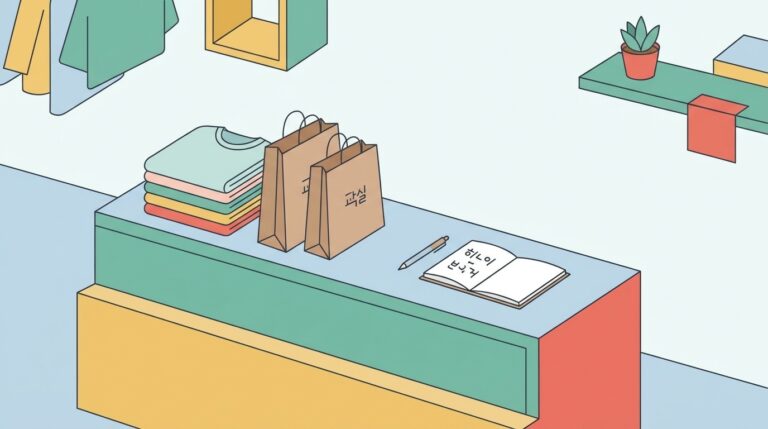
How to Ask for a Shopping Bag in Korea Like a Local
Phase 1: Empathy & The Reality of Shopping in Korea
안녕하세요! 매일한글 (Daily Hangul) editor here! Imagine this: You find the absolute coolest oversized knit sweater in a chic boutique in Hongdae or Seongsu-dong. Feeling triumphant, you tap your card at the counter. The clerk smiles, rings up your item, and suddenly asks a quick question: “Bongtu piryohaseyo?” You freeze, smile awkwardly, nod, and step outside clutching your delicate new clothes directly in your bare hands because you didn’t realize paper and plastic bags cost 100 to 500 KRW in Korea and require explicit consent!
Don’t worry—almost every traveler in Korea has faced this exact mini-panic at checkout. Due to strict eco-friendly regulations, cashiers legally cannot give away free bags. In this guide, tailored specifically for A2 learners, we’ll teach you natural, effortless phrases to ask for a bag (or politely decline) so you can shop around Seoul with effortless confidence.
Phase 2: 3 Essential Expressions for Buying a Shopping Bag
1. 쇼핑백 하나 주세요 (Syopingbaek hana juseyo)
- Pronunciation: Syopingbaek hana juseyo (Sounds like: Show-ping-beck ha-na joo-seh-yo)
- Meaning: “Please give me one shopping bag.” (Polite & Standard)
- K-Culture Moment: You’ll hear this in K-dramas when characters buy gifts in department stores and want an extra presentation bag.
- Editor’s Insight: Syopingbaek usually refers to paper shopping bags with handles, while bongtu refers to plastic or general bags.
- Situation Spectrum: Casual ✅ | Semi-formal ✅ | Formal ✅
- 🤔 Think About It: In English, we usually ask “Can I get a bag?” In Korean, stating the item followed by juseyo (please give) is already the gold standard of politeness.
2. 봉투에 넣어 주세요 (Bongtue neoeo juseyo)
- Pronunciation: Bongtue neoeo juseyo (Sounds like: Bong-too-eh nuh-uh joo-seh-yo)
- Meaning: “Please put it in a bag.”
- K-Culture Moment: A casual shopper purchasing two or three shirts at an underground shopping mall in Gangnam.
- Editor’s Insight: Use this when your clothes are folded on the counter and the clerk is waiting to see if you want them packaged.
- Situation Spectrum: Casual ✅ | Semi-formal ✅ | Formal ⚠️
- 🤔 Think About It: Neota means ‘to put in’. Combining it with -eo juseyo turns an action into a friendly service request.
3. 괜찮아요, 그냥 들고 갈게요 (Gwaenchanhayo, geunyang deulgo galgeyo)
- Pronunciation: Gwaenchanayo, geunyang deulgo galgeyo (Sounds like: Gwen-chan-ah-yo, geun-yang deul-go gal-geh-yo)
- Meaning: “It’s okay, I’ll just carry it as is.”
- K-Culture Moment: Seen frequently in lifestyle vlogs when sustainable Seoulites put small purchases straight into their backpacks.
- Editor’s Insight: Saying gwaenchanhayo alone can sometimes sound ambiguous. Adding geunyang deulgo galgeyo makes your intention 100% crystal clear.
- Situation Spectrum: Casual ✅ | Semi-formal ✅ | Formal ✅
- 🤔 Think About It: Notice how Koreans soften refusals with ‘It is okay’ (Gwaenchanhayo) rather than a direct ‘No’ (Aniyo).
Phase 3: Textbook Korean vs. Real-World Korean
Situation 1: Asking if bags cost money
- 📖 Textbook Korean: 쇼핑백은 얼마입니까? (Syopingbaegeun eolmaimnikka? – How much is a shopping bag?)
- 🗣️ Real Korean: 봉투값 얼마예요? (Bongtukkam eolmayeyo? – How much is the bag fee?)
- 💡 Why is it different? While the textbook form sounds like a military report, real shoppers blend bongtu + gap (price) into the snappy word bongtukkam.
Situation 2: Accepting the extra bag fee
- 📖 Textbook Korean: 네, 백 원을 지불하겠습니다. (Ne, baek woneul jibulhagetseumnida. – Yes, I will pay 100 won.)
- 🗣️ Real Korean: 네, 같이 계산해 주세요. (Ne, gachi gyesanhae juseyo. – Yes, please add it to the bill.)
- 💡 Why is it different? Cashiers simply want to know whether to tap the +100 won button on their POS register. Simple is best!
Phase 4: K-Culture Deep Dive & Non-Verbal Manners
4-1. Nunchi & Payment Gestures
When the cashier asks about the bag, give a light nod and hand your payment card with both hands (or support your right elbow with your left hand). This tiny gesture shows massive respect. If you brought your own eco-bag (에코백), gently hold it up so the cashier sees it right away before they ask!
4-2. The Rise of Eco-Bags in K-Fashion
In Korea, carrying a stylish canvas tote or eco-bag isn’t just about saving 100 KRW—it is a core K-fashion staple seen in student hotspots like Sinchon and university drama campuses. Most trendy fashion brands now sell branded reusable tote bags right by the checkout counter.
Phase 5: Real-World Roleplay Scenario
- Setting: A trendy clothing boutique near Hongdae Station.
- Characters: Cashier (점원 – Friendly staff) & You (손님 – Shopper).
- 점원: 결제 도와드릴게요. (Gyeolje dowadeurilgeyo. / Let me help you check out.)
🎭 Staff smiles and folds your new hoodie neatly. - 손님: 네, 카드 여기 있어요. (Ne, kadeu yeogi isseoyo. / Yes, here is my card.)
🎭 You offer the credit card with both hands. - 점원: 쇼핑백 필요하세요? 100원 추가되세요. (Syopingbaek piryohaseyo? Baekwon chugadoeseyo. / Do you need a shopping bag? It is an extra 100 won.)
- 손님: 네, 쇼핑백 하나 같이 계산해 주세요. (Ne, syopingbaek hana gachi gyesanhae juseyo. / Yes, please add one shopping bag to the total.)
- 점원: 네! 큰 사이즈로 드릴까요? (Ne! Keun saijeuro deurilkkayo? / Sure! Would you like a large size?)
- 손님: 아니요, 작은 걸로 주세요. (Aniyo, jageun geollo juseyo. / No, please give me the small one.)
- 점원: 네, 결제 완료되었습니다. 영수증 드릴까요? (Ne, gyeolje wanryeodoeeotseumnida. Yeongsujeung deurilkkayo? / Payment complete. Would you like a receipt?)
- 손님: 영수증은 버려주세요. 감사합니다! (Yeongsujeungeun beoryeojuseyo. Gamsahamnida! / Please discard the receipt. Thank you!)
🔀 Interactive Choice Point
The clerk asks: “쇼핑백 필요하세요?” (Do you need a shopping bag?)
* Choice A: “네, 담아 주세요.” (Ne, dama juseyo.)
* 👉 Feedback (Best): Natural and polite! The clerk will promptly bag your clothes and charge the standard fee.
* Choice B: “싫어요.” (Sireoyo.)
* 👉 Feedback (Bad): Too blunt! Sireoyo sounds like a child refusing vegetables. Use Gwaenchanhayo instead.
* Choice C: “봉투 공짜 아니에요?” (Bongtu gongjja anieyo?)
* 👉 Feedback (Risk): Awkward! By law, disposable bags cannot be free in Korea. Stating this might make the clerk uncomfortable.
Phase 6: 10-Second Emotion Shadowing Drill
Practice matching the exact rhythm and pitch of a local:
[😊 Cheerful & Direct]
쇼핑백 / 하나 / 주세요!
(Syopingbaek / hana / juseyo!)-
[🤔 Quick & Inquiring]
봉투값 / 얼마예요?
(Bongtukkam / eolmayeyo?) -
[👋 Polite & Easygoing]
괜찮아요, / 그냥 들고 갈게요.
(Gwaenchanhayo, / geunyang / deulgo galgeyo.)
Phase 7: K-Culture Mini Dictionary
- 쇼핑백 (Syopingbaek) | Paper Shopping Bag | Used primarily in clothing stores and department outlets; usually made of stiff paper with rope handles.
- 종량제 봉투 (Jongnyangje bongtu) | Standard Waste Bag | In convenience stores, if you ask for a plastic bag, they often sell you a local government trash bag that you can reuse at home.
- 에코백 (Ekobaek) | Eco Tote Bag | Everyday canvas tote bag popular across all age groups in Seoul.
- 담아주다 (Damajuda) | To pack/bag items | Compound verb (damda to put in + juda to give). Extremely common service vocabulary.
Phase 8: Traveler’s Survival Kit
-
Top 3 Survival Lines:
- 쇼핑백에 넣어 주세요. (Syopingbaege neoeo juseyo. – Please put it in a shopping bag.) -> Pro Tip: Use this right after handing your payment card.
- 가방에 들어갈 것 같아요. (Gabange deureogal geot gatayo. – I think it will fit in my bag.) -> Pro Tip: Say this while patting your backpack to decline politely.
- 그냥 갈게요. (Geunyang galgeyo. – I will take it as is.) -> Pro Tip: Shortest natural way to refuse a bag during fast checkout.
- Editor’s Travel Note:
When shopping around bustling districts like Myeongdong or Dongdaemun, keep a foldable tote in your pocket. Before heading out, check your store routes via Naver Map app download to locate stores with tax-refund kiosks easily!
Phase 9: Think Deeper
In South Korea, charging for bags began as an aggressive national environmental policy in 2019, but it quickly evolved into a shared civic etiquette. When clerks ask if you want a bag, they are balancing customer service with strict environmental regulations. Choosing to say “Geunyang galgeyo” (I’ll carry it) is seen as both eco-conscious and thoughtful.
💬 Your Turn: In your home country, are shopping bags automatically provided or do you pay an extra fee? Share your shopping experiences in the comments below!
Phase 10: FAQ & Common Mistakes
Q: Why do cashiers ask about bags even when I buy ten shirts?
A: By law, retailers face heavy fines if they hand out single-use bags for free. Cashiers must confirm whether you want to purchase a shopping bag regardless of order size.
Q: What is the difference between 봉투 (bongtu) and 쇼핑백 (syopingbaek)?
A: Bongtu is a general term encompassing plastic bags, paper envelopes, and trash bags. Syopingbaek specifically refers to handled shopping bags provided by retail stores.
Q: Can I return the shopping bag if I don’t use it?
A: In clothing shops, paper shopping bags are considered consumables and are usually non-refundable once purchased.
🚨 Common Mistakes Alert
- Saying ‘No’ (Aniyo!) aggressively: Always soften refusals with Gwaenchanhayo (It’s alright).
- Expecting free plastic bags at checkouts: Always assume a 100~500 KRW fee per bag.
- Confusing ‘종이’ (paper) with ‘종량제’ (official garbage bag): At supermarkets, ask for jong-i bongtu if you want paper.
Phase 11: Action Missions
- 🥉 Bronze Mission: Stand in front of a mirror and say “쇼핑백 하나 주세요” 5 times with a bright smile.
- 🥈 Silver Mission: Audio record yourself saying “괜찮아요, 그냥 들고 갈게요” on your phone notes app and verify your rhythm.
- 🥇 Gold Mission: Walk into a retail shop or convenience store in Korea and order a bag in 100% natural Korean without hesitation!
- 🎮 K-Culture Mission: Watch any modern K-drama shopping scene and spot whether the cashier uses bongtu or syopingbaek!
Phase 12: Interactive Quiz Challenge
Q1. You want to ask the clerk to pack your new jacket into a shopping bag. What do you say?
a) 봉투 싫어요. (Bongtu sireoyo.)
b) 쇼핑백에 넣어 주세요. (Syopingbaege neoeo juseyo.)
c) 그냥 갈게요. (Geunyang galgeyo.)
👉 View Answer & Explanation
Correct Answer: b) 쇼핑백에 넣어 주세요.
Explanation: This is the most polite and natural way to ask the staff to place your purchased clothes inside a shopping bag.
Q2. Fill in the blank:
“괜찮아요, 그냥 ______ 갈게요.” (It’s okay, I’ll just carry it.)
👉 View Answer & Explanation
Correct Answer: 들고 (deulgo)
Explanation: Deulgo gada means ‘to carry and go’. Combined with geunyang (just), it means ‘I will just hold it in my hands.’
Q3. True or False: In Korea, clothing boutiques can legally provide free plastic bags if you spend over 100,000 KRW.
👉 View Answer & Explanation
Correct Answer: False
Explanation: Korean environmental regulations mandate charging for disposable bags regardless of total purchase amount!







