

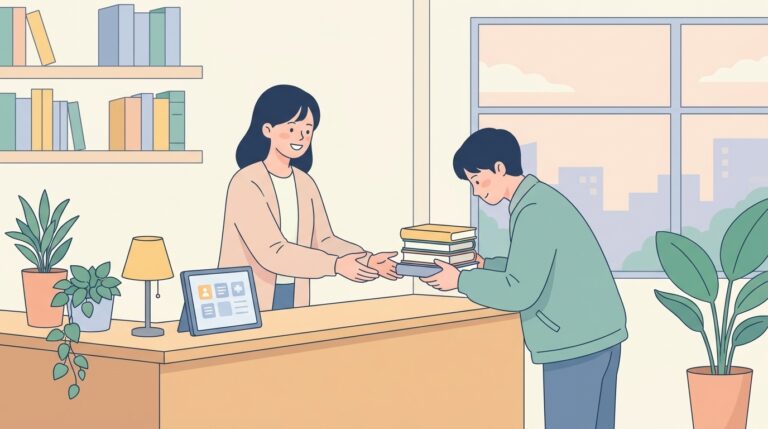
Master Returning Books at a Korean Library Without Breaking the Silence
Phase 1: Empathy (Storytelling Opening)
안녕하세요! 매일한글 에디터입니다. (Hello! This is your Daily Hangul Editor!)
Picture this: You are standing in the middle of a stunning, serene Korean public library—maybe one of those aesthetic neighborhood libraries you spotted in a K-drama like Our Beloved Summer or the iconic Coex Starfield Library. You have finished reading a Korean graded reader or a travel guide, and now it is time to return it. You walk toward the information desk (안내 데스크). The library is pin-drop quiet. Everyone is studying intensely with their colorful highlighters and iced Americanos. Suddenly, a wave of panic hits you: What if I speak too loudly? How do I say ‘return’ politely in Korean? What if my book is overdue and I get scolded?
Take a deep breath! Returning a book in Korea is one of the smoothest, most rewarding everyday interactions you can experience. Over the past decade tutoring A2-level learners, I have seen so many students freeze up at the circulation counter simply because textbooks teach overly stiff, robotic phrases. Today, we are breaking down the exact natural phrases, non-verbal cues, and smart library hacks you need to feel right at home in any Korean library.
Phase 2: Core 3 Expressions Deep Dive
1. 책 반납하러 왔어요. (Chaek ban-nap-ha-reo wa-sseo-yo.)
- Pronunciation: Check bahn-nahp-hah-ruh wah-ssuh-yo (Think of ‘check’ like a bill, ‘bahn’ like a soft bun, and ‘nahp’ snapping gently).
- Meaning: Literal: “I came in order to return a book.” / Actual Nuance: “Hi, I’m here to return this book.”
- K-Culture Moment: The standard, friendly phrase used when stepping up to the librarian’s desk in college campus dramas.
- Editor’s Insight: The pattern
-(으)러 왔어요means “I came here to [verb].” It immediately clarifies your purpose without unnecessary chatter.- Situation Spectrum: Casual: ⚠️ (반납하러 왔어) | Semi-formal: ✅ (반납하러 왔어요) | Formal: ✅ (반납하러 왔습니다)
- 🤔 Think About It: In English, we often just say “Just dropping this off.” How does stating your exact purpose (
반납하러 왔어요) reflect Korean conversational clarity?
2. 대출 연장할 수 있나요? (Dae-chul yeon-jang-hal su in-na-yo?)
- Pronunciation: Deh-chool yuhn-jahng-hahl soo een-nah-yo? (‘Dae-chul’ sounds like ‘day-chul’, ‘yeon’ rhymes with ‘sun’).
- Meaning: Literal: “Is borrowing extension possible?” / Actual Nuance: “Could I extend the borrowing period for this?”
- K-Culture Moment: When a university student in a web drama needs more time to finish their midterm research paper.
- Editor’s Insight:
연장(extension) +-(으)ㄹ 수 있나요?(can I…?) is a versatile combination. You can use it at hotels, car rentals, or train bookings too!- Situation Spectrum: Casual: 🚫 | Semi-formal: ✅ (연장할 수 있나요?) | Formal: ✅ (연장 가능합니까?)
- 🤔 Think About It: Why does adding polite modal questions (
-수 있나요?) make requests sound softer in Korean service interactions?
3. 반납함에 넣으면 되나요? (Ban-nap-ham-e neo-eu-myeon doe-na-yo?)
- Pronunciation: Bahn-nahp-hahm-eh nuh-oo-myuhn dweh-nah-yo? (‘Ham’ like a box container, ‘neo’ like ‘nudge’).
- Meaning: Literal: “If I put it in the return box, will it be okay?” / Actual Nuance: “Can I just drop it in the return drop-box?”
- K-Culture Moment: Late at night when the library interior is closed, but you drop your book into the outdoor automated return chute.
- Editor’s Insight:
-으면 되나요?(“Do I just need to…?”) is the golden phrase for asking about procedures in Korea.- Situation Spectrum: Casual: ⚠️ | Semi-formal: ✅ (반납함에 넣으면 돼요?) | Formal: ✅ (반납함에 넣으면 됩니까?)
- 🤔 Think About It: How does the concept of automated drop-boxes reflect Korea’s fast-paced, high-tech public service system (
Palli-Palliculture)?
Phase 3: Textbook Korean vs. Real-World Korean
Situation 1: Handing the book over at the counter
- 📖 교과서 한국어 (Textbook): “이 책을 도서관에 반납하겠습니다.” (I shall return this book to the library.)
- 🗣️ 진짜 한국어 (Real-World): “이거 반납할게요.” (I’ll return this one, please.)
- 💡 왜 다를까? (Why the difference?): In everyday situations, Koreans prefer concise demonstratives like
이거(this thing) over rigid formal declarations.
Situation 2: Asking if there is an overdue fine or penalty
- 📖 교과서 한국어 (Textbook): “제가 책을 연체하여 벌금을 내야 합니까?” (Did I delay the book and must pay a fine?)
- 🗣️ 진짜 한국어 (Real-World): “혹시 연체료 있나요?” or “연체됐나요?” (Is it overdue? / Is there a late fee?)
- 💡 왜 다를까? (Why the difference?): Starting with
혹시(by any chance) instantly softens the question and sounds humble and natural.
Phase 4: K-Culture Deep Dive & Non-Verbal Manners
4-1. 눈치 (Nunchi) & Polite Gestures
- The Two-Handed Handover: When handing the book or your library card (
대출증) to the staff, hold the item with both hands, or support your right forearm with your left hand. It shows immediate respect. - The ‘Library Whisper’ Volume: Korean libraries take quiet zones very seriously. When speaking at the front counter, lower your volume to an audible, gentle murmur. A slight nod of the head before speaking signals good nunchi.
4-2. Cultural Code: Smart Libraries & K-Drama Aesthetics
In Korea, public libraries have evolved into high-tech community hubs. You will often see 무인 반납기 (smart unmanned return kiosks) located in subway stations and library lobbies. Furthermore, the cozy library vibe is a staple of K-Dramas (think When the Weather is Fine). Understanding how to navigate these spots allows you to experience authentic local life beyond tourist hotspots.
Phase 5: Real-World Roleplay Scenario
- Setting: A sunny afternoon at the Mapo Public Library (
마포평생학습관). - Librarian Minji (민지): Calm, efficient, and wearing wire-rimmed glasses behind the circulation counter.
- You (학습자): Holding two Korean novels you borrowed two weeks ago.
Turn 1 [Librarian Minji]: 🎭 (Looks up and smiles gently)
안녕하세요. 대출이세요, 반납이세요?
(Annyeonghaseyo. Daechul-iseyo, bannap-iseyo?)
"Hello. Borrowing or returning?"

Turn 2 [You]: 🎭 (Placing the books gently on the desk with both hands)
안녕하세요! 반납하러 왔어요.
(Annyeonghaseyo! Bannap-hareo wasseoyo.)
"Hello! I came to return these."

Turn 3 [Librarian Minji]: 🎭 (Scans the barcodes with a beeper)
네, 두 권 확인되셨습니다. 어, 이 책은 반납일이 어제까지였네요.
(Ne, du gwon hwagindoesyeotseumnida. Eo, i chaeg-eun bannap-iri eoje-kkajiyeotneyo.)
"Yes, two books confirmed. Oh, this book was due yesterday."

Turn 4 [You]: 🎭 (Looking apologetic with a slight bow)
앗, 죄송합니다. 혹시 연체료가 있나요?
(At, joesonghamnida. Hoksi yeoncheryoga innayo?)
"Ah, I'm sorry. Is there a late fee by any chance?"

Turn 5 [Librarian Minji]: 🎭 (Typing on the computer)
아니요, 연체료는 없고 하루 동안 대출이 제한돼요.
(Aniyo, yeoncheryoneun eopgo haru dong-an daechuri jehandwaeyo.)
"No, there's no late fee, but your borrowing privilege is paused for one day."

Turn 6 [You]: 🎭 (Nodding understandingly)
아, 네! 알겠습니다. 다른 책은 연장할 수 있나요?
(A, ne! Algetseumnida. Dareun chaeg-eun yeonjang-hal su innayo?)
"Ah, I see! Understood. Can I extend the other book?"

Turn 7 [Librarian Minji]: 🎭 (Clicks the mouse)
네, 이 책은 예약자가 없어서 일주일 연장해 드렸어요.
(Ne, i chaeg-eun yeyakjaga eopseoseo iljuil yeonjang-hae deuryeosseoyo.)
"Yes, there is no reservation for this one, so I extended it by one week."

Turn 8 [You]: 🎭 (Smiling warmly)
감사합니다! 좋은 하루 보내세요.
(Gamsahamnida! Joeun haru bonaeseyo.)
"Thank you! Have a wonderful day."
🔀 Interactive Choice Point
What should you say if you arrive at the library after 8 PM when the counter is closed?
* Choice A: 문 앞에 책을 두고 간다. (Leave the book in front of the locked glass door.)
* Choice B: “반납함에 넣으면 되나요?”라고 지나가는 경비원에게 묻는다. (Ask the security guard: “Can I put it in the return box?”)
* Choice C: 소리를 질러 직원을 부른다. (Shout loudly for staff to open the door.)
Feedback:
* Choice A (Risk): 🚫 Books left outside can be lost or damaged, leading to replacement fees.
* Choice B (Best): ✅ Perfect! Most Korean libraries have an outdoor drop-box (외부 반납함) active 24/7.
* Choice C (Bad): 🚫 Disturbing the peace in a Korean library neighborhood is a major social taboo!
Phase 6: 10-Second Emotion Shadowing Drill
Practice these with natural rhythm and pauses (/):
[😊 친절하고 차분하게 / Friendly & Calm]- 안녕하세요! / 책 반납하러 / 왔어요.
- (Annyeonghaseyo! / Chaek bannap-hareo / wasseoyo.)
[🥺 조심스럽고 공손하게 / Apologetic & Polite]- 앗, 죄송해요. / 연체료 / 내야 하나요?
- (At, joesonghaeyo. / Yeoncheryo / naeya hanayo?)
[✨ 가볍고 밝게 / Bright & Inquiring]- 이거 / 반납함에 / 넣으면 돼요?
- (Igeo / bannap-hame / neo-eu-myeon dwaeyo?)
Phase 7: K-Culture Mini Dictionary
- 반납 (Bannap): Returning borrowed items (books, rental umbrellas, rental cars).
- 연체 (Yeonche): Overdue / Delayed return. Often paired with
연체료(late fee) or연체일(days overdue). - 대출 (Daechul): Borrowing books (Note: In banking, this also means a financial loan!).
- 무인 반납기 (Muin Bannapgi): Unmanned automated book return kiosk machine found in libraries and metro stations.
Phase 8: Traveler’s Survival Kit
Top 3 Survival Phrases
- 이거 반납할게요. (Igeo bannap-halgeyo.) — “I’d like to return this, please.”
- 반납 확인증 주세요. (Bannap hwaginjeung juseyo.) — “Please give me a return receipt.”
- 무인 반납기가 어디에 있어요? (Muin bannapgiga eodie isseoyo?) — “Where is the self-return machine?”
Editor’s Travel Note
- Need to find the nearest local public library with cozy study spots and free Wi-Fi? Open your phone and use the [Naver Map app search for neighborhood libraries] to look up
구립 도서관(District Library) or시립 도서관(City Library). Most public facilities allow tourists to read inside without a card!
Phase 9: Think Deeper (Cultural Reflection)
In Korean society, public libraries are viewed as collective sanctuaries of focus and communal harmony. Unlike some countries where public libraries have high overdue fines, many Korean municipal libraries practice a ‘grace and suspension’ policy—suspending borrowing privileges for the exact number of overdue days rather than demanding heavy fines. This emphasizes shared civic responsibility (시민의식) over monetary penalty.
💬 Your Turn: How does your home country handle library book returns and overdue penalties compared to Korea? Share your story in the comments below!
Phase 10: FAQ & Common Mistakes
Q: Can I return books from one public library to another branch in Korea?
A: Yes! In many cities like Seoul, the 책이음 (Chaek-eum) inter-library system allows you to return books borrowed from one participating library to another within the network.
Q: Do Korean libraries charge huge late fines for overdue books?
A: Most municipal and university libraries in Korea do not charge monetary fines; instead, they temporarily block your borrowing privileges for the number of days you were late.
Q: What if I lose a borrowed book?
A: You will usually be asked to purchase and submit the exact same edition of the lost book, or pay the publisher’s list price at the desk.
🚨 Common Mistakes Warning Board
- ❌ Mistake 1: Calling the librarian “아줌마” (Ajumma) or “아가씨” (Agassi).
- ✅ Correct Action: Use polite titles like “선생님” (Teacher/Sir/Ma’am) or a polite “저기요, 반납할게요”.
- ❌ Mistake 2: Dropping fragile CDs/DVDs into the outdoor automated return drop-box chute.
- ✅ Correct Action: Return multimedia items directly to the staff counter to prevent disc damage.
- ❌ Mistake 3: Speaking on your phone inside the borrowing area.
- ✅ Correct Action: Step out into the stairwell or lobby area designated for phone calls.
Phase 11: Action Missions
- 🥉 Bronze Mission: Practice saying
"이거 반납할게요!"out loud 5 times using the gentle two-handed gesture. - 🥈 Silver Mission: Write a sentence in the comments asking to extend your book loan using
-할 수 있나요?. - 🥇 Gold Mission: Visit a local Korean cultural center or a library in Korea and complete a real return without speaking English!
- 🎮 K-Culture Mission: Watch an episode of a campus romance K-drama and spot whether characters use counter returns or smart return kiosks.
Phase 12: Interactive Quiz Challenge
1. Situational Check
You want to ask if you can extend the book loan for another week. What is the best phrase?
* A) 책 연장해라.
* B) 대출 연장할 수 있나요?
* C) 반납함에 넣었어요.
👉 Click to see the answer and explanation
Correct Answer: B
* Explanation: 대출 연장할 수 있나요? is the polite and standard A2 expression to request a loan extension. Choice A is rude banmal, and Choice C means you already put it in the drop-box.
2. Fill in the Blank
“책 ________ 왔어요.” (I came in order to return a book.)
* Hint: Combine 반납하다 with the intention grammar -(으)러.
👉 Click to see the answer
Correct Answer: 반납하러
* Full Sentence: 책 반납하러 왔어요.
3. True or False
In Korea, you can often return books after closing hours using an automated drop-box called 무인 반납기. ( True / False )
👉 Click to see the answer
Correct Answer: True
* Explanation: Most modern Korean libraries and subway stations feature automated 24-hour return drop-boxes!







