

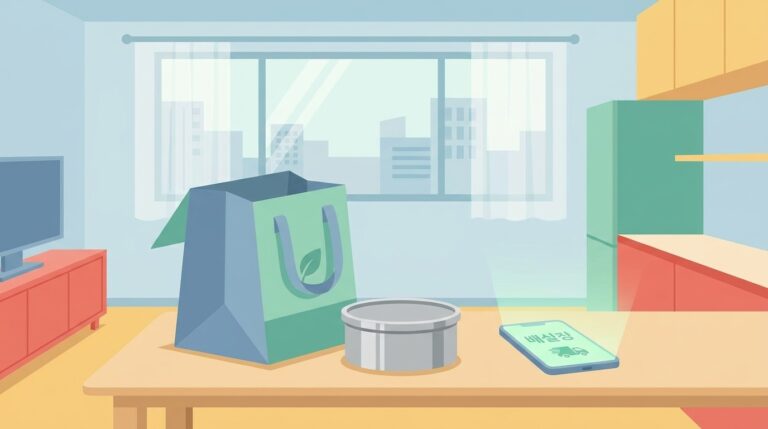
How to Master Korean Food Delivery Without the Mountain of Plastic Waste
Phase 1: Empathy (Story-Driven Opening)
안녕하세요! (Annyeonghaseyo!) I’m your lead editor and cultural navigator at Daily Hangul.
Picture this: It is 11:30 PM on a brisk Friday in Seoul. You’ve just finished binge-watching your favorite K-Drama, and your stomach lets out an unmistakable rumble. Naturally, you fire up Baedal Minjok (배달의민족) or Coupang Eats to order steaming Tteokbokki and crispy garlic fried chicken. Thirty minutes later, the doorbell rings. Joy! But as you unbag the feast, a sudden wave of guilt hits: three pairs of wooden chopsticks, four plastic spoons, plastic knives, wrapped toothpicks, and five tiny plastic cups holding danmuji (yellow radish) that you didn’t even plan to eat.
If you’ve spent any time living in or visiting South Korea, you already know that Korean food delivery is world-class in speed and convenience—yet it can easily bury your small kitchen in single-use plastic. Korea’s modern delivery culture is actively shifting toward sustainability, with smart app settings and polite custom requests. Today, we’ll equip you with natural, B2-level Korean phrases to politely decline disposables, order like a conscientious local, and participate seamlessly in Korea’s nationwide eco-movement.
Phase 2: Deep Dive into 3 Core Expressions
1. 일회용 수저 안 주셔도 돼요 (Il-hoe-yong su-jeo an ju-syeo-do dwae-yo)
- Pronunciation: eel-hweh-yong soo-juh ahn joo-shuh-doh dweh-yo (Sounds like “eel-way-yong” followed by a gentle “dway-yo” drop)
- Meaning: Direct: “It is okay even if you don’t give disposable cutlery.” / Real Nuance: “No disposable utensils needed, thank you!”
- K-Culture Moment: Seen frequently typed into delivery app request boxes (요청사항) or spoken when ordering takeout in neighborhood snack bars (bunsikjip).
- Editor’s Insight: The grammar
~아/어/여도 되다expresses permission, making this soft, polite, and completely non-demanding. In Korean culture, softening a refusal shows consideration for the restaurant owner’s hospitality.- Situation Spectrum: Casual: ✅ | Semi-formal: ✅ | Formal: ✅
- 🤔 Think About It: In English, we often say a blunt “No cutlery, please.” Notice how Korean frames it as “It is totally fine without it.” Why do you think indirect phrasing sounds warmer in service contexts?
2. 기본 반찬은 빼주세요 (Gi-bon ban-chan-eun ppae-ju-se-yo)
- Pronunciation: ghee-bon bahn-chahn-eun ppeh-joo-seh-yo (Rhymes with saying “bone” gently and “peh-zoo-seh-yo”)
- Meaning: Direct: “Please subtract the basic side dishes.” / Real Nuance: “Please leave out the default side dishes.”
- K-Culture Moment: When ordering main dishes that come with automatic small plastic side tubs (like kimchi, pickled radish, or salad) that you know will go untouched in your fridge.
- Editor’s Insight:
빼다means to take out or exclude. Adding~아/어 주세요turns it into an earnest request. This is the ultimate insider phrase to prevent food waste and curb excess packaging.- Situation Spectrum: Casual: ⚠️ (Use ‘빼줘’) | Semi-formal: ✅ | Formal: ✅
- 🤔 Think About It: Korean dining culture takes pride in generous side dishes (banchan culture). How does actively turning down free side dishes balance respect for the chef with eco-conscious lifestyle choices?
3. 다회용기로 선택했어요 (Da-hoe-yong-gi-ro seon-taek-haess-eo-yo)
- Pronunciation: dah-hweh-yong-ghee-ro sun-tehk-hess-uh-yo
- Meaning: Direct: “I selected with reusable containers.” / Real Nuance: “I chose the reusable container option.”
- K-Culture Moment: Used in major districts across Seoul (Gangnam, Mapo, Gwanak) where delivery platforms partner with returnable stainless steel container services (like Greenup or It’s Green).
- Editor’s Insight:
다회용기(multi-use container) is the antonym of일회용기(single-use container). Informing a delivery driver or shop owner using this phrase signals you’re up-to-date with Seoul’s latest green initiatives.- Situation Spectrum: Casual: ✅ | Semi-formal: ✅ | Formal: ✅
- 🤔 Think About It: Many countries struggle with container returns. In Korea, you simply leave the insulated bag outside your door, scan a QR code, and a collection service picks it up. How does high-density urban living enable this innovation?
Phase 3: Textbook Korean vs. Real Native Korean
Situation 1: Leaving a note for the restaurant to skip plastic cutlery
- 📖 Textbook Korean: 일회용 숟가락과 젓가락을 보내지 마십시오. (Il-hoe-yong sut-ga-rak-gwa jeot-ga-rak-eul bo-nae-ji ma-sip-si-o. – “Do not send disposable spoon and chopsticks.”)
- 🗣️ Real Native Korean: 일회용 수저는 안 주셔도 괜찮아요! 집 수저 쓸게요~ (Il-hoe-yong su-jeo-neun an ju-syeo-do gwaen-chan-a-yo! Jip su-jeo sseul-ge-yo~ – “Disposable cutlery is totally fine to skip! I’ll use my own utensils at home~”)
- 💡 Why is it different?: Imperative textbook commands (
-마십시오) sound cold, aggressive, or like an official safety warning. Native speakers soften notes with wavy tildes (~) and explicit reassurance.
Situation 2: Asking the delivery driver to leave food without extra plastic packaging
- 📖 Textbook Korean: 비닐봉지를 사용하지 말아 주세요. (Bi-nil-bong-ji-reul sa-yong-ha-ji mal-a ju-se-yo. – “Please do not use plastic bags.”)
- 🗣️ Real Native Korean: 혹시 포장할 때 봉투 없이 그냥 주셔도 돼요! (Hok-si po-jang-hal ttae bong-tu eop-si geu-nyang ju-syeo-do dwae-yo! – “By any chance when packaging, it’s totally okay to hand it over without a bag!”)
- 💡 Why is it different?: Using
혹시(by any chance) acts as a politeness buffer before presenting an unusual request that deviates from standard store procedures.
Phase 4: K-Culture Deep Dive & Non-Verbal Manners
4-1. 눈치 (Nunchi) & App Etiquette
Korean delivery apps previously had single-use cutlery checked by default. To combat plastic accumulation, government regulations partnered with delivery platforms to change the default setting to “Opt-out.”
If you truly need chopsticks, you must intentionally check the box. If you order takeout in person at a bunsik place and don’t want disposables, gently wave your hands with palms downward or gesture toward your own bag/tumbler while saying, “일회용품은 안 주셔도 돼요!” This shows quick situational awareness (nunchi), saving the busy staff time before they instinctively drop utensils into your bag.
4-2. The ‘Zero-Waste’ Trend in K-Food Delivery
In trendy neighborhoods like Yeonnam-dong and Seongsu-dong, the MZ generation champions Yonggi-nae (용기내 캠페인) — a clever pun meaning both “bring your container” (yong-gi = container) and “be brave / muster courage” (yong-gi = courage). When you participate in this culture, small businesses genuinely appreciate your contribution to reducing their packaging overhead.
Phase 5: Real-World Roleplay Scenario
- Setting: Friday night in a cozy Hongdae officetel. You and your Korean roommate, Minwoo (민우), are craving Midnight Fried Chicken (Yashik).
- Characters:
- You (유진 – Youjin): Environmentally conscious intermediate Korean learner.
- Minwoo (민우): Fast-talking local roommate holding the delivery app.
민우: 유진아, 오늘 치킨 각인데? 후라이드 반, 양념 반 시킬까?
(Youjin-ah, oneul chi-kin gak-in-de? Hu-ra-i-deu ban, yang-nyeom ban si-kil-kka?)
“Youjin, it’s definitely a chicken night! Should we order half fried, half seasoned?”
🎭 [눈을 반짝이며 배달 앱을 켠다 - Eyes shining as he launches the delivery app]
Youjin: 좋아! 근데 일회용 수저 선택 해제되어 있는지 확인해 줘.
(Jo-a! Geun-de il-hoe-yong su-jeo seon-taek hae-je-doe-eo it-neun-ji hwag-in-hae jwo.)
“Great! But make sure the disposable cutlery option is unchecked.”
🎭 [주방에서 개인 젓가락을 꺼내며 - Pulling out reusable chopsticks from the kitchen]
민우: 아, 맞다! 요즘 기본으로 빠져있긴 한데 다시 체크할게. 치킨무는 먹지?
(A, mat-da! Yo-jeum gi-bon-eu-ro ppa-jyeo-it-gin han-de da-si che-keu-hal-ge. Chi-kin-mu-neun meok-ji?)
“Ah, right! It’s usually unselected by default these days, but let me double-check. You eat pickled radish, right?”
🎭 [화면을 탭하며 질문한다 - Tapping the screen while asking]
Youjin: 치킨무는 먹는데, 다른 소스나 비닐장갑은 안 주셔도 된다고 적어줄래?
(Chi-kin-mu-neun meong-neun-de, da-reun so-seu-na bi-nil-jang-gab-eun an ju-syeo-do doen-da-go jeok-eo-jul-rae?)
“I do eat the chicken radish, but could you write that they don’t need to send other sauces or plastic gloves?”
🎭 [부탁하는 미소를 지으며 - Smiling gently as a request]
민우: 오케이, 요청사항에 적었어. 다회용기 수거 서비스도 신청할까?
(O-kei, yo-cheong-sa-hang-e jeok-eoss-eo. Da-hoe-yong-gi su-geo seo-bi-seu-do sin-cheong-hal-kka?)
“Okay, wrote it in the request box. Should we apply for the reusable container return service too?”
🎭 [체크박스를 보여주며 - Showing the screen checkbox]
Youjin: 응! 다 먹고 문앞에 내놓기만 하면 되니까 편하더라.
(Eung! Da meok-go mun-ap-e nae-noh-gi-man ha-myeon doe-ni-kka pyeon-ha-deo-ra.)
“Yeah! It’s so convenient since we just leave it outside the door after eating.”
🎭 [고개를 끄덕이며 엄지를 올린다 - Nodding and giving a thumbs up]
민우: 접수 완료! 30분 뒤에 도착한대. 집 앞 편의점에서 제로콜라나 사 오자.
(Jeop-su wan-ryo! Sam-sip-bun dwi-e do-chak-han-dae. Jip ap pyeon-ui-jeom-e-seo je-ro-kol-ra-na sa o-ja.)
“Order placed! Says it’ll arrive in 30 minutes. Let’s grab some Zero Cola from the convenience store downstairs.”
🎭 [휴대폰을 주머니에 넣으며 일어선다 - Putting the phone in his pocket and standing up]
Youjin: 장바구니 챙겨서 나가자!
(Jang-ba-gu-ni chaeng-gyeo-seo na-ga-ja!)
“Let’s grab a reusable shopping bag on our way out!”
🎭 [에코백을 어깨에 메며 - Slashing an eco-bag over the shoulder]
🔀 Interactive Decision Point
The restaurant accidentally includes extra disposable wooden chopsticks and plastic dipping cups despite your request. How do you handle it?
- Option A: Call the restaurant immediately and demand a refund for the plastic you didn’t want.
- Feedback (Risk): Unnecessary conflict. In Korea, mistakes during the busy rush hour happen unintentionally. Demanding a refund over free disposable cutlery sounds overly aggressive and damages rapport.
- Option B: Throw the unopened wooden chopsticks directly into general trash (일반쓰레기).
- Feedback (Bad): Missed opportunity! Unused wooden chopsticks should either be kept for emergencies, offered to neighbors, or properly separated.
- Option C (Best!): Keep them neatly in a kitchen drawer for future outdoor picnics, and leave a friendly 5-star review saying: “치킨 너무 맛있어요! 다음엔 일회용품 빼주셔도 괜찮습니다 ^^” (The chicken is delicious! It’s totally fine to skip the disposables next time ^^).
- Feedback (Best): Kind, effective, and maintains warm relations with local shop owners while gently reinforcing your eco-friendly preference.
Phase 6: 10-Second Emotion Shadowing Drill
Practice reading these out loud with rhythm and native cadence! / indicates a micro-pause.
[😊 다정하고 명확하게 - Friendly & Clear]
사장님! / 일회용 수저는 / 빼주셔도 돼요~
(Sa-jang-nim! / Il-hoe-yong su-jeo-neun / ppae-ju-syeo-do dwae-yo~)[💡 똑부러지고 센스있게 - Crisp & Mindful]
기본 반찬은 / 안 주셔도 괜찮으니까 / 메인만 많이 주세요! / 하하.
(Gi-bon ban-chan-eun / an ju-syeo-do gwaen-chan-eu-ni-kka / me-in-man man-i ju-se-yo! / Ha-ha.)[🌿 차분하고 자연스럽게 - Calm & Natural]
다회용기 배달로 / 부탁드릴게요 / 감사합니다!
(Da-hoe-yong-gi bae-dal-ro / bu-tak-deu-ril-ge-yo / gam-sa-hap-ni-da!)
Phase 7: K-Culture Mini Dictionary
- 일회용품 (Il-hoe-yong-pum) | Single-use items / Disposables
- Usage: Used widely across delivery apps, cafes, and supermarkets to denote plastic cups, straw wrappers, and cutlery.
- 다회용기 (Da-hoe-yong-gi) | Multi-use / Reusable container
- Usage: The keyword for green delivery options on Coupang Eats, Baemin, and Yogiyo in select pilot areas.
- 분리배출 (Bun-ri-bae-chul) | Recycling & Waste Sorting
- Usage: The civic system in Korea where clean plastics, cans, glass, vinyl, and food waste must be strictly separated.
- 요청사항 (Yo-cheong-sa-hang) | Order Requests / Special Instructions
- Usage: The app text box where you leave notes for the store (가게 사장님께) and the delivery driver (라이더님께).
Phase 8: Traveler’s Survival Kit
TOP 3 Survival Phrases
- 포장 용기 챙겨왔어요! (Po-jang yong-gi chaeng-gyeo-wass-eo-yo!)
- Pro Tip: Say this at street food stalls or bakeries when handing over your own Tupperware container.
- 영수증과 비닐봉투는 버려주세요. (Yeong-su-jeung-gwa bi-nil-bong-tu-neun beo-ryeo-ju-se-yo.)
- Pro Tip: Use this at convenience stores when you don’t need a paper receipt or single-use bag.
- 음식물 쓰레기 봉투 어디서 사요? (Eum-sik-mul sseu-re-gi bong-tu eo-di-seo sa-yo?)
- Pro Tip: Essential for Airbnbs! Ask your local convenience store clerk for official food waste bags.
Editor’s Travel Note
When navigating Korea’s food scene, download food apps and eco-maps using the Naver Map app download. If you live in an officetel or Airbnb, make sure you clean and rinse out delivery containers before placing them in the designated recycling station (분리수거장). Contaminated plastic is rejected and ends up incinerated!
Phase 9: A Step Deeper (Reflection Essay)
In Korean culture, food is never just sustenance; it is a manifestation of Jeong (정 – deep emotional connection and generosity). When restaurant owners pack extra side dishes and multiple pairs of cutlery, they are showing hospitality and making sure you won’t experience the slightest inconvenience. Refusing their offerings might historically have felt counter-intuitive. However, contemporary Korean society is merging this traditional Jeong with a collective social responsibility toward the environment. By politely opting out, you are not rejecting their kindness—you are participating in a modern, shared civic etiquette.
💬 Your Turn: What is the food delivery waste situation like in your home country? Have you ever felt guilty about the packaging after ordering takeout? Share your story in the comments below!
Phase 10: FAQ & Common Mistakes
Q: Can I use reusable container (다회용기) delivery anywhere in Korea?
A: Currently, multi-use container delivery is predominantly active in Seoul (Gangnam, Seocho, Songpa, Mapo, Gwanak) and select parts of Gyeonggi province. Check your app interface for the green “다회용기” badge.
Q: What should I type in the app note if I don’t want extra plastic containers for pickles?
A: Simply write: 반찬/피클 안 주셔도 됩니다. 메인 음식만 보내주세요! (No need to send side dishes/pickles. Please send only the main dish!).
Q: Does checking “No cutlery” make the food arrive slower or offend the restaurant?
A: Not at all! Restaurants actually prefer this as it saves packaging costs and streamlines their assembly lines during busy peak hours.
🚨 Common Mistakes Warning Board
- Mistake: Throwing greasy, unwashed chicken delivery containers directly into the plastic recycling bin.
- Correct Action: Thoroughly wash food oils with dish soap first; if stained red from chili oil, place it in the regular trash (일반쓰레기).
- Mistake: Saying “수저 주지 마!” (Banmal/impolite casual tone) in delivery notes.
- Correct Action: Always maintain polite endings like “수저는 안 주셔도 괜찮습니다^^”.
- Mistake: Assuming wooden chopsticks are recyclable.
- Correct Action: Wooden chopsticks cannot be recycled in Korea. They must always go into the yellow or white standard municipal trash bag (종량제 봉투).
Phase 11: Action Missions
- 🥉 Bronze Mission (Solo Drill): Stand in front of your mirror and practice saying “일회용 수저 안 주셔도 돼요!” 5 times with a bright smile.
- 🥈 Silver Mission (SNS & Community): Screenshot a delivery app interface or photo of your zero-waste meal and post it with the hashtag
#DailyHangul_ZeroWaste. - 🥇 Gold Mission (Real-Life Action): On your next delivery order or takeout visit in Korea, successfully decline single-use utensils and extra unwanted side dishes in Korean!
🎮 K-Culture Mission: Watch a modern Korean lifestyle vlog (Vlog) on YouTube and spot how creators rinse and sort (분리배출) their delivery containers after eating.
Phase 12: Interactive Quiz Challenge
Question 1: Situation Judgement
You are ordering spicy stir-fried pork (Jeyuk-bokkeum) through an app. You already have rice, kimchi, and utensils at home. What is the most natural sentence to write in the store request box?
* A) 반찬이랑 수저 다 버려주세요.
* B) 숟가락이랑 반찬은 안 보내주셔도 괜찮습니다! 집에서 먹을게요.
* C) 일회용품을 주면 화를 낼 것입니다.
Question 2: Fill-in-the-Blank
다회용기로 주문했을 때는 식사 후 용기를 씻어서 문앞에 ( ____ ) 내놓으면 수거해 갑니다.
* Hint: Meaning “to put out / place outside”
Question 3: True or False (Culture Check)
True or False: In Korea, plastic containers covered in deep red chili oil that cannot be cleaned white are classified as recyclable plastic.
👉 Click here to reveal Answers & Explanations!
- Answer: B | Explanation: Option B is extremely natural and polite. Option A sounds rude (“throw it away”), and Option C is an awkward threat.
- Answer: 내놓으면 (또는 두면 / 놓아두면) | Explanation:
내놓다means to put something out (e.g., outside your front door for pickup). - Answer: False | Explanation: If plastic containers cannot be cleaned of food grease and red stain, they cannot be processed by recycling facilities and must go into the general trash (일반쓰레기).







