

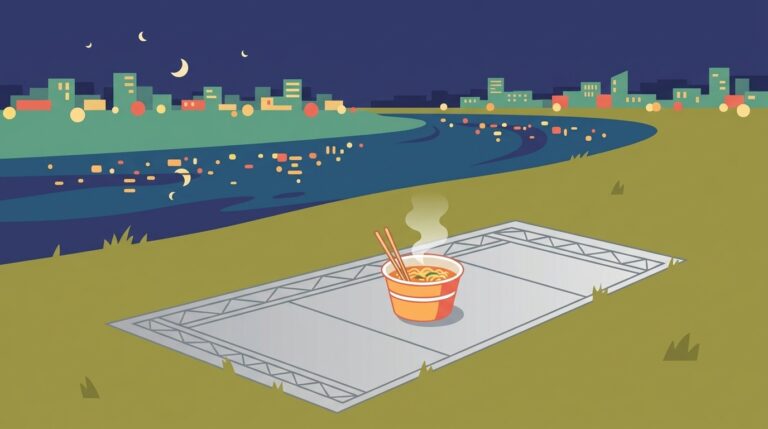
The Ultimate Han River Picnic Guide: How to Rent and Lay Down a Picnic Mat Like a Local
Phase 1: Empathy (Story Opening)
안녕하세요! 매일한글 에디터입니다. (Hello! I’m your Daily Hangul editor.) Picture this: you just landed in Seoul on a breezy spring evening. You head straight to Yeouido Han River Park, holding a steaming cup of instant ramen and a can of cold beverage. You look around, and hundreds of locals are chillaxing on shiny silver picnic mats (dotjari), laughing under twinkle lights. You want to join the vibe, but suddenly anxiety strikes: Where do I get a mat? Can I just sit here? What do I say to the rental vendor? Don’t worry! Han River picnics are the ultimate soul therapy of Seoul, and with just 3 beginner-friendly A1 Korean phrases, you will claim your cozy spot with 100% confidence. This guide is built on real learner feedback to get you picnic-ready in 5 minutes!
Phase 2: Core 3 Expressions Deep Dive
1. 돗자리 있어요? (Dotjari isseoyo?)
- Pronunciation: [Dot-ja-ri ee-sseo-yo?] (Sounds like: ‘Dote-jah-ree’ + ‘E-saw-yo’)
- Meaning: Literal: “Is there a picnic mat?” / Real Nuance: “Do you have picnic mats available for rent/purchase?”
- K-Culture Moment: Seen in countless K-Dramas like Weightlifting Fairy Kim Bok-joo when friends go to the riverside store and ask the cashier for supplies.
- Editor’s Insight: ‘있어요?’ (isseoyo) is your magic A1 phrase. Add any noun before it with a rising intonation to ask if someone has it!
- Situation Spectrum: Casual (⚠️ only with close friends: 돗자리 있어?), Semi-formal (✅ 돗자리 있어요?), Formal (✅ 돗자리 있습니까?)
- 🤔 Think About It: In English, you ask “Do you have a mat?” but Korean frequently omits the subject “you” completely. Why do you think Korean focuses more on the object’s presence rather than who holds it?
2. 여기 앉아도 돼요? (Yeogi anjado dwaeyo?)
- Pronunciation: [Yeo-gi an-ja-do dwae-yo?] (Sounds like: ‘Yaw-gee ahn-jah-doh dway-yo’)
- Meaning: Literal: “Is it okay even if I sit here?” / Real Nuance: “Can I sit here? / Is this spot open?”
- K-Culture Moment: When parks get crowded on Friday nights, asking nearby picnickers politely before setting up right next to them shows top-tier manners.
- Editor’s Insight: ‘~해도 돼요?’ (~haedo dwaeyo?) is the go-to beginner structure to ask for permission politely.
- Situation Spectrum: Casual (⚠️ 여기 앉아도 돼?), Semi-formal (✅ 여기 앉아도 돼요?), Formal (✅ 여기 앉아도 되겠습니까?)
- 🤔 Think About It: Notice the word ‘도’ (even/also). It softens the request into “Would it be okay even if I sit?” showing consideration for personal space.
3. 얼마예요? (Eolmayeyo?)
- Pronunciation: [Eol-ma-ye-yo?] (Sounds like: ‘Uhl-mah-yay-yo’)
- Meaning: Literal & Real Nuance: “How much is it?”
- K-Culture Moment: Renting a picnic set (mat + mini table + LED lamp) from street pop-up tents near Subway Exit 2.
- Editor’s Insight: The most universal shopping question in Korea. Always speak with a warm smile and a slight head nod.
- Situation Spectrum: Casual (⚠️ 얼마야?), Semi-formal (✅ 얼마예요?), Formal (✅ 얼마입니까?)
- 🤔 Think About It: Pricing in Korea is always tax-included, so the number you hear is the exact total you pay!
Phase 3: Textbook Korean vs. Real Korean
Situation 1: Asking if a space is occupied
- 📖 교과서 한국어 (Textbook): 이 자리는 비어 있습니까? (I jarineun bieo itsseumnikka? / Is this seat vacant?)
- 🗣️ 진짜 한국어 (Real-life): 여기 자리 있어요? (Yeogi jari isseoyo? / Is someone sitting here?)
- 💡 왜 다를까?: Textbook forms are overly robotic. In real life, asking if a ‘spot exists’ (meaning occupied) is natural and quick.
Situation 2: Asking the rental duration
- 📖 교과서 한국어 (Textbook): 대여 가능 시간은 몇 시간입니까? (Daeyeo ganeung siganeun myeot siganimnikka?)
- 🗣️ 진짜 한국어 (Real-life): 몇 시간 빌려요? (Myeot sigan billyeoyo? / How many hours is the rental?)
- 💡 왜 다를까?: Native speakers favor short everyday verbs like ‘빌리다’ (to borrow/rent) over formal Sino-Korean nouns.
Phase 4: K-Culture Deep Dive & Non-verbal Manners
4-1. 눈치 (Nunchi) & Picnic Manners
- Shoe Etiquette on Mats: The silver or fabric mat is treated as an extension of an indoor floor! Always step out of your shoes and leave them at the mat edge facing outward. Stepping onto a mat with shoes on is a major cultural no-no.
- Distance Etiquette: In crowded grass areas, leave at least half an arm’s length between your mat and your neighbors’ so everyone can enjoy their music and conversations peacefully.
4-2. The Han River ‘Chimaek & Hangang Ramyeon’ Ritual
- Han River picnics are world-famous for Chimaek (Chicken + Maekju/Beer) and machine-cooked instant ramen in foil bowls. Delivery riders on scooters bring hot fried chicken right to designated park delivery zones (Baedal Zone).
Phase 5: Real-World Roleplay Scenario
- Setting: Yeouido Han River Park on a pleasant Saturday afternoon. Min-jun is a friendly picnic gear rental vendor near Subway Exit 2.
-
Turn 1 (Min-jun): 안녕하세요! 돗자리 필요하세요? (Annyeonghaseyo! Dotjari piryohaseyo? / Hello! Do you need a picnic mat?)
🎭 Smiling warmly and pointing at the picnic bundles - Turn 2 (Learner): 네! 돗자리 있어요? (Ne! Dotjari isseoyo? / Yes! Do you have picnic mats?)
🎭 Nodding politely - Turn 3 (Min-jun): 네, 기본 돗자리랑 테이블 세트 있어요. (Ne, gibon dotjarirang teibeul seteuisseoyo. / Yes, we have basic mats and table sets.)
🎭 Showing the display set - Turn 4 (Learner): 세트 얼마예요? (Seteu eolmayeyo? / How much is the set?)
🎭 Pointing at the set with two hands - Turn 5 (Min-jun): 3시간에 만 원이에요. (Se-sigane man-won-ieyo. / It is 10,000 KRW for 3 hours.)
🎭 Showing 3 fingers - Turn 6 (Learner): 카드로 할게요. 감사합니다! (Kadeuro halkkeyo. Gamsahamnida! / I will pay by card. Thank you!)
🎭 Handing over credit card with both hands - Turn 7 (Min-jun): 네, 즐거운 시간 보내세요! (Ne, jeulgeoun sigan bonaeseyo! / Yes, have a wonderful time!)
🎭 Handing over the gear bag - Turn 8 (Learner): 네, 안녕히 계세요! (Ne, annyeonghi gyeseyo! / Yes, goodbye!)
🎭 Light bow
🔀 Interactive Choice Branch:
You arrive at the grassy lawn and spot an open area next to two college students.
* Option A: Silently spread your mat right on top of their shoes.
* Option B: Make gentle eye contact, smile, and say: “여기 앉아도 돼요?”
* Option C: Shout loudly in English: “Hey, move over!”
- Feedback:
- Option A (Risk): Rude! Stepping on someone’s belongings breaks Korean social harmony (Nunchi fail).
- Option B (Best! ⭐): Perfect! They will smile and say “네, 앉으세요!” (Yes, please sit!).
- Option C (Bad): Aggressive and startles people around you.
Phase 6: 10-Second Emotion Shadowing Drill
[😊 Excitement]돗자리 / 있어요? (Dotjari / isseoyo?) – Rising pitch at the end like asking a treat from a buddy![🥺 Polite & Gentle]여기 / 앉아도 / 돼요? (Yeogi / anjado / dwaeyo?) – Soft, friendly melody with a slight pause after ‘여기’.[🤝 Cheerful Confidence]카드로 / 할게요! (Kadeuro / halkkeyo!) – Crisp, upbeat finish when tapping your card!
Phase 7: K-Culture Mini Dictionary
- 돗자리 (Dotjari): Picnic mat. Essential gear for outdoor chilling in Korea.
- 한강라면 (Hangang Ramyeon): Instant ramen cooked in foil bowls using specialized automated boiling stations at riverside convenience stores.
- 치맥 (Chimaek): The legendary portmanteau of Chicken (치킨) + Beer (맥주).
- 배달존 (Baedal Zone): Designated pick-up spot in Han River parks where delivery drivers hand over food.
Phase 8: Traveler’s Survival Kit
- Top 3 Survival Expressions:
- 쓰레기통 어디예요? (Sseuregitong eodiyeyo? / Where is the trash bin?)
Pro Tip: Han River parks have large designated recycling stations. - 물티슈 있어요? (Multisyu isseoyo? / Do you have wet wipes?)
Pro Tip: Essential for clean hands while eating finger foods. - 화장실 어디예요? (Hwajangsil eodiyeyo? / Where is the restroom?)
Pro Tip: Park restrooms are numbered along the riverside paths.
- 쓰레기통 어디예요? (Sseuregitong eodiyeyo? / Where is the trash bin?)
- Editor’s Travel Note: Make sure you install the Naver Map Navigation App to easily locate park convenience stores and delivery drop-off zones. Most picnic vendors take international credit cards (Visa/Mastercard) and T-Money transport cards!
Phase 9: Think Deeper
In many Western cultures, public parks are vast green fields where people sunbathe individually with large personal bubbles. In Korea, the Han River lawn transforms into a vibrant communal living room. Families, couples, and friends share close physical proximity while maintaining polite consideration through quiet voices and clean spaces.
💬 Your Turn: What is the picnic culture like in your home country? Would you like to try cooking automated ramen by the Han River? Leave a comment below!
Phase 10: FAQ & Common Mistakes
Q: Can I set up a tent anywhere in Han River Park?
A: No. Small pop-up shade tents are only allowed in designated zones until 7:00 PM or 8:00 PM (depending on the season), and at least two sides must remain unzipped. Standard picnic mats (dotjari), however, can be laid out almost anywhere on grassy lawns!
Q: What time do picnic mat rental shops close?
A: Most rental stalls operate until 10:00 PM or 11:00 PM during spring, summer, and autumn. Always check the return deadline when you pay.
Q: Do I need to speak Korean to order delivery food at the park?
A: Many tourists use English delivery apps or simply buy hot takeaway food from the large convenience stores right along the water.
🚨 Common Mistakes Alert
- Stepping on the mat with shoes: ❌ Always take your shoes off before stepping onto the mat.
- Leaving trash behind: ❌ Korea enforces strict recycling (separate cans, plastics, and food waste).
- Using overly blunt speech (Banmal): ❌ Don’t say ‘얼마야?’ to elders or strangers; always keep the polite ending ‘-요’ (‘얼마예요?’).
Phase 11: Action Missions
- 🥉 Bronze Mission (Solo Practice): Stand in front of your mirror and repeat “돗자리 있어요?” 5 times with a bright smile.
- 🥈 Silver Mission (Social Share): Share this phrase on your Instagram story and tag a friend you want to visit Seoul with.
- 🥇 Gold Mission (Real-World Test): Head to Yeouido or Banpo Han River Park, find a rental stall, and rent your first mat purely in Korean!
- 🎮 K-Culture Mission: Watch an episode of a Han River vlog or K-Drama scene and spot how many times characters say “맛있겠다!” (Looks delicious!) while eating on their mat.
Phase 12: Interactive Quiz Challenge
1. Situation Quiz: You want to ask the rental owner the price of a picnic mat. What do you say?
* A) 얼마예요?
* B) 어디예요?
* C) 누구예요?
2. Fill in the Blank: “여기 ________ 돼요?” (Can I sit here?)
* A) 가도 (gado)
* B) 앉아도 (anjado)
* C) 먹어도 (meogeodo)
3. True or False: You should always leave your outdoor sneakers on when sitting on a Korean picnic mat. (T/F)
👉 Click to reveal Answers & Explanations!
- Answer: A) 얼마예요? (How much is it? ‘어디예요?’ means ‘Where is it?’).
- Answer: B) 앉아도 (‘앉다’ = to sit. ‘앉아도 돼요?’ = Can I sit?).
- Answer: False! Always take off your shoes at the edge of the mat to keep it clean for everyone.







