

Phase 1: Empathy (Story Immersion Opening)
안녕하세요! 매일한글 에디터입니다. (Hello! I’m your Daily Hangul editor.)
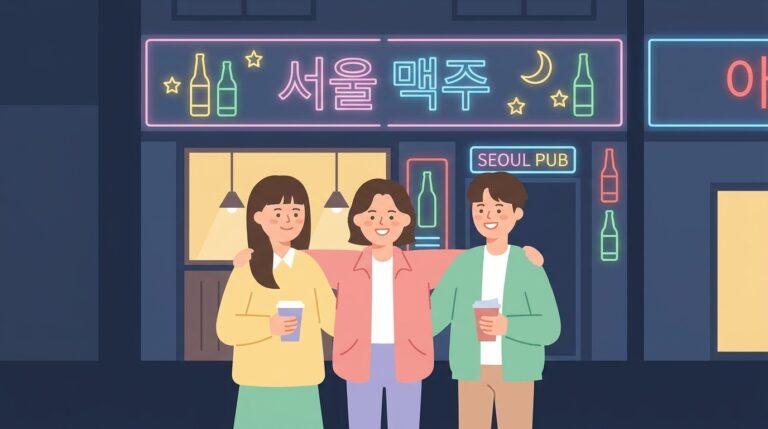
Picture this: You are sitting in a bustling Korean BBQ restaurant in Hongdae or Itaewon. The grill is sizzling with pork belly (삼겹살 – samgyeopsal), empty green soju bottles are lining up on the table, and your Korean friends are laughing heartily. The plates are nearly empty, and you check your watch thinking, “Well, that was an amazing dinner, time to head back to the hotel!”
Just as you reach for your jacket, your Korean friend suddenly slams a fresh soju glass on the table with a huge grin and shouts: “2차 가자!” (I-cha gaja!)
Everyone cheers, stands up, and starts packing up their bags. You freeze. Wait… 2차? Round two? Are we eating dinner all over again? Where are we going? How do I say I’m in, or politely say I’m tired?
If you have ever watched K-dramas like Itaewon Class or Work Later, Drink Now, you know that a night out in Korea never ends at just one place. But as a beginner learner (A1), stepping into the legendary Korean nightlife culture without knowing what “2차” means can feel overwhelming.
Don’t worry! In today’s guide, built on real feedback from hundreds of foreign travelers and beginner learners just like you, I will show you how to navigate Korea’s multi-round night culture with total confidence. Let’s dive in!
Phase 2: Key Expressions Deep Dive
1. 2차 가자! (I-cha gaja!)
- Pronunciation: i-cha ga-ja (Sounds like “ee-cha gah-jah”)
- Meaning: Literal: “Let’s go to Round 2!” | Real Nuance: “The night is still young! Let’s move to the next fun venue (pub, karaoke, or pocha)!”
- K-Culture Moment: Seen in almost every modern K-drama when colleagues or university friends wrap up their first meal and head to a lively bar for beer and snacks.
- Editor’s Insight: In Korea, “차” (cha) means “round” or “order”. 1차 (il-cha) is dinner, 2차 (i-cha) is usually beer or pocha, and 3차 (sam-cha) might be Noraebang (karaoke)!
- Situation Spectrum: Casual (✅ Friends, peers) / Semi-formal (⚠️ With coworkers, use “2차 가요!” – i-cha gayo) / Formal (🚫 To bosses/seniors, use “2차 가실까요?” – i-cha gasilkkayo?)
- 🤔 Think About It: In many Western cultures, people usually stay at one bar all night. Why do you think Koreans love moving venues every couple of hours?
2. 배불러요 (Bae-bul-leo-yo)
- Pronunciation: bae-bool-luh-yo (Sounds like “beh-boo-luh-yo”)
- Meaning: Literal: “My stomach is full.” | Real Nuance: “I’m stuffed / I couldn’t eat another bite!”
- K-Culture Moment: Used whenever an enthusiastic Korean friend keeps ordering more food at 2차 and you need to wave your hands gently to say you’re full.
- Editor’s Insight: Even if you say “배불러요”, your Korean friends might reply, “괜찮아, 2차는 맥주야!” (It’s okay, round two is just beer!).
- Situation Spectrum: Casual (✅ “배불러” – bae-bul-leo) / Semi-formal (✅ “배불러요”) / Formal (✅ “배부릅니다” – bae-bu-reum-ni-da)
- 🤔 Think About It: Does your language have a friendly way to say you’re full without sounding impolite to the host?
3. 오늘은 여기까지 할게요 (Oneul-eun yeogi-kkaji hal-ge-yo)
- Pronunciation: oh-neul-eun yuh-gi-kka-ji hal-ge-yo (Sounds like “oh-neul-eun yuh-gee-kkah-jee hal-geh-yo”)
- Meaning: Literal: “I will do until here today.” | Real Nuance: “I’ll call it a night today / I have to head out now.”
- K-Culture Moment: The polite golden escape phrase used when you’re too sleepy to join 3차 (karaoke at 1 AM) and need to catch the last subway train.
- Editor’s Insight: Adding “오늘은” (today) softens your departure, implying: “I love hanging out with you, but just for tonight, I must stop here!”
- Situation Spectrum: Casual (⚠️ Use “나 먼저 갈게” – na meon-jeo gal-ge with close friends) / Semi-formal (✅ Perfect for mixed groups/coworkers) / Formal (✅)
- 🤔 Think About It: Why is it socially smoother to say “Until here today” rather than a blunt “No, I want to go home”?
Phase 3: Textbook Korean vs. Real Korean
Situation A: Suggesting to move to the next spot
- 📖 Textbook Korean: “우리 다음 장소로 이동합시다.” (Uri daeum jangsoro idonghapsida. – “Let us relocate to the next location.”)
- 🗣️ Real Korean: “2차 가자!” (I-cha gaja! – “Let’s go for Round 2!”)
- 💡 Why is it different? Textbook phrases sound like an official military movement or a tour guide briefing. Native speakers instinctively use “[Number]차 + 가자” to keep the social momentum flowing.
Situation B: Saying goodbye when you need to go home
- 📖 Textbook Korean: “저는 집으로 돌아가겠습니다.” (Jeoneun jibeuro doragagessseumnida. – “I shall return to my residence.”)
- 🗣️ Real Korean: “저 먼저 들어갈게요!” (Jeo meonjeo deureogalgeyo! – “I’ll head in first!”)
- 💡 Why is it different? In Korean daily speech, entering one’s home is described as “들어가다” (to go inside). Saying you will “enter first” is the natural, warm way to take your leave.
Phase 4: K-Culture Deep Dive & Non-Verbal Manners
4-1. Nunchi (눈치) & Body Gestures during 2차
- The Exit Signal: When you need to leave after 1차, do not announce it suddenly while everyone is clinking glasses. Wait for the bill settlement or as everyone is stepping outside the restaurant onto the street. Bow slightly with both hands together and say: “저 먼저 들어갈게요, 오늘 너무 재밌었어요!” (I’ll head home first, today was so fun!).
- The Clinking Courtesy (건배 매너): At 2차 (e.g., Hof pub with draft beer), when clinking glasses with someone older or higher status, gently hold your glass with both hands (or touch your wrist with your left hand) and keep the rim of your glass slightly lower than theirs.
4-2. Cultural Code: The Multi-Round Culture (차 문화)
Korean nightlife is modular! It is rarely about staying at one place for 5 hours. Instead:
* 1차 (1st Round): Hearty meal with alcohol (K-BBQ, Dakgalbi, Fried Chicken).
* 2차 (2nd Round): Lighter vibe (Hof pub with draft beer, Pocha with fishcake soup, or craft beer bar).
* 3차 (3rd Round): Entertainment (Noraebang / Karaoke room, or Bingsu dessert cafe)!
* 4차 (4th Round): Haejang-guk (Hangover soup shop) or 24-hour convenience store ramen before taking the morning first train.
Phase 5: Real-Life Roleplay Scenario
Setting: It is 10:30 PM outside a famous samgyeopsal restaurant in Gangnam. Cool night breeze, neon signs glowing everywhere. Minho (your friendly Korean buddy) turns to you.
- Turn 1 (Minho): 오늘 삼겹살 진짜 맛있었지? 🎭 (Pats his stomach with a happy smile)
- Oneul samgyeopsal jinjja mas-isseotji? (The pork belly was really delicious today, right?)
- Turn 2 (You): 네, 진짜 맛있었어요! 🎭 (Smiles and gives a thumbs up)
- Ne, jinjja mas-isseoss-eoyo! (Yes, it was really delicious!)
- Turn 3 (Minho): 좋아! 시간도 아직 이른데, 2차 가자! 🎭 (Points excitedly towards a nearby craft beer pub)
- Joah! Sigando ajik ireunde, i-cha gaja! (Great! It’s still early, let’s go to Round 2!)
- Turn 4 (You): 2차요? 어디 가요? 🎭 (Curious expression)
- I-chayo? Eodi gayo? (Round 2? Where are we going?)
- Turn 5 (Minho): 저기 시원한 생맥주 마시러 가자! 내가 쏠게! 🎭 (Grins warmly, offering to pay)
- Jeogi siwonhan saengmaekju masireo gaja! Naega ssolge! (Let’s go drink cool draft beer over there! My treat!)
- Turn 6 (You): 와, 좋아요! 가요! 🎭 (Nods cheerfully)
- Wa, jo-ayo! Gayo! (Wow, sounds great! Let’s go!)
- Turn 7 (Minho): 배부르면 안주는 간단한 감자튀김만 시키자. 🎭 (Opens the pub door for you)
- Bae-bureumyeon anjuneun gandanhangamjatwigimman sikija. (If you’re full, we’ll just order light French fries as snacks.)
- Turn 8 (You): 네, 딱 좋아요! 🎭 (Walks inside enthusiastically)
- Ne, ttak jo-ayo! (Yes, that’s just perfect!)
🔀 Interactive Choice Branch
What if you were actually super exhausted and needed to wake up early tomorrow? How should you answer Minho at Turn 4?
- Option A: “싫어요. 집 갈래요.” (Sireoyo. Jip gallaeyo. – I hate it. I will go home.)
- ❌ Bad: Too harsh and abrupt! It might make Minho feel rejected or embarrassed.
- Option B: “죄송해요, 내일 일찍 일어나야 해서 오늘은 여기까지 할게요!” (Joesonghaeyo, naeil iljjik ireonaya haeseo oneureun yeogikkaji halgeyo!)
- 🏆 Best: Polite, explains the clear reason with warm consideration, leaves no hard feelings.
- Option C: (Say nothing, nod along, and quietly sneak away without saying goodbye)
- ⚠️ Risk: The infamous “Ghosting Exit”. Your friends might panic and think you got lost in Seoul!
Phase 6: 10-Second Emotion Shadowing Drill
Practice saying these lines out loud with the right rhythm and emotion! (The / symbol marks natural pauses):
[😊 Exciting & Energetic]- 우리 / 2차 가요! / 맥주 마셔요!
- U-ri / i-cha ga-yo! / maek-ju ma-syeo-yo!
- (Let’s go to round two! Let’s drink beer!)
[🥺 Regretful & Polite]- 아쉽지만 / 오늘은 / 여기까지 할게요!
- A-swip-ji-man / o-neul-eun / yeo-gi-kka-ji hal-ge-yo!
- (It’s a pity, but I’ll stop here today!)
[😋 Cheerful & Full]- 배불러요! / 그래도 / 2차는 가요!
- Bae-bul-leo-yo! / geu-rae-do / i-cha-neun ga-yo!
- (I’m full! But let’s still go to round two!)
Phase 7: K-Culture Mini Dictionary
- 안주 (Anju)
- Translation: Food/snacks eaten with alcohol.
- Context: In Korea, you rarely drink alcohol without 안주. Common 2차 anju includes dried squid, dried pollack (먹태), fries, or fruit platter.
- 막차 (Makcha)
- Translation: The last train or bus of the night.
- Context: You will often hear people ask, “막차 몇 시예요?” (What time is the last train?). Seoul subways typically stop around midnight to 1 AM.
- 치맥 (Chimaek)
- Translation: Chicken + Maekju (Beer).
- Context: A quintessential 2차 classic beloved across all generations in Korea.
- 엔빵 / N빵 (N-ppang)
- Translation: Splitting the bill equally (Dutch pay / 1/N).
- Context: Among university students or close friends, someone will say, “우리 N빵 하자!” (Let’s split the bill evenly!).
Phase 8: Survival Kit for Travelers
TOP 3 Nightlife Survival Phrases
- 계산해 주세요 (Gyesanhae juseyo) — Pro Tip: Say this at the counter or to your server while making a slight card/bill gesture to ask for the bill.
- 화장실 어디예요? (Hwajangsil eodiyeyo?) — Pro Tip: Many Korean 2차 pubs have keypads on bathroom doors. The server might point to a password written on the receipt!
- 물 좀 더 주세요 (Mul jom deo juseyo) — Pro Tip: Great for asking for fresh cold water between soju rounds.
🧳 Editor’s Travel Note
- Getting Home Safe: Taxis can be hard to flag down on the street on Friday nights in Hongdae or Gangnam. Install the [Kakao T Taxi App guide] on your phone beforehand to hail verified taxis easily.
- Checking Subway Times: Download and check the [Naver Map Subway navigation] to confirm your 막차 (last train) time so you don’t get stranded!
Phase 9: One Step Deeper (Reflection)
In Korean culture, the phrase “2차 가자” is more than just an invitation for more drinks—it is a warm sign of affection and social bonding (Jeong – 정). When Koreans suggest 2차, it translates to: “I enjoy your company so much that I don’t want this evening to end yet.” Leaving early is completely okay, but understanding this cultural warmth turns a simple night out into an unforgettable friendship memory.
💬 Your Turn: Have you ever experienced a multi-round night out in Korea or your own country? What is your favorite late-night food spot? Share your story in the comments below!
Phase 10: FAQ & Common Mistakes
Q: Do I have to drink alcohol if I go to 2차 in Korea?
A: Not at all! Modern Korean nightlife is very welcoming. You can order cider (Korean Sprite), cola, or non-alcoholic beer and still enjoy the lively vibe and food.
Q: Is it rude to decline an invitation to 2차?
A: No, as long as you decline politely! Saying “오늘은 여기까지 할게요. 다음에 또 불러주세요!” (I’ll call it a night today. Please invite me again next time!) shows gratitude and good manners.
Q: Who usually pays for 2차?
A: Traditionally, one person pays for 1차 and another person covers 2차 (e.g., senior pays 1차, junior pays 2차 or coffee). Among younger peers, splitting the bill (N빵) is very common.
🚨 Common Mistakes TOP 3
- Mistake: Disappearing without saying goodbye to avoid being persuaded to stay.
- Correct Action: Always notify your host or friend warmly: “저 먼저 갈게요!” (I’ll head out first!).
- Mistake: Pouring your own drink at a group table while everyone else’s cup is empty.
- Correct Action: Pour for others first, and someone will happily return the favor and pour for you!
- Mistake: Assuming 2차 is always alcohol.
- Correct Action: 2차 can easily be a dessert cafe, a bubble tea shop, or coin karaoke (코인노래방)!
Phase 11: Action Mission & Engagement
- 🥉 Bronze Mission (Solo Practice): Stand in front of a mirror and say “2차 가자!” with high energy 3 times, followed by a polite “오늘은 여기까지 할게요!”.
- 🥈 Silver Mission (Social Share): Share your favorite Korean snack or drink picture on Instagram with the caption #2차가자 #DailyHangul.
- 🥇 Gold Mission (Real Life): When hanging out with friends or language partners, initiate the next venue by boldly shouting “2차 가자!”.
- 🎮 K-Culture Mission: Watch an episode of any slice-of-life K-drama this week and spot how many times the characters move to 2차 or mention 막차!
Phase 12: Interactive Quiz Challenge
Q1. [Situation Check] Your Korean colleague says “2차 가자!” but you are exhausted and need to catch the last train. What is the most natural and polite response?
* A) 싫어요. (I hate it.)
* B) 오늘은 여기까지 할게요. (I’ll call it a night today.)
* C) 몰라요. (I don’t know.)
Q2. [Fill in the Blank] Fill in the missing word: “배가 너무 불러서 안주는 간단하게 먹어요. 나는 지금 ______!” (I’m full!)
* A) 배불러요 (Bae-bul-leo-yo)
* B) 배고파요 (Bae-go-pa-yo)
* C) 반가워요 (Ban-ga-wo-yo)
Q3. [True / False Cultural Check] In Korea, “2차” can only be a bar that serves soju and beer, and you cannot go to cafes or karaoke.
* (True / False)
👉 Click here to reveal the Quiz Answers & Explanations!
- Q1 Answer: B) 오늘은 여기까지 할게요. (It politely explains that you want to stop here for tonight without hurting the mood).
- Q2 Answer: A) 배불러요. (배고파요 means “I’m hungry”, and 반가워요 means “Nice to meet you”).
- Q3 Answer: False. (2차 can be anything—draft beer pub, Noraebang, dessert cafe, or even an arcade!).







