

Master Korean Housewarming Party Games: Fun Phrases and Culture Tips
Phase 1: Empathy & K-Culture Story Opening
안녕하세요! 매일한글 에디터입니다. (Hello! This is your Daily Hangul editor.)
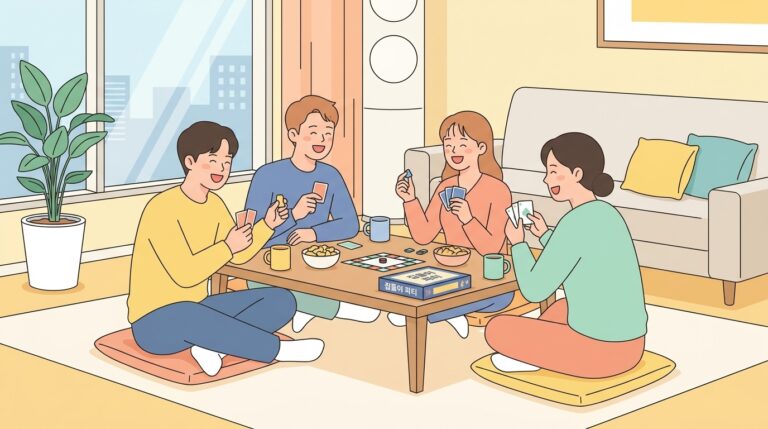
Picture this: You are invited to your Korean friend’s brand-new apartment for a jipdeuri (집들이, housewarming party). The dining table is cleared after enjoying delicious delivery food like fried chicken and tteokbokki. Suddenly, someone claps their hands and announces, “자, 이제 게임 한 판 하자!” (Now, let’s play a round of games!).
Everyone starts chanting rhythmic beats, pointing fingers, and laughing hysterically. You want to join the excitement, but your mind freezes. What is the penalty? How do I ask for a rematch? How do I say rock-paper-scissors in Korean without sounding like a robot?
If you have ever felt nervous about joining Korean party games, you are definitely not alone. Many of our A2 beginner learners tell us that group games in Korea feel super fast-paced. But here is the secret: you do not need complex grammar to be the life of the party! With just a handful of punchy, natural phrases, you can jump right in, dodge penalties, and laugh along like a seasoned local.
Phase 2: 3 Core Expressions for Game Night
1. 벌칙이 뭐예요? (Beolchigi mwoyeyo?)
- Pronunciation: [Beol-chi-gi mwo-ye-yo?] (Think: “Bowl-cheeky mo-yeah-yo?”)
- Meaning: Literal: “What is the penalty?” / Real Nuance: “What do I have to do if I lose?”
- K-Culture Moment: You will hear this in almost every episode of Korean variety shows like Running Man or Knowing Bros whenever a new challenge is introduced.
- Editor’s Insight: In Korea, games are twice as fun because of the playful beolchik (penalty)—from drinking sour lemon juice to wearing silly props. Asking this right before the game shows you are ready to play seriously!
- Situation Spectrum: Casual: ✅ | Semi-formal: ✅ | Formal: ⚠️
- 🤔 Think About It: In your home country, do house games always involve penalties, or do people just play for points?
2. 다시 한 번만요! (Dasi han beonmanyo!)
- Pronunciation: [Da-si han beon-man-yo!] (Sounds like: “Tah-shee han bun-mahn-yo!”)
- Meaning: Literal: “Just one more time!” / Real Nuance: “Give me one more chance, please!”
- K-Culture Moment: Used whenever an idol makes an adorable mistake on an entertainment show and asks the production crew for a do-over.
- Editor’s Insight: Koreans love giving second chances when asked with a cute, apologetic smile. Saying this keeps the vibe cheerful even when you mess up on round one.
- Situation Spectrum: Casual: ✅ | Semi-formal: ✅ | Formal: 🚫
- 🤔 Think About It: How do you politely plead for a second chance in your culture without sounding like a sore loser?
3. 가위바위보로 정해요. (Gawibawiboro jeonghaeyo.)
- Pronunciation: [Ga-wi-ba-wi-bo-ro jeong-hae-yo.] (Sounds like: “Gah-wee-bah-wee-boh-roh jung-heh-yo”)
- Meaning: Literal: “Let’s decide by scissors-rock-cloth.” / Real Nuance: “Let’s settle this with Rock-Paper-Scissors.”
- K-Culture Moment: When friends argue over who cleans the table or who takes the first turn in a party game.
- Editor’s Insight: Notice the order: Scissors (Gawi), Rock (Bawi), Paper (Bo). In Korea, Gawibawibo is the ultimate democratic conflict solver for everyday life!
- Situation Spectrum: Casual: ✅ | Semi-formal: ✅ | Formal: ⚠️
- 🤔 Think About It: Why do you think Rock-Paper-Scissors is the universal decision-maker across so many cultures?
Phase 3: Textbook Korean vs. Real Korean
Situation 1: Suggesting a game
- 📖 Textbook Korean: “우리 함께 재미있는 게임을 시작합시다.” (Let us begin an interesting game together.)
- 🗣️ Real Korean: “자, 게임 한 판 하자!” (Alright, let’s play a round!)
- 💡 Why is it different? The counter pan (판) specifically refers to a single match or round. Using 한 판 하자 sounds casual, proactive, and energetic.
Situation 2: Admitting defeat
- 📖 Textbook Korean: “제가 경기에서 패배했습니다.” (I have been defeated in the match.)
- 🗣️ Real Korean: “아, 졌다! 벌칙 받을게요.” (Ah, I lost! I’ll take the penalty.)
- 💡 Why is it different? Pae-bae (패배) is a heavy formal noun used in sports broadcasts. In real social gatherings, friends simply say 졌다 (I lost) with humor.
Phase 4: K-Culture Deep Dive & Non-Verbal Manners
4-1. 눈치 (Nunchi) & Party Gestures
Korean party games rely heavily on quick reflexes and nunchi (social awareness). When playing games like the Nunchi Game (눈치게임)—where players stand up and count numbers one by one without overlapping—watch everyone’s shoulder movements and eye contact. Clapping hands on your thighs to keep the group rhythm (tteok-tteok-tteok) shows you are engaged with the team.
4-2. The Joy of Housewarming Games
At a Korean jipdeuri, games break the ice between friends, co-workers, and significant others. Classics like the “Sonbyeongho Game” (folding a finger if a statement applies to you, like Never Have I Ever) or “Bapo Game” allow guests to learn hilarious personal facts about each other in a warm, friendly atmosphere.
Phase 5: Real-Life Roleplay Scenario
Setting: Minho’s cozy new living room in Mapo-gu. Five friends are sitting around the low table after finishing dinner.
- 민호 (Host): “배부르니까 우리 눈치게임 한 판 할까?”
(Bae-bu-reu-ni-kka u-ri nun-chi-ge-im han pan hal-kka?)
“Since we’re full, shall we play a round of the Nunchi game?”
🎭 Hands clapping rhythmically on knees -
You: “좋아요! 그런데 벌칙이 뭐예요?”
(Jo-a-yo! Geu-reon-de beol-chi-gi mwo-ye-yo?)
“Sounds great! But what is the penalty?”
🎭 Smiling with curious eyes -
소라 (Friend): “진 사람이 설거지 돕기! 준비됐지? 시작!”
(Jin sa-ram-i seol-geo-ji dop-gi! Jun-bi-dwaet-ji? Si-jak!)
“The loser helps wash the dishes! Ready? Start!”
🎭 Looking around the circle tensely -
민호: “일 (One)!”
(Il!)
“One!”
🎭 Jumps up quickly -
You: “이 (Two)!”
(I!)
“Two!”
🎭 Stands up simultaneously with Sora -
소라: “이 (Two)! 아, 같이 외쳤다!”
(I! A, gat-i oe-chyeot-da!)
“Two! Ah, we shouted at the exact same time!”
🎭 Pointing at you playfully -
You: “아쉽다! 다시 한 번만요!”
(A-swip-da! Da-si han beon-man-yo!)
“So close! Just one more time, please!”
🎭 Clasping hands together in cute plea -
민호: “안 돼요~ 가위바위보로 최종 탈락자 정해요!”
(An dwae-yo~ Ga-wi-ba-wi-bo-ro choe-jong tal-rak-ja jeong-hae-yo!)
“No way~ Let’s decide the final loser with rock-paper-scissors!”
🎭 Raising a fist ready to count
🔀 Interactive Choice:
How will you answer Minho’s challenge?
* Choice A: “좋아요, 가위바위보 해요!” (Sure, let’s do rock-paper-scissors!)
* Choice B: “싫어요, 안 할래요.” (No, I won’t do it.)
* Choice C: “저는 외국인이니까 봐주세요.” (Please let me off because I am a foreigner.)
Feedback:
* Choice A (Best): Perfect! It keeps the party fun and shows great sporting spirit.
* Choice B (Bad): Too blunt; it can suddenly kill the lively party mood.
* Choice C (Risk): While meant humorously, it takes away the excitement of friendly competition.
Phase 6: 10-Second Emotion Shadowing Drill
Practice reading these lines out loud with the indicated pausing points (/) and emotions:
[😊 Excitement]“자, / 게임 한 판 / 하자!” (Alright, let’s play a round!)[🤔 Curiosity]“그런데… / 벌칙이 / 뭐예요?” (By the way… what’s the penalty?)[🥺 Playful pleading]“아, 아깝다! / 다시 한 번만 / 봐주세요!” (Ah, so close! Give me just one more chance!)
Phase 7: K-Culture Mini Dictionary
- 벌칙 (Beol-chik): Game penalty or forfeit. Usually lighthearted (singing a song, dishwashing, making funny faces).
- 한 판 (Han pan): One game/round. Used in board games, card games, and online video games.
- 눈치게임 (Nun-chi ge-im): A popular Korean party game where players count numbers without talking over each other.
- 깍두기 (Kkak-du-gi): Literal meaning: radish kimchi. In games: a bonus player or beginner who is exempted from penalties so everyone can enjoy together.
Phase 8: Traveler’s Survival Kit
Survival Phrases TOP 3
- “저도 같이 해도 돼요?” (Jeo-do gat-i hae-do dwae-yo? / Can I join in too?) – Pro Tip: Use this at guesthouses or board game cafes.
- “규칙을 잘 모르겠어요.” (Gyu-chi-geul jal mo-reu-get-seo-yo. / I don’t know the rules well.) – Pro Tip: Prompts friends to explain kindly in English or simple Korean.
- “제가 깍두기 할게요!” (Je-ga kkak-du-gi hal-ge-yo! / I’ll be the bonus player!) – Pro Tip: Perfect excuse when you are still learning the rules.
Editor’s Travel Note
When heading to a housewarming party in Seoul, double-check your host’s address on the Naver Map navigation application rather than international maps for precise building entrance directions. If your hosts love board games, you can easily suggest visiting a local Board Game Cafe (보드게임 카페) in Hongdae or Gangnam using the same app.
Phase 9: A Step Deeper (Reflection)
In Korean culture, housewarming games are not about winning trophies; they are about Jeong (정, emotional bonding) and breaking down social barriers. Games create a safe space where hierarchy temporarily softens, allowing people of different ages and backgrounds to laugh together as equals.
💬 Your Turn: What is your favorite group party game in your home country? Share your top party game in the comments below in simple Korean or English!
Phase 10: FAQ & Common Mistakes
Q: Can I use “다시 한 번만요” with my boss or professor?
A: It is too casual for formal professional contexts. With a boss or teacher, stick to “죄송하지만 한 번만 다시 부탁드립니다” (Excuse me, but I kindly request one more time).
Q: What does “안 내면 진 거” mean before rock-paper-scissors?
A: It means “If you don’t show your hand, you lose!” It’s a playful chant to make sure nobody hesitates during Gawibawibo.
Q: How do I say “I won!” naturally?
A: You can shout “이겼다!” (I-gyeot-da!) with your hands in the air!
🚨 Common Mistakes Warning Board
- Mistake: Translating “Rock-Paper-Scissors” literally as “바위-종이-가위”.
Correct Action: Always say 가위바위보 (Scissors-Rock-Paper). - Mistake: Overthinking grammar during fast counting games.
Correct Action: Keep your responses short and punchy (e.g., “저요!”, “일!”, “이!”). - Mistake: Taking penalties too seriously or getting upset.
Correct Action: Smile, laugh, and ask for a rematch with “다시 한 번만요!”
Phase 11: Action Mission
- 🥉 Bronze Mission: Practice saying “가위바위보로 정해요!” out loud 3 times in front of a mirror.
- 🥈 Silver Mission: Write down your favorite game penalty in Korean in your study notebook.
- 🥇 Gold Mission: Suggest a quick Gawibawibo with a Korean friend or classmate to decide who orders coffee today!
- 🎮 K-Culture Mission: Watch any Korean variety show episode (like Running Man) and spot at least one person shouting “벌칙이 뭐예요?”.
Phase 12: Interactive Quiz Challenge
1. Situation Check
You accidentally made a mistake during a housewarming party game and want a playful second chance. What should you say?
* A) 패배를 인정합니다.
* B) 다시 한 번만요!
* C) 집에 갈게요.
👉 Click to see the answer & explanation
Answer: B) 다시 한 번만요!
Explanation: Option A is overly formal textbook speech, and Option C means “I am going home.” Option B is the natural, charming way to ask for a do-over among friends.
2. Fill in the Blank
Complete the phrase to suggest rock-paper-scissors:
“_______로 정해요!”
👉 Click to see the answer & explanation
Answer: 가위바위보
Explanation: 가위바위보로 정해요 means “Let’s decide by Rock-Paper-Scissors!”
3. True / False Culture Quiz
In Korean party games, being designated as a 깍두기 (Kkakdugi) means you are permanently banned from playing.
👉 Click to see the answer & explanation
Answer: False
Explanation: Kkakdugi is a friendly helper status given to beginners or guests so they can play without fear of losing or taking penalties!







