

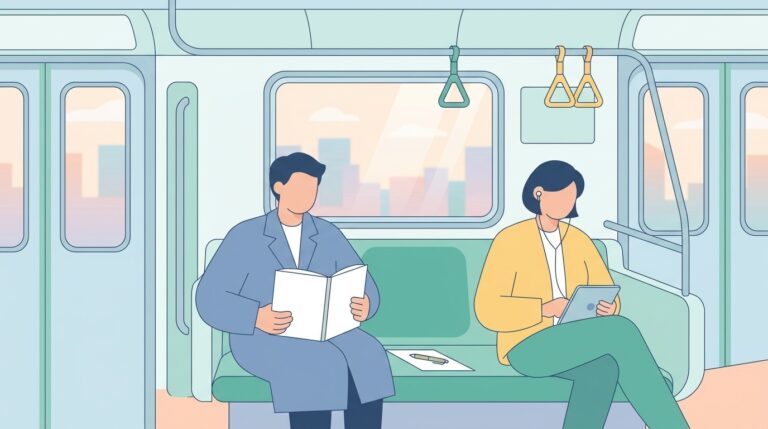
Master Korean Public Etiquette: Essential Rules and Polite Phrases for Everyday Situations
Phase 1: Empathy & Storytelling Opening
안녕하세요! Daily Hangul editor here. Picture this: you just landed in Seoul after a 13-hour flight. You hop onto the shiny, whisper-quiet Line 2 subway car during morning rush hour. Exhausted, you spot an empty seat at the end of the aisle and gladly sit down, or maybe you pick up a quick phone call to let your friend know you arrived. Suddenly, you feel several pairs of eyes quietly darting in your direction. The subtle tension is palpable—what did you do wrong?
If you have ever watched K-dramas like My Liberation Notes or Extraordinary Attorney Woo, you might have noticed how tranquil Korean public transit and cafes can be. Navigating public spaces in Korea is not just about knowing vocabulary; it is about tuning into unspoken community codes. Over the past 10 years of mentoring hundreds of intermediate learners, I have seen so many students freeze up in public out of fear of making a cultural faux pas. This guide breaks down the essential language and cultural mindset to help you blend in seamlessly and navigate Korean public places with total confidence.
Phase 2: Top 3 Essential Expressions for Public Etiquette
1. 조용히 해 주세요 (Joyonghi hae juseyo)
- Pronunciation: [Jo-yong-hee hae joo-seh-yo] (Sounds like “Joe-young-he” + “hey” + “Jew-say-yo”)
- Meaning: Literal: “Please do quietly.” | Actual Nuance: “Please keep your voice down / Please be quiet.”
- K-Culture Moment: Heard in study cafes (독서실), libraries, or quiet subway cars when someone’s phone ringtone goes off loudly.
- Editor’s Insight: Using
해 주세요adds a soft, polite request tone instead of a harsh command (조용히 하세요). It strikes the perfect B1-level balance between clear boundary-setting and politeness.- Situation Spectrum: Casual ⚠️ | Semi-formal ✅ | Formal ✅
- 🤔 Think About It: In your culture, do people ask strangers directly to be quiet, or do they wait for staff to intervene? How does direct politeness shape public harmony?
2. 먼저 지나가셔도 돼요 (Meonjeo jinagasyeodo dwaeyo)
- Pronunciation: [Mun-juh jee-nah-gah-shuh-doh dway-yo] (Sounds like “Munder” without ‘d’ + “Gina-gas-shore-doe” + “dway-yo”)
- Meaning: Literal: “You may pass by first.” | Actual Nuance: “Please, go ahead of me / After you.”
- K-Culture Moment: Standing on an escalator in a busy metro station like Gangnam or holding the door in an apartment elevator.
- Editor’s Insight: Combining
먼저(first) with the permissive grammar-아/어도 되다(it is okay to) creates an ultra-considerate offer. Adding the honorific시elevates your Korean naturally.- Situation Spectrum: Casual ⚠️ | Semi-formal ✅ | Formal ✅
- 🤔 Think About It: Why does yielding physical space carry such high social respect in dense urban cities like Seoul?
3. 자리 비어 있나요? (Jari bieo innayo?)
- Pronunciation: [Jah-ree bee-uh eep-nah-yo?] (Think “Jari” like safari + “bee-uh” + “in-nah-yo”)
- Meaning: Literal: “Is the seat empty?” | Actual Nuance: “Is this seat taken? / May I sit here?”
- K-Culture Moment: Crowded franchise cafes in Hongdae or commuter train waiting zones where personal belongings might be placed on adjacent chairs.
- Editor’s Insight: The gentle questioning ending
-나요?softens inquiries to strangers without sounding interrogative.- Situation Spectrum: Casual 🚫 | Semi-formal ✅ | Formal ✅
- 🤔 Think About It: In Korea, people often leave laptops unattended to hold a seat, but still ask before taking a chair nearby. What does this reveal about trust vs. personal space?
Phase 3: Textbook Korean vs. Real Korean
Situation 1: Asking to get past someone on a crowded bus
- 📖 Textbook Korean:
실례합니다, 내리겠습니다.(Excuse me, I will get off.) - 🗣️ Real Korean:
잠시만요, 내릴게요!(Just a second, getting off!) - 💡 Why the difference? While
실례합니다is grammatically textbook-perfect, native speakers instinctively shout a crisp잠시만요!(Just a moment!) with rising intonation to quickly clear a path before the doors close.
Situation 2: Asking if phone volume can be lowered in a cafe
- 📖 Textbook Korean:
소리를 낮추어 주시겠습니까?(Would you please lower the volume?) - 🗣️ Real Korean:
소리 조금만 줄여 주실 수 있나요?(Could you turn the sound down just a bit?) - 💡 Why the difference? Standard textbooks use heavy honorifics, but real Koreans rely on soften-words like
조금만(just a little) paired with-ㄹ 수 있나요?to prevent awkward confrontation.
Phase 4: K-Culture Deep Dive & Non-Verbal Manners
4-1. Nunchi (눈치) & Public Transit Gestures
- The Invisible Perimeter: Notice those bright pink seats at the ends of subway cars? Those are the 임산부 배려석 (Pregnant Women Consideration Seats). Even if the train is packed and empty, locals usually leave them unoccupied.
- Subway Backpack Rule (백팩 에티켓): When entering a crowded train, swing your backpack to your front or place it between your feet. Wearing a bulky bag on your back is called 민폐 (public nuisance).
- Silent Phone Mode: Phone conversations in transit should be kept under 30 seconds at whisper level. Look around: almost everyone wears earbuds or keeps notifications on vibrate (진동).
4-2. Cultural Code: The Seat Holding Phenomenon (자리 맡기)
In Korean cafes, it is totally normal to see unattended smartphones, jackets, and open laptops marking a table while someone orders. This reflects high social safety, but etiquette dictates that you should not occupy large 4-person tables alone during peak lunch hours (12:00 PM – 1:30 PM).
Phase 5: Real-Life Roleplay Scenario
- Setting: A quiet cafe near Anguk Station on a Sunday afternoon. Minho (the cafe manager) approaches a table.
-
Turn 1 (Minho): 손님, 죄송하지만 통화는 밖에서 부탁드려도 될까요? (Excuse me, customer, could I ask you to take phone calls outside?)
🎭 Politely bowing his head with hands clasped together - Turn 2 (You): 아, 죄송합니다! 목소리가 너무 컸죠? (Ah, I am so sorry! Was my voice too loud?)
🎭 Immediately lowering your phone and bowing lightly - Turn 3 (Minho): 네, 여기가 스터디 공간이라 다른 분들이 공부 중이셔서요. (Yes, this is a quiet study area and other guests are studying.)
🎭 Pointing gently with an open palm toward the laptop zone - Turn 4 (You): 몰랐어요. 지금 바로 진동으로 바꿀게요. (I didn’t know. I will switch it to vibrate right now.)
🎭 Tapping your phone screen quickly to silent mode - Turn 5 (Minho): 이해해 주셔서 감사합니다. 편하게 쉬다 가세요. (Thank you for understanding. Please enjoy your time here.)
🎭 Smiling warmly and offering a fresh napkin - Turn 6 (You): 혹시 여기 와이파이 비밀번호 어디에 적혀 있나요? (By the way, where is the Wi-Fi password written?)
🎭 Pointing subtly toward the receipt - Turn 7 (Minho): 영수증 하단이나 카운터 앞 안내판에 있어요. (It is at the bottom of the receipt or on the sign by the counter.)
🎭 Nodding toward the front desk - Turn 8 (You): 감사합니다. 조용히 이용할게요! (Thank you. I will use the space quietly!)
🎭 Giving a quiet thumbs-up gesture and whisper-smile
🔀 Interactive Branch Point:
You accidentally bump into someone on an escalator in Myeongdong station. What do you say?
* Option A: 야! 조심해! (Hey! Watch out!)
* ❌ Bad: Extremely rude. This is aggressive informal speech and can cause public arguments.
* Option B: 죄송합니다! 다치지 않으셨어요? (I am so sorry! Are you hurt?)
* 🏆 Best: Perfect B1 Korean! Shows deep concern and instant polite accountability.
* Option C: 괜찮아요! (It is okay!)
* ⚠️ Risk: Confusing. In Korean, the person who bumped should apologize (죄송합니다), not declare that things are okay (괜찮아요 is for the receiver).
Phase 6: 10-Second Emotion Shadowing Drill
Practice reading these sentences aloud, pausing at / and mimicking the mood:
[🥺 Apologetic & Quick]아, 죄송해요! / 제가 미처 못 봤어요. (Ah, I’m sorry! / I didn’t see that.)[😊 Considerate & Soft]먼저 / 타세요. / 저는 다음 거 탈게요. (Please / get on first. / I’ll take the next one.)[🤫 Whispering & Polite]여기 / 자리 / 비어 있나요? (Is this / seat / empty?)[🏃 Urgent yet Courteous]잠시만요! / 문 좀 잡아주세요! (Just a moment! / Please hold the door!)
Phase 7: K-Culture Mini Dictionary
- 민폐 (Min-pye): Nuisance / Inconvenience caused to others. Used when discussing improper public behavior (e.g., “민폐 끼치지 말자” = Let’s not cause trouble for others).
- 노키즈존 (No-kijeu-jon): No Kids Zone. A growing label in trendy Korean cafes designating areas reserved for adults seeking quiet.
- 줄서기 (Jul-seo-gi): Queueing / Lining up. In Korea, strictly standing behind painted floor markers on subway platforms is an essential everyday habit.
- 매너모드 (Mae-neo-mo-deu): Vibrate / Silent mode on smartphones. Derived from “manner,” it is the default expected state on all public transit.
Phase 8: Traveler’s Survival Kit
- Top 1:
내릴게요!(Naerilgeyo! / Getting off!) → Pro Tip: Shout this with a hand raised halfway if trapped behind commuters. - Top 2:
여기 앉아도 돼요?(Yeogi anjado dwaeyo? / May I sit here?) → Pro Tip: Always point with an open hand, not an index finger. - Top 3:
실례지만, 길 좀 비켜주시겠어요?(Sillyejiman, gil jom bikyeojusigesseoyo? / Excuse me, could you clear the way?) → Pro Tip: Use when moving luggage through crowded train aisles.
Editor’s Travel Note
Before traveling, download [Naver Map App for transit routes and quiet car info] to navigate real-time subway congestion in Seoul. Make sure to purchase a T-Money card at convenience stores; tagging your card smoothly at the turnstile prevents crowd bottlenecks.
Phase 9: One Step Deeper (Reflection)
Korean public etiquette revolves heavily around the concept of Jeong (정) balanced with Buddhism and Confucian civic consciousness. Because over 25 million people live tightly packed in the Greater Seoul Metropolitan Area, silence and spatial awareness are considered the highest forms of kindness. By minimizing your own footprint, you actively protect your neighbor’s mental peace.
💬 Your Turn: Have you ever experienced a quiet subway ride in Korea or seen a cultural rule that surprised you? Share your stories and questions in the comments below!
Phase 10: FAQ & Misconceptions
Q: Can I eat street food on the Seoul subway or city buses?
A: No. Seoul city buses strictly ban open food and drink containers (including take-out iced coffee). Subways technically allow sealed items, but eating hot or aromatic food is considered a major cultural taboo (민폐).
Q: Why do elderly people tap my shoulder if I sit in the corner subway seats?
A: The three seats on either end of each train car are strictly reserved for the elderly, disabled, and pregnant passengers (경로석/교통약자석). Even on completely empty trains, young commuters leave those seats open.
Q: How do I ask someone in a quiet train to turn off their speakerphone?
A: Avoid angry confrontations. Instead, make gentle eye contact and say softly: 죄송하지만 이어폰 써 주시겠어요? (Excuse me, but could you please use earphones?)
🚨 Common Mistakes Alert
- Sitting on Pink Seats: Even if tired, leave the pink pregnant women seats open.
- Shouting across the aisle: Keep conversation volume at whisper level in transit.
- Rushing into the elevator: Always wait for exiting passengers to clear out completely before stepping in.
Phase 11: Action Missions
- 🥉 Bronze Level: Practice saying
잠시만요, 내릴게요!five times out loud with natural intonation. - 🥈 Silver Level: Look up a Korean subway announcement video on YouTube and spot how many times the word 배려 (consideration) appears.
- 🥇 Gold Level: Next time you visit a Korean restaurant or cafe, ask
여기 앉아도 되나요?before seating yourself.
🎮 K-Culture Mission: Watch an episode of Hospital Playlist or Business Proposal. Observe how characters carry their umbrellas and bags when entering elevators or public lobbies.
Phase 12: Interactive Quiz Challenge
Question 1: Situation Judgement
You are on Line 2 during rush hour and need to get off at Hongik University Station, but people are blocking the door. What is the most natural Korean phrase?
* A) 저기요! 비키세요!
* B) 잠시만요, 내릴게요!
* C) 실례합니다, 당신은 움직이세요.
👉 Click to reveal Answer & Explanation
Answer: B (잠시만요, 내릴게요!)
* Explanation: 잠시만요, 내릴게요! is polite, natural, and immediately understood. Option A sounds overly bossy, and Option C is an awkward direct translation that sounds unnatural.
Question 2: Fill in the Blank
When politely asking if an empty seat can be used, complete the sentence:
여기 자리 ____ 있나요?
* A) 닫혀
* B) 비어
* C) 숨어
👉 Click to reveal Answer & Explanation
Answer: B (비어 from the verb 비다 – to be empty)
* Explanation: 자리 비어 있나요? is the idiomatic phrase for “Is this seat available?”.
Question 3: True or False
True or False: In Seoul buses, you are allowed to board while sipping an open cup of iced bubble tea.
👉 Click to reveal Answer & Explanation
Answer: False (X)
* Explanation: Seoul city buses enforce a strict ban on takeout beverage cups and open food items to prevent spills and protect fellow passengers.







