

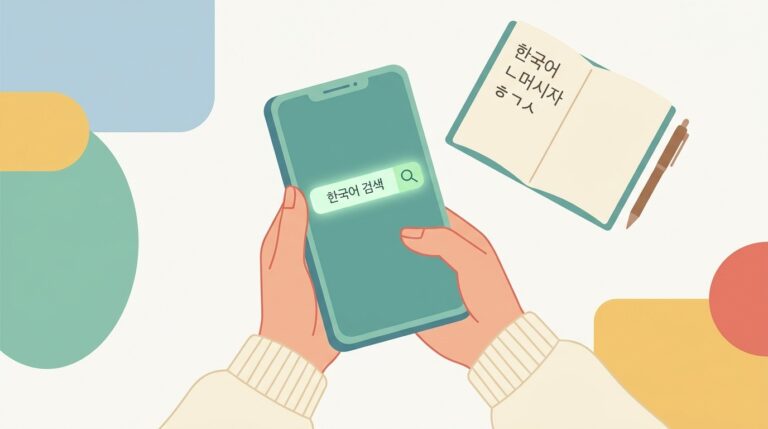
Master Searching Online in Korean: From Naver Searches to Daily Life Tips
Phase 1: Empathy & Storytelling Opening
안녕하세요! 매일한글 에디터입니다. (Hello! This is your Daily Hangul editor.) Have you ever found yourself wandering the bustling streets of Hongdae or Myeongdong, craving that viral strawberry soufflé pancake you saw on TikTok, but completely blanking on how to ask your Korean friend to look it up? Or maybe you tried typing English into a local map app, only to get zero results? We have all been there! In Korea, where digital life moves at lightning speed, knowing how to say “let’s search for it” or “look it up online” is just as essential as saying hello. This guide is crafted from real classroom feedback and daily life experiences in Seoul, designed specifically for A1 beginners. By the end of this post, you will comfortably talk about searching things online in Korean without any awkward pauses!
Phase 2: Top 3 Core Expressions Breakdown
1. 검색해 봐요 (Geom-saek-hae bwa-yo)
- Pronunciation: geom-saek-hae bwa-yo (Sounds like “gum-sack-hae bwah-yo”)
- Meaning: “Try searching for it” (Literal: Search and see)
- K-Culture Moment: When two friends in a K-Drama debate whether a restaurant is still open, one whips out their phone and says, “인터넷에 검색해 봐요!” (Let’s search it on the internet!)
- Editor’s Insight: Adding -해 봐요 (-hae bwa-yo) turns a dry command into a friendly, gentle suggestion like “why don’t you look it up?”
- Situation Spectrum: Casual ✅ | Semi-formal ✅ | Formal ⚠️
- 🤔 Think About It: In English, we often replace “search” with brand names like “Google it.” Do you think Koreans say “Naver it”? (Keep reading to find out!)
2. 인터넷으로 찾아요 (In-teo-ne-seu-ro cha-ja-yo)
- Pronunciation: in-teo-ne-seu-ro cha-ja-yo (Sounds like “in-ter-net-eu-roh chah-jah-yo”)
- Meaning: “I find/look it up via internet”
- K-Culture Moment: A variety show guest explaining how they learned a viral dance recipe: “인터넷으로 찾아서 만들었어요!”
- Editor’s Insight: 찾다 (chat-da) means “to find/look for.” Pairing it with 인터넷으로 (-euro means “by means of”) is the most natural beginner-friendly phrase for gathering information.
- Situation Spectrum: Casual ✅ | Semi-formal ✅ | Formal ✅
- 🤔 Think About It: Notice how Korean specifies the tool (인터넷으로) before the action (찾아요). How does your native language structure this?
3. 여기에 쳐요 (Yeo-gi-e chyeo-yo)
- Pronunciation: yeo-gi-e chyeo-yo (Sounds like “yeo-gee-eh chuh-yo”)
- Meaning: “Type it in here” (Literal: Hit/strike here)
- K-Culture Moment: A cafe clerk pointing at the kiosk search bar showing you where to type the menu item.
- Editor’s Insight: Koreans frequently use 치다 (chi-da, “to hit/strike”) to mean “to type keywords” on a keyboard or touchscreen.
- Situation Spectrum: Casual ✅ | Semi-formal ✅ | Formal 🚫
- 🤔 Think About It: Why do you think “typing” and “hitting” share the same root word in both English (keystrokes) and Korean (치다)?
Phase 3: Textbook Korean vs. Real Korean
- Situation 1: Asking someone to look up the location
- 📖 교과서 한국어 (Textbook): 정보를 검색하십시오. (Jeong-bo-reul geom-saek-ha-sip-si-o. / “Please search for information.”)
- 🗣️ 진짜 한국어 (Real-life): 네이버에 검색해 보세요. (Ne-i-beo-e geom-saek-hae bo-se-yo. / “Please look it up on Naver.”)
- 💡 Why is it different?: Textbook phrases are overly formal. Real Koreans directly name the portal (usually Naver) with the polite suggestion ending -해 보세요.
- Situation 2: Telling someone you will check your phone
- 📖 교과서 한국어 (Textbook): 스마트폰으로 조사하겠습니다. (Seu-ma-teu-pon-eu-ro jo-sa-ha-get-seum-ni-da. / “I will investigate with a smartphone.”)
- 🗣️ 진짜 한국어 (Real-life): 제가 찾아볼게요! (Je-ga cha-ja-bol-ge-yo! / “I will look it up!”)
- 💡 Why is it different?: 조사하다 sounds like a detective investigation. Everyday Korean prefers the cozy compound verb 찾아보다 (to look and find).
Phase 4: K-Culture Deep Dive & Nonverbal Etiquette
4-1. Nunchi & Screen Sharing Manners
When you ask a Korean friend to search something on their phone, never lean in too close or touch their screen without permission. Tilt your upper body slightly forward, point gently at your own phone first, and say, “같이 검색해 봐요!” (Let’s search together!). This shows you respect their personal digital space.
4-2. The “Green Window” (초록창) Phenomenon
In South Korea, Naver is affectionately called 초록창 (Cho-rok-chang, “The Green Search Box”). While Google is popular for global tech and academic queries, Koreans rely heavily on Naver and Kakao for local restaurants, opening hours, subway navigation, and trendy blog reviews. Mentioning “초록창에 검색해요” will instantly make you sound like a local insider!
Phase 5: Real-Life Roleplay Scenario
Setting: You and your Korean classmate, Minho (민호), are looking for a famous tteokbokki restaurant in Hongdae.
- Turn 1 (You): 민호 씨, 배고파요. 맛집 알아요? (Min-ho ssi, bae-go-pa-yo. Mat-jip a-ra-yo? / “Minho, I’m hungry. Do you know a good place to eat?”)
- Turn 2 (Minho): 음, 이 근처 떡볶이 유명해요. (Eum, i geun-cheo tteok-bok-kki yu-myeong-hae-yo. / “Um, tteokbokki around here is famous.”)
🎭 Minho taps his chin thoughtfully. - Turn 3 (You): 어디에 있어요? (Eo-di-e it-seo-yo? / “Where is it?”)
- Turn 4 (Minho): 잠깐만요, 제가 검색해 볼게요. (Jam-kkan-man-yo, je-ga geom-saek-hae bol-ge-yo. / “Hold on a second, I will search for it.”)
🎭 Minho unlocks his smartphone. - Turn 5 (You): 네이버로 찾아요? (Ne-i-beo-ro cha-ja-yo? / “Are you finding it with Naver?”)
- Turn 6 (Minho): 네! 네이버 지도에 검색창에 이름 쳐요. (Ne! Ne-i-beo ji-do-e geom-saek-chang-e i-reum chyeo-yo. / “Yes! I type the name in the Naver Map search bar.”)
- Turn 7 (You): 나왔어요? (Na-wat-seo-yo? / “Did it pop up?”)
🎭 You smile and look at Minho's screen politely. - Turn 8 (Minho): 네, 찾았어요! 여기서 5분 걸려요. (Ne, cha-jat-seo-yo! Yeo-gi-seo o-bun geol-lyeo-yo. / “Yes, found it! It takes 5 minutes from here.”)
🔀 Interactive Choice Point
How do you respond to Minho finding the shop?
* Choice A: “와, 빨라요! 지금 가요!” (Wa, ppal-la-yo! Ji-geum ga-yo! / “Wow, fast! Let’s go now!”)
* Choice B: “검색하십시오.” (Geom-saek-ha-sip-si-o. / “Please execute a search.”)
* Choice C: “스마트폰 꺼요.” (Seu-ma-teu-pon kkeo-yo. / “Turn off your smartphone.”)
- Feedback:
- Choice A (Best): Perfect! Natural, enthusiastic, and polite for an A1 speaker.
- Choice B (Bad): Too robotic and awkward. He just finished searching!
- Choice C (Risk): Rude and confusing out of nowhere.
Phase 6: 10-Second Emotion Shadowing Drill
Practice these lines out loud with the exact emotional pitch:
[🤔 호기심 가득하게 / Wondering & Curious]- 인터넷에 / 검색해 볼까요? (In-teo-ne-se / geom-saek-hae bol-kka-yo?)
[💡 깨달음을 얻고 신나게 / Excited Discovery]- 아! / 네이버에서 / 찾았어요! (Ah! / Ne-i-beo-e-seo / cha-jat-seo-yo!)
[🤝 친절하고 다정하게 / Friendly & Helpful]- 여기에 / 단어를 / 쳐 보세요! (Yeo-gi-e / da-neo-reul / chyeo bo-se-yo!)
Phase 7: K-Culture Mini Dictionary
- 검색창 (Geom-saek-chang): Search bar / search box. Combine 검색 (search) + 창 (window/box). Essential for navigating Korean websites.
- 검색어 (Geom-saek-eo): Search keyword / query term. Seen on real-time ranking charts on Korean portals.
- 실시간 (Sil-si-gan): Real-time. Often paired with trending searches: 실시간 검색어.
- 링크 (Ling-keu): Link / URL. Used casually: “링크 보내 주세요” (Please send me the link).
Phase 8: Traveler’s Survival Kit
TOP 3 Survival Phrases
- Phrase 1: 와이파이 비밀번호 검색해 주세요. (Wa-i-pa-i bi-mil-beon-ho geom-saek-hae ju-se-yo. / “Please search/check the Wi-Fi password for me.”)
- Pro Tip: Use this at guesthouses or cafes when you cannot locate the router sticker.
- Phrase 2: 지도에서 어떻게 찾아요? (Ji-do-e-seo eo-tteo-ke cha-ja-yo? / “How do you find it on the map?”)
- Pro Tip: Hand your phone politely to a station staff or clerk when lost.
- Phrase 3: 검색창이 어디예요? (Geom-saek-chang-i eo-di-ye-yo? / “Where is the search bar?”)
- Pro Tip: Super useful on digital self-checkout kiosks.
Editor’s Travel Note
Before stepping foot in Incheon Airport, ensure you complete the 네이버 지도 앱 다운로드 (Naver Map App Download) and 카카오맵 설치 가이드 (Kakao Map Setup Guide). Google Maps has limited walking navigation in Korea due to local security regulations. Searching in Korean or pasting Korean names into Naver Map will save you hours of wandering!
Phase 9: Think Deeper (한 발 더 깊이)
In Korea, search culture reflects the nation’s Palli-Palli (빠리빨리, “quick, quick”) ethos and communal sharing culture. When Koreans find a hidden gem, they immediately publish detailed photo blogs with exact search keywords (태그). Information is treated as a shared communal resource. When you say “함께 검색해요” (Let’s search together), you are actively inviting someone into your shared experience.
💬 Your Turn: What is the first Korean word or K-Pop location you want to search for on Naver? Share in the comments below!
Phase 10: FAQ & Common Mistakes
Q: Can I use the verb 구글하다 (to google) in Korea?
A: Young Koreans understand 구글링하다 (Googling), but in standard daily conversation with diverse age groups, 검색하다 (to search) or 찾아보다 (to look up) is far more universal and natural.
Q: What is the difference between 찾다 and 검색하다?
A: 찾다 means to look for or find anything (keys, friends, lost items, answers), while 검색하다 specifically refers to searching a database, internet engine, or index.
Q: How do I say “I will look it up on YouTube”?
A: You can say “유튜브에 검색해 볼게요” (Yu-tyu-beu-e geom-saek-hae bol-ge-yo).
🚨 Common Mistakes Alert!
- Mistake: Saying “인터넷을 봐요” when you mean searching a specific answer.
- Correct Action: Use “인터넷에서 찾아요” or “검색해요”.
- Mistake: Forgetting the location particle -에 before search platforms.
- Correct Action: Say “네이버에 검색해요” (Naver-e), not “네이버 검색해요” in formal writing.
- Mistake: Translating “Type the word” as 타이핑하다.
- Correct Action: Use 단어를 쳐요 (da-neo-reul chyeo-yo) for natural speaking.
Phase 11: Action Missions
- 🥉 Bronze Mission: Open your phone browser right now and say “검색창에 쳐요!” aloud three times before typing.
- 🥈 Silver Mission: Take a screenshot of a Korean search bar and share it on Instagram/X with the caption #검색해봐요 #DailyHangul.
- 🥇 Gold Mission: Next time you order at a Korean restaurant or talk to a language partner, say “제가 인터넷으로 찾아볼게요!”.
- 🎮 K-Culture Mission: Watch one episode of a K-Drama and spot whenever an actor uses their phone to look up someone’s profile or news article!
Phase 12: Interactive Quiz Challenge
1. Situation Quiz: You want to politely ask a Korean friend to search for a cafe address on their phone. Which phrase is best?
* A) 검색하십시오.
* B) 검색해 보세요!
* C) 인터넷을 끄세요.
2. Fill-in-the-Blank: Type the correct particle: 네이버____ 검색해요. (Search on Naver.)
3. True or False: 치다 can mean “to hit” and also “to type keywords” in Korean digital context. (T/F)
👉 Click here to reveal the Quiz Answers & Explanations!
- Answer: B) 검색해 보세요! (Friendly, natural polite request for A1 level. Option A is too stiff, Option C means “turn off the internet”).
- Answer: 에 (e) (네이버에 검색해요 – “Search on Naver”).
- Answer: True (T) (치다 is widely used for keyboard/touchscreen typing: 검색창에 쳐요).







