

Master Korean Emailing: Write Natural and Polite Emails Without the Stress
Phase 1: Empathy (Story-Driven Opening)
안녕하세요! 매일한글 에디터입니다. (Hello! I’m your Daily Hangul editor.)
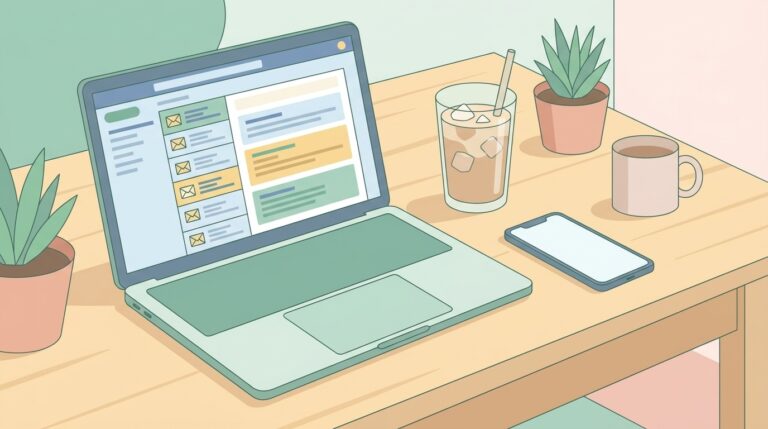
Picture this: You are sitting at a bustling cafe in Hongdae or at your desk preparing a message for your Korean professor, Airbnb host, or colleague. You open your inbox, type a greeting, and suddenly freeze. How do you say “I attached the file” or “Please check your email” without sounding like a translated robot from the 1990s or accidentally being rude? If you have ever watched K-Dramas like Misaeng or Start-Up, you know how crucial smooth communication is in Korean daily life.
Sending an email in Korean doesn’t require a master’s degree in classical literature. By mastering just a few friendly, practical A2-level sentence patterns, you can confidently hit “Send” knowing your message is clear, warm, and natural. Based on years of feedback from real learners, this guide will transform your digital Korean from stiff to smooth!
Phase 2: Top 3 Core Expressions In-Depth Analysis
1. 메일 확인 부탁드립니다 (Mail hwag-in bu-tag-deu-rim-ni-da)
- Pronunciation: meh-il hwa-geen boo-tahk-deu-reem-nee-da (Sounds like “mail” + hwa-gin + boo-tahk)
- Meaning: Literal: “I request your confirmation of the mail.” / Actual Nuance: “Please kindly check the email.”
- K-Culture Moment: The quintessential line heard in Korean office dramas when an employee sends an urgent update to their team leader.
- Editor’s Insight: Combining 확인 (check/verify) with 부탁드립니다 (I humbly ask) creates the golden standard of Korean polite requests.
- Situation Spectrum: Casual: ⚠️ (Use 메일 확인해 줘) | Semi-formal: ✅ | Formal: ✅
- 🤔 Think About It: Notice how English says “Please check,” while Korean frames it as “I ask a favor of checking.” How does this reflect the polite culture of mutual respect?
2. 첨부파일 확인해 주세요 (Cheom-bu-pa-il hwag-in-hae ju-se-yo)
- Pronunciation: chum-boo-pah-eel hwa-geen-hae joo-seh-yo (Cheom-bu rhymes with “thumb-boo”)
- Meaning: Literal: “Please check the attached file for me.” / Actual Nuance: “Please take a look at the attachment.”
- K-Culture Moment: Used constantly when sending concert ticket confirmations, study group notes, or homework documents.
- Editor’s Insight: 첨부 means “attachment” and 파일 is the loanword for “file.” Adding -해 주세요 makes it soft and approachable for everyday A2 communication.
- Situation Spectrum: Casual: ⚠️ | Semi-formal: ✅ | Formal: ✅
- 🤔 Think About It: Why does Korean combine native grammar helpers like -해 주다 (to do something for someone) with English loanwords like 파일?
3. 좋은 하루 보내세요! (Jo-eun ha-ru bo-nae-se-yo!)
- Pronunciation: joh-eun ha-roo boh-neh-seh-yo (Jo-eun rhymes with “go-eun”)
- Meaning: Literal: “Spend a good day!” / Actual Nuance: “Have a wonderful day! / Warm regards.”
- K-Culture Moment: The classic sign-off phrase at the end of friendly customer service replies, personal emails, or club announcements.
- Editor’s Insight: While English often ends with “Best regards,” Korean emails love wishing health, good weather, or a bright day ahead.
- Situation Spectrum: Casual: ✅ | Semi-formal: ✅ | Formal: ✅
- 🤔 Think About It: How does ending an email with a wish for someone’s well-being soften the entire interaction?
Phase 3: Textbook Korean vs. Real-World Korean
Situation 1: Letting someone know you sent an email
- 📖 Textbook Korean: 당신에게 이메일을 발송했습니다. (Dang-sin-e-ge i-me-il-eul bal-song-haess-seum-ni-da. – “I dispatched an electronic mail to you.”)
- 🗣️ Real-World Korean: 메일 보냈어요! / 메일 드렸습니다! (Me-il bo-naess-eo-yo! / Me-il deu-ryeoss-seum-ni-da!)
- 💡 Why is it different? Native speakers rarely say “당신” (you) or “발송” (dispatch) in regular messages. Using simple “메일 보냈어요” or polite “메일 드렸습니다” is natural and effortless.
Situation 2: Asking for a fast reply
- 📖 Textbook Korean: 신속한 회신을 기다리겠습니다. (Sin-sok-han hoe-sin-eul gi-da-ri-gess-seum-ni-da. – “I shall await your prompt response.”)
- 🗣️ Real-World Korean: 편하실 때 확인 부탁드려요. (Pyeon-ha-sil ttae hwag-in bu-tag-deu-ryeo-yo. – “Please check when it’s convenient for you.”)
- 💡 Why is it different? Direct demands for speed can sound pressuring. Adding “편하실 때” (when convenient) demonstrates high-level digital Nunchi.
Phase 4: K-Culture Deep Dive & Non-Verbal Manners
4-1. Digital Nunchi (눈치) & Email Etiquette
In Korea’s hyper-connected Ppalli-Ppalli (fast-paced) society, communication speed matters, but politeness matters more. In text-based communication, non-verbal tone is expressed through proper greetings and polite ending particles. Starting abruptly with your request without a simple greeting like “안녕하세요!” is seen as blunt. Always include a short one-line seasonal or pleasant greeting before making your main request.
4-2. Culture Code: The Warm Sign-off
If you watch workplace dramas like Misaeng, you will notice that Koreans rarely end emails with just their signature. Even in brief exchanges, phrases like “감사합니다, 좋은 하루 보내세요!” (Thank you, have a great day!) bridge professional distance and build warm personal rapport (Jeong).
Phase 5: Real-Life Roleplay Scenario
Setting: You are organizing a group study session with your Korean classmate, Min-woo (민우), at a cafe in Sinchon. You just sent him the study worksheet via email.
- You (민지): 민우 씨, 과제 파일 메일로 보냈어요! (Min-woo ssi, gwa-je pa-il me-il-lo bo-naess-eo-yo!)
Translation: “Min-woo, I sent the assignment file by email!”
🎭 Stage Direction: (Smiling while showing the sent box on your smartphone screen) -
Min-woo (민우): 아, 그래요? 바로 확인해 볼게요! (A, geu-rae-yo? Ba-ro hwag-in-hae bol-ge-yo!)
Translation: “Oh, really? I will check it right away!”
🎭 Stage Direction: (Opening the laptop screen with interest) -
You (민지): 첨부파일 열려요? (Cheom-bu-pa-il yeol-lyeo-yo?)
Translation: “Does the attached file open properly?”
🎭 Stage Direction: (Tilting head slightly with a questioning look) -
Min-woo (민우): 네, 아주 잘 열려요. 정리가 진짜 깔끔하네요! (Ne, a-ju jal yeol-lyeo-yo. Jeong-ni-ga jjin-jja kkal-kkeum-ha-ne-yo!)
Translation: “Yes, it opens very well. Your notes are so neatly organized!”
🎭 Stage Direction: (Nodding and giving a thumbs-up) -
You (민지): 다행이에요. 수정할 내용 있으면 답장 주세요. (Da-haeng-i-e-yo. Su-jeong-hal nae-yong iss-eu-myeon dap-jang ju-se-yo.)
Translation: “What a relief. If there’s anything to edit, please reply to the email.”
🎭 Stage Direction: (Sipping iced americano with relief) -
Min-woo (민우): 알겠어요. 꼼꼼히 읽어보고 오늘 저녁 전까지 메일 드릴게요. (Al-gess-eo-yo. Kkom-kkom-hi ilg-eo-bo-go o-neul jeo-nyeok jeon-kka-ji me-il deu-ril-ge-yo.)
Translation: “Got it. I’ll read it carefully and email you before this evening.”
🎭 Stage Direction: (Typing quick notes on his keyboard) -
You (민지): 네, 편하실 때 확인해 주세요! (Ne, pyeon-ha-sil ttae hwag-in-hae ju-se-yo!)
Translation: “Sure, please check it whenever it is convenient for you!”
🎭 Stage Direction: (Giving a warm, relaxed smile) -
Min-woo (민우): 고마워요! 오늘도 좋은 하루 보내요! (Go-ma-wo-yo! O-neul-do jo-eun ha-ru bo-nae-yo!)
Translation: “Thanks! Have a wonderful day today as well!”
🎭 Stage Direction: (Waving hand warmly)
🔀 Interactive Choice Point
Min-woo asks: “메일 제목이 뭐예요?” (What is the subject line of the email?)
How do you reply?
- Choice A: “제목은 ‘한국어 스터디 자료’예요. 확인 부탁드립니다!”
Feedback: [BEST] Clear, courteous, and gives the exact information while maintaining polite speech. - Choice B: “몰라요. 그냥 찾으세요.”
Feedback: [BAD] “I don’t know. Just find it yourself.” This sounds extremely dismissive and blunt. - Choice C: “야! 내가 메일 보냈으니까 빨리 봐!”
Feedback: [RISK] Very informal slang; using this with casual classmates or colleagues will cause awkward tension.
Phase 6: 10-Second Emotion Shadowing Drill
Practice reading these rhythmically with the pause marks (/) and matching the emotional cues!
[😊 Cheerful & Helpful]
안녕하세요! / 메일 보냈으니 / 확인 부탁드립니다!
(An-nyeong-ha-se-yo! / Me-il bo-naess-eu-ni / hwag-in bu-tag-deu-rim-ni-da!)-
[🧐 Thoughtful & Polite]
첨부파일 확인해 보시고 / 편하실 때 / 답장 주세요.
(Cheom-bu-pa-il hwag-in-hae bo-si-go / pyeon-ha-sil ttae / dap-jang ju-se-yo.) -
[☀️ Bright & Warm]
오늘도 / 힘내시고 / 좋은 하루 보내세요!
(O-neul-do / him-nae-si-go / jo-eun ha-ru bo-nae-se-yo!)
Phase 7: K-Culture Mini Dictionary
- 메일 (Me-il): Email. Short for 이메일. Commonly paired with verbs like 보내다 (to send) or 받다 (to receive).
- 첨부파일 (Cheom-bu-pa-il): Attached file / attachment. Essential for sending PDFs, resumes, or travel documents.
- 확인 (Hwag-in): Confirmation / Checking. Combined with 부탁드립니다 to politely ask someone to look over something.
- 답장 (Dap-jang): Reply / Response. Used when expecting an answer back (답장 주세요 = Please reply).
Phase 8: Survival Kit for Travelers & Expats
Top 3 Email Survival Phrases
- 예약 확인 메일 보냈습니다. (Ye-yak hwag-in me-il bo-naess-seum-ni-da. – “I have sent the booking confirmation email.”)
Pro Tip: Perfect when checking in at guesthouses or confirming rental car reservations. - 메일 주소 다시 알려주시겠어요? (Me-il ju-so da-si al-lyeo-ju-si-gess-eo-yo? – “Could you please tell me your email address again?”)
Pro Tip: Use when you suspect a typo in the recipient’s address. - 확인 후 메일 드리겠습니다. (Hwag-in hu me-il deu-ri-gess-seum-ni-da. – “I will email you after checking.”)
Pro Tip: A polite way to buy time while checking information.
Editor’s Travel & Tech Note
When navigating Korean administrative services, university courses, or business communications, downloading standard Korean internet tools makes life easier. Check the Naver Mail mobile app guide to manage .naver.com addresses smoothly, and use Hancom Office Web Viewer if you receive files ending in .hwp.
Phase 9: Think Deeper (Cultural Perspective)
In Korean digital communication, the boundary between formal writing and thoughtful hospitality often blurs. While English emails focus heavily on brevity and efficiency, Korean emails value relational harmony. The simple choice between using 드리다 (humble giving) instead of 주다 (standard giving) signals genuine respect for the recipient’s time and status.
💬 Your Turn: In your home country, how do you usually start and end polite emails? Share your thoughts and typical email greetings in the comments below!
Phase 10: FAQ & Common Pitfalls
Q: What is the difference between “메일 보냈어요” and “메일 드렸습니다”?
A: Both mean “I sent an email.” However, 메일 보냈어요 is standard polite language (Polite Informal, -요 form) great for friendly peers, while 메일 드렸습니다 uses the humble honorific 드리다, making it ideal for managers, clients, or professors.
Q: Can I use “~씨” in the email greeting?
A: Yes, when emailing colleagues of similar rank or friendly acquaintances (e.g., 민우 씨, 안녕하세요). However, for superiors, professors, or clients, always use their title + 님 (e.g., 교수님 안녕하세요 or 팀장님 안녕하세요).
Q: How do Koreans say “CC” (Carbon Copy) in email?
A: Koreans use the loanword term 참조 (Cham-jo) for CC and 숨은 참조 (Sum-eun cham-jo) for BCC.
🚨 Common Mistakes Alert (Top 3)
- Saying “당신에게 메일을 보냅니다”: “당신” sounds overly aggressive or awkwardly theatrical in contemporary Korean. Action: Omit the word “you” or use the person’s name/title.
- Forgetting the greeting before the request: Jumping straight into “첨부파일 확인하세요” sounds like an order. Action: Always start with “안녕하세요, [Name]님” and end with “부탁드립니다”.
- Overusing automated translation sign-offs like ‘친애하는’: “친애하는” (Dear/Beloved) sounds like an old-fashioned political speech. Action: Stick to “[Name]님, 안녕하세요”.
Phase 11: Action Mission Challenge
- 🥉 Bronze Mission (Solo): Type out the sentence
메일 확인 부탁드립니다3 times on your phone keyboard without auto-correct. - 🥈 Silver Mission (Social): Leave a comment on this post introducing yourself and ending with
좋은 하루 보내세요!in Korean. - 🥇 Gold Mission (Real Life): Send a short email in Korean to a language exchange partner or teacher with an attached photo.
- 🎮 K-Culture Mission: Next time you watch an office K-Drama, listen closely for the words 메일 and 확인 in the dialogue!
Phase 12: Interactive Quiz Challenge
1. Situation Challenge: You just attached your homework file and want to ask your teacher politely to check it. Which sentence is best?
* A) 첨부파일 봐.
* B) 첨부파일 확인 부탁드립니다.
* C) 파일 보냈다.
2. Fill-in-the-Blank:
“오늘도 힘내시고 좋은 하루 (________)!” (Fill in the polite sign-off verb meaning ‘have/spend’).
3. Culture True or False:
True or False: In Korean business emails, it is standard to call your boss “당신” to show respect.
👉 Click here to check the Answers & Explanations!
- Answer: B (첨부파일 확인 부탁드립니다.)
Explanation: Option B is polite and professional. Options A and C are informal banmal (반말) which should not be used with teachers. -
Answer: 보내세요 (or 보내십시오)
Explanation: 좋은 하루 보내세요 is the most natural, welcoming way to say “Have a great day!” -
Answer: False
Explanation: Never use “당신” for superiors or clients. Use their formal title + 님 (e.g., 팀장님, 부장님).







