

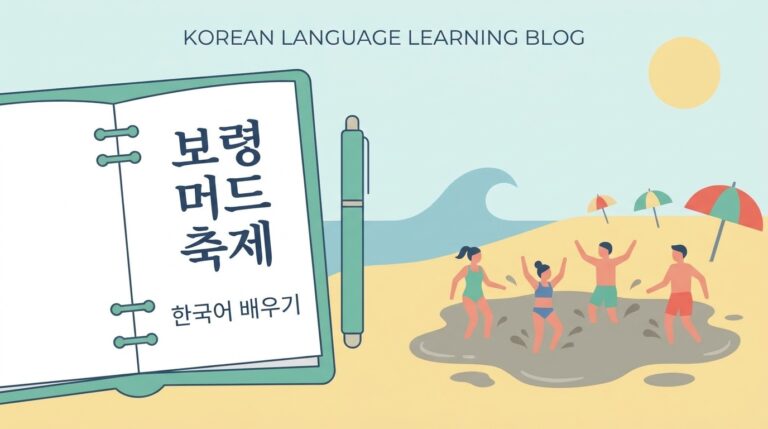
Conquer Boryeong Mud Festival: Talk, Play, and Party Like a Local!
Phase 1: Empathy (Story-Driven Opening)
안녕하세요! 매일한글 에디터입니다. (Hello! I’m your Daily Hangul Editor.)
Picture this: You are standing under the blazing July sun on Daecheon Beach. Upbeat K-Pop beats are thumping in your chest, EDM rhythms are blasting through massive speakers, and everywhere you look, thousands of people from all over the world are covered head-to-toe in mineral-rich grey mud! You see giant inflatable mud slides, intense mud wrestling rings, and friends playfully tackling each other into the mud pits.
You want to dive straight into the action, join a group for a friendly mud fight, or ask a staff member where to rinse off before your contact lenses get completely coated in slime. But suddenly, your mind blanks out. How do you shout “Let’s go crazy today!” without sounding like a polite 1990s audio textbook? How do you ask a fellow festival-goer for help washing mud off your face naturally without awkwardness?
Don’t worry! Based on real feedback from intermediate learners who survived and thrived at Korea’s wildest summer festivals, I’ve crafted this comprehensive B2 guide. By the end of this article, you will not only master the vibrant colloquial phrasing needed to fully embrace the festive “Heung” (흥 – joyful energy), but you’ll also navigate Korean festival etiquette like a seasoned insider.
Phase 2: Top 3 Core Expressions Deep Dive
1. 제대로 놀아보자! (Let’s really have a blast today!)
- Pronunciation: Je-dae-ro no-ra-bo-ja! (Sounds like: Jae-dae-row no-rah-boh-jah! – imagine saying “Day-row” with a soft ‘J’)
- Meaning: Literal: “Let’s play properly!” | Actual Nuance: “Let’s go all out and party with zero regrets!”
- K-Culture Moment: Seen frequently in Korean variety shows like Running Man or Infinite Challenge right before the cast dives into intense physical summer games.
- Editor’s Insight: The adverb ‘제대로’ (properly/thoroughly) elevates a basic activity into an all-in, passionate commitment. It signals high enthusiasm.
- Situation Spectrum: Casual (Banmal) ✅ | Semi-formal (제대로 놀아봐요) ⚠️ | Formal 🚫
- 🤔 Think About It: In English, we often say “Let’s party hard!” How does the Korean focus on “playing properly (제대로)” reflect the cultural attitude of dedicating 100% passion to both work and leisure?
2. 머드 범벅이 됐어요! (I’m completely covered in mud!)
- Pronunciation: Meo-deu beom-beok-i dwae-sseo-yo! (Sounds like: Muh-deu bum-buck-ee dwae-ssuh-yo! – rhymes with “bum duck”)
- Meaning: Literal: “I have become a mud medley.” | Actual Nuance: “I am smeared/covered from head to toe in mud!”
- K-Culture Moment: Used whenever someone emerges from the mud prison zone looking completely unrecognizable on travel vlogs.
- Editor’s Insight: ‘-범벅’ is a vivid noun suffix describing something messy, mixed, and totally coated (e.g., 눈물범벅 – drenched in tears, 땀범벅 – drenched in sweat).
- Situation Spectrum: Casual (머드 범벅 됐어) ✅ | Semi-formal ✅ | Formal ⚠️
- 🤔 Think About It: Why does Korean have so many descriptive sensory suffixes like ‘-범벅’ to express physical states?
3. 눈에 머드가 들어갔는데, 물 좀 뿌려주실래요? (Mud got in my eyes, could you splash some water for me?)
- Pronunciation: Nun-e meo-deu-ga deu-reo-gat-neun-de, mul jom bbu-ryeo-ju-sil-lae-yo?
- Meaning: Direct & Polite request for emergency quick-rinse assistance in the mud zone.
- K-Culture Moment: An essential survival sentence shouted near the water stations and obstacle courses when you’re temporarily blinded by flying mud.
- Editor’s Insight: Using ‘-는데’ softens the background situation, while ‘-주실래요?’ makes an urgent request sound polite and friendly to strangers.
- Situation Spectrum: Casual (물 좀 뿌려줘) ⚠️ | Semi-formal ✅ | Formal ✅
- 🤔 Think About It: Notice how explaining the situation first (눈에 머드가 들어갔는데…) naturally primes the listener before making the actual request.
Phase 3: Textbook Korean vs. Real Korean
Situation 1: Suggesting to jump into the giant mud slide together
- 📖 교과서 한국어 (Textbook): “우리 함께 진흙 미끄럼틀을 타러 갈까요?” (Shall we go ride the mud slide together?)
- 🗣️ 진짜 한국어 (Real-life Native): “저기 머드 슬라이드 줄 서서 같이 뛰어들자!” (Let’s line up for that mud slide over there and dive in together!)
- 💡 왜 다를까? (Why the difference?): In real festival situations, locals use specific loanwords like ‘머드 슬라이드’ and dynamic action verbs like ‘뛰어들다’ (jump in) rather than rigid, overly formal textbook phrasing.
Situation 2: Asking someone to take a fun group photo
- 📖 교과서 한국어 (Textbook): “저희 사진을 한 장 찍어 주시겠습니까?” (Would you take a picture for us?)
- 🗣️ 진짜 한국어 (Real-life Native): “저기 죄송한데, 저희 전신 나오게 한 장만 찍어주실 수 있나요?” (Excuse me, could you take one shot showing our full body?)
- 💡 왜 다를까? (Why the difference?): At Boryeong, showing the mud from head to toe is crucial, so Koreans specifically request ‘전신 나오게’ (full-body shot) while keeping the tone polite yet approachable.
Phase 4: K-Culture Deep Dive & Non-Verbal Manners
4-1. 눈치 (Nunchi) & Festival Body Language
- The “Mud-Consent” Rule: While Boryeong is an interactive festival where smearing mud is expected, never throw mud directly into strangers’ eyes, ears, or mouth. Always aim for shoulders or arms.
- The Head-Tilt Rinse Gesture: If someone has mud in their eyes, gently tap your cheek and tilt your head downward. This non-verbal signal tells friendly bystanders you need targeted rinsing without speech.
4-2. Cultural Code: The Spirit of “Heung” (흥) & Summer Festivals
Koreans work hard, but when it comes to summer festivals, the collective energy known as 흥 (Heung) takes over. Mutual politeness breaks down in a healthy, joyful way: age hierarchies disappear inside the mud pit, and everyone becomes equal under the grey mud. Embracing this communal playfulness is the secret key to truly enjoying Korean festive culture.
Phase 5: Real-Life Roleplay Scenario
- Setting: The Mega Mud Zone at Boryeong Mud Festival. Loud DJ music is playing. You meet Min-su, an energetic festival volunteer.
-
Min-su (민수): 어서 오세요! 머드 축제 처음이세요? 완전 환영해요!
(Eo-seo o-se-yo! Meo-deu chuk-je cheo-eum-i-se-yo? Wan-jeon hwan-yeong-hae-yo!)
🎭 Hands you a small bucket of pure mud with an enthusiastic grin.
“Welcome! Is it your first time at the Mud Festival? You are so welcome!” -
You (나): 네, 처음이에요! 오늘 제대로 놀아보려고 작정하고 왔어요.
(Ne, cheo-eum-i-e-yo! O-neul je-dae-ro no-ra-bo-ryeo-go jak-jeong-ha-go wa-sseo-yo.)
🎭 Laughing while putting on waterproof goggles.
“Yes, it’s my first time! I came here determined to really have a blast today.” -
Min-su (민수): 와, 열정 대박! 그럼 먼저 저기 머드 마사지 존부터 들어갈래요?
(Wa, yeol-jeong dae-bak! Geu-reom meon-jeo jeo-gi meo-deu ma-sa-ji jon-bu-teo deu-reo-gal-lae-yo?)
🎭 Pointing toward the main mud puddle zone.
“Wow, awesome passion! Then do you want to head into the mud massage zone first?” -
You (나): 좋아요! 근데 폰은 방수팩에 넣었는데도 괜찮겠죠?
(Jo-a-yo! Geun-de pon-eun bang-su-paek-e neo-eot-neun-de-do gwaen-chan-ket-jyo?)
🎭 Checking your waterproof phone pouch tightly.
“Sounds great! But my phone will be okay inside this waterproof pouch, right?” -
Min-su (민수): 네, 목에 잘 걸어두세요. 자, 이제 슬슬 머드 범벅 될 준비 하시고!
(Ne, mok-e jal geo-reo-du-se-yo. Ja, i-je seul-seul meo-deu beom-beok doel jun-bi ha-si-go!)
🎭 Lightly smudges a swipe of cosmetic mud across your cheeks.
“Yes, make sure it’s secured around your neck. Now, get ready to get completely muddy!” -
You (나): 하하, 벌써 시작이네요! 저기 슬라이드 같이 타실 분 찾아서 가볼게요.
(Ha-ha, beol-sseo si-jak-i-ne-yo! Jeo-gi seul-ra-i-deu ga-chi ta-sil bun cha-ja-seo ga-bol-ge-yo.)
🎭 High-fiving Min-su with muddy hands.
“Haha, it’s already started! I’ll look for people to ride that slide over there together.” -
Min-su (민수): 조심해서 노세요! 눈에 들어가면 바로 세안 부스로 뛰어가시고요!
(Jo-sim-hae-seo no-se-yo! Nun-e deu-reo-ga-myeon ba-ro se-an bu-seu-ro ttwi-eo-ga-si-go-yo!)
🎭 Waving thumbs up.
“Play safely! If mud gets in your eyes, run straight to the eye-wash booth!” -
You (나): 네, 꿀팁 감사해요! 신나게 던지고 올게요!
(Ne, kkul-tip gam-sa-hae-yo! Sin-na-ge deon-ji-go ol-ge-yo!)
🎭 Running cheerfully into the crowd.
“Thanks for the pro-tip! I’ll go have fun splashing around!”
🔀 Interactive Decision Point:
A fellow participant accidentally splashes mud on your arms and laughs excitedly. How do you respond?
* Choice A: “야! 옷 더러워졌잖아! 왜 그래?” (Hey! My clothes got dirty! What’s wrong with you?)
* Choice B: “와, 한 방 제대로 먹었네요! 저도 반격 들어갑니다~!” (Whoa, you got me good! Time for my counterattack~!)
* Choice C: “저는 진흙을 싫어하니 다른 사람에게 가세요.” (I dislike mud, please go to someone else.)
- Feedback:
- Choice A (Bad): Ruins the festive mood. Everyone expects to get dirty at this festival!
- Choice B (Best): Playful, witty, and perfectly captures the dynamic B2 intermediate festival spirit.
- Choice C (Risk): Overly cold and stiff; makes the other person feel awkward for engaging in festival fun.
Phase 6: 10-Second Emotional Shadowing Drill
[😊 Excitement & Pure Thrill]
“오늘 / 머드 축제에서 / 아주 뼈를 묻을 각오로 / 놀아보자!”
(O-neul / meo-deu chuk-je-e-seo / a-ju ppyeo-reul mu-deul gak-o-ro / no-ra-bo-ja!)-
[🥺 Desperate but Playful Tone]
“저기요, / 눈을 못 뜨겠는데 / 물 한 번만 / 헹궈주실 수 있나요?”
(Jeo-gi-yo, / nun-eul mot tteu-get-neun-de / mul han beon-man / heng-gwo-ju-sil su in-na-yo?) -
[🥳 Proud & Triumphant Celebration]
“우리 팀이 / 머드 줄다리기 / 압도적으로 / 이겼어요!”
(U-ri tim-i / meo-deu jul-da-ri-gi / ap-do-jeok-eu-ro / i-gyeo-sseo-yo!)
Phase 7: K-Culture Mini Dictionary
- 물품 보관함 (Mul-pum bo-gwan-ham) | Locker / Storage Box
- Usage: Essential festival terminology. Look for signs saying ‘물품 보관소’ to stash your dry clothes and valuables before jumping in.
- 방수팩 (Bang-su-paek) | Waterproof Phone Pouch
- Usage: Must-have item sold in convenience stores around Korean beaches during summer.
- 물총 싸움 (Mul-chong ssa-um) | Water Gun Fight
- Usage: Refers to both dedicated mini-events within summer festivals and the famous Sinchon Water Gun Festival.
- 뒤풀이 (Dwi-pul-i) | After-party / Post-event gathering
- Usage: The gathering after sports, concerts, or mud festivals to eat grilled clams (조개구이) and drink somaek.
Phase 8: Survival Kit for Travelers
Top 3 Survival Phrases
- 셔틀버스 어디서 타요? (Shuttle-beo-seu eo-di-seo ta-yo? – Where do I catch the shuttle bus?)
- Pro Tip: Use this at Daecheon Station (대천역) to get directly to the festival expo grounds.
- 샤워장 이용권 어디서 사요? (Sya-wo-jang i-yong-gwon eo-di-seo sa-yo? – Where can I buy a ticket for the shower facility?)
- Pro Tip: Public shower stalls require small fee vouchers purchased at nearby booths.
- 머드 비누 하나 주세요. (Meo-deu bi-nu ha-na ju-se-yo. – Please give me one mud soap bar.)
- Pro Tip: Boryeong’s cosmetic mud soaps make the best compact souvenir for friends back home.
Editor’s Travel Note
- Transport & Navigation: Reserve your train tickets in advance via the Korail Talk App 3-4 weeks prior because weekend trains to Daecheon sell out quickly during July. Download the Naver Map Application to track real-time local bus arrivals from the terminal to the beach.
- Payment & Lockers: Most food stalls and mud merchandise shops accept international credit cards, but keeping 10,000 KRW in cash is helpful for coin lockers.
Phase 9: One Step Deeper (Reflection)
Korean culture often emphasizes order, etiquette, and meticulous self-presentation in everyday professional life. Yet, events like the Boryeong Mud Festival provide a unique socio-cultural release valve, where social facades are joyfully dissolved under thick layers of mud. It reflects the ancient Korean folk tradition of Madangnori (마당놀이), where rigid social hierarchies were momentarily inverted through music, satire, and communal celebration.
💬 Your Turn: Have you ever attended a festival where you had to get completely messy to enjoy it? How would you describe that feeling in Korean? Share your thoughts below!
Phase 10: FAQ & Common Mistakes
Q: What should I wear under my clothes at Boryeong Mud Festival?
A: Wear dark swimwear or rashguards under old clothes you wouldn’t mind throwing away. The high mineral content of the mud can permanently tint light fabrics.
Q: Can I participate in activities alone?
A: Absolutely! Most obstacle zones and mud pits naturally group solo participants into teams, making it one of the easiest places in Korea to make new travel friends.
Q: Is the mud safe for sensitive skin?
A: Yes! Boryeong mud is rigorously processed, refined cosmetic-grade clay famous for its beneficial minerals and skin purification qualities.
🚨 Common Mistakes Warning Board
- Mistake: Wearing contact lenses without swim goggles.
- Correct Action: Wear daily disposable lenses and tight waterproof goggles, or bring glasses with a strap.
- Mistake: Speaking ultra-formal Korean (하십시오체) when inviting people to play.
- Correct Action: Use lively semi-formal (-해요) or casual polite invitations (~같이 가요!) to match the energetic summer vibe.
- Mistake: Leaving shoes untied in deep mud pits.
- Correct Action: Wear secure water shoes or strap sandals; loose flip-flops easily get swallowed by deep mud!
Phase 11: Action Missions
- 🥉 Bronze Mission (Solo): Practice saying “오늘 제대로 놀아보자!” in front of a mirror with a high-energy facial expression 5 times.
- 🥈 Silver Mission (Social): Post your favorite summer photo on Instagram and caption it in Korean using the word #머드범벅 or #축제즐기기.
- 🥇 Gold Mission (Real-world): Next time you visit a water park, festival, or beach in Korea, use “저희 전신 나오게 한 장만 찍어주실 수 있나요?” with a local.
- 🎮 K-Culture Mission: Watch an episode of a Korean variety show featuring summer water games and spot how many times the cast uses the word “제대로” or “대박”!
Phase 12: Interactive Quiz Challenge
Q1. Fill in the blank:
“I got completely covered in mud from head to toe!”
→ “머리부터 발끝까지 머드 (_______)이 됐어요!”
Q2. Cultural Context Check:
True or False: At Boryeong Mud Festival, it is considered rude if you try to rinse mud off yourself using designated water stations.
🔍 Click to view Answers & Explanations
- Answer 1: 범벅 (beom-beok). Remember, ‘-범벅’ expresses being completely coated or smeared with a substance!
- Answer 2: False. Rinsing stations and eye-wash areas are placed across the grounds specifically for safety and comfort.







