

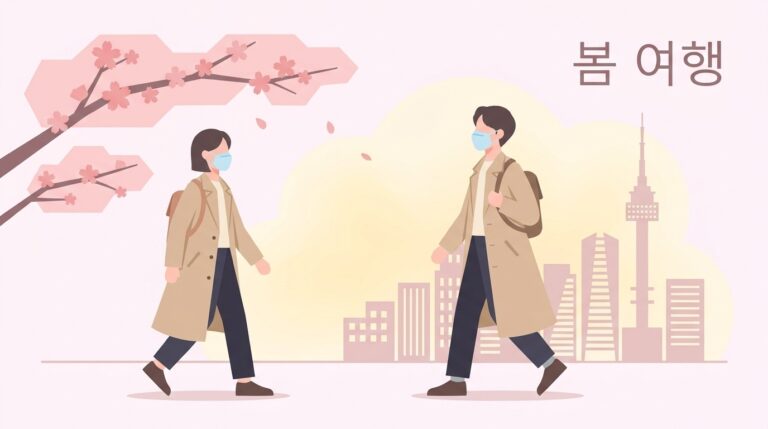
Phase 1: Empathy — Spring in Seoul Isn’t Just Cherry Blossoms
안녕하세요! 매일한글 에디터입니다. (Hello! This is your Daily Hangul editor.)
Imagine this: You wake up on a crisp April morning in Seoul, hyped to snap dreamy aesthetic photos under the pink cherry blossoms at Yeouido or Seokchon Lake. You throw on your favorite pastel spring outfit, step outside, and… wait. Why is the sky an ominous, foggy sepia? Why does the sun look like a pale orange coin, and why does your throat suddenly feel like you just swallowed a spoonful of dry sand?
Welcome to the real Korean spring: the season of beautiful cherry blossoms (beot-kkot), accompanied by the notorious tag team of 황사 (Hwangsa – Yellow Dust) and 미세먼지 (Misemeonji – Fine Dust).
Every spring, countless international students and travelers find themselves coughing into their sleeves, frantically wandering into a convenience store (pyeon-ui-jeom), and staring blankly at a wall of 50 different face masks. What is ‘KF94’? How do you ask someone if the air is bad today without sounding like a robotic weather report? Learning these survival expressions will save your vocal cords, prevent awkward pharmacy mishaps, and make you sound like an experienced Seoulite who knows how to navigate spring with style and health intact.
Phase 2: Top 3 Core Expressions for Spring Dust Survival
1. 오늘 미세먼지 심해요? (Oneul misemeonji simhaeyo?)
- Pronunciation: oh-neul mee-seh-meon-jee sheem-hae-yo? (Rhymes loosely with saying “Oh Neil, missy munchy, seem hey yo?”)
- Meaning: Literal: Is the fine dust severe today? | Real Nuance: “Is the air quality terrible today? Should I wear a mask?”
- K-Culture Moment: You’ll hear this exact line muttered in K-Dramas right before characters grab an iced Americano and put on their chic black mask before commuting to work.
- Editor’s Insight: The word 심하다 (simhada) means “to be severe” or “intense.” Koreans use it for everything from dust (미세먼지 심해요) to traffic (차 막히는 거 심해요) and hangovers (숙취 심해요).
- Situation Spectrum: Casual (⚠️ 오늘 미세먼지 심해?) / Semi-formal (✅ 오늘 미세먼지 심해요?) / Formal (✅ 오늘 미세먼지가 심합니까?)
- 🤔 Think About It: In many Western countries, checking the air quality index (AQI) isn’t part of daily morning small talk. Why do you think air quality is as common a conversation starter in Korea as the rain is in London?
2. KF94 마스크 있어요? (KF-gusa maseukeu isseoyo?)
- Pronunciation: K-F goo-sah mah-seu-keu eess-eo-yo? (Say “KF”, then the numbers 9 (gu) and 4 (sa), followed by “mask-uh eess-uh-yo?”)
- Meaning: Literal: Do you have KF94 masks? | Real Nuance: “Excuse me, where are your heavy-duty fine dust masks?”
- K-Culture Moment: Walking into an Olive Young or GS25 convenience store when the weather app turns red, asking the staff directly at the counter.
- Editor’s Insight: “KF” stands for Korean Filter, and “94” means it filters out at least 94% of micro-particles. Regular dental/cotton masks won’t protect you against micro-dust particles, so Koreans will specifically ask for KF94 or KF80.
- Situation Spectrum: Casual (⚠️ KF94 마스크 있어?) / Semi-formal (✅ KF94 마스크 있어요?) / Formal (✅ KF94 마스크 있습니까?)
- 🤔 Think About It: Notice how Korea has a standardized health rating system embedded right into daily consumer vocabulary. How does your home country categorize protective gear?
3. 목이 좀 칼칼해요. (Mogi jom kalkalhaeyo.)
- Pronunciation: moh-gee johm kahl-kahl-hae-yo. (The ‘k’ sound in kal is sharp and aspirated, like coughing a quick ‘k’ sound).
- Meaning: Literal: My neck/throat is a bit scratchy/dry. | Real Nuance: “My throat feels irritated and raspy (from the dust/spicy food).”
- K-Culture Moment: Idols on live broadcasts drinking warm yuzu tea and apologizing: “Today the yellow dust was bad, so 목이 좀 칼칼해요!”
- Editor’s Insight: 칼칼하다 (kalkalhada) is an expressive onomatopoeic adjective describing that specific rough, scratchy sensation in your throat, or a pleasantly spicy, sharp soup broth.
- Situation Spectrum: Casual (⚠️ 목이 좀 칼칼해) / Semi-formal (✅ 목이 좀 칼칼해요) / Formal (✅ 목이 다소 칼칼합니다)
- 🤔 Think About It: Korean has dozens of vivid sensory words for bodily sensations (칼칼하다, 뻐근하다, 찌릿하다). Why is sensory descriptive language so rich in Korean culture?
Phase 3: Textbook Korean vs. Real Native Korean
Situation 1: Warning a friend about yellow dust before heading out
- 📖 Textbook Korean: “오늘 대기 중에 황사가 많으니 마스크를 착용하십시오.” (There is much yellow dust in the atmosphere today, so please equip a mask.)
- 🗣️ Real Native Korean: “오늘 황사 대박이야. 마스크 꼭 챙겨!” (Yellow dust is insane today. Definitely bring a mask!)
- 💡 Why is it different? Nobody speaks like a public health broadcast with friends! Using 대박 (daebak – crazy/insane) and 꼭 챙겨 (make sure to pack/wear) sounds infinitely more natural and caring.
Situation 2: Explaining why your throat hurts at a pharmacy
- 📖 Textbook Korean: “미세먼지 때문에 인후염 통증이 발생했습니다.” (Laryngitis pain has occurred due to fine dust.)
- 🗣️ Real Native Korean: “미세먼지 때문인지 목이 따갑고 칼칼해요.” (Maybe because of the fine dust, my throat stings and feels scratchy.)
- 💡 Why is it different? Real Koreans describe the physical sensation (따갑다 – stinging, 칼칼하다 – scratchy) rather than self-diagnosing with clinical medical terms.
Phase 4: K-Culture Deep Dive & Non-Verbal Manners
4-1. 눈치 (Nunchi) & Mask Etiquette in Spring
When fine dust hits “Bad” (나쁨) or “Very Bad” (매우 나쁨) levels in Korea, wearing a mask isn’t just self-protection; it’s considered good manners. If you cough openly on the subway without a mask or without covering your mouth with your inner elbow, you will feel the intense, silent lasers of Korean grandmother (halmeoni) nunchi.
* Discreet Throat Clearing: If your throat feels scratchy in an elevator or quiet train, don’t clear it loudly. Take a discreet sip of water or gently cough into your sleeve.
* Mask Handling: When eating at a restaurant, don’t place your used mask directly on the dining table. Fold it inward and tuck it into your pocket or bag.
4-2. The Samgyeopsal Myth (K-Food Culture)
Did you know Koreans traditionally eat 삼겹살 (Samgyeopsal – Pork Belly) on heavy yellow dust days? Historically, miners and factory workers believed that the slippery pork fat helped wash away the inhaled dust down their throats. While modern doctors have debunked this medically, it remains a beloved cultural excuse to gather with friends at a K-BBQ restaurant for sizzling pork belly and soju whenever the sky turns yellow!
Phase 5: Real-Life Roleplay Scenario
Setting: A brightly lit GS25 convenience store in Hongdae on a hazy Tuesday morning.
Characters:
* You (민우 / Minwoo): An exchange student whose throat is starting to burn.
* Convenience Store Clerk (알바생): A friendly university student wearing a black apron.
Turn 1
민우: 저기요, 혹시 마스크 어디에 있어요?
(Jeogiyo, hoksi maseukeu eodie isseoyo?)
[🎭 Leaning forward slightly, looking around the aisles]
"Excuse me, where might the masks be?"

Turn 2
알바생: 아, 마스크는 카운터 바로 옆 매대에 있어요!
(A, maseukeuneun kaunteo baro yeop maedae-e isseoyo!)
[🎭 Pointing to the rack next to the register]
"Ah, masks are right on the display stand next to the counter!"

Turn 3
민우: 오늘 미세먼지가 너무 심해서요. 목이 칼칼해요.
(Oneul misemeonjiga neomu simhaeseoyo. Mogi kalkalhaeyo.)
[🎭 Touching the throat with a slight grimace]
"The fine dust is so bad today. My throat feels really scratchy."

Turn 4
알바생: 맞아요, 오늘 황사 경보 떴더라고요. KF94로 쓰셔야 해요.
(Maj-ayo, oneul hwangsa gyeongbo tteotdeoragoyo. KF-gusa-ro sseusyeoya haeyo.)
[🎭 Nodding in empathy while scanning items]
"I know, a yellow dust warning was issued today. You must use a KF94."

Turn 5
민우: 아, 그래요? 어떤 게 제일 편해요?
(A, geuraeyo? Eotteon ge jeil pyeonhaeyo?)
[🎭 Looking at the various brands with curious eyes]
"Ah, really? Which one is the most comfortable?"

Turn 6
알바생: 숨쉬기 편한 새부리형 마스크가 인기 많아요. 이거요!
(Sumswigi pyeonhan saeburi-hyeong maseukeuga ingi manayo. Igeoyo!)
[🎭 Handing over a 2D beak-shaped KF94 mask package]
"The bird-beak shaped ones that make breathing easier are very popular. This one!"

Turn 7
민우: 좋네요! 이걸로 두 개 주시고, 따뜻한 꿀물도 하나 주세요.
(Jonne-yo! Igeollo du gae jusigo, ttatteutan kkulmuldo hana juseyo.)
[🎭 Smiling and handing over payment card]
"Sounds good! Please give me two of these, and one warm honey drink too."

Turn 8
알바생: 네! 영수증 버려드릴까요?
(Ne! Yeongsujeung beoryeodeurilkkayo?)
[🎭 Handing the bagged items and receipt gracefully with both hands]
"Sure! Would you like me to throw away the receipt?"
🔀 Interactive Choice Point
The clerk asks if you want your receipt: “영수증 버려드릴까요?” How do you respond?
- Option A: “네, 버려주세요! 감사합니다.” (Yes, please throw it away! Thank you.)
👉 Feedback [Best]: Natural, polite, and standard everyday native interaction. 10/10! - Option B: “아니요, 마스크 싫어요.” (No, I dislike masks.)
👉 Feedback [Bad]: You completely misunderstood the receipt question and made the clerk confused! - Option C: “응, 버려.” (Yeah, throw it away.)
👉 Feedback [Risk]: This is informal Banmal. Using it with a stranger clerk sounds rude! Always end with *-yo.*
Phase 6: 10-Second Emotion Shadowing Drill
Practice reading these lines aloud with the emotional cues and pauses (/):
[😷 답답하고 걱정스럽게 / Frustrated & concerned]
“오늘 / 미세먼지 수치 / 진짜 최악이다… / 마스크 꼭 써야 돼.”
(Oneul / misemeonji suchi / jinjja choe-ag-ida… / maseukeu kkok sseoya dwae.)-
[🛍️ 친절하고 또렷하게 / Polite & clear store request]
“저기요, / 숨쉬기 편한 / KF94 마스크 / 어디 있나요?”
(Jeogiyo, / sumswigi pyeonhan / KF-gusa maseukeu / eodi innayo?) -
[😮💨 칼칼한 목을 만지며 / Rubbing scratchy throat in relief]
“목이 너무 칼칼했는데 / 따뜻한 차 마시니까 / 훨씬 낫네요.”
(Mogi neomu kalkalhaenneunde / ttatteutan cha masinikka / hwolssin nan-neyo.)
Phase 7: K-Culture Mini Dictionary
- 황사 (Hwang-sa) | Yellow Dust / Asian Dust
Mineral-rich desert sand blown from northern China and Mongolia into the Korean peninsula during spring. Requires high-filtration masks. - 미세먼지 (Mi-se-meon-ji) | Fine Dust / Particulate Matter (PM10 & PM2.5)
Microscopic industrial air pollution. Koreans track this on a 4-color scale: Blue (Good), Green (Normal), Yellow (Bad), Red (Very Bad). - 새부리형 (Sae-bu-ri-hyeong) | Beak-style Mask (2D folded)
Mask design protruding like a bird’s beak (saeburi). It creates breathing room in front of lips, preventing lipstick smudges and breathing stuffiness. - 삼겹살 데이 (Sam-gyeop-sal Day / Culture) | Pork Belly Cleansing Myth
The time-honored cultural habit of eating greasy grilled pork belly to “wash out” fine dust from the throat after spending a day outside.
Phase 8: Traveler’s Survival Kit
Top 3 Survival Phrases
- 마스크 1+1 행사 하나요? (Maseukeu won-peullu-seu-won haengsa hanayo?)
Pro Tip: Convenience stores constantly run “Buy 1, Get 1 Free” deals on KF94 multi-packs. Look for the yellow1+1or2+1stickers. - 따뜻한 생강차 있어요? (Ttatteutan saenggangcha isseoyo?)
Pro Tip: When your throat hurts from dust, find the heated glass display case (on-jang-go) in convenience stores and grab hot ginger or honey citron tea. - 창문 좀 닫아도 될까요? (Changmun jom dadado doelkkayo?)
Pro Tip: In cafes or buses with open windows on dusty days, use this polite phrase to ask permission before closing them.
Editor’s Travel Note
Before stepping outside in spring, don’t rely only on standard foreign weather apps that often underestimate local particulate matter. Search and download the dedicated [MiseMise Air Quality App Download on App Store/Google Play] to get real-time visual alerts with cute emoji faces (blue smiles to red screaming masks). Also, check your subway route with the [Naver Map App Download] which frequently posts real-time subway fine dust status updates.
Phase 9: One Step Deeper — The Korean Culture of “Mutual Health Care”
In Korean society, asking “Did you check the fine dust?” or telling someone “Make sure to wear a mask today!” is not a critique of the weather—it is an act of deep personal affection (Jeong / 정). In individualistic cultures, health precautions are personal choices, but in Korea’s relational culture, reminding peers to care for their lungs shows that you consider them part of your communal circle. When a Korean coworker hands you an individually wrapped KF94 mask before you leave the office, it’s the cultural equivalent of a warm hug.
💬 Your Turn: Does your culture have a unique seasonal health habit or a myth like Korea’s pork belly cure? Share your thoughts in the comments below!
Phase 10: FAQ & Common Mistakes
Q: Can I just wear a black fabric K-Pop fashion mask for fine dust?
A: Unfortunately, no! Fabric and basic cotton masks only block large droplets, not microscopic PM2.5 particles. Always look for the KF80, KF94, or KF-AD certified stamp on the package.
Q: What is the difference between 황사 (Hwangsa) and 미세먼지 (Misemeonji)?
A: 황사 is natural sand blown from Gobi/Mongolian deserts during spring, while 미세먼지 is fine particle industrial air pollution that can occur year-round. However, they frequently arrive mixed together in spring!
Q: Where is the cheapest place to buy KF94 masks in Korea?
A: Pharmacies (yakguk) and convenience stores are handy, but Daiso or large supermarkets (E-Mart, Homeplus) sell bulk packs of 10–20 masks at significantly lower prices.
🚨 Common Mistakes Alert
- ❌ Mistake 1: Pronouncing KF94 as “KF-Ninety-Four” in small local shops.
👉 Correct Action: Say KF-구사 (KF-gusa) so elderly pharmacy owners understand instantly. - ❌ Mistake 2: Calling the dust 더러운 공기 (dirty air).
👉 Correct Action: Use the natural term 미세먼지 (misemeonji) or 공기가 안 좋다 (the air is not good). - ❌ Mistake 3: Taking off your mask and leaving it exposed on tables in restaurants.
👉 Correct Action: Fold it in half or hang it around your neck with a mask strap (maseukeu seutraep).
Phase 11: Action Missions
- 🥉 Bronze Mission (Solo Practice): Stand in front of your mirror and practice asking: “KF94 마스크 있어요?” smoothly three times in 5 seconds.
- 🥈 Silver Mission (Social Sharing): Check today’s air quality on your phone and post a story with a mask selfie captioning: “오늘 미세먼지 심해요! 마스크 꼭 챙기세요 😷”
- 🥇 Gold Mission (Real Life Execution): Visit a local Korean mart, pharmacy, or restaurant and order a warm tea or pork belly using the phrase: “목이 칼칼해서 따뜻한 차 마시려고요!”
- 🎮 K-Culture Mission: Watch a modern K-drama spring episode and spot how characters store their masks or talk about the sky condition.
Phase 12: Interactive Quiz Challenge
Quiz 1: Situation Judgment
You wake up and see that the air quality app is bright red. You want to suggest to your Korean friend to wear a protective mask. Which expression is the most natural?
1. 오늘 황사 없으니 마스크 버려요.
2. 오늘 미세먼지 심하니까 KF94 마스크 꼭 챙겨!
3. 오늘 날씨가 추우니까 장갑을 끼세요.
🔍 Click to reveal Answer & Explanation
Answer: 2
Explanation: Option 2 accurately addresses the high dust index and kindly reminds your friend to bring a KF94 mask (마스크 꼭 챙겨!). Option 1 says there is no dust, and Option 3 talks about gloves for cold weather.
Quiz 2: Fill in the Blank
Complete the scratchy throat expression:
“미세먼지 때문에 목이 좀 __________.”
(Hint: Think of the expressive ‘K’ sound for dry, scratchy sensation)
🔍 Click to reveal Answer & Explanation
Answer: 칼칼해요 (kalkalhaeyo)
Explanation: “목이 칼칼해요” is the authentic phrase Koreans use whenever particulate matter irritates their throat.
Quiz 3: True or False Culture Check
True or False: Historically in Korea, eating grilled pork belly (samgyeopsal) became a popular tradition on yellow dust days because people believed the pork oil cleansed dust from their throats.
🔍 Click to reveal Answer & Explanation
Answer: TRUE (참)
Explanation: While scientifically proven to be a myth, this tradition originated from workers and miners and is still widely enjoyed across Korea today!







