

Mastering Korean Convenience Stores: Transit Card Top-ups and Lottery Wins
Phase 1: Empathy & Immersion
안녕하세요! 매일한글 에디터입니다. Have you ever experienced that heart-dropping beep at the subway turnstile: “잔액이 부족합니다” (Insufficient balance) right when the final train is pulling up in 3 minutes? In a panic, you sprint into the nearest glowing GS25 or CU, throw down your transit card and international credit card, only to be met with a polite wave of hands and the dreaded sentence: “손님, 교통카드 충전은 현금만 돼요” (Customer, transit card top-up is cash only).
Navigating Korean convenience stores (편의점 – pyeon-ui-jeom) is virtually a rite of passage for every traveler and expat in Korea. Beyond delicious triangular kimbap and instant ramen, the convenience store counter is the nerve center for daily logistics: topping up your T-Money/Climate Card (기후동행카드) and even testing your luck with weekly Lotto slips. Drawing directly from hundreds of learner consultations and real-life field testing in Seoul, this guide guarantees you will never feel flustered at the cash register again. Let’s turn you into a confident, savvy local.
Phase 2: Core Expressions Deep Dive
1. 교통카드 2만 원 충전해 주세요.
- Pronunciation: [Gyo-tong-ka-deu i-man-won chung-jeon-hae ju-se-yo.] (Sound analogy: Think “Gyo-tong” like ‘Go-tongue’, “Chung-jeon” like charging up an electric vehicle).
- Meaning: Literal: “Please charge transit card 20,000 won.” | Real Nuance: “Could you please top up my transit card with 20,000 won?”
- K-Culture Moment: Seen in nearly every slice-of-life K-Drama (like My Liberation Notes) where exhausted commuters slide their cards across the counter on the way home.
- Editor’s Insight: The word 충전 (chungjeon) means both recharging a battery and topping up stored monetary value. Specifying the exact amount before handing over cash saves critical seconds.
- Situation Spectrum: Casual: ⚠️ (Only with friends) | Semi-formal: ✅ (Standard store etiquette) | Formal: ✅
- 🤔 Think About It: In many Western subway systems, machines handle 100% of top-ups. Why does Korea maintain a hybrid system where convenience store clerks personally recharge cards?
2. 충전은 현금만 가능한가요?
- Pronunciation: [Chung-jeon-eun hyeon-geum-man ga-neung-han-ga-yo?] (Sound analogy: “Hyeon-geum” rhymes with ‘Yum-gum’, emphasizing the ‘man’ which means ‘only’).
- Meaning: Literal: “As for charging, is only cash possible?” | Real Nuance: “Is it strictly cash-only for top-ups?”
- K-Culture Moment: Foreign travelers in Seoul vloggers often capture their surprise discovering that even in ultra-cashless Korea, transit card recharges legally require physical cash.
- Editor’s Insight: Using ~만 가능한가요? (~man ga-neung-han-ga-yo?) is an intermediate-level polite inquiry pattern that sounds natural without being overly defensive or stiff.
- Situation Spectrum: Casual: 🚫 | Semi-formal: ✅ | Formal: ✅
- 🤔 Think About It: Korea is 99% card-friendly, but prepaid transit balances are classified as quasi-currency under financial laws, preventing credit card cash-advances at checkout counters.
3. 로또 자동 5천 원어치 주세요.
- Pronunciation: [Rot-to ja-dong o-cheon-won-eo-chi ju-se-yo.] (Sound analogy: “Rot-to” is crisp like ‘Lotto’, “Ja-dong” sounds like ‘Jaw-dong’ meaning automatic).
- Meaning: Literal: “Please give 5,000 won worth of automatic Lotto.” | Real Nuance: “I’d like 5,000 won worth of quick-pick Lotto numbers, please.”
- K-Culture Moment: The classic Saturday afternoon ritual where office workers queue up outside convenience stores designated as famous lucky spots (로또 명당).
- Editor’s Insight: Adding ~치 (-chi) after an amount (e.g., 5천 원어치) signifies “an amount worth X value,” a hallmark of native natural phrasing.
- Situation Spectrum: Casual: ⚠️ | Semi-formal: ✅ | Formal: ✅
- 🤔 Think About It: How does purchasing lottery tickets via automated quick-picks (자동) versus manual bubble filling (수동) reflect Korea’s fast-paced Ppalli-Ppalli (hurry-hurry) culture?
Phase 3: Textbook Korean vs. Real Korean
Situation 1: Asking for Transit Card Top-up
- 📖 교통카드에 금액을 충전하고 싶습니다. (I wish to recharge an amount onto the transportation card.)
- 🗣️ 교통카드 만 원만 넣어주세요. (Please put 10,000 won into the transit card.)
- 💡 Why the difference? Native speakers rarely say “I want to recharge an amount.” Instead, they use the casual verb 넣다 (neota – to insert/put in) coupled with the softening particle 만 (man – just/only) to sound smoother and more concise.
Situation 2: Buying Instant Scratch-off Lottery Tickets
- 📖 즉석식 복권을 두 장 구매하겠습니다. (I will purchase two sheets of instant lottery tickets.)
- 🗣️ 스피또 천 원짜리 두 장 주세요. (Give me two 1,000-won Speetto scratchers, please.)
- 💡 Why the difference? Nobody uses the formal legal term 즉석식 복권 at the checkout. Locals directly use the official brand name 스피또 (Speetto) followed by the price tier (천 원짜리/이천 원짜리).
Phase 4: K-Culture Deep Dive & Non-Verbal Manners
4-1. Nunchi (눈치) & Body Gestures at the Counter
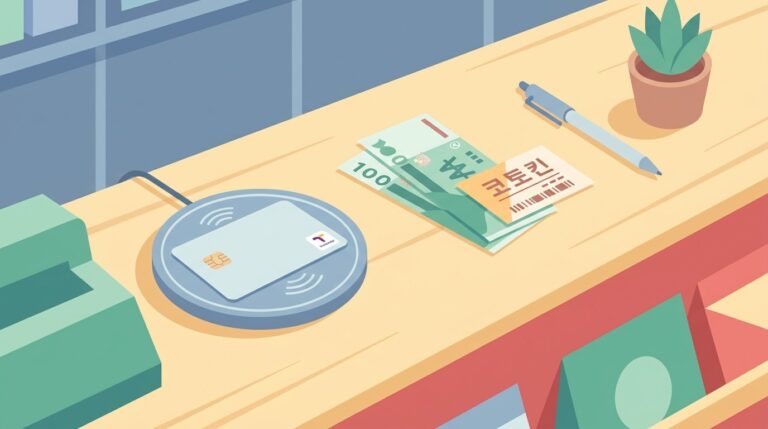
When recharging a transit card in Korea, do not hand the card directly into the clerk’s palm unless they reach out. Instead, place it down onto the designated RFID terminal pad located right beside the POS machine.
* The Two-Handed Cash Pass: Always hand cash using both hands or resting your left hand gently under your right wrist. It signals respect (Gongson-ham).
* The POS Screen Glance: Watch the customer-facing screen to verify your current balance and target recharge value before taking your card back.
4-2. Cultural Code: The Saturday 8 PM Rush & “Myeongdang”
Lottery ticket sales halt promptly at 8:00 PM every Saturday. In Korea, convenience stores that have sold multiple 1st-prize winning tickets earn the title 로또 명당 (Lotto Myeongdang). You will spot enormous yellow banners proudly announcing: “1등 당첨 15회 배출!” (Produced 15 First-Place Winners!). If you see a long line extending outside a convenience store on a Friday or Saturday afternoon, they aren’t waiting for milk—they’re lining up for fortune.
Phase 5: Real-Life Roleplay Scenario
- Setting: 10:30 PM at a brightly lit GS25 near Hongik University Station.
- NPC: Part-timer Minho (friendly university student wearing a blue store vest).
- Alex (You): 안녕하세요! 저 교통카드 충전 좀 하려고 하는데요.
(An-nyeong-ha-se-yo! Jeo gyo-tong-ka-deu chung-jeon jom ha-ryeo-go ha-neun-de-yo.)
(Hello! I’d like to top up my transit card.)🎭 Places the T-Money card on the black RFID pad - Minho: 네, 얼마 충전해 드릴까요?
(Ne, eol-ma chung-jeon-hae deu-ril-kka-yo?)
(Sure, how much would you like to recharge?) - Alex (You): 2만 원 충전해 주세요. 카드로 결제할게요.
(I-man-won chung-jeon-hae ju-se-yo. Ka-deu-ro gyeol-je-hal-ge-yo.)
(20,000 won, please. I’ll pay by credit card.)🎭 Taps credit card on the IC reader - Minho: 아, 손님 죄송한데 교통카드는 현금으로만 충전 가능하세요.
(A, son-nim joe-song-han-de gyo-tong-ka-deu-neun hyeon-geum-eu-ro-man chung-jeon ga-neung-ha-se-yo.)
(Ah, I’m sorry customer, but transit cards can only be recharged with cash.) - Alex (You): 아, 그렇군요! 잠시만요, 현금 여기 2만 원 있습니다.
(A, geu-reot-gun-yo! Jam-si-man-yo, hyeon-geum yeo-gi i-man-won it-seum-ni-da.)
(Ah, I see! One moment, here is 20,000 won in cash.)🎭 Hands over two 10,000-won bills with both hands - Minho: 네, 2만 원 충전 완료되셨습니다. 영수증 필요하세요?
(Ne, i-man-won chung-jeon wan-ryo-doe-syeot-seum-ni-da. Yeong-su-jeung pil-yo-ha-se-yo?)
(Okay, 20,000 won recharge completed. Do you need the receipt?) - Alex (You): 영수증은 버려주세요. 그리고 혹시 로또도 여기서 파나요?
(Yeong-su-jeung-eun beo-ryeo-ju-se-yo. Geu-ri-go hok-si rot-to-do yeo-gi-seo pa-na-yo?)
(Please discard the receipt. And by any chance, do you also sell Lotto here?) - Minho: 저희 매장은 로또는 안 팔고 스피또 복권만 있어요!
(Jeo-hui mae-jang-eun rot-to-neun an pal-go seu-pi-tto bok-gwon-man it-eo-yo!)
(Our store doesn’t sell Lotto, only Speetto scratchers!)
🔀 Interactive Choice Point
How will you respond to Minho’s statement about having Speetto scratchers?
* Option A: “아, 그럼 스피또 천 원짜리 세 장만 주세요!” (Ah, then give me three 1,000-won Speetto tickets, please!)
* Option B: “왜 로또는 카드 결제가 안 돼요? 그냥 카드 긁어주세요.” (Why isn’t Lotto payable by card? Just swipe my card.)
* Option C: “안녕히 계세요.” (Leaves immediately without taking the transit card from the pad.)
Feedback:
* Option A (Best): Perfect natural transition! You adapt smoothly, utilize the exact unit term (~천 원짜리), and try the instant scratch lottery.
* Option B (Bad): Culturally awkward and slightly rude. The clerk doesn’t make financial regulations, and insisting on card payment creates an uncomfortable standoff.
* Option C (Risk): Dangerous! You forgot your freshly charged T-Money on the countertop RFID scanner pad. Always verify you took your card.
Phase 6: 10-Second Emotional Shadowing Drill
Practice matching the cadence, rhythmic pauses (/), and emotional tones:
[😊 Polished & Confident]
교통카드 / 2만 원만 / 충전해 주세요!
(Gyo-tong-ka-deu / i-man-won-man / chung-jeon-hae ju-se-yo!)-
[💡 Realizing & Polite]
아, 현금만 돼요? / 여기 1만 원 / 드릴게요.
(A, hyeon-geum-man dwae-yo? / yeo-gi il-man-won / deu-ril-ge-yo.) -
[🎉 Playful & Hopeful]
스피또 천 원짜리 / 다섯 장 주세요! / 1등 되면 올게요!
(Seu-pi-tto cheon-won-jja-ri / da-seot-jang ju-se-yo! / Il-deung doe-myeon ol-ge-yo!)
Phase 7: K-Culture Mini Dictionary
- 충전 패드 (Chung-jeon Pae-deu) | RFID Sensor Pad | The small rectangular scanner next to the convenience store cashier where your transit card must remain stationary until transaction confirmation.
- 현금 인출기 / ATM (Hyeon-geum In-chul-gi) | In-store ATM | Located in 95% of convenience stores. Vital when you realize you have zero cash for card recharges or lottery.
- 스피또 (Seu-pi-tto) | Speetto Instant Scratch Card | Korea’s official instant lottery series sold in 500, 1000, and 2000 won denominations.
- 기후동행카드 (Gi-hu-dong-haeng-ka-deu) | Climate Card | Seoul’s unlimited public transit pass. Recharging requires the physical card and cash at convenience stores or metro station kiosks.
Phase 8: Traveler’s Survival Kit
Top 3 Survival Expressions
- “교통카드 잔액 확인해 주세요.” (Please check my transit card balance.) — Use this when you are unsure if you have enough money left.
- “현금영수증은 안 하셔도 돼요.” (You don’t need to do a cash receipt.) — Clerks will often ask “현금영수증 해드릴까요?” for tax deductions. This phrase speeds up the line.
- “봉투 하나만 주세요.” (One plastic/paper bag, please.) — Bags cost 100–200 won in Korea; they are never given automatically.
Editor’s Travel Note
Always keep a 10,000 won paper banknote tucked inside your phone case. While Korea is overwhelmingly digital, transit card recharges and lottery purchases are strictly cash-only operations. To avoid delays, check the Official Seoul Metro Transit Navigation App guide before heading out for late-night travels.
Phase 9: Stepping Deeper (Cultural Reflection)
In a metropolis where even street food vendors accept bank transfers and contactless payments, convenience stores maintain an almost sacred analog enclave: physical cash transactions for transit and lotteries. This duality highlights Korea’s strict regulatory separation between digital credit liabilities and guaranteed bearer funds. The convenience store counter serves as a democratized public service station where everyone from corporate executives to high school students stands in the exact same line, holding crisp banknotes.
💬 Your Turn: Have you ever experienced a sudden “cash-only” surprise while traveling abroad? How do convenience stores in your home country compare to Korea’s multifunctional hubs? Let us know in the comments below!
Phase 10: FAQ & Common Mistakes
Q: Can I buy official 6/45 Lotto tickets at every convenience store in Korea?
A: No. Only convenience stores holding a specific government lottery retail license sell regular Lotto (로또 6/45). However, almost all convenience stores sell instant scratch-off tickets (스피또).
Q: Can I charge my transit card with an international Visa or Mastercard?
A: No. Under Korean financial laws, transit cards can only be recharged using physical Korean Won (KRW) cash at convenience stores and subway kiosks.
Q: Can I refund the balance on my transit card at a convenience store if I am leaving Korea?
A: Yes! If your remaining balance is under 20,000 KRW, most convenience stores (GS25, CU, 7-Eleven) will refund the balance in cash on the spot for a minor service fee of 500 KRW.
🚨 Common Mistakes Alert Board
- Mistake 1: Tapping your T-Money on the credit card terminal instead of the dedicated flat RFID sensor.
- Correct Action: Look for the flat pad labeled 교통카드 놓는 곳 (Place transit card here).
- Mistake 2: Handing a credit card to recharge the Climate Card or T-Money.
- Correct Action: Prepare 10,000 or 50,000 KRW cash in advance.
- Mistake 3: Pulling the transit card away before the clerk completes the POS input.
- Correct Action: Leave the card untouched until the cash register plays a musical chime or the clerk says “완료되셨습니다”.
Phase 11: Action Mission & Community Challenge
- 🥉 Bronze Mission: Practice saying “교통카드 만 원 충전해 주세요” aloud three times in under 5 seconds.
- 🥈 Silver Mission: Share this post on Instagram or X with your favorite Korean convenience store snack recommendation.
- 🥇 Gold Mission: Walk into a local Korean mart or convenience store, place your card on the pad, and complete a cash top-up entirely in Korean!
- 🎮 K-Culture Mission: Watch an episode of a Korean drama or variety show and spot when the characters say “영수증 버려주세요” (Please throw away the receipt) at checkout.
Phase 12: Interactive Quiz Challenge
1. Situation Assessment
You want to purchase 5,000 KRW worth of automated Lotto numbers at a licensed convenience store. What should you say?
* A) 로또 오천 원어치 카드 결제해 주세요.
* B) 로또 자동 5천 원어치 주세요.
* C) 로또 즉석식 5장 충전해 주세요.
2. Fill-in-the-Blank
“교통카드는 _______(으)로만 충전이 가능합니다.”
(Transit cards can only be charged with _______.)
* A) 신용카드 (Credit card)
* B) 현금 (Cash)
* C) 포인트 (Reward points)
3. Cultural True or False
True or False: All convenience stores in Seoul accept Apple Pay or foreign credit cards for T-Money card recharges.
🔍 Click here to reveal Answers & Explanations!
- Answer: B (로또 자동 5천 원어치 주세요.)
- Explanation: ‘자동’ means automated quick-pick, and lotteries are strictly cash-only (eliminating option A).
- Answer: B (현금 – Cash)
- Explanation: Recharging prepaid transit cards requires cash under national retail regulations.
- Answer: FALSE
- Explanation: Transit card recharges strictly require physical KRW cash, regardless of Apple Pay or contactless card capabilities at the general merchandise register.
- Explanation: Transit card recharges strictly require physical KRW cash, regardless of Apple Pay or contactless card capabilities at the general merchandise register.







