

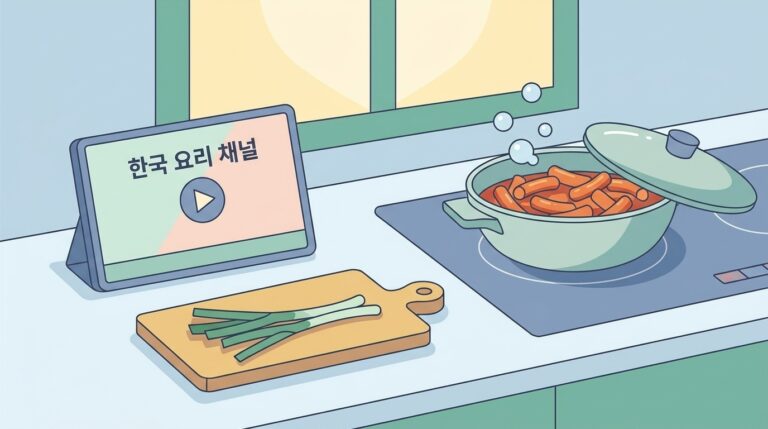
Master Korean YouTube Cooking Videos Like a True Local
Phase 1: Empathy (Story-Driven Opening)
안녕하세요! 매일한글 에디터입니다. (Hello! This is your Daily Hangul editor.) Have you ever paused a Korean cooking vlog ten times in a single minute because the chef nonchalantly tosses an ingredient into the pan saying “적당히 넣으세요” (put in an adequate amount), leaving you staring blankly at your measuring spoons? You crave that glossy Tteokbokki or crispy Kimchi pancake you saw on YouTube, but cooking terms like song-song (송송) or dareuk-dareuk (달달) feel like secret code words.
At Daily Hangul, over 70% of our intermediate learners share this exact struggle: textbook Korean teaches you standard units like “10 grams” or “slice,” yet real Korean home chefs cook with intuitive son-mat (hand taste) and sensory verbs. Mastering these kitchen terms will not only help you cook mouthwatering dishes without subtitles, but also give you deep insight into how Koreans perceive texture, balance, and warmth in daily life. Let’s dive right into the vibrant world of Korean YouTube cooking!
Phase 2: 3 Key Expressions Deep Dive
1. 적당히 넣으세요 (Jeok-dang-hi neo-eu-se-yo)
- Pronunciation: [Jeok-dang-hi neo-eu-se-yo] (Sounds like “Jug-dang-hee” + “neo-she-yo”)
- Meaning: Literal: “Put it in moderately.” | Real Nuance: “Eyeball it to your personal taste.”
- K-Culture Moment: Classic Baek Jong-won cooking videos where he pours soy sauce or sugar directly from the bottle without a measuring spoon, telling viewers to adjust by instinct.
- Editor’s Insight: Korean cooking values flexibility. “적당히” isn’t carelessness; it’s an invitation to trust your own palate rather than rigid rules.
- Situation Spectrum: Casual (✅) / Semi-formal (✅) / Formal (⚠️)
- 🤔 Think About It: In Western recipes, exact metric measurements rule. Why do you think Korean culinary culture values intuitive balance over strict measurements?
2. 파는 송송 썰어주세요 (Pa-neun song-song sseo-reo-ju-se-yo)
- Pronunciation: [Pa-neun song-song sseo-reo-ju-se-yo] (Song-song feels like light, rhythmically bouncy scissor chops)
- Meaning: Literal: “Cut green onions song-song.” | Real Nuance: “Finely chop green onions into cute little coin rounds.”
- K-Culture Moment: Aesthetic aesthetic cooking vlogs featuring sound-focused ASMR knife work on wooden cutting boards.
- Editor’s Insight: “송송” (Song-song) is an iconic Korean mimetic word (의태어) representing small, round cuts of scallions or chili peppers.
- Situation Spectrum: Casual (✅) / Semi-formal (✅) / Formal (✅)
- 🤔 Think About It: Korean has dozens of mimetic cutting sounds: song-song (small rounds), sseuk-sseuk (rough slices), chae-sseol-gi (julienne). How does this sensory vocabulary change cooking enjoyment?
3. 간을 맞춰보세요 (Gan-eul mat-chwo-bo-se-yo)
- Pronunciation: [Gan-eul mat-chwo-bo-se-yo] (Sounds like “Gahn-eul maht-chwo-boh-seh-yoh”)
- Meaning: Literal: “Match the seasoning.” | Real Nuance: “Taste test and adjust the savoriness/saltiness until it’s just right.”
- K-Culture Moment: K-Drama family scenes where a mother feeds a spoonful of soup to her child with her hand cupped underneath, asking if the gan is right.
- Editor’s Insight: “간” specifically refers to the savory/salty equilibrium of a dish. When something is bland, Koreans say “간이 싱거워요” (the seasoning is weak).
- Situation Spectrum: Casual (✅) / Semi-formal (✅) / Formal (✅)
- 🤔 Think About It: Notice how “간” isn’t just salt—it represents the entire harmony of a meal’s flavor.
Phase 3: Textbook Korean vs. Real Korean
Situation 1: Letting the sauce thicken on low heat
- 📖 교과서 한국어: “약한 불에서 소스를 걸쭉하게 만드세요.” (Make the sauce thick on low heat.)
- 🗣️ 진짜 한국어: “약불로 줄이고 국물을 자작하게 졸여주세요.”
- 💡 왜 다를까? Koreans naturally use food-specific state descriptors like 자작하게 (shallow liquid barely covering the ingredients) and 졸이다 (simmer down to glaze) rather than generic adjectives like ‘thick’.
Situation 2: Stir-frying aromatics in oil
- 📖 교과서 한국어: “기름에 파를 볶아서 향기를 내세요.” (Stir-fry scallions in oil to give aroma.)
- 🗣️ 진짜 한국어: “파기름을 달달 볶아내세요.”
- 💡 왜 다를까? Culinary creators favor dynamic sensory verbs like 달달 볶다 (to sauté enthusiastically until fragrant) to express energy and rich flavor extraction.
Phase 4: K-Culture Deep Dive & Non-Verbal Manners
4-1. 눈치 (Nunchi) & Kitchen Mannerisms
When tasting soup straight from a hot pot while cooking with Korean friends or family, never double-dip with your personal spoon! Instead, use a tasting ladle or scoop a small portion into a small side dish (jongji or ap-jeopsi). Also, blowing on the soup while cupping your hand underneath shows attentive courtesy.
4-2. The Soul of Son-mat (손맛) & YouTube Culture
In Korean food philosophy, son-mat (“taste of the hands”) implies that love, touch, and intuition create better flavors than automated kitchen gadgets. Top creators like Baek Jong-won or vloggers like Ondobado highlight relaxed, visual benchmarks (e.g., “until it turns golden-brown like caramel”) rather than clinical timers.
Phase 5: Real Roleplay Scenario
Setting: You are on a video call with your Korean buddy Minji, cooking Tteokbokki together while following a trending YouTube recipe.
- 민지 (Minji): 자, 이제 팬에 기름 두르고 마늘부터 볶아볼까?
(Ja, i-je paen-e gi-reum du-reu-go ma-neul-bu-teo bok-a-bol-kka?)
“Alright, shall we coat the pan with oil and fry the garlic first?”
🎭 [Grabbing the minced garlic container] -
나 (You): 응! 마늘은 얼마나 넣어야 해? 유튜브에는 그냥 한 큰술이라던데.
(Eung! Ma-neul-eun eol-ma-na neo-eo-ya hae? Yu-tyu-beu-e-neun geu-nyang han keun-sul-i-ra-deon-de.)
“Yeah! How much garlic should I put in? The video just said one tablespoon.”
🎭 [Holding a measuring spoon ready] -
민지 (Minji): 한국 요리에서 마늘 한 큰술은 산더미처럼 듬뿍이야! 적당히 듬뿍 넣어.
(Han-guk yo-ri-e-seo ma-neul han keun-sul-eun san-deo-mi-cheo-reom deum-ppuk-i-ya! Jeok-dang-hi deum-ppuk neo-eo.)
“In Korean cooking, a tablespoon of garlic means a heaping mountain! Put in a generous eyeball amount.”
🎭 [Laughing and scooping a big lump into the pan] -
나 (You): 와, 마늘 향 대박이다. 이제 고추장이랑 떡 넣을까?
(Wa, ma-neul hyang dae-bak-i-da. I-je go-chu-jang-i-rang tteok neo-eul-kka?)
“Wow, the garlic aroma is incredible. Should we add the chili paste and rice cakes now?”
🎭 [Stirring the garlic gently with a wooden spatula] -
민지 (Minji): 물 먼저 붓고 양념을 풀어준 다음에 떡을 넣어야 해.
(Mul meon-jeo but-go yang-nyeom-eul pul-eo-jun da-um-e tteok-eul neo-eo-ya hae.)
“Pour the water first, dissolve the sauce paste, and then put in the rice cakes.”
🎭 [Carefully pouring 300ml of water into the pan] -
나 (You): 알겠어. 불은 어떻게 조절할까?
(Al-get-eo. Bul-eun eo-tteo-ke jo-jeol-hal-kka?)
“Got it. How should I adjust the heat?”
🎭 [Hand reaching towards the stove dial] -
민지 (Minji): 끓어오르면 중약불로 줄이고, 국물이 자작해질 때까지 졸여줘.
(Kkeulh-eo-o-reu-myeon jung-yak-bul-lo jur-i-go, guk-mul-i ja-jak-hae-jil ttae-kka-ji jol-yeo-jwo.)
“Once it boils, turn it down to medium-low and simmer until the broth is shallow and thick.”
🎭 [Watching the red bubbles form with excitement] -
나 (You): 마지막으로 대파 송송 썰어 올리면 완성이지?
(Ma-ji-mak-eu-ro dae-pa song-song sseo-reo ol-ri-myeon wan-seong-i-ji?)
“And finally, top it with finely sliced scallions to finish, right?”
🎭 [Sprinkling scallions on top with a proud smile]
🔀 Interactive Choice Branch
Minji asks you to taste the sauce before serving: “국물 맛 어때?” (How does the sauce taste?)
- Choice A: “음, 조금 싱거워서 간장 살짝 더 넣어야 할 것 같아.” (Mmm, it’s slightly bland so I think I should add a touch more soy sauce.)
- Feedback: [Best! ⭐] Super natural B1 phrasing showing you understand how to use ‘싱겁다’ and ‘간장’ for seasoning correction.
- Choice B: “소금이 3그램 부족한 것 같아요.” (It feels short of 3 grams of salt.)
- Feedback: [Awkward ⚠️] Grammatically okay, but sounds overly robotic in a relaxed casual cooking chat.
- Choice C: “맛없어, 버려.” (It’s tasteless, throw it away.)
- Feedback: [Risk 🚫] Too harsh and rude! Korean friends will feel discouraged.
Phase 6: 10-Second Emotional Shadowing Drill
[😊 Exited & Confident]- Korean: “파기름을 / 달달 볶아주면 / 진짜 맛있어요!”
- Pronunciation: Pa-gi-reum-eul / dal-dal bok-a-ju-myeon / jin-jja mat-it-eo-yo!
- English: “If you stir-fry the scallion oil until fragrant, it’s seriously delicious!”
[🤔 Curious & Checking]- Korean: “국물이 / 자작해질 때까지 / 조금만 더 졸일까요?”
- Pronunciation: Guk-mul-i / ja-jak-hae-jil ttae-kka-ji / jo-geum-man deo jol-il-kka-yo?
- English: “Shall we simmer it a bit more until the liquid reduces down nicely?”
[😋 Delighted & Inviting]- Korean: “간이 딱 맞아요! / 식기 전에 / 어서 드세요!”
- Pronunciation: Gan-i ttak mat-a-yo! / Sik-gi jeon-e / eo-seo deu-se-yo!
- English: “The seasoning is spot on! Eat quickly before it gets cold!”
Phase 7: K-Culture Mini Dictionary
- 손맛 (Son-mat) | The signature ‘taste of the hands’; intuitive touch and care invested in homemade cooking.
- 송송 (Song-song) | Mimetic adverb; rhythmically chopping vegetables into neat, round circular slices.
- 졸이다 (Jol-i-da) | Culinary verb; boiling down a broth or sauce until it turns rich, thick, and well-coated.
- 꿀조합 (Kkul-jo-hap) | Slang noun; “honey combination,” meaning a match-made-in-heaven ingredient or menu pairing (e.g., Tteokbokki + Hotdog).
Phase 8: Survival Kit for Home Chefs & Travelers
Top 3 Cooking Video Survival Phrases
- “한소끔 끓여주세요.” (Han-sok-kkeum kkeulh-yeo-ju-se-yo.) → “Bring it to a quick rolling boil once, then adjust.”
- “취향껏 조절하세요.” (Chwi-hyang-kkeot jo-jeol-ha-se-yo.) → “Adjust according to your personal preference.”
- “불을 끄고 참기름을 둘러주세요.” (Bul-eul kkeu-go cham-gi-reum-eul dul-reo-ju-se-yo.) → “Turn off the stove and swirl in sesame oil for aroma.”
Editor’s Travel & Kitchen Note
Want to cook authentic Korean dishes at your Airbnb or accommodation during your Seoul trip? Check out fresh meal kits through the 마켓컬리 앱 다운로드 및 식재료 주문 가이드 or stop by a local traditional market like Mangwon Market to practice buying ingredients directly with vendors using numbers and counter words!
Phase 9: One Step Deeper (Reflective Insight)
Korean cooking language reflects a profound relational philosophy. Words like 적당히 (moderately) and 간을 맞추다 (balancing seasoning) highlight personal autonomy and care for the person eating the meal. Cooking in Korea is rarely a solitary, rigid science; it is an organic conversation between fresh seasonal produce, the cook’s instinct, and the diner’s health.
💬 Your Turn: What is your favorite Korean dish you have tried cooking at home? Did you find measuring the ingredients tricky? Share your cooking adventures in the comments below!
Phase 10: FAQ & Common Mistakes
Q: What is the difference between ‘끓이다’ (Kkeulh-i-da) and ‘졸이다’ (Jol-i-da)?
A: 끓이다 simply means heating a liquid until it boils (e.g., boiling plain water or Ramen broth). In contrast, 졸이다 means intentionally reducing and simmering down the liquid on lower heat so the flavors condense and glaze over the ingredients.
Q: Why do Korean recipes say ‘다진 마늘 한 스푼’ (one spoon of minced garlic) but put so much?
A: In Korea, garlic is treated almost like a primary vegetable rather than a timid spice! A standard spoon usually means a generous, rounded mountain spoon unless specified as a flat metric measuring spoon.
Q: Does ‘참기름을 두르다’ mean pouring a lot of oil?
A: No, 두르다 means making a light, circular drizzling motion around the circumference of the pan to infuse aroma without making the dish overly greasy.
🚨 Common Mistakes Alert!
| Incorrect Expression | Why It Feels Unnatural | Correct Action (진짜 표현) |
|---|---|---|
| 소금을 넣어서 짭짤하게 만드세요. | Sounds clinical and unnatural in home cooking vlogs. | 소금으로 간을 맞춰주세요. (Season to balance taste.) |
| 파를 작게 부러뜨리세요. | ‘부러뜨리다’ means snapping hard objects like sticks. | 파를 송송 썰어주세요. (Chop scallions song-song.) |
| 물을 100% 제거하세요. | Sounds like an industrial chemistry lab manual. | 물기를 꽉 짜주세요. (Squeeze out excess moisture firmly.) |
Phase 11: Action Missions
- 🥉 Bronze Mission (Solo): Find a 3-minute Korean recipe short/Reels on YouTube and spot if the creator says 적당히 or 송송.
- 🥈 Silver Mission (Social): Cook a simple Korean ramen or dish, take a photo, and post a caption using:
"파 송송 넣고 끓였어요! 🍜" - 🥇 Gold Mission (Real Life): Leave a friendly Korean comment on a Korean recipe YouTube video:
"레시피 보고 따라 했는데 간이 딱 맞고 정말 맛있어요! 감사합니다!" -
🎮 K-Culture Bonus Quest: Watch an episode of Baek Jong-won’s Recipe Lounge and count how many times he smiles while saying “간단하쥬?” (Simple, right?).
Phase 12: Interactive Quiz Challenge
Q1. When a recipe video says “국물이 자작해질 때까지 끓이세요,” what should your pan look like?
* A) The pan should be completely dry and burnt.
* B) The ingredients should be submerged in deep soup water.
* C) The liquid should be reduced to a shallow level, coating the ingredients.
Q2. Fill in the blank: “대파를 도마 위에서 ( ) 썰어 찌개에 넣으세요.”
Q3. [True or False] In Korean cooking, “간을 보다” means looking at the visual color of the food without tasting it.
👉 Click here to reveal the answers & explanations!
- Answer: C | 자작하다 describes shallow simmering liquid that just barely covers the bottom and ingredients.
- Answer: 송송 (song-song) | The perfect mimetic word for neatly chopping round stalks of scallions.
- Answer: False | 간을 보다 means actually sipping or tasting a small portion to check the savory balance and salt level.







