

Phase 1: Empathy (Story-Immersive Opening)
안녕하세요! 매일한글 에디터입니다. (Hello! This is your Daily Hangul editor.)
Picture this: It’s 1:30 AM in the neon-lit alleyways of Hongdae. You missed the last subway train, taxis are zooming past with red “Reserved” (예약) signs lit up, and nearby hotels are either fully booked or charging an entire weekend’s budget for a single night. Panic sets in—until you remember the holy grail of Korean nocturnal travel: the 24-hour Jjimjilbang (찜질방).
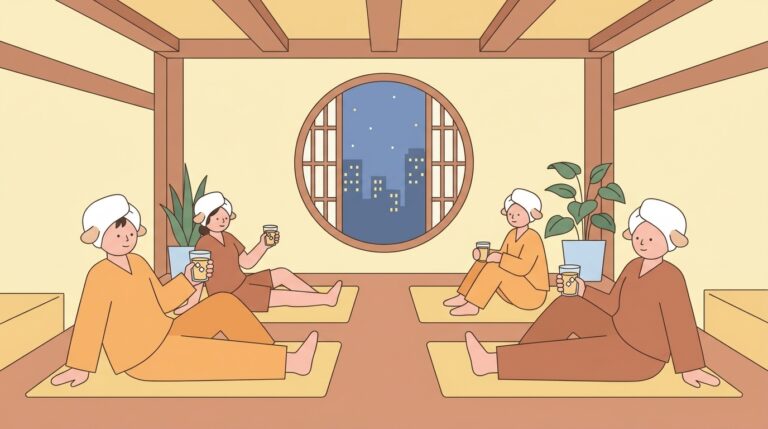
Stepping through the sliding glass doors, you are hit with a wave of warm pine aroma, the rhythmic clack of locker doors, and rows of people blissfully relaxing in matching oversized cotton pajamas. But as an intermediate Korean learner, a sudden wave of nunchi (눈치) kicks in. How do you ask if you can sleep overnight without sounding like a lost tourist? Where do you leave your bulky suitcase? How do you snag one of those coveted “sleeping caves” without violating unspoken social codes?
Don’t worry! Staying overnight at a Korean sauna is not just a budget travel hack; it is a quintessential K-culture rite of passage. In this guide, built on real feedback from seasoned travelers and vetted Korean language patterns, we’ll equip you with sophisticated, natural B2-level expressions and cultural navigation tools so you can stride into any 24-hour Jjimjilbang with total confidence.
Phase 2: Core Expressions Deep Dive
1. 혹시 여기서 하룻밤 자고 가도 되나요?
- Pronunciation: Hoksi yeogiseo harubam jago gado doenayo? (Hok-shee yeo-ghee-seo ha-roo-bam ja-go ga-do dway-na-yo? — Sounds like asking “By any chance, may I sleep here overnight?”)
- Meaning: Direct: “By chance, may I sleep overnight here and go?” | Nuance: A polite, natural way to confirm whether the bathhouse allows overnight stays and overnight pricing.
- K-Culture Moment: Seen in classic K-dramas when the runaway main character checks into a sauna late at night with a duffel bag.
- Editor’s Insight: Using 혹시 (hoksi) softens the inquiry, showing polite intermediate Korean tact. Adding 자고 가다 (to sleep and then go) sounds far more natural than just saying “여기서 잘 수 있어요?”
- Situation Spectrum: Casual: ⚠️ (Only with friends) | Semi-formal: ✅ (Perfect for front counter) | Formal: ⚠️
- 🤔 Think About It: In Korean culture, prefixing inquiries with 혹시 cushions the request. How does your native language politely hedge inquiries at service counters?
2. 수면실이나 토굴방 자리가 아직 널널한가요?
- Pronunciation: Sumyeonsirina togulbang jariga ajik neolneolhangayo? (Soo-myeon-shil-ee-na toh-gool-bang ja-ree-ga ah-jik neol-neol-han-ga-yo? — “Are the sleeping rooms or sleeping caves still relatively spacious/available?”)
- Meaning: Direct: “Are sleeping rooms or cave room spots still spacious?” | Nuance: Inquiring if there is comfortable resting space left before paying.
- K-Culture Moment: Weekend nights at popular saunas like Spaland or Dragon Hill (pre-renovation), where locals peek inside to check floor space.
- Editor’s Insight: 널널하다 (neolneolhada) is a lively, native colloquial adjective meaning “spacious/not crowded.” Using it elevates your speech from robotic textbook to authentic native-level naturalness.
- Situation Spectrum: Casual: ✅ | Semi-formal: ✅ | Formal: 🚫
- 🤔 Think About It: Notice the word 토굴방 (togulbang), literally “earth-cave room”—the cozy individual sleeping pods built into the walls.
3. 캐리어나 귀중품은 카운터에 따로 맡길 수 있을까요?
- Pronunciation: Kaerieona gwijungpumeun kaunteoe ttaro matgil su isseulkkayo? (Kae-ree-eo-na gwee-joong-poom-eun ka-oon-teo-eh tta-ro mat-geel soo ees-seul-kka-yo? — “Could I separately leave my suitcase or valuables at the counter?”)
- Meaning: Direct: “Can carrier luggage or valuables be entrusted separately at the counter?” | Nuance: A safe, refined way to ask staff to safeguard oversized baggage that won’t fit in shoe/clothes lockers.
- K-Culture Moment: Travelers arriving straight from Incheon Airport checking large baggage with the counter Ajjussi (아저씨).
- Editor’s Insight: Standard shoe and clothes lockers inside the changing room are tall and narrow. Asking to 맡기다 (entrust/check in) oversized bags is essential for overnight travelers.
- Situation Spectrum: Casual: ⚠️ | Semi-formal: ✅ | Formal: ✅
- 🤔 Think About It: Korean service counters frequently hold large items for free based on mutual trust (Jeong).
Phase 3: Textbook Korean vs. Real Korean
Scenario 1: Confirming the 12-Hour Overnight Limit
- 📖 Textbook Korean: “몇 시간 동안 머무를 수 있습니까? 초과 요금이 있습니까?” (Myeot sigan dongan meomureul su itsseumnikka? Chogwa yogeumi itsseumnikka? — “For how many hours may I stay? Is there an excess fee?”)
- 🗣️ Real Korean: “기본이 12시간 기준이죠? 시간 넘기면 할증이 얼마나 붙어요?” (Giboni yeol-du-sigan gijun-ijyo? Sigan neomgimyeon haljeungi eolmana buteoyo? — “Standard is based on 12 hours, right? How much is the surcharge if I exceed the time?”)
- 💡 Why is it different? Native speakers use 기준 (standard/basis) and conversational terms like 할증이 붙다 (a surcharge is applied) rather than rigid formal questions.
Scenario 2: Ordering Late-Night Essentials at the Snack Bar (매점)
- 📖 Textbook Korean: “식혜와 구운 계란 세 개를 주십시오.” (Sikhwewa guun gyeran se gaereul jusipsio. — “Please give me sikhye and three baked eggs.”)
- 🗣️ Real Korean: “사장님, 식혜 큰 거 하나랑 맥반석 계란 3개짜리 세트 부탁드려요!” (Sajangnim, sikhye keun geo hanarang maekbanseok gyeran se-gae-jjari seteue butakdeuryeoyo! — “Boss, one large sikhye and a 3-piece baked egg set, please!”)
- 💡 Why is it different? Calling the clerk 사장님 (boss/proprietor) is the standard friendly honorific in Korea, and baked eggs are specifically called 맥반석 계란 (germanite-baked eggs).
Phase 4: K-Culture Deep Dive & Non-Verbal Manners
4-1. Nunchi & Silent Gestures for Overnighting
- The Mat Boundary Rule: When finding a sleeping spot on the main heated floor (Hwangto floor), grab a leather mat (Mae-teu) and a wooden/foam block pillow. Never place your mat closer than 30cm to a stranger’s mat. Korean personal space bubble applies even on communal floors!
- Wristband Tap Culture: You don’t bring cash into the sauna. Every snack, massage chair, and drink is billed by tapping your electronic locker key bracelet (Locker key band). You settle the total bill at the front desk when checking out.
- Volume Modulation: After 11:00 PM, the main hall lights dim. Conversations shift strictly to soft whispers. Phone screens should be dimmed to minimum brightness.
4-2. Cultural Code: The Trinity of Jjimjilbang Relaxation
Why do Koreans love overnighting here? It’s not just a budget bed; it’s a sensory sanctuary.
* The Signature Snack: 식혜 (Sikhye – sweet fermented rice drink) paired with 맥반석 계란 (Maekbanseok baked eggs). The slow-baked brown eggs replenish salt and protein after sweating out toxins, while ice-cold sikhye restores electrolytes.
* The Sheep Head (양머리 – Yangmeori): Folding a small towel into two ear-puffs to keep hair off the neck in steam rooms became a legendary K-drama meme starting in early 2000s classics like My Name is Kim Sam-soon.
Phase 5: Real-Life Roleplay Scenario
Setting: 1:45 AM at the reception desk of a 24-hour Jjimjilbang near Dongdaemun.
Characters: Minho (The friendly night-shift clerk) and You (The intermediate Korean learner seeking a bed).
- Turn 1 (You): 🎭 (Approaching counter politely with a slight bow) “안녕하세요! 혹시 지금 들어가서 하룻밤 자고 가도 되나요?” (Annyeonghaseyo! Hoksi jigeum deureogaseo harubam jago gado doenayo? — Hello! By any chance, can I go in now and sleep overnight?)
- Turn 2 (Minho): 🎭 (Nodding with a warm smile) “네, 가능합니다. 야간 입장료는 15,000원이고, 찜질복 포함입니다.” (Ne, ganeunghamnida. Yagan ipjangnyoneun man-o-cheon-won-igo, jjimjilbok poham-imnida. — Yes, it is available. The night entrance fee is 15,000 won, including sauna clothes.)
- Turn 3 (You): 🎭 (Pointing to your rolling suitcase) “제가 짐이 좀 큰데, 캐리어는 카운터에 보관해 주실 수 있나요?” (Jega jimi jom keunde, kaerieoneun kaunteoe bogwanhae jusil su 있nayo? — My luggage is a bit large, could you store my suitcase at the counter?)
- Turn 4 (Minho): 🎭 (Taking the suitcase handle and sticking a tag on it) “네, 네임택 달아서 보관해 드릴게요. 락커키는 여기 있습니다. 324번 쓰세요.” (Ne, neim-taek daraseo bogwanhae deurilgeyo. Rakkeo-kineun yeogi itsseumnida. Sam-baek-i-sip-sa-beon sseuseyo. — Yes, I’ll attach a name tag and store it for you. Here is your locker key. Please use number 324.)
- Turn 5 (You): 🎭 (Taking the key and sauna clothes) “감사합니다! 혹시 수면실에 이불이나 담요는 따로 대여해야 하나요?” (Gamsahamnida! Hoksi sumyeonsire iburina damyoneun ttaro daeyeohaeya hanayo? — Thank you! Do I need to rent blankets separately in the sleeping room?)
- Turn 6 (Minho): 🎭 (Pointing toward the hallway) “매점에서 보증금 5천 원에 담요 2천 원으로 대여 가능하세요. 정숙 시간이라 2층 수면실은 조용히 이용해 주세요.” (Maejeomeseo bojeunggeum o-cheon-wone damyo i-cheon-woneuro daeyeo ganeunghaseyo. Jeongsuk siganira i-cheung sumyeonsireun joyonghi iyonghae juseyo. — You can rent blankets at the snack bar for 2,000 won with a 5,000 won deposit. Please keep quiet in the 2nd-floor sleeping room since it’s quiet hours.)
- Turn 7 (You): 🎭 (Checking wristwatch) “네, 알겠습니다. 기본 이용 시간은 내일 오후 2시까지 맞죠?” (Ne, algessumnida. Gibon iyong siganeun naeil ohu du-si-kkaji matjyo? — Yes, understood. The base stay is until 2 PM tomorrow, right?)
- Turn 8 (Minho): 🎭 (Handing receipt) “네, 12시간 기준입니다. 푹 쉬다 가세요!” (Ne, yeol-du-sigan gijun-imnida. Puk swida gaseyo! — Yes, 12 hours standard. Have a deep, restful stay!)
🔀 Interactive Choice Point
You walk up to the 2nd floor and see all individual cave rooms (Togulbang) occupied, but a large open heated floor area has plenty of empty space.
* Option A: Place your mat right next to an occupied cave room entrance to block light.
* Option B: Find an empty spot on the heated floor near a wall outlet, lay down a leather mat and wood pillow, and set your phone to silent mode.
* Option C: Turn on the overhead light switch so you can see where to lay your blanket.
- Choice Feedback:
- Option A (Risk): Blocking someone’s cave entrance causes discomfort and violates Jjimjilbang courtesy.
- Option B (Best ✅): Respectful, smart! You secure floor heat and safe distance while keeping quiet hours intact.
- Option C (Bad 🚫): Turning on lights in the quiet zone after midnight will immediately trigger annoyed groans from sleepy locals.
Phase 6: 10-Second Emotion Shadowing Drill
Practice these natural rhythm pauses (/) with the designated emotion:
[😴 Exhausted but exceedingly polite]
“혹시 / 지금 들어가서 / 하룻밤 자고 가도 되나요?”
(Hoksi / jigeum deureogaseo / harubam jago gado doenayo?)-
[😋 Cheerful and hungry at 2 AM]
“사장님! / 식혜 큰 거 하나랑 / 맥반석 계란 3개짜리 세트 / 부탁드려요!”
(Sajangnim! / sikhye keun geo hanarang / maekbanseok gyeran se-gae-jjari seteue / butakdeuryeoyo!) -
[🤫 Polite whisper inquiry]
“저기 실례지만 / 담요 대여는 / 몇 시까지 가능한가요?”
(Jeogi sillyejiman / damyo daeyeoneun / myeot sikkaji ganeunghangayo?)
Phase 7: K-Culture Mini Dictionary
- 야간 할증 (Yagan Haljeung): Late-night surcharge. Saunas usually apply an extra 2,000–5,000 KRW fee for admissions entering between 9:00 PM and 5:00 AM.
- 토굴방 (Togulbang): 1-person wooden or clay sleeping pods built like mini caves. Highly popular for privacy and darkness.
- 락커키 결제 (Locker Key Gyeolje): The RFID wristband payment system inside the facility. No cash/cards needed until checkout.
- 양머리 (Yang-meori): “Sheep Head” towel fold. A fun, iconic K-culture craft made by folding a bath towel into thirds and rolling each end outwards.
Phase 8: Survival Kit for Travelers
Top 3 Survival Phrases
- “담요 하나 빌릴 수 있을까요?” (Damyo hana billil su isseulkkayo? – Can I rent one blanket?)
- Pro Tip: Some saunas can get chilly in the early morning air conditioning; renting a blanket for ~2,000 KRW guarantees deep sleep.
- “휴대폰 충전은 어디서 하나요?” (Hyudaepon chungjeoneun eodiseo hanayo? – Where can I charge my phone?)
- Pro Tip: Look for locker charging boxes near the snack bar or wall outlets marked for public use.
- “체크아웃 시간 넘기면 요금이 어떻게 돼요?” (Chekeu-aut sigan neomgimyeon yogeumi eotteoke dwaeyo? – What is the charge if I exceed checkout time?)
- Pro Tip: Standard overstay charges are usually ~1,000 KRW per hour.
Editor’s Travel Note
- Transport Backup: If a Jjimjilbang is fully packed, use the Kakao T taxi booking guide to search for nearby 24-hour saunas in neighboring districts.
- Navigation: Open your Naver Map navigation app and search “24시 찜질방” (24-hour Jjimjilbang) to verify operating hours before commuting.
- Luggage Etiquette: Never take rolling suitcases into the gender-separated bath or locker areas. Always check them at the main front reception.
Phase 9: “One Step Deeper” (Critical Reflection)
In Western hospitality culture, sleeping in a public space alongside dozens of strangers without individual walls might initially feel like a loss of personal privacy. However, in Korea, the Jjimjilbang represents a unique extension of communal warmth (Jeong, 정) and public trust. People let down their guard, unwind together after hard work weeks, and share a communal heated floor without fear of theft or disturbance. It demonstrates how high social safety and collective consideration shape physical environments.
💬 Your Turn: Would you feel comfortable sleeping in an open communal room with other travelers, or do you prefer private capsule rooms? Share your thoughts below in Korean!
Phase 10: FAQ & Common Mistakes
Q: Can foreign tourists stay overnight at any Jjimjilbang without a Korean ID?
A: Yes! Foreign travelers only need to present their passport at the front counter if requested. Most 24-hour saunas welcome international tourists warmly.
Q: What should I wear while sleeping in the common hall?
A: You must wear the official matching sauna uniform (Jjimjilbok) provided at the entrance. Sleeping in your personal street clothes in the shared lounge area is not permitted.
Q: Are Jjimjilbangs safe for solo female travelers overnight?
A: Extremely safe. Most establishments have dedicated 여성 전용 수면실 (Women-only Sleeping Rooms) with passcode or curtain-secured entrances.
🚨 Common Mistakes Alert
- Entering the bath area with clothes or shoes on: Always take off your shoes at the entrance shoe locker and enter the wet bath area completely bare after undressing in the locker room.
- Bringing outside food and drinks: Jjimjilbangs survive on internal snack bar revenue; outside food is strictly prohibited.
- Losing your wristband key: Losing the electronic key incurs a replacement penalty of roughly 10,000–30,000 KRW plus the risk of someone charging snacks to your key.
Phase 11: Action Missions
- 🥉 Bronze Mission (Solo): Practice speaking the 3 core expressions in the mirror with natural pitch and pauses.
- 🥈 Silver Mission (Social): Fold your own 양머리 (Sheep head towel), take a selfie, and post it to social media with the caption: “오늘 찜질방 갈 준비 완료!” (Ready for Jjimjilbang today!)
- 🥇 Gold Mission (Real World): Visit a 24-hour Jjimjilbang during your trip to Korea, order baked eggs and sikhye at the counter using 100% Korean, and rent a blanket for an overnight rest.
🎮 K-Culture Challenge: In your next K-drama watch, spot a scene where characters crack baked eggs against each other’s foreheads before eating!
Phase 12: Interactive Quiz Challenge
Question 1: Situational Judgment
You arrive at a Jjimjilbang at 2:00 AM. Which phrase is the most natural to ask the clerk if sleeping overnight is allowed?
– A) 여기서 영원히 잘 수 있습니까?
– B) 혹시 지금 하룻밤 자고 가도 되나요?
– C) 방을 하나 예약해 주세요.
Question 2: Fill in the Blank
Complete the sentence to ask for the classic snack combo:
“사장님, 식혜 한 잔이랑 맥반석 계란 3개짜리 세트 ________!”
– A) 부셔주세요
– B) 부탁드려요
– C) 볶아주세요
Question 3: Cultural True or False
T/F: In a Korean Jjimjilbang, you should pay cash directly to the snack counter worker whenever you buy food inside.
👉 Click to reveal Quiz Answers & Explanations!
- Answer: B (혹시 지금 하룻밤 자고 가도 되나요? is the polite, idiomatic B2 phrase. A means ‘Can I sleep here forever?’, and C asks to reserve a hotel room.)
- Answer: B (부탁드려요 means ‘Please / I request’. 부셔주세요 means ‘Please crush it’, and 볶아주세요 means ‘Please stir-fry it’.)
- Answer: False (F) (All payments inside are recorded on your electronic locker wristband and paid together at the front desk when leaving.)







