

Conquering the Locked Door: How to Celebrate Escaping a Korean Bangtalchul Like a Local
Phase 1: Empathy (Story-Driven Opening)
안녕하세요! 매일한글 에디터입니다. (Hello! I’m your Daily Hangul editor.)
Picture this: You are locked inside a dimly lit, cyberpunk-themed room in the vibrant streets of Hongdae, Seoul. The digital clock on the wall blinks red: 01:42. Your team has solved four padlock codes, decoded a UV light message on a mirror, and now stands before the final electronic keypad. You punch in the last code—click! The heavy steel door slides open. Music swells, the game master cheers through the intercom, and your heart races with pure adrenaline.
Then, silence. Your Korean friends shout high-fives and exclaim phrases you’ve heard on Korean variety shows like The Great Escape (대탈출), but you freeze. What do you say? Do you bow? Do you just say “Thank you”?
Escape rooms—known in Korea as 방탈출 (Bangtalchul)—are a massive social staple for university students, young professionals, and couples. Successfully escaping isn’t just about solving riddles; it’s about sharing that explosive communal joy (Jeong and teamwork) the second you step out into the lobby. Based on feedback from hundreds of our A2 learners, mastering just a few energetic celebration phrases will turn an awkward lobby moment into unforgettable team camaraderie. Let’s make sure you’re ready to celebrate like a true Seoul insider!
Phase 2: 3 Core Expressions in Depth
1. 드디어 탈출했어요! (Deu-di-eo tal-chul-hae-sseo-yo!)
- Pronunciation: [Deu-di-eo tal-chul-hae-sseo-yo] (Think of ‘deu’ like the start of ‘dirt’, and ‘tal-chul’ like ‘tal-chul’ with crisp L sounds)
- Meaning: Literal: “Finally escaped!” | Real Nuance: “We finally made it out! We did it!”
- K-Culture Moment: Seen whenever celebrity cast members in shows like Running Man or Sixth Sense finish a grueling mission with seconds to spare.
- Editor’s Insight: The word 드디어 (deudieo) carries the weight of long effort, relief, and triumphant payoff. Adding -했어요 keeps it polite yet emotionally charged.
- Situation Spectrum: Casual ✅ | Semi-formal ✅ | Formal ⚠️
- 🤔 Think About It: In English, we often say “We beat the room!” In Korean, the focus is on the state of release: “We escaped!” Why do you think Korean emphasizes the outcome of freedom over “defeating” the game?
2. 몇 분 남았어요? (Myeot bun na-ma-sseo-yo?)
- Pronunciation: [Myeot boon na-ma-sseo-yo] (Sounds like: ‘Myut boon nah-mah-ssuh-yo’)
- Meaning: Literal: “How many minutes remained?” | Real Nuance: “How much time do we have left? / What was our record?”
- K-Culture Moment: The very first question players ask the game master at the photo zone counter to see if they made the hall-of-fame board.
- Editor’s Insight: Korean escape rooms measure your bragging rights by the minutes and seconds remaining on the timer. Even if you escaped with only 30 seconds left, asking this creates instant fun dialogue with the staff!
- Situation Spectrum: Casual ✅ | Semi-formal ✅ | Formal ✅
- 🤔 Think About It: Notice how the verb is in the past tense (남았어요). Why do Koreans ask about time already spent rather than “What is our remaining time?”
3. 사진 찍어 주세요! (Sa-jin jji-geo ju-se-yo!)
- Pronunciation: [Sa-jin jji-geo joo-seh-yo] (Make the ‘jj’ tight like the ‘zz’ in ‘pizza’)
- Meaning: Literal: “Please take a picture for us!” | Real Nuance: “Could you take our victory photo, please?”
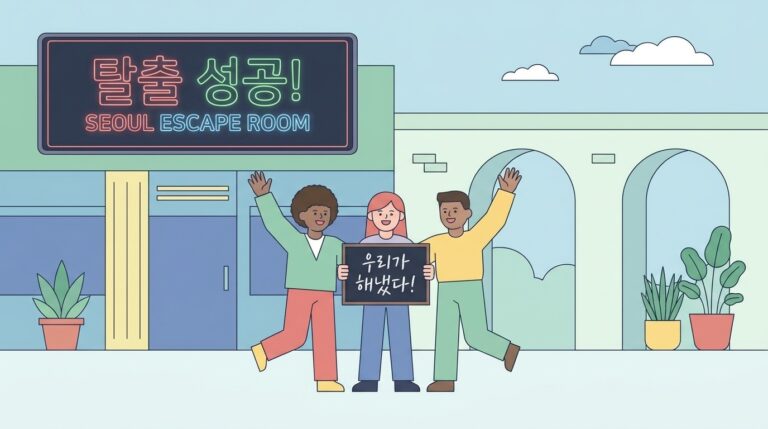
- K-Culture Moment: Every Korean escape room offers a chalkboard to draw on and a commemorative Polaroid photo when you escape.
- Editor’s Insight: The staff will gladly snap multiple angles on your smartphone too if you hand it to them with both hands while asking this politely.
- Situation Spectrum: Casual ⚠️ | Semi-formal ✅ | Formal ✅
- 🤔 Think About It: Requesting photos is a universal travel habit, but in Korea, offering to take photos for others first is a common courtesy. How does asking politely foster friendly rapport?
Phase 3: Textbook Korean vs. Real Korean
Situation 1: Expressing that you succeeded
- 📖 Textbook Korean: 우리는 게임에서 승리했습니다. (U-ri-neun ge-im-e-seo seung-ri-haet-seum-ni-da. – “We won the game.”)
- 🗣️ Real Korean: 와, 우리 탈출 성공했어요! (Wa, u-ri tal-chul seong-gong-hae-sseo-yo! – “Wow, we successfully escaped!”)
- 💡 Why the Difference? Korean speakers rarely use military-style words like ‘승리’ (victory) for leisure activities. Combining “탈출” (escape) and “성공” (success) is the natural, modern conversational standard.
Situation 2: Praising your teammate’s clue-solving skills
- 📖 Textbook Korean: 당신은 아주 똑똑합니다. (Dang-sin-eun a-ju ttok-ttok-ham-ni-da. – “You are very smart.”)
- 🗣️ Real Korean: 대박! 아까 그거 어떻게 풀었어요? (Dae-bak! A-kka geu-geo eo-tteo-ke pu-reo-sseo-yo? – “Awesome! How did you solve that earlier?”)
- 💡 Why the Difference? Calling an acquaintance “당신” sounds overly dramatic or stiff. Complimenting their specific action with “대박!” creates instant warmth and friendship.
Phase 4: K-Culture Deep Dive & Non-Verbal Manners
4-1. 눈치 (Nunchi) & Lobby Gestures
When stepping out into the lobby after a win, remember that sound travels easily. Korean escape room venues have multiple themes operating simultaneously. Nunchi (tactful awareness) means celebrating enthusiastically without spoiling clues for teams waiting in the lobby. Keep your voice at a considerate volume, hold up your victory chalkboard proudly, and when the staff hands you your commemorative photo, receive it with both hands as a sign of respect.
4-2. The Post-Escape Board Art Culture
In areas like Gangnam, Sinchon, and Hyehwa, room escapes take theme immersion seriously. After escaping, you are given colorful liquid chalk markers and a black acrylic board. Koreans spend 5 to 10 minutes decorating this board with their escape time, nickname, and cute illustrations. Writing “탈출 성공!” (Escape Success!) along with the remaining minutes is an essential social media ritual before grabbing K-BBQ together.
Phase 5: Real-Life Roleplay Scenario
Setting: The bustling lobby of Key-Escape in Gangnam. Min-su (your Korean friend) and the Game Master (Staff) are standing by the photo zone.
- Turn 1 (Staff): 축하드립니다! 방금 문 열고 나오셨네요!
(Chuk-ha-deu-rim-ni-da! Bang-geum mun yeol-go na-o-syeon-ne-yo!)
“Congratulations! You just unlocked the door and came out!”
🎭 Clapping hands enthusiastically with a warm smile -
Turn 2 (You): 와, 드디어 탈출했어요! 너무 재미있었어요!
(Wa, deu-di-eo tal-chul-hae-sseo-yo! Neo-mu jae-mi-i-sseo-yo!)
“Wow, we finally escaped! It was so much fun!”
🎭 Catching your breath and high-fiving Min-su -
Turn 3 (Min-su): 우리 시간 얼마나 남았어요? 5분 남았나요?
(U-ri si-gan eol-ma-na na-ma-sseo-yo? O-bun na-mang-na-yo?)
“How much time do we have left? Did we have 5 minutes?”
🎭 Looking eagerly at the timer tablet -
Turn 4 (Staff): 3분 20초 남기고 탈출하셨어요. 힌트도 2개밖에 안 쓰셨네요!
(Sam-bun i-sip-cho nam-gi-go tal-chul-ha-syeo-sseo-yo. Hin-teu-do du-gae-bak-e an sseu-syeon-ne-yo!)
“You escaped with 3 minutes and 20 seconds left. And you only used 2 hints!”
🎭 Pointing to the record sheet -
Turn 5 (You): 휴, 다행이다! 민수 씨가 마지막 자물쇠 진짜 잘 풀었어요.
(Hyu, da-haeng-i-da! Min-su ssi-ga ma-ji-mak ja-mul-soe jin-jja jal pu-reo-sseo-yo.)
“Phew, what a relief! Minsu, you solved that last padlock so well.” -
Turn 6 (Min-su): 아니에요, 같이 단서 찾아서 가능했죠!
(A-ni-e-yo, ga-chi dan-seo cha-ja-seo ga-neung-haet-jyo!)
“Not at all, it was possible because we searched for clues together!” -
Turn 7 (Staff): 자, 여기 보드판에 기록 적으시고 사진 찍어 드릴게요!
(Ja, yeo-gi bo-deu-pan-e gi-rok jeog-eu-si-go sa-jin jji-geo deu-ril-ge-yo!)
“Here, write your record on this board and I will take your photo!”
🎭 Handing over the chalkboard markers -
Turn 8 (You): 감사합니다! 저희 폰으로도 사진 한 장 찍어 주세요!
(Gam-sa-ham-ni-da! Jeo-hui pon-eu-ro-do sa-jin han jang jji-geo ju-se-yo!)
“Thank you! Please take one photo with our phone as well!”
🔀 Interactive Branching Point
The staff member takes your camera and asks where you want to pose. How do you respond?
- Option A: “여기 포토존 앞에서 찍을게요!” (Yeo-gi po-to-jon ap-e-seo jji-geul-ge-yo! – We will take it in front of the photo zone here!)
- 👉 Feedback [BEST]: Natural, polite, and clearly designates the designated photo area. The staff will happily direct your lighting.
- Option B: “빨리 찍어요! 배고파요!” (Ppal-li jji-geo-yo! Bae-go-pa-yo! – Take it fast! I’m hungry!)
- 👉 Feedback [BAD]: Sounds overly demanding and impolite to service staff, even if meant as a joke among close friends.
- Option C: “안 찍을래요.” (An jji-geul-lae-yo. – I won’t take one.)
- 👉 Feedback [RISK]: Grammatically correct, but abruptly declining after winning dampens the celebratory mood with your teammates.
Phase 6: 10-Second Emotion Shadowing Drill
Practice matching the exact rhythm and pitch of native speakers!
[😊 Proud & Relieved]
드디어 / 탈출에 / 성공했어요!
(Deu-di-eo / tal-chul-e / seong-gong-hae-sseo-yo!)
“Finally / in escaping / we succeeded!”-
[🤩 Amazed & Curious]
와, / 몇 분 / 남았어요?
(Wa, / myeot bun / na-ma-sseo-yo?)
“Wow, / how many minutes / are left?” -
[🤝 Polite & Friendly]
여기서 / 사진 한 장만 / 찍어 주세요!
(Yeo-gi-seo / sa-jin han jang-man / jji-geo ju-se-yo!)
“From here, / just one photo / please take for us!”
Phase 7: K-Culture Mini Dictionary
- 보드판 (Bo-deu-pan) | Chalkboard / Record Board
The custom acrylic board given to teams who escape where they write their clear time and draw team logos. - 노힌트 (No-hin-teu) | No Hint Escape
Escaping without using any hints from the intercom. Achievers of this are treated like tactical geniuses in Korea! - 자물쇠 (Ja-mul-soe) | Padlock / Physical Lock
Key and combination locks inside the room, distinct from electronic sensor gimmicks (장치). - 인생 테마 (In-saeng Te-ma) | “Life-defining Theme” / Best Room Ever
A slang compound of ‘인생’ (life) + ‘테마’ (theme), used to describe the most memorable escape room you have ever played.
Phase 8: Traveler’s Survival Kit
Survival Expressions TOP 3
- 힌트 쓸게요! (Hin-teu sseul-ge-yo!) – “We will use a hint!” (Use this via the in-room walkie-talkie when stuck for over 10 minutes).
- 시간 다 됐어요? (Si-gan da dwae-sseo-yo?) – “Is time already up?” (Useful when the room lights turn on).
- 수고하셨습니다! (Su-go-ha-syeot-seum-ni-da!) – “Thank you for your hard work!” (The golden polite farewell to staff when leaving).
Editor’s Travel Note
Escape room reservations in Seoul open up to two weeks in advance at midnight. Top-tier venues in Gangnam and Hongdae book out in seconds. You can locate and reserve slots by checking venues via the Naver Map official application. When paying, foreign credit cards work at almost all physical front desks, but keep your booking name in simple Roman letters.
Phase 9: “한 발 더 깊이” (Deep Cultural Thought)
In Western escape rooms, individual deduction and speed are celebrated. In Korea, escape rooms are a micro-reflection of ‘우리’ (Woori – Collective Us) culture. Teams actively distribute roles—one person records numbers, another handles locks, while another organizes used clues. Celebrating with “우리 탈출 성공했어요!” reinforces that the victory belongs to the group bonds formed under pressure.
💬 Your Turn: Have you ever played an escape room with friends in your country or in Korea? What is the first thing you shouted when the door opened? Share your story in the comments below!
Phase 10: FAQ & Common Mistakes
Q: Can foreigners play Korean escape rooms without fluent Korean?
A: Yes! Many venues in Hongdae and Myeongdong offer “English-friendly” (영어 가능) themes where all clue cards and audio transcripts are translated.
Q: Do we get a prize if we escape successfully?
A: Most venues reward you with printed souvenir photos, keychains, or discount coupons for your next visit rather than cash prizes.
Q: What if we don’t finish in 60 minutes?
A: The game master will enter, guide you through the remaining unsolved puzzles so you get story closure, and lead you out politely.
🚨 Common Mistakes Alert!
- ❌ Mistake 1: Shouting “우리가 이겼다!” (We beat this!) in the lobby.
➡️ Correct Action: Say “탈출 성공했어요!” (We successfully escaped!). - ❌ Mistake 2: Talking loudly about specific lock codes in front of next players.
➡️ Correct Action: Keep puzzle solutions quiet in the waiting room (Nunchi). - ❌ Mistake 3: Handing your phone with one hand while asking for a picture.
➡️ Correct Action: Hold your phone with both hands and say “사진 찍어 주세요!”.
Phase 11: Action Missions
- 🥉 Bronze Mission: Practice saying “드디어 탈출했어요!” out loud 3 times with enthusiastic facial expressions.
- 🥈 Silver Mission: Save an Instagram reel or YouTube clip of a Korean variety escape room show and identify when players yell “성공!”.
- 🥇 Gold Mission: Book an escape room in Seoul, solve the final puzzle, and ask the game master “몇 분 남았어요?” entirely in Korean!
- 🎮 K-Culture Mission: Watch an episode of tvN’s Great Escape (대탈출) and write down two clue-related words you spot on screen.
Phase 12: Interactive Quiz Challenge
1. Situation Judgment: You just solved the final room puzzle with 2 minutes left. What is the most natural sentence to say to the staff?
a) 우리 졌어요. (We lost.)
b) 드디어 탈출 성공했어요! (We finally successfully escaped!)
c) 당신은 누구입니까? (Who are you?)
2. Fill in the Blank: “사진 한 장만 [ ______ ] 주세요!” (Please take one photo for us!)
a) 먹어
b) 찍어
c) 닫아
3. Cultural True/False: Decorating a chalkboard with your escape record and remaining time is a popular post-game activity in Korean escape rooms. (True / False)
🔍 Click here to reveal the answers and explanations!
-
Answer: b) 드디어 탈출 성공했어요!
Explanation: This expression naturally combines relief and triumphant celebration at the A2 level. -
Answer: b) 찍어 (from 찍다 – to take a photo)
Explanation: ‘사진을 찍다’ is the standard verb collocation for taking pictures. -
Answer: True
Explanation: Drawing on the record board (보드판) is an iconic part of Korean Bangtalchul culture!






