

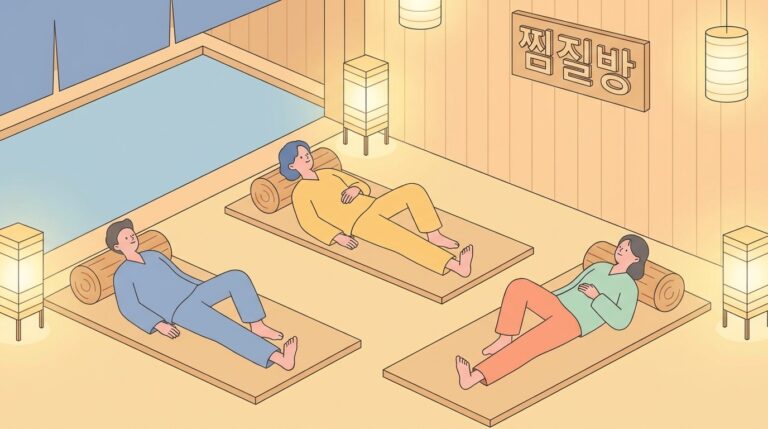
The Ultimate Guide to Sleeping in a Korean Jjimjilbang (수면실)
Phase 1: Empathy & Story Intro
안녕하세요! 매일한글 에디터입니다. (Hello! I’m your editor from Daily Hangul.)
Picture this: You’ve spent the entire day walking around Seoul—climbing the hills of Bukchon Hanok Village, shopping in Myeongdong, and feasting on spicy Tteokbokki. Your legs are aching, your energy is at zero, and you decide to experience the ultimate Korean relaxation haven: a Jjimjilbang (찜질방).
After soaking in steaming herbal baths and sweating out toxins in a hot clay kiln, you put on your oversized matching spa clothes and head to the 수면실 (Sumyeon-sil – Sleeping Room) for a well-deserved nap. But the moment you slide open the heavy wooden door, panic sets in. It’s dim, people are lying silently side-by-side on thin mats on the floor, and half the spots have small towels or wooden blocks on them.
Is this empty spot taken? Can I grab that brown wooden pillow over there? What do I say if someone is snoring right in my ear?
Don’t worry! Sleeping in a communal Korean sauna can feel intimidating at first, but with a few polite phrases and basic etiquette, you’ll blend right in like a local regular. Based on real learner feedback, this guide will give you exact A2-level survival Korean to claim your space, ask for extra blankets, and rest peacefully.
Phase 2: 3 Core Expressions Deep-Dive
1. 여기 자리 있어요? (Is this spot taken?)
- Pronunciation: [Yeogi jari isseoyo?] (Think: ‘Yo-gi jah-ree ee-so-yo?’)
- Meaning: Literal: “Is there a seat/spot here?” | Nuance: “Is someone using this mat/space, or may I sleep here?”
- K-Culture Moment: In K-Dramas like Secret Garden or Reply 1988, whenever characters crash at a 24-hour Jjimjilbang, they always scan the floor and whisper this to the person next to an empty mat.
- Editor’s Insight: In Korea, leaving a small item like a folded towel or phone charger on a mat means “I’m saving this spot while I go to the bathroom.” Always look around and ask softly before claiming an open mat.
- Situation Spectrum:
- Casual (with close friends): 여기 자리 있어? (✅)
- Semi-formal/Polite (default for strangers): 여기 자리 있어요? (✅ Standard & Recommended)
- Formal (with elders/superiors): 여기 자리 있습니까? (⚠️ A bit overly stiff for a relaxing sauna!)
- 🤔 Think About It: In many Western cultures, asking stranger-neighbors if you can lie down 30 cm next to them feels awkward. Why is communal sleeping in Korea considered a natural, shared comfort?
2. 담요 하나 더 주실 수 있나요? (Could I get one more blanket?)
- Pronunciation: [Dam-yo hana deo jusil su innayo?] (Think: ‘Dahm-yo hah-nah duh joo-sheel soo een-nah-yo?’)
- Meaning: Literal: “Can you give one more blanket?” | Nuance: “Could I please have an extra blanket? (It’s a bit chilly here)”
- K-Culture Moment: At the front desk or rental counter inside the sauna hall, late-night visitors often ask the front desk ajumma for a warm comforter before heading to the sleeping floor.
- Editor’s Insight: Most Jjimjilbangs provide a standard mat and wooden block pillow for free, but thick blankets (담요) often require a small deposit or rental fee (usually 1,000~2,000 KRW paid via your locker key band).
- Situation Spectrum:
- Casual: 담요 하나 더 줘. (🚫 Rude to staff!)
- Semi-formal/Polite: 담요 하나 더 주실 수 있나요? (✅ Perfect)
- Short Polite: 담요 하나 더 주세요. (✅ Very common & easy)
- 🤔 Think About It: Notice the word 더 (deo – more). Korean uses simple counters (하나 = one, 더 = more) to form very polite requests without long sentence structures.
3. 조금만 조용히 해 주세요 (Please keep it a little quiet)
- Pronunciation: [Jogeum-man joyong-hi hae juseyo] (Think: ‘Cho-geum-mahn jo-yong-hee hae joo-seh-yo’)
- Meaning: Literal: “Please do quietly just a little.” | Nuance: “Could you please lower your voice/whisper?”
- K-Culture Moment: Seen in comedy skits where late-night talkers or gamers with phone speakers get gentle ‘shushes’ from tired patrons who have work the next morning.
- Editor’s Insight: The magic word here is 조금만 (jogeum-man – just a little). Koreans rarely say a blunt “Be quiet!” (조용히 하세요). Adding “조금만” softens the friction and makes you sound considerate yet clear.
- Situation Spectrum:
- Casual: 조용히 해! (🚫 Never use with strangers)
- Semi-formal/Polite: 조금만 조용히 해 주세요. (✅ Soft and effective)
- Indirect Gesture: Shushing finger gesture with an apologetic nod. (✅ Often enough!)
- 🤔 Think About It: How does softening a direct request with “just a little bit” reflect the Korean value of preserving harmony (Gibun) in public shared spaces?
Phase 3: Textbook Korean vs. Real-Life Korean
Situation A: Asking if you can lie down in an open area
- 📖 Textbook Korean: “제가 여기에 누워도 됩니까?” (Am I permitted to lie down here?)
- 🗣️ Real-Life Korean: “여기 자리 있어요?” (Is this spot taken?)
- 💡 Why is it different? Asking for formal legal permission feels like a military drill. Real Koreans simply check if someone else is currently occupying the space.
Situation B: Asking someone to lower phone brightness or sound
- 📖 Textbook Korean: “소리를 내지 마십시오.” (Do not make sounds.)
- 🗣️ Real-Life Korean: “저기요, 조금만 소리 줄여 주시겠어요?” (Excuse me, could you turn down the sound just a bit?)
- 💡 Why is it different? Direct imperative commands sound aggressive. Using “저기요” (Excuse me) followed by “줄여 주시겠어요?” (Would you lower it?) shows manners while solving the issue.
Phase 4: K-Culture Deep-Dive & Non-Verbal Manners
4-1. 눈치 (Nunchi) & Sleeping Room Gestures
- The Tip-Toe Glide: The sleeping room floor is heated (온돌 – Ondol), and sound echoes easily. Walk softly without letting your heels stomp on the wooden floor.
- The Mat Distance Rule: Never place your mat touching a stranger’s mat directly. Leave at least a forearm’s width of space if possible.
- Phone Screen Etiquette: Keep your screen brightness at the absolute lowest setting. In the pitch-dark room, bright screens wake people up instantly.
- Look for Gender-Specific Rooms: Most modern Jjimjilbangs have a 남성 전용 수면실 (Men-only sleeping room) and 여성 전용 수면실 (Women-only sleeping room) in addition to the common co-ed sleeping floor. If you want a quieter sleep, look for these dedicated rooms!
4-2. The Culture Code: Ondol & Mokbae-gae
Why are Koreans sleeping on a hard floor with a hard rectangular wooden block? That wooden block is called a 목베개 (Mokbae-gae – neck pillow). It is designed to support the cervical spine and keep your head cool while the radiant Ondol (온돌) heat warms your back and muscles. It might feel strange for the first 10 minutes, but many travelers wake up with their chronic lower-back tightness completely gone!
Phase 5: Real-Life Roleplay Scenario
- Setting: 1:30 AM at ‘Dragon Hill Spa’ in Seoul. You enter the dimmed sleeping zone holding a floor mat.
- Characters: You (민우 / Learner) and a fellow relaxing visitor (수진).
Turn 1 (You): (Approaching an empty mat with a gentle whisper)
             저기요, 실례지만 여기 자리 있어요?
             [Jeogiyo, sillyejiman yeogi jari isseoyo?]
             🎭 (Excuse me, is this spot taken? - tilting head politely)

Turn 2 (Sujin): (Softly smiling, shaking hands slightly)
               아니요, 비어 있어요. 쓰셔도 돼요.
               [Aniyo, bieo isseoyo. Sseusyeodo dwaeyo.]
               🎭 (No, it's empty. You can use it.)

Turn 3 (You): 감사합니다! 좋은 밤 되세요.
             [Gamsahamnida! Joeun bam doeseyo.]
             🎭 (Thank you! Have a good night.)

Turn 4 (Sujin): 네, 편하게 쉬세요.
               [Ne, pyeonhage swiseyo.]
               🎭 (Yes, rest comfortably.)

Turn 5 (You): (Noticing it's a bit cold near the window, heading to counter)
             저기요 이모님, 담요 하나 더 주실 수 있나요?
             [Jeogiyo imonim, damyo hana deo jusil su innayo?]
             🎭 (Excuse me auntie, could I get one more blanket?)

Turn 6 (Staff): 네, 키 밴드 찍어주세요. 천 원이에요.
               [Ne, ki baendeu jjigeojuseyo. Cheon won-ieyo.]
               🎭 (Sure, tap your locker key band here. It's 1,000 KRW.)

Turn 7 (You): (Tapping electronic wristband)
             여기 찍었어요. 감사합니다!
             [Yeogi jjigeosseoyo. Gamsahamnida!]
             🎭 (I tapped it here. Thank you!)

Turn 8 (Staff): 따뜻하게 잘 자요!
               [Ttatteuthage jal jayo!]
               🎭 (Sleep warm and well!)
🔀 Interactive Choice Point
You lay down, but someone next to you is playing YouTube videos on their smartphone without earphones.
* Choice A: You shout loudly: “조용히 해! 잠 좀 자자!” (Be quiet! Let me sleep!)
* Choice B: You gently tap their arm, put a finger to your lips, and whisper: “저기요, 조금만 조용히 해 주실 수 있나요?”
* Choice C: You stay silent, grumble in frustration, and put the wooden pillow over your head all night.
- Feedback:
- Choice A (Bad): 🚫 You will cause unnecessary public drama and embarrassment (Gukhem moment).
- Choice B (Best): 🌟 Courteous, direct, and universally respected in Korean communal spaces.
- Choice C (Risk): ⚠️ You will lose sleep! Koreans appreciate polite, quiet communication.
Phase 6: 10-Second Emotion Shadowing Drill
Repeat these lines aloud with the indicated pause (/) and feeling:
[🤫 조심스럽고 공손하게 - Whispering & Respectful]- 저기요… / 여기 자리 있어요? / 써도 돼요?
- [Jeogiyo… / yeogi jari isseoyo? / sseodo dwaeyo?]
[😊 다정하고 감사하게 - Sweet & Appreciative]- 감사합니다! / 이모님, / 담요 하나 더 주세요!
- [Gamsahamnida! / imonim, / damyo hana deo juseyo!]
[🥺 조용히 간곡하게 - Quietly & Earnestly]- 쉿… / 조금만 / 조용히 해 주실 수 있나요?
- [Swit… / jogeum-man / joyong-hi hae jusil su innayo?]
Phase 7: K-Culture Mini Dictionary
- 수면실 (Sumyeon-sil) [Sleeping Room]: The designated quiet, darkened sleeping hall in a Korean sauna.
- 목베개 (Mokbae-gae) [Wooden Neck Pillow]: The traditional hard rectangular block designed to align your neck on heated floors.
- 온돌 (Ondol) [Korean Floor Heating System]: The traditional sub-floor heating technology that keeps Korean sauna floors toasty warm all year.
- 매트 (Mae-teu) [Floor Mat]: The portable thin leather/foam mat you lay down on the floor for cushioning.
Phase 8: Survival Kit for Travelers
Survival Expressions TOP 3
- “여성/남성 전용 수면실 어디예요?” (Yeoseong/Namseong jeonyong sumyeonsil eodiyeyo?)
- Pro Tip: Where is the Women/Men-only sleeping room? (Great for solo travelers seeking total quiet).
- “콘센트 어디에 있어요?” (Konsenteu eodie isseoyo?)
- Pro Tip: Where are the electrical outlets? (To charge your phone overnight safely).
- “알람 맞춰도 돼요?” (Allam matchwodo dwaeyo?)
- Pro Tip: Can I set an alarm? (Always use vibration mode or earphones so you don’t wake the whole room!).
Editor’s Travel Note
- Check the exact location and late-night opening status using 네이버 지도 앱 다운로드 or 카카오맵 길찾기 앱 before visiting, as some saunas close sleeping zones for deep cleaning between 3:00 AM and 5:00 AM.
- Never carry cash around inside! All payments for food, drinks (like Sikkhye), and blankets are scanned with your electronic wristband (키 밴드) and settled when you check out.
Phase 9: One Step Deeper (한 발 더 깊이)
In many countries, sharing an open sleeping room with dozens of strangers on the floor would feel unsafe or invasive. Yet in Korea, the Jjimjilbang reflects a deep culture of 공동체적 신뢰 (Communal Trust) and 정 (Jeong). People leave their phones charging on walls and sleep soundly knowing others will respect their rest. When you step into a Sumyeon-sil, you aren’t just saving money on a hotel; you are partaking in a unique Korean tradition of shared tranquility.
💬 Your Turn: Would you be able to sleep comfortably with a hard wooden pillow on a warm floor? Have you ever visited a communal sauna before? Let us know in the comments below!
Phase 10: FAQ & Common Mistakes
Q: Can I bring my heavy luggage or backpack into the sleeping room?
A: No. Large suitcases and noisy backpacks should be left in your main shoe/clothing locker or checked in with the front desk staff at the entrance.
Q: Is it okay to talk on the phone in the sleeping room if I whisper?
A: No, phone conversations of any kind are strictly frowned upon in the 수면실. Step outside into the common main lounge (찜질 홀) to make phone calls.
Q: Do I need to pay extra to sleep overnight in a Jjimjilbang?
A: Most places allow you to stay for 12 hours on a standard admission ticket. If you stay past 12 hours (or stay past midnight), an extra overnight surcharge of 2,000 ~ 5,000 KRW may be applied upon checkout.
🚨 Common Mistakes Warning Board
- ❌ Mistake 1: Hoarding 3-4 floor mats and piling them up like a thick mattress. (Greedy behavior! Take only one mat per person).
- ❌ Mistake 2: Leaving your smartphone alarm ringing at full volume on the floor. (Set it to vibrate under your pillow!).
- ❌ Mistake 3: Entering the sleeping room with food or open drinks. (Keep all snacks in the dining lounge area).
Phase 11: Action Mission
- 🥉 Bronze Mission (Solo Practice): Practice whispering “여기 자리 있어요?” 5 times in front of the mirror with a polite smile.
- 🥈 Silver Mission (Social Challenge): Share your favorite K-Drama sauna moment on your Instagram story with the tag #DailyHangul #Jjimjilbang.
- 🥇 Gold Mission (Real Action): On your next trip to Korea, visit a local Jjimjilbang, ask for an extra blanket at the counter in Korean, and sleep an hour on the warm Ondol floor!
- 🎮 K-Culture Mission: Watch an episode of Legend of the Blue Sea or Crash Landing on You and spot how the main characters sleep inside the sauna!
Phase 12: Interactive Quiz Challenge
Question 1 (Situational Judgment)
You enter the sleeping room and see an empty mat, but there is a small towel lying neatly folded on it. What should you do?
1. Throw the towel away and lie down immediately.
2. Find another open mat, or politely ask nearby: “여기 자리 있어요?”
3. Yell asking whose towel it is.
Question 2 (Fill in the Blank)
Fill in the missing Korean word to politely ask for an extra blanket:
“담요 하나 더 ( ) 수 있나요?”
Question 3 (True or False)
[T / F] It is polite and normal to talk in a normal speaking voice inside the Jjimjilbang sleeping room (수면실) as long as it is before midnight.
👉 Click here to reveal Answers & Explanations!
- Answer: 2 — An item on a mat usually means someone stepped away for a minute. Always find another mat or ask politely.
- Answer: 주실 (Full phrase: 주실 수 있나요? – Could you give?)
- Answer: False (F) — The sleeping room is designated as a 24-hour whisper-only / quiet zone regardless of the time!







