

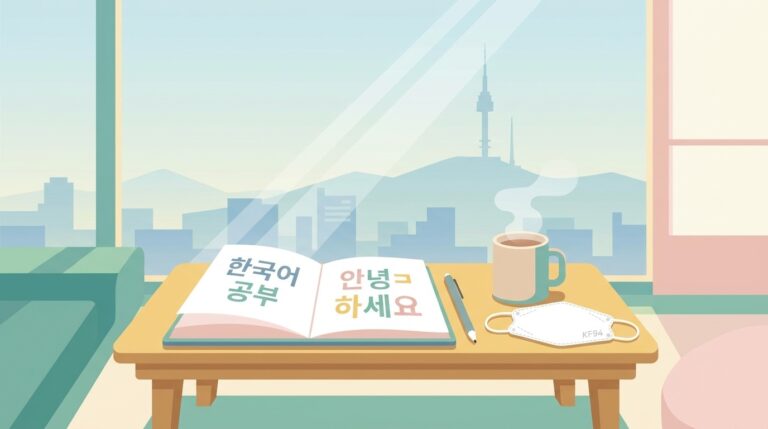
When the Seoul Sky Turns Grey: Essential Korean Phrases for Staying Indoors During Fine Dust Season
Phase 1: Empathy & Storytelling
안녕하세요! 매일한글 에디터입니다. (Hello! This is your Daily Hangul editor.)
Picture this: You wake up in your cozy Seoul Airbnb, excited to explore Han River park or visit Gyeongbokgung Palace. You open the window, expecting a bright morning sunrise, but the sky looks like a moody K-drama filter—a thick, yellow-grey haze blanket over Namsan Tower. Suddenly, your phone buzzes with an Emergency Disaster Alert: [미세먼지 주의보] (Fine Dust Advisory).
Your Korean buddy texts you asking if you’re ready to head outside. You want to suggest staying in or relaxing at a cozy cafe, but how do you say “The air is bad, let’s stay inside today” without sounding awkward or overly dramatic? As an A1 beginner, dealing with sudden weather changes can feel intimidating. Don’t worry! This guide is packed with real-life, super-simple phrases tested by hundreds of our beginner learners so you can protect your lungs and communicate like a caring local friend.
Phase 2: Top 3 Core Expressions for A1 Beginners
1. 오늘은 집에 있어요. (Oneul-eun jib-e isseoyo.)
- Pronunciation: [Oh-neul-eun jeeb-eh ee-ssuh-yo] (Think: “Oh-knelt in jeep-eh is-saw-yo”)
- Meaning: Literal: “Today, I am at home.” / Actual Nuance: “Let’s stay home today.” or “I’m staying in today.”
- K-Culture Moment: You hear this all the time in slice-of-life K-dramas when characters cancel outdoor plans on rainy or dusty days to binge-watch series and eat instant ramen.
- Editor’s Insight: The particle 은 (eun) emphasizes today compared to other days. It’s polite, gentle, and doesn’t sound like a harsh rejection.
- Situation Spectrum: Casual: ⚠️ (Use ‘집에 있자’ with close friends) | Semi-formal/Polite: ✅ | Formal: ⚠️
- 🤔 Think About It: In English, we often say “I don’t want to go out.” In Korean, stating the positive location (“I’m staying home”) sounds much softer and considerate.
2. 미세먼지 심해요. (Misemeonji simhaeyo.)
- Pronunciation: [Mee-seh-mun-jee seem-heh-yo] (Think: “Mee-say-mun-jee seem-hey-yo”)
- Meaning: Literal: “Fine dust is severe.” / Actual Nuance: “The air quality is really bad today.”
- K-Culture Moment: Weather forecast segments on Korean morning news or idols on live broadcasts warning fans to mask up.
- Editor’s Insight: 심해요 (simhaeyo) comes from 심하다 (to be severe/intense). It is the #1 adjective Koreans use for extreme weather, bad traffic, or heavy dust.
- Situation Spectrum: Casual: ⚠️ (Use ‘심해’) | Semi-formal/Polite: ✅ | Formal: ✅ (심합니다)
- 🤔 Think About It: Why do Koreans talk about dust instead of just saying ‘bad weather’? Because air quality checking is an everyday habit in Korea!
3. 마스크 써야 해요. (Maseukeu sseoya haeyo.)
- Pronunciation: [Mah-seu-keu ssuh-yah heh-yo] (Think: “Mah-scoo sir-yah hay-yo”)
- Meaning: Literal: “Must wear a mask.” / Actual Nuance: “You/We need to put on a mask.”
- K-Culture Moment: When your Korean friend spots you walking out without a mask on a yellow-dust day and immediately pulls a spare KF94 out of their bag for you.
- Editor’s Insight: -아야/어야 해요 (-aya/eoya haeyo) expresses “must/need to”. Combining it with 쓰다 (sseuda – to wear on the face/head) creates this essential survival line.
- Situation Spectrum: Casual: ⚠️ (Use ‘마스크 써’) | Semi-formal/Polite: ✅ | Formal: ✅
- 🤔 Think About It: Notice that the subject “You” or “I” is omitted. In Korean, shared context is everything!
Phase 3: Textbook Korean vs. Real Korean
Situation 1: Suggesting to avoid going outside
- 📖 Textbook Korean: “외출을 자제하십시오.” (Please refrain from outdoor activities – Sounds like an automated government loudspeaker!)
- 🗣️ Real Korean: “오늘은 그냥 실내에 있어요!” (Let’s just stay indoors today!)
- 💡 Why is it different? ‘자제하다’ is legal/formal terminology. In daily conversation, Koreans prefer casual action words like ‘실내에 있다’ (stay indoors).
Situation 2: Describing terrible air quality
- 📖 Textbook Korean: “대기 오염 지수가 매우 높습니다.” (The atmospheric pollution index is exceptionally high.)
- 🗣️ Real Korean: “공기 진짜 안 좋아요.” (The air is really bad.)
- 💡 Why is it different? Beginners get tripped up by technical vocabulary. Simple words like 공기 (air) and 안 좋아요 (not good) communicate your point immediately and naturally.
Phase 4: K-Culture Deep Dive & Non-verbal Manners
4-1. Nunchi & Gestures: Navigating Dusty Days
- The Check-the-Phone Glance: Before making plans, Koreans intuitively open apps like MisaeMisae (미세미세). When proposing to stay inside, showing your phone screen with the red/black angry cloud icon is the ultimate polite justification—no one will argue!
- Handing out Masks: If meeting someone indoors, pulling out an extra individually wrapped KF94 mask and offering it with two hands is a warm gesture of care (Jeong, 정).
4-2. Cultural Code: The ‘Jip-kok’ & Samgyeopsal Tradition
When yellow dust blows in from the continent, Koreans embrace 집콕 (Jip-kok – cocooning at home). You’ll see delivery apps like Baemin bustling with orders. Historically, Koreans believed the grease from 삼겹살 (pork belly) washed the fine dust out of your throat! While scientifically unproven, it is the best cultural excuse to order pork belly or hot Korean stew at home.
Phase 5: Real-Life Roleplay Scenario
Setting: Sam (Foreign exchange student) is texting Minji (Korean classmate) on a hazy Saturday morning in Sinchon.
- Turn 1 (Minji): 🎭 (Typing on KakaoTalk) 샘, 오늘 한강 공원 갈까요? (Sam, shall we go to Han River park today?)
- Turn 2 (Sam): 🎭 (Looking out the hazy window) 민지 씨, 오늘 미세먼지 심해요. (Minji, the fine dust is really bad today.)
- Turn 3 (Minji): 🎭 (Checking weather app) 아, 진짜네요! 하늘이 완전 노래요. (Ah, you are right! The sky is completely yellow.)
- Turn 4 (Sam): 🎭 (Suggesting alternative) 오늘은 그냥 실내에 있어요. (Let’s just stay indoors today.)
- Turn 5 (Minji): 🎭 (Relieved) 좋아요! 그럼 더현대 백화점이나 카페 갈래요? (Sounds good! Then shall we go to The Hyundai mall or a cafe?)
- Turn 6 (Sam): 🎭 (Nodding) 네, 좋아요. 마스크 꼭 써요! (Yes, sounds good. Make sure to wear a mask!)
- Turn 7 (Minji): 🎭 (Sending a thumbs-up sticker) 네, 역 안에서 만나요! (Okay, let’s meet inside the subway station!)
- Turn 8 (Sam): 🎭 (Smiling) 네, 조금 이따 봐요! (See you in a bit!)
🔀 Interactive Branching Point
Minji asks: “미세먼지 많은데 우리 뭐 할까요?” (There’s a lot of fine dust, what shall we do?)
- Option A: “집에서 배달 음식 시켜 먹어요!” (Let’s order delivery food at home!)
- 👉 Feedback: [BEST] Perfect response! Cozy, natural, and culturally 100% on point for A1.
- Option B: “밖에서 자전거 타요.” (Let’s ride bikes outside.)
- 👉 Feedback: [BAD] Oh no! Exercising in heavy fine dust will hurt your throat and surprise your friend.
- Option C: “안 나가요. 끝.” (I’m not going out. The end.)
- 👉 Feedback: [RISK] Grammatically understandable, but too blunt! It might hurt your friend’s feelings.
Phase 6: 10-Second Emotion Shadowing Drill
Practice these lines with pause marks (/) and real emotions:
[😷 목이 칼칼하고 걱정스럽게 / Concerned & husky throat]- 오늘 / 미세먼지 / 너무 심해요. (Oneul / misemeonji / neomu simhaeyo.)
[🛋️ 편안하고 다정하게 / Relaxed & friendly]- 우리 / 오늘은 / 그냥 집에 있어요. (Uri / oneul-eun / geunyang jib-e isseoyo.)
[⚠️ 챙겨주며 다정하게 / Caring reminder]- 나갈 때 / 마스크 / 꼭 써야 해요! (Nagal ttae / maseukeu / kkok sseoya haeyo!)
Phase 7: K-Culture Mini Dictionary
- 미세먼지 (Mise-meonji) | Fine Dust / PM10 & PM2.5
- The official term for airborne particulate matter. Essential for reading daily weather alerts.
- 집콕 (Jip-kok) | Cocooning / Staying at home
- Slang combining ‘집’ (home) and ‘콕’ (stuck tight). Popularized for homebody holidays or bad weather days.
- 배달 (Bae-dal) | Delivery (especially Food Delivery)
- The backbone of modern Korean convenience. On dusty days, staying in and ordering 배달 is standard practice.
- KF94 마스크 (KF94 Maseukeu) | KF94 Certified Protective Mask
- ‘Korean Filter 94%’. The gold standard mask sold at every Korean convenience store and pharmacy.
Phase 8: Traveler’s Survival Kit
Top 3 Survival Phrases
- KF94 마스크 있어요? (KF94 maseukeu isseoyo?) – Do you have KF94 masks? [Pro Tip: Ask this at GS25 or CU convenience stores].
- 목이 아파요. (Mog-i apayo.) – My throat hurts. [Pro Tip: Say this at a pharmacy (약국) to get soothing throat lozenges].
- 실내로 가요. (Silnae-ro gayo.) – Let’s go indoors.
Editor’s Travel Note
- Install the [MisaeMisae Air Quality App download for iOS and Android] to get cute visual color-coded icons (Blue = Best, Red = Bad, Black = Stay Inside).
- When traveling between spots, use underground shopping arcades like the [Express Bus Terminal Goto Mall navigation route] or connected subway links to stay protected from outdoor air.
Phase 9: A Step Deeper (한 발 더 깊이)
In Korean culture, talking about the weather and fine dust isn’t just small talk—it is an expression of interpersonal care (안부 묻기). When someone says “미세먼지 심하니까 마스크 쓰세요” (The dust is bad, please wear a mask), they aren’t lecturing you; they are extending warmth and looking after your health. Caring for one another’s well-being is deeply ingrained in the communal spirit of the Korean language.
💬 Your Turn: What do you usually do in your home country when the weather is bad? How would you suggest staying inside to a friend in your language? Tell us in the comments below!
Phase 10: FAQ & Common Mistakes
Q: What does ‘KF94’ mean on Korean masks?
A: ‘KF’ stands for ‘Korean Filter’. The number 94 means it blocks more than 94% of micro-particles (0.4μm). It is the recommended standard for fine dust and yellow sand seasons in Korea.
Q: Can I use ‘안 나가요’ (I don’t go out) instead of ‘집에 있어요’?
A: ‘안 나가요’ simply states a negative fact and can sound a bit cold or stubborn if used alone. ‘오늘은 집에 있어요’ (Let’s stay home today) or ‘실내에 있어요’ sounds far more natural and inviting.
Q: How do I tell a taxi driver to close the window because of dust?
A: You can simply say politely: “창문 닫아 주세요.” (Chang-mun dad-a ju-se-yo. / Please close the window.)
🚨 Common Mistakes Warning Board
- ❌ Mistake 1: Calling fine dust just “먼지” (Meonji). ‘먼지’ means ordinary household dust under your bed! Always specify ‘미세먼지’ for outdoor air pollution.
- ❌ Mistake 2: Saying “마스크를 입어요” (Wearing a mask like clothes). In Korean, clothes are ‘입다’ (ipda), but masks and hats placed on the face/head must use ‘쓰다’ (sseuda) -> 마스크 써요.
- ❌ Mistake 3: Using formal textbook phrase “외출을 금지합니다” in a private text. This means ‘Outings are strictly prohibited by law’. Keep it light with ‘오늘은 나가지 마요’ or ‘집에 있어요’.
Phase 11: Action Missions
- 🥉 Bronze Mission (Solo Practice): Stand in front of your mirror and practice saying “미세먼지 심해요. 마스크 써야 해요!” 3 times with a caring facial expression.
- 🥈 Silver Mission (Social Media): Post a photo of your cozy indoor tea/coffee setup with the Korean caption #집콕 #미세먼지조심 on Instagram or X.
- 🥇 Gold Mission (Real Life / Chat): Next time the weather is gloomy, message a Korean language partner: “오늘 공기 안 좋아요. 집에 있어요!”
- 🎮 K-Culture Mission: Watch a modern K-drama episode and spot the characters wearing white KF94 masks when commuting.
Phase 12: Interactive Quiz Challenge
1. Situation Challenge: The air outside is yellow and hazy. You want to suggest to your friend to stay inside a cafe. What is the most natural A1 sentence?
* (A) 외출을 거부합니다.
* (B) 우리 카페 안에 있어요.
* (C) 마스크 입으세요.
🔍 Click to reveal Answer & Explanation
Correct Answer: (B) 우리 카페 안에 있어요.
* Explanation: (A) is unnaturally robotic/dramatic, and (C) uses the wrong verb (입다 is for shirts/pants, 쓰다 is for masks). (B) is warm, simple, and polite!
2. Fill-in-the-blank: Complete the survival sentence: “Fine dust is bad today!”
* 오늘 ____________ 심해요.
🔍 Click to reveal Answer & Explanation
Correct Answer: 미세먼지 (Misemeonji)
* Full Sentence: 오늘 미세먼지 심해요. (Today the fine dust is severe.)
3. True or False Culture Check: In Korea, suggesting to eat Samgyeopsal (pork belly) is a popular cultural food tradition on fine dust days.
🔍 Click to reveal Answer & Explanation
Correct Answer: TRUE (참)
* Explanation: While a fun myth, many Koreans love bonding over hot pork belly dishes when the dust levels spike!






