

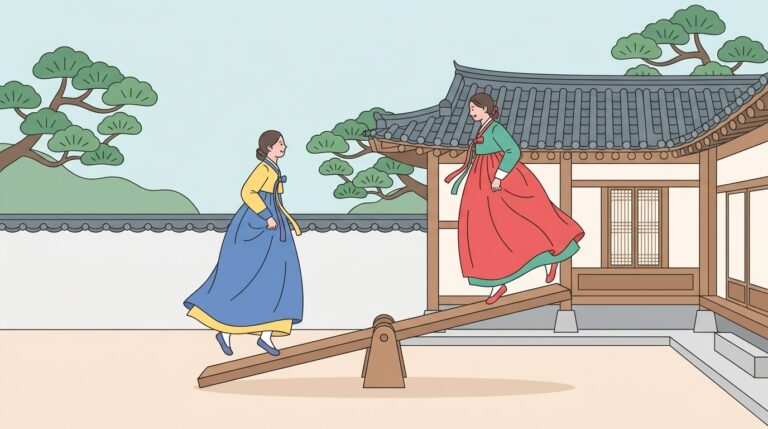
Soaring Beyond the Palace Walls: Mastering Neolttwigi (널뛰기) and Geunetagi (그네타기)
Phase 1: Empathy & Immersive Storytelling
안녕하세요! 매일한글 에디터입니다. (Hello! This is your Daily Hangul editor.)
If you have ever watched a historical K-Drama (Sageuk) like The Moon Embracing the Sun or Mr. Queen, you have undoubtedly seen that breathtaking scene: vibrant silk hanbok skirts billowing in the breeze as two women rocket into the sky from opposite ends of a wooden plank, or a heroine soaring higher than the courtyard walls on an impossibly high rope swing.
Many advanced Korean learners tell me, “Editor, when I visited the Korean Folk Village (한국민속촌), I tried hopping on the neolttwigi plank, but I felt completely tongue-tied! I wanted to coordinate the rhythm naturally with the local performers instead of just shouting ‘Jump! Jump!’ like a total beginner.”
Traditional Korean pastimes like Neolttwigi (널뛰기 – standing seesaw jumping) and Geunetagi (그네타기 – high-standing swinging) are not merely games; they are living metaphors for synchronicity, resilience, and historically, rare moments of liberation for Joseon-era women. At a C1 level, mastering the vocabulary and cultural subtext of these traditions will allow you to articulate nuanced concepts like collective rhythm, dynamic momentum, and literary elegance with native-level fluency.
Phase 2: Core 3 Expressions Deep-Dive
1. 호흡을 맞추다 (Hoheub-eul matchuda)
- Pronunciation: [Ho-heu-beul mat-chu-da] (Sounds like “Hoh-heub-ool maht-choo-dah”)
- Meaning: Literal: To align breaths / Nuance: To achieve seamless synergy, mutual timing, or impeccable team synchronicity.
- K-Culture Moment: Used by variety show hosts on Running Man when two teammates must synchronize explosive jumps on a traditional balance board.
- Editor’s Insight: In Neolttwigi, if partners jump independently, both will lose balance or suffer knee strain. “호흡을 맞추다” expresses that instinctual, non-verbal calibration where you anticipate the other person’s descent to power their ascent.
- Situation Spectrum: Casual: ✅ | Semi-formal: ✅ | Formal: ✅
- 🤔 Think About It: How does your native language express harmonious teamwork? Does it emphasize intellectual agreement or physical/respiratory harmony like Korean?
2. 발돋움하다 (Baldodeumhada)
- Pronunciation: [Bal-do-deum-ha-da] (Sounds like “Bahl-doh-deum-hah-dah”)
- Meaning: Literal: To push off on tiptoes for a leap / Nuance: To use an experience as a springboard or stepping stone toward greater heights.
- K-Culture Moment: Often heard in documentary narrations discussing how Korean cultural traditions served as an emotional springboard for historic communities.
- Editor’s Insight: While 뛰다 is simply “to jump,” 발돋움하다 captures the deliberate downward compression before an expansive, upward bound. In business and high-level essays, it is frequently used figuratively: “글로벌 시장으로 발돋움하다” (To spring forward into the global market).
- Situation Spectrum: Casual: ⚠️ | Semi-formal: ✅ | Formal: ✅
- 🤔 Think About It: What physical sensations does your culture associate with personal or professional breakthroughs?
3. 치맛자락을 휘날리며 (Chimatjarak-eul hwinallimyeo)
- Pronunciation: [Chi-mat-ja-ra-geul hwi-nal-li-myeo] (Sounds like “Chee-maht-jah-rah-gool hwee-nahl-lee-myuh”)
- Meaning: Literal: Fluttering the hem of one’s skirt / Nuance: Moving with dynamic grace, freedom, and majestic momentum.
- K-Culture Moment: A quintessential literary descriptor used in historical dramas when depicting Chunhyang on the Dano swing during the traditional festival.
- Editor’s Insight: This phrase encapsulates the aesthetic beauty of Korean motion (동중정 – dynamic stillness). It is not just about clothes flapping; it evokes defiance against confinement and vibrant vitality.
- Situation Spectrum: Casual: ⚠️ (Sounds poetic) | Semi-formal: ✅ | Formal: ✅
- 🤔 Think About It: Why do you think motion-based idiomatic expressions in Korea carry such strong emotional resonance with female historical narratives?
Phase 3: Textbook Korean vs. Real Native Korean
Situation 1: Coordinating the jump on the Neolttwigi plank
- 📖 교과서 한국어 (Textbook): “동시에 같이 높이 뛰어봅시다.” (Let us jump high together at the same time.)
- 🗣️ 진짜 한국어 (Real Native C1): “제가 착지할 때 템포 맞춰서 딱 굴러주셔야 탄력 받아요!” (When I land, stamp down right in tempo so we catch the elastic rebound!)
- 💡 왜 다를까? (Why the difference?): Native speakers use biomechanical terms like 탄력을 받다 (gain kinetic elasticity/rebound) and 발을 구르다 (stamp/drive the foot downward) rather than generic “jumping” verbs to describe the reciprocal physics of Neolttwigi.
Situation 2: Encouraging someone on the tall traditional swing (Geune)
- 📖 교과서 한국어 (Textbook): “더 높이 그네를 밀어 보세요.” (Try to push the swing higher.)
- 🗣️ 진짜 한국어 (Real Native C1): “허리 쫙 펴고 허공을 박차고 나가보세요! 시야가 확 트여요.” (Straighten your back and kick into the open sky! The whole horizon opens up.)
- 💡 왜 다를까? (Why the difference?): Advanced natural Korean relies on dynamic idioms like 허공을 박차다 (kick out into empty air) to convey the visceral rush of standing swings, moving past elementary verbs like 밀다 (to push).
Phase 4: K-Culture Deep Dive & Non-Verbal Manners
4-1. 눈치 (Nunchi) & Non-Verbal Manners on the Plank
- Weight Calibration Eye Contact: On the Neolttwigi plank, never look down at your feet. Lock eyes with your partner at chest-level to read their vertical rhythm through micro-adjustments in their shoulders.
- The Cushion Etiquette: In traditional settings, a heavy straw sack (짚단) or coiled mat is placed under the center pivot. Step on the board gently; jarring stomps before your partner is stabilized are seen as unsafe and unrefined.
- Knee-Damping (무릎 굽히기): When dismounting, bend your knees deeply to absorb the remaining kinetic energy so the plank does not slap down violently on your counterpart.
4-2. Cultural Code Analysis: The Dano (단오) Festival & Liberation
In traditional Joseon society, noblewomen (양반 여성) were largely confined to the inner quarters (안채). However, during Dano (단오 – the 5th day of the 5th lunar month), social restrictions were loosened. Women engaged in Geunetagi and Neolttwigi—activities that allowed them, quite literally, to vault high enough to peer over tall residential compound walls and gaze out at the world beyond. This historical context imbues both games with a profound sense of catharsis (해한 / 解恨 – resolving accumulated sorrow through joy).
Phase 5: Real-Life Roleplay Scenario
Setting: The traditional gaming yard at the Korean Folk Village (한국민속촌). You are standing on one end of a cedar Neolttwigi plank across from Min-jun, a skilled heritage performer in full Joseon attire.
- 민준 (Min-jun): “처음엔 살짝 무서울 수 있어요. 발끝에 힘 딱 주고 제 눈만 보세요!”
(Cheo-eum-en sal-jjak mu-seo-ul su iss-eo-yo. Bal-kkeut-e him ttak ju-go je nun-man bo-se-yo!)
“It might feel a bit intimidating at first. Brace your toes and keep your eyes fixed on mine!”
🎭 (Adjusts his belt, stabilizing the center of the wooden plank with a confident smile) -
당신 (You): “네! 타이밍 놓치지 않게 호흡 바짝 맞춰볼게요.”
(Ne! Ta-i-ming no-chi-ji ank-ke ho-heub ba-jjak mat-chwo-bol-ge-yo.)
“Understood! I’ll synchronize my breathing closely so we don’t miss the timing.”
🎭 (Slightly bends knees, matching Min-jun’s starting posture) -
민준 (Min-jun): “좋습니다! 제가 먼저 박차고 올라갈 테니, 착지 순간에 굴러주세요. 하나, 둘, 셋!”
(Jot-seum-ni-da! Je-ga meon-jeo bak-cha-go ol-la-gal te-ni, chak-ji sun-gan-e gul-leo-ju-se-yo. Ha-na, dul, set!)
“Great! I’ll kick off first, so drive your weight down the exact moment I land. One, two, three!”
🎭 (Leaps smoothly into the air with seasoned grace) -
당신 (You): “지금이에요! 쿵!”
(Ji-geum-i-e-yo! Kung!)
“Now! Boom!”
🎭 (Pushes firmly down on the board, launching Min-jun higher) -
민준 (Min-jun): “와, 탄력 제대로 받네요! 이제 그 반동 그대로 이용해서 솟구쳐 보세요!”
(Wa, tan-ryeok je-dae-ro ban-ne-yo! I-je geu ban-dong geu-dae-ro i-yong-hae-seo sot-gu-chyeo bo-se-yo!)
“Wow, that caught the rebound perfectly! Now harness that kinetic recoil and soar up!”
🎭 (Descends effortlessly with centered balance) -
당신 (You): “앗, 생각보다 시야가 확 트이네요! 담장 밖까지 다 보여요!”
(At, saeng-gak-bo-da si-ya-ga hwak teu-i-ne-yo! Dam-jang bak-kka-ji da bo-yeo-yo!)
“Ah, the view opens up way more than I expected! I can see all the way over the wall!”
🎭 (Laughs in exhilarating airborne suspension) -
민준 (Min-jun): “하하! 옛 선조들이 왜 널을 뛰었는지 실감 나시죠? 착지도 안정적이에요.”
(Ha-ha! Yet seon-jo-deul-i wae neol-eul ttwieot-neun-ji sil-gam na-si-jyo? Chak-ji-do an-jeong-jeok-i-e-yo.)
“Haha! Now you see why our ancestors jumped the seesaw, right? Your landing is rock solid too.”
🎭 (Nods in genuine respect, slowing down the plank’s movement) -
당신 (You): “민준 씨가 호흡을 완벽하게 이끌어주신 덕분이에요. 정말 짜릿했어요!”
(Min-jun ssi-ga ho-heub-eul wan-byeok-ha-ge ik-kkeul-eo-ju-sin deok-bun-i-e-yo. Jeong-mal jja-rit-haess-eo-yo!)
“It’s all thanks to how perfectly you guided our tempo, Min-jun. That was truly thrilling!”
🎭 (Steps off the plank cleanly, offering a courteous bow)
🔀 Interactive Choice Point
After sticking a high-altitude jump on the Neolttwigi, what do you say to the crowd gathering around?
- Choice A: “이 반동 그대로 다음 타자분께 넘겨드릴게요! 같이 호흡 맞춰보실 분 계신가요?”
(👉 Best: Demonstrates sophisticated C1 idiomatic control [반동, 호흡] while engaging the audience with traditional hospitality.) - Choice B: “제가 제일 높이 뛰었죠? 점수 매겨주세요!”
(👉 Risk: Treats a harmonious, cooperative ritual as a self-centered western arcade competition, missing the collective spirit.) - Choice C: “무서우니까 이제 그만할래요. 판이 너무 흔들려요.”
(👉 Bad: Halts the festive mood awkwardly and sounds overly timid for a participant in an interactive performance.)
Phase 6: 10-Second Emotion Shadowing Drill
Read aloud focusing on natural cadence, emotional authenticity, and deliberate pauses marked by /.
- [🔥 자신감 넘치고 역동적으로 – Dynamic & Confident]
“반동을 딱 실어서 / 허공을 박차고 날아오르면 / 답답했던 속이 / 확 뚫리는 기분이에요!”
(Catch the rebound / kick into the empty sky and take flight / and all that stifled feeling / instantly clears away!) -
[🤝 세심하게 파트너를 배려하며 – Attentive & Empathetic]
“제가 중심을 꽉 잡고 있을 테니 / 흔들리지 말고 / 편하게 발을 굴러보세요.”
(I will hold the center firm / so without wobbling / comfortably stamp down your foot.) -
[✨ 감탄하며 시적 여운을 담아 – Lyrical & Awestruck]
“바람을 가르며 치맛자락을 휘날리는 모습이 / 마치 한 폭의 동양화 같네요.”
(Cleaving through the wind with skirts fluttering / looks just like a classical ink-and-wash painting.)
Phase 7: K-Culture Mini Dictionary
| # | Keyword (한글 / Romanization) | Translation | Cultural / Situational Context |
|---|---|---|---|
| 1 | 단오 (Dano) | Dano Festival (Lunar May 5th) | A major traditional seasonal festival marking the start of summer; the cultural centerpiece for geunetagi, neolttwigi, and washing hair in iris water (창포물). |
| 2 | 반동 (Bandong) | Kinetic Recoil / Elastic Rebound | Essential concept in sports and physical culture; utilized metaphorically in essays describing resilience (위기를 반동 삼아 도약하다). |
| 3 | 춘향가 (Chunhyangga) | The Epic Song of Chunhyang | Korea’s most iconic pansori narrative; the initial romantic spark between Lee Mong-ryong and Chunhyang ignites precisely while she is on a high swing (그네). |
| 4 | 박차를 가하다 (Bakcha-reul gahada) | To spur on / accelerate momentum | Derived from equestrian spurs and dynamic leaps; used in high-level business news to denote accelerating projects. |
Phase 8: Traveler’s Survival Kit
Top 3 Survival Lines for Folk Experiences
- “발판 가운데가 맞나요, 아니면 끝 쪽으로 디뎌야 하나요?”
(Is the foot placement right in the middle, or should I step toward the tip?)
Pro Tip: Sticking to the outer third gives maximum leverage (지렛대 원리). - “그네 줄이 생각보다 묵직한데, 손잡이 위치를 어디로 잡을까요?”
(The swing ropes are heavier than expected; where should I place my grip?)
Pro Tip: Gripping at chest height allows your core muscles to drive the standing swing safely. - “서로 체중 차이가 나면 짚단을 어느 쪽으로 옮기나요?”
(If our body weights differ, which way should we adjust the center straw pivot?)
Pro Tip: Move the straw sack closer to the heavier person to equalize the lever length.
🧳 Editor’s Travel Note
When visiting traditional sites like Namsangol Hanok Village or the Korean Folk Village, avoid standard sneakers with completely flat, slippery soles. Traditional wooden planks can be slick. Check real-time seasonal performance schedules via the Korean Folk Village Experience and Events Guide before heading out.
Phase 9: A Step Deeper (한 발 더 깊이)
Traditional Korean pastimes are distinctively built upon 상생 (Sangsaeng – Mutual Flourishing) rather than zero-sum conquest. In Neolttwigi, one person cannot rise unless the other commits their full weight downward to propel them upward; your partner’s glory in touching the sky is a direct function of your grounded sacrifice on the earth. This physical dialogue reflects the underlying communal collectivism (정/Jeong and 두레/Dure) that continues to shape modern Korean corporate and social dynamics.
💬 Your Turn: Have you ever participated in a traditional sport where one person’s elevation strictly depended on another’s coordinated effort? Share your thoughts in the comments below!
Phase 10: FAQ & Common Mistakes
Q: Can men also jump on the Neolttwigi in modern festival settings?
A: Absolutely! While historically it was primarily practiced by women during holidays like Seollal and Dano, contemporary folk festivals welcome everyone regardless of gender. Modern heritage shows even feature acrobatic male performers doing mid-air flips.
Q: Why do Koreans stand rather than sit on the traditional rope swing (그네)?
A: Traditional Korean swings (외줄그네 / 쌍줄그네) use thick tree trunks or tall wooden scaffolding. Standing allows the swinger to utilize their entire body weight, hip extension, and legs to generate massive momentum, transforming the swing from leisurely play into dynamic aerial art.
Q: Is Neolttwigi dangerous for beginners?
A: If you maintain proper posture (keeping your knees slightly unlocked and your center of gravity balanced over the balls of your feet), it is very safe. Always start with small rhythmic bounces before attempting high leaps.
🚨 Common Mistakes Warning Board
| Mistake | Why It Causes Trouble | Correct Action |
|---|---|---|
| ❌ Stiffening the knees upon landing | Absorbs the shock directly into knee joints, risking injury. | ✅ Keep knees flexibly bent (무릎 굽히기) to absorb impact dynamically. |
| ❌ Looking down at your feet | Destroys vertical equilibrium and disconnects timing with your partner. | ✅ Keep your chin level and maintain eye contact with your counterpart’s chest. |
| ❌ Jumping up prematurely before your partner lands | Breaks kinetic recoil, cutting off swing momentum entirely. | ✅ Wait for the downward pressure pulse before springing off the balls of your feet. |
Phase 11: Action Missions
- 🥉 Bronze Mission: Practice saying the shadowing phrase “반동을 실어서 허공을 박차고 날아오르다” out loud 5 times with natural rhythm and emotional inflection.
- 🥈 Silver Mission: Write a short 3-sentence diary entry in Korean using the metaphorical expression 호흡을 맞추다 or 발돋움하다 to describe a project or team effort in your life.
- 🥇 Gold Mission: Visit a local Korean cultural festival or Hanok village, step onto the traditional swing or seesaw, and interact with the guide using at least two expressions learned today!
- 🎮 K-Culture Mission: Watch an episode of a Sageuk drama (e.g., Mr. Sunshine or The King’s Affection) and spot any scene depicting traditional games. Note down the subtle non-verbal eye contact between the characters!
Phase 12: Interactive Quiz Challenge
1. Situational Judgment:
You are standing on a Neolttwigi board and notice your partner is much lighter than you. What is the most culturally and physically accurate action?
* (A) Jump with three times your normal strength.
* (B) Suggest adjusting the center pivot (받침목/짚단) closer to your side to balance leverage.
* (C) Tell them to hold heavy rocks in their pockets.
2. Fill-in-the-Blank:
“우리 팀이 이번 프로젝트에서 완벽하게 ( _________ ) 덕분에 기대 이상의 성과를 거두었다.”
(Hint: To harmonize timing/breaths)
3. True or False:
Historically, Geunetagi and Neolttwigi were simply recreational pastimes without any social or emotional significance for Joseon women.
🔍 Click to reveal answers & explanations!
-
Answer: (B)
Explanation: Shifting the pivot point balances physical torque (지렛대 원리), ensuring both participants jump safely and evenly without dangerous discrepancies in altitude. -
Answer: 호흡을 맞춘 (or 호흡을 맞추었기)
Explanation: “호흡을 맞추다” perfectly conveys high-level professional and communicative synergy. -
Answer: False
Explanation: These games provided rare, socially sanctioned opportunities for women to break free from spatial confinement and experience exhilarating vertical mobility.







