

Phase 1: Empathy & Immersion (Hello from Daily Hangul!)
안녕하세요! 매일한글 에디터입니다! (Hello! It’s your Daily Hangul editor!)
Picture this: You just stepped out of Hongdae station after filming reels of street buskers, checking Naver Map five times every block, and snapping aesthetic photos of an iced Americano. You glance down at your phone screen, and your heart drops—1% battery. In your home country, you might brace yourself for a panic-stricken rush back to your hotel or prepare to buy an overpriced cable. But here in South Korea, you are standing in the most connected society on earth!
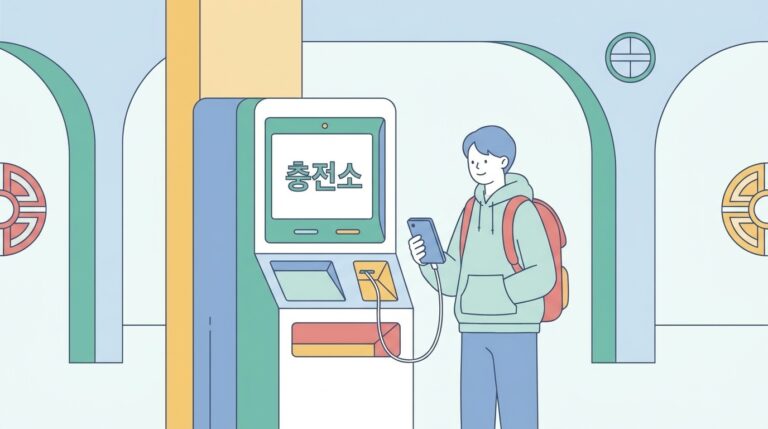
Whether it’s a district office, a public subway station, a cozy café, or a neighborhood library, free charging stations (무료 충전소) and thoughtful battery amenities are tucked around almost every corner. However, walking up to a counter and asking for charging help can feel surprisingly intimidating when your screen is pitch black and you don’t know the right natural phrasing.
This guide is crafted directly from our real coaching sessions with intermediate learners who found themselves stranded with a dead battery in Seoul. Master these key expressions and cultural subtleties today, and you will never fear the dreaded black screen during your Korean adventures again!
Phase 2: Top 3 Core Expressions In-Depth Analysis
1. 휴대폰 충전 좀 할 수 있을까요? (Can I charge my phone a bit?)
- Pronunciation: [Hyudae-pon chung-jeon jom hal su isseul-kkayo?] (Sounds like: ‘Hyoo-dae-pawn choong-jeon johm hahl soo ee-seul-kkah-yo’)
- Meaning: Literal: “Is it possible to do a little mobile phone charging?” | Actual Nuance: A gentle, polite request to use an available outlet or charging port.
- K-Culture Moment: You will hear this in K-dramas whenever a character rushes into a convenience store or a café in an emergency to call their dramatic second lead.
- Editor’s Insight: The tiny word 좀 (jom – a little) works magic here. In Korean culture, directly asking “Can I charge my phone?” can sound demanding. Adding 좀 softens the burden on the listener.
- Situation Spectrum: Casual (⚠️ with close friends say: 충전 좀 해도 돼?) | Semi-formal (✅ Great for cafés/staff) | Formal (✅)
- 🤔 Think About It: Why does Korean rely heavily on minimizers like ‘좀 (a bit)’ when making requests, whereas English often relies on conditional modal verbs like ‘Would it be possible’ to soften tone?
2. 혹시 충전기 빌릴 수 있나요? (By any chance, could I borrow a charger?)
- Pronunciation: [Hoksi chung-jeon-gi billil su innayo?] (Sounds like: ‘Hohk-shee choong-jeon-gee beel-leel soo een-nah-yo’)
- Meaning: Literal: “By any chance, can I borrow a charger?” | Actual Nuance: Inquiring if the venue has a spare cable/charger behind the counter for public or guest use.
- K-Culture Moment: Often spotted in trendy K-variety shows where cast members travel to countryside spots and politely ask restaurant owners (Imo-nim) for extra charging cables.
- Editor’s Insight: Starting with 혹시 (hoksi – by any chance) signals immense politeness because it gives the listener an easy, pressure-free exit if they don’t have one.
- Situation Spectrum: Casual (⚠️ with friends: 충전기 있어?) | Semi-formal (✅ Perfect for staff/public desks) | Formal (✅)
- 🤔 Think About It: In many Western spaces, asking staff to lend personal chargers feels intrusive. Why are Korean businesses so accustomed to offering charging assistance to visitors?
3. 무료 충전소가 어디에 있어요? (Where is the free charging station?)
- Pronunciation: [Muryo chung-jeon-soga eodi-e isseoyo?] (Sounds like: ‘Moo-ryoh choong-jeon-soh-gah oh-dee-eh ees-saw-yo’)
- Meaning: Literal: “Where is the free charging place?” | Actual Nuance: Asking for public charging lockers or towers located in subway stations, airports, or tourist lounges.
- K-Culture Moment: Common in Seoul Metro stations where high-tech smart lockers and charging kiosks (like ‘T-Locker’ or ‘O-Taek’) stand right beside ticket gates.
- Editor’s Insight: When asking in public hubs, pair 무료 (free) with 충전소 (charging station) to clarify you are looking for municipal kiosks rather than commercial rental stations.
- Situation Spectrum: Casual (⚠️) | Semi-formal (✅ Ideal for subway info desks) | Formal (✅)
- 🤔 Think About It: Notice the compound structure: 무 (Without) + 료 (Fee) = 무료 (Free of charge). How does understanding Hanja root words help unlock public facility signs across Korea?
Phase 3: Textbook Korean vs. Real Korean
Situation 1: Asking a café barista for battery charging
- 📖 Textbook Korean: “제 스마트폰을 충전해 주실 수 있습니까?” (Je seumateu-poneul chungjeon-hae jusil su itseumnikka? – Would you be able to charge my smartphone?)
- 🗣️ Real Korean: “저, 혹시 배터리가 없어서 그런데 충전 맡겨도 될까요?” (Jeo, hoksi baeteori-ga eopseoseo geureonde chungjeon matgyeodo doelkkayo? – Excuse me, my battery is dead, could I leave it here to charge?)
- 💡 Why the Difference?: Native speakers rarely say ‘스마트폰’ in conversation; they use 배터리 (battery) or 폰 (phone). Explaining your situation with -아서 그런데 (it’s because…) makes the request feel natural and considerate.
Situation 2: Asking if you need your own cable at a public desk
- 📖 Textbook Korean: “케이블이 구비되어 있습니까?” (Keibeul-i gubidoeeo itseumnikka? – Are cables equipped?)
- 🗣️ Real Korean: “충전선도 여기서 같이 쓸 수 있어요?” (Chungjeon-seondo yeogiseo gachi sseul su isseoyo? – Can I use the charging cable here as well?)
- 💡 Why the Difference?: While ‘구비 (equipped)’ is formal administrative vocabulary, native speakers naturally refer to charging cables as 충전선 (charging line/cord) or C타입 (Type-C).
Phase 4: K-Culture Deep Dive & Non-Verbal Etiquette
4-1. 눈치 (Nunchi) & Polite Gestures at Charging Spots
- Two-Handed Handover: When handing your phone to a barista or information clerk to charge behind the desk, always hand it with both hands (or one hand supporting your forearm). Handing a phone over with one hand looks dismissive.
- Checking Port Types (C-Type vs. 8-Pin vs. 5-Pin): In Korea, most public stations provide multi-head cables (3-in-1). Before plugging in, quickly verify: C타입 (Type-C), 8핀 (iPhone Lightning), or 5핀 (Micro-USB) to avoid bending delicate public pins.
- The Quick Turnaround Rule: Public charging booths inside subway stations are meant for emergency quick boosts (15–20 minutes). Standing in front of a public kiosk playing games while plugged in shows a lack of Nunchi toward others waiting with 0% battery!
4-2. Cultural Insight: The World of 보조배터리 대여 (Power Bank Sharing)
In modern Korea, public convenience has evolved from static charging cords into dynamic sharing networks. If you see a bright yellow or blue machine inside convenience stores (like CU, GS25, or 7-Eleven) labeled 충전돼지 (Piggy Cell) or 타입플러그 (Type Plug), you can rent a power bank for around 1,000 KRW/hour and return it at any other branch across the country. It is the ultimate testament to Korea’s “Palli-Palli” (quick, seamless) lifestyle!
Phase 5: Real-World Roleplay Scenario
Setting: You are inside a bustling subway station near Gwanghwamun. Your phone battery is at 3%, and you need to navigate to your dinner meetup. You approach the Station Customer Center.
Characters: You (B1 Intermediate Learner) vs. Station Attendant (역무원 아저씨 – Friendly Subway Staff)
- You: 저기요, 실례지만 혹시 여기서 휴대폰 충전 좀 할 수 있을까요? 🎭 (Approaching gently with a slight bow)
- Staff: 아, 폰 배터리가 다 됐어요? 저기 개찰구 옆에 무료 급속 충전기 있어요. 🎭 (Pointing toward the smart kiosk near the turnstile)
- You: 아, 저기 보이는 기계 말씀이신가요? 🎭 (Looking in the direction of the pointer)
- Staff: 네, 맞아요. 비밀번호 4자리 설정하고 꽂아두면 30분 만에 금방 차요. 🎭 (Demonstrating keying numbers in the air)
- You: 혹시 아이폰 케이블도 거기에 다 연결되어 있나요? 🎭 (Showing your iPhone screen)
- Staff: 그럼요! C타입이랑 아이폰 8핀 다 달려 있으니까 그냥 꽂으시면 됩니다. 🎭 (Giving a reassuring smile)
- You: 다행이네요! 친절하게 알려주셔서 정말 감사합니다. 🎭 (Bowing politely with both hands together)
- Staff: 별말씀을요. 잘 충전하고 조심히 가세요! 🎭 (Waving warmly)
🔀 Interactive Decision Fork
The station machine asks you to set a 4-digit PIN, but the screen menu is entirely in Korean. You want to ask a commuter standing nearby for quick assistance. What do you say?
- Option A: “이거 비밀번호 어떻게 설정하는지 잠깐만 도와주실 수 있나요?” (Could you briefly help me with how to set this password?)
- Option B: “야, 이거 눌러줘.” (Hey, press this for me.)
- Option C: “핸드폰 고장 났어요. 돈 내야 돼요?” (My phone is broken. Do I have to pay money?)
Feedback:
* Choice A (Best): 🌟 Perfect B1 Korean! It uses polite honorifics and clearly states the problem without placing undue burden on the stranger.
* Choice B (Bad): ❌ Extremely rude! Using Banmal (야) to a stranger in public can create severe awkwardness or offense.
* Choice C (Risk): ⚠️ Confusing. The phone is not broken (고장), and asking about payment might derail the conversation since the kiosk is free.
Phase 6: 10-Second Emotion Shadowing Drill
Read these out loud! Focus on the rhythm slashes / and immerse yourself in the emotional state.
[😰 Anxious & Rushed]- 저기요, / 배터리가 1%밖에 안 남아서 그런데 / 충전선 좀 빌릴 수 있을까요?
- (Jeogiyo, / baeteori-ga il-peosenteu-bakke an namaseo geureonde / chungjeon-seon jom billil su isseul-kkayo?)
[😮💨 Relieved & Grateful]- 와, / 여기서 무료로 급속 충전이 돼요? / 진짜 살았다!
- (Wa, / yeogiseo muryo-ro geupsok chungjeon-i dwaeyo? / Jinjja saratta!)
[😊 Polite & Inquiring]- 혹시 / 제 폰 20분만 / 카운터에 맡겨도 괜찮을까요?
- (Hoksi / je pon isip-bun-man / kaunteo-e matgyeodo gwaenchaneulkkayo?)
Phase 7: K-Culture Mini Dictionary
- 보조배터리 (Bojo-baeteori) | Power Bank / Portable Charger | Essential for daily travel; locals rarely leave home without a fully charged bojo-baeteori.
- 급속 충전 (Geupsok Chungjeon) | Fast Charging / Quick Charge | High-voltage charging spots marked “급속” can restore 50% battery in roughly 20-30 minutes.
- 충전 단자 (Chungjeon Danja) | Charging Port / Terminal | Refers to the physical slot where the cable plugs into your device or the public wall socket.
- 완충 (Wanchung) | Full Charge (Slang/Abbreviation of 완전 충전) | Commonly texted to friends: “나 완충했어! 이제 나가자!” (I’m fully charged! Let’s head out!).
Phase 8: Traveler’s Survival Kit
Survival Expressions Top 3
- “C타입 잭 있어요?” (Do you have a Type-C plug?) — Pro Tip: Say “C-type jack” naturally; almost every shopkeeper understands this instantly.
- “충전 맡긴 거 찾으러 왔어요.” (I’m here to pick up the phone I left to charge.) — Pro Tip: Say this with a warm smile when returning to the café counter.
- “콘센트 자리 어디예요?” (Where are the seats with power outlets?) — Pro Tip: Korea calls wall outlets 콘센트 (consent), derived from “concentric plug”.
Editor’s Travel Note & Must-Have Apps
- KakaoMap / Naver Map Integration: If you type 무료 충전 or search convenience store rental services like 충전돼지 on Naver Map App Download Page, nearby public battery rental stations and automated kiosks appear right on your route.
- Transit Hub Perks: Major railway stations (KTX Seoul, Busan) feature open charging pillars with regular 220V plug sockets alongside USB ports. Keep a compact Type-C plug adapter in your day bag!
Phase 9: A Step Deeper (Cultural Reflection)
In South Korea, digital connectivity is considered an essential public utility rather than a luxury. The concept of 정 (Jeong – communal empathy and warmth) extends into modern infrastructure: just as traditional Korean villages maintained public drinking wells, modern smart cities provide ubiquitous Wi-Fi and power hubs for passersby. When you ask a small diner owner to plug in your phone, they treat it not as an inconvenience, but as natural hospitality.
💬 Your Turn: How does your home country handle public charging amenities? Would a barista charge your phone behind the counter if you asked politely? Share your stories in the comments below!
Phase 10: FAQ & Common Mistakes
Q: Can I legally charge my personal device using wall outlets in subway stations or public parks?
A: Stick to designated public kiosks labeled 충전소 or marked USB charging poles. Plugging high-wattage personal adapters into random maintenance wall sockets inside subway tunnels can occasionally be flagged for unauthorized electricity use (전기 무단 사용).
Q: Are free charging lockers in Seoul Metro safe from theft?
A: Yes! Most Korean subway charging lockers require you to input a 4-to-6-digit PIN and automatically lock the physical door during the charge cycle. South Korea has exceptionally low theft rates, but always remember to memorize your box number and PIN.
Q: Do Korean convenience stores still charge phones behind the counter for free?
A: In the past, store clerks charged phones behind the register. Today, almost all convenience stores have shifted to self-service power bank sharing lockers (충전돼지/타입플러그) which cost about 1,000–1,500 KRW.
🚨 Common Mistakes Alert
- Mistake: Handing over your phone without unlocking it or leaving it on silent when awaiting urgent calls. -> Correct Action: Ensure your volume or vibration is set appropriately if you expect alerts while sitting nearby.
- Mistake: Forgetting your personal cable when visiting quiet study cafés (스터디카페) or libraries. -> Correct Action: Public desks offer sockets, but you must carry your own 충전선 (cable).
- Mistake: Leaving your device plugged in hours after reaching 100%. -> Correct Action: Free spots operate on mutual courtesy; unplug once you reach sufficient battery (80-90%).
Phase 11: Action Mission Challenge
- 🥉 Bronze Level (Solo Practice): Practice pronouncing “휴대폰 충전 좀 할 수 있을까요?” 5 times in front of your mirror with a friendly two-hand gesture.
- 🥈 Silver Level (Social Sharing): Post a picture of your phone battery under 10% on Instagram Stories with the caption: “배터리가 없어요! 충전이 필요해요 ⚡” and tag your Korean study buddy.
- 🥇 Gold Level (Real Life): Walk into a local Korean café, order a beverage, and politely locate or ask for a seat with a 콘센트 (outlet) using the phrases learned today!
- 🎮 K-Culture Media Mission: Watch an episode of a modern drama (like Hospital Playlist or Welcome to Samdal-ri) and spot characters borrowing charging cables at convenience counters!
Phase 12: Interactive Quiz Challenge
1. Situation Judgement
You are at a coffee shop in Incheon. Your phone is at 2%. What is the most natural, polite way to ask the staff if you can charge it at the counter?
* (A) 야, 충전기 줘봐.
* (B) 저, 죄송한데 폰 충전 좀 맡길 수 있을까요?
* (C) 스마트폰 충전소를 여기서 건설해 주십시오.
2. Fill-in-the-Blank
“지하철역 안에 있는 ______ 충전소에서 배터리를 80%까지 충전했어요.” (I charged my battery up to 80% at the free charging station inside the subway station.)
* (A) 유료 (Paid)
* (B) 무료 (Free)
* (C) 위험 (Dangerous)
3. True / False Cultural Fact
In Korean, the wall power socket/outlet is commonly referred to by the loanword 콘센트 (Consent). (True / False)
👉 Click here to reveal Answer Key & Explanations!
- Answer: (B) — (B) uses humble hesitation (저, 죄송한데…) and polite phrasing (충전 좀 맡길 수 있을까요?), which baristas appreciate. (A) is rude slang; (C) means ‘Please construct a charging station here’.
- Answer: (B) 무료 — 무료 (Free of charge) correctly describes public, complimentary transit charging amenities.
- Answer: True — Korea uses the term 콘센트 (from ‘concentric plug’) for standard 220V electrical wall outlets!







