

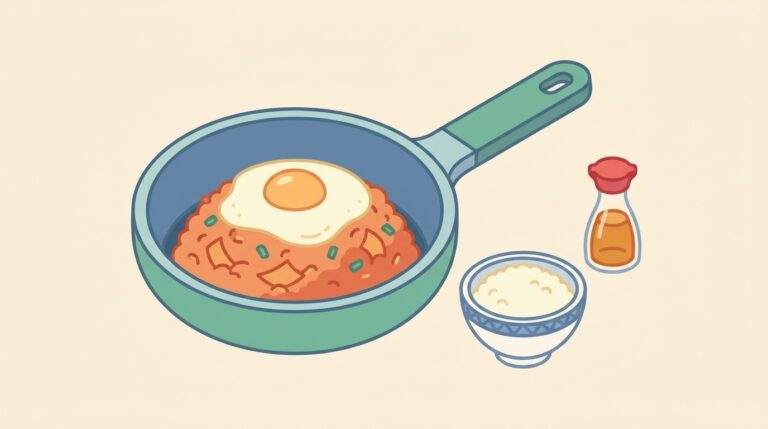
Phase 1: 공감 (Story Opening)
안녕하세요! 매일한글 에디터입니다. Have you ever watched a K-drama where the characters finish a massive tabletop stew or BBQ, and just when you think the meal is over, someone says, “Now let’s add the rice!” Suddenly, fluffy white rice hits the sizzling pan with seaweed flakes, sesame oil, and kimchi, transforming into the legendary K-dessert: fried rice!
Cooking Korean food at home or eating out at a traditional restaurant is an incredible experience, but many A2 learners hit a wall when dealing with rice in the cooking process. Should you say “밥을 넣으세요” or “밥 볶아 주세요”? When do you put the rice in while cooking Kimchi Bokkeumbap or Budae Jjigae? You don’t want to sound like a robotic textbook, nor do you want to awkwardly point at the rice bowl. This guide is built directly from real student feedback to help you master the art of talking about adding rice like a true local foodie!
Phase 2: 핵심 표현 3선 심층 분석 (3 Core Expressions)
1. 밥을 넣어요 (Babeul neoeoyo)
- Pronunciation: [Bah-beul nuh-uh-yo] (Sounds like “bob” + “eul” + “nuh-uh-yo”)
- Meaning: Literal: “I put in rice.” / Nuance: “Add the rice now” or “I’m adding the cooked rice.”
- K-Culture Moment: Seen in cooking variety shows like Three Meals a Day or Baek Jong-won recipes when the base ingredients are sizzling and it’s time to add the carbs.
- Editor’s Insight: ‘넣다’ means to put in or add. When you are making fried rice (볶음밥) or soup with rice (국밥), this is your baseline go-to verb.
- Situation Spectrum: Casual: ✅ | Semi-formal: ✅ | Formal: ⚠️
- 🤔 Think About It: In English, we just say “Add rice,” but in Korean, raw rice is ssal (쌀) and cooked rice is bap (밥). Why is Korean so specific about cooked vs. raw rice?
2. 밥 볶아 주세요 (Bap bokk-a ju-se-yo)
- Pronunciation: [Bap bok-kah joo-seh-yo] (Think of stir-frying: “bokk” pops like the hot pan)
- Meaning: Literal: “Please stir-fry rice for me.” / Nuance: “We are ready for the fried rice round!”
- K-Culture Moment: In Dakgalbi (spicy chicken) or Samgyeopsal restaurants when you finish the meat and signal the staff to make the iconic finishing fried rice.
- Editor’s Insight: This combines bap (rice) + bokkda (to fry) + juseyo (please give/do). It is the magic spell of Korean dining.
- Situation Spectrum: Casual: ⚠️ | Semi-formal: ✅ | Formal: ✅
- 🤔 Think About It: Why do Koreans consider stir-fried rice at the end of a meal the true “dessert”?
3. 밥 말아 먹어요 (Bap mar-a meog-eo-yo)
- Pronunciation: [Bap mah-rah muhg-uh-yo] (Roll the ‘r’ slightly: “mah-rah”)
- Meaning: Literal: “Roll/mix rice into broth and eat.” / Nuance: “Let’s dump the rice right into the soup!”
- K-Culture Moment: Eating hot Gukbap (pork soup rice) or spicy Ramyeon where dropping leftover cold rice into the broth is the ultimate soul food move.
- Editor’s Insight: ‘말다’ means to mix rice or noodles into hot broth. It conveys deep warmth, comfort, and zero food waste.
- Situation Spectrum: Casual: ✅ | Semi-formal: ✅ | Formal: ⚠️
- 🤔 Think About It: How does combining soup and rice into one bowl reflect communal dining traditions in Korea?
Phase 3: 교과서 한국어 vs 진짜 한국어 (Textbook vs. Real Korean)
Situation 1: Adding rice to the frying pan
- 📖 교과서 한국어: 지금 밥을 프라이팬 안에 넣으십시오. (Please put the rice inside the frying pan now.)
- 🗣️ 진짜 한국어: 이제 밥 넣을게요! / 밥 넣고 볶을게요~ (Putting the rice in now! Let’s mix it in~)
- 💡 왜 다를까?: Real home cooking and restaurant talks use soft connective endings (
-을게요,-고) to keep the vibe friendly rather than giving rigid commands.
Situation 2: Asking for fried rice at a restaurant table
- 📖 교과서 한국어: 남은 음식에 밥을 추가해 주시겠습니까? (Would you please add rice to the leftover food?)
- 🗣️ 진짜 한국어: 사장님, 여기 밥 2개 볶아 주세요! (Boss, please fry two bowls of rice here!)
- 💡 왜 다를까?: In Korea, portions of post-meal fried rice are counted in bowls (
1개,2개) and addressed directly with warmth (사장님).
Phase 4: K-Culture 딥다이브 & 비언어적 매너 (K-Culture & Manners)
4-1. 눈치(Nunchi) & Table Gestures
- Leave some sauce! When ordering bokkeumbap at a restaurant, never wipe the pan clean. Leave a few spoons of sauce and veggies so the server has rich flavors to fry the rice with.
- Two-Hand Spoon Handling: When the chef or server is stir-frying the rice at your table, hold your chopsticks or spoon resting on your plate. Don’t dig in until they flatten the rice with the spatula and say “드셔도 돼요” (You may eat now).
4-2. The “K-Dessert” Phenomenon
In Korea, no matter how full you are from K-BBQ, Tteokbokki, or Shabu-shabu, the meal is incomplete without Bokkeumbap (볶음밥). It is humorously known as the “true Korean dessert” (한국인의 진짜 디저트). Learning how to ask for rice to be mixed in is your ticket to culinary belonging.
Phase 5: 실전 롤플레이 시나리오 (Roleplay Scenario)
Setting: You are cooking Kimchi Bokkeumbap at home with your Korean friend, Minho (민호).
- 민호: 김치랑 햄 다 볶았어! 다음엔 뭐 할까?
(Gim-chi-rang haem da bokk-ass-eo! Da-eum-en mwo hal-kka?)
“Kimchi and ham are all fried! What should we do next?”
🎭 [민호가 프라이팬을 숟가락으로 가리키며 묻는다] -
You: 이제 밥을 넣어요! 햇반 하나 돌렸어요.
(I-je bab-eul neoeoyo! Haet-ban ha-na dol-ryeoss-eo-yo.)
“Now let’s put in the rice! I heated up one instant rice.”
🎭 [전자레인지에서 따뜻한 햇반을 꺼내며] -
민호: 오, 센스 굿! 밥 주걱으로 잘 풀어줘.
(O, sen-seu gut! Bap ju-geok-eu-ro jal pul-eo-jwo.)
“Oh, nice sense! Break up the rice clumps well with the spatula.”
🎭 [참기름 병을 집어 들며] -
You: 네, 밥 넣고 참기름도 둘러요?
(Ne, bap neot-go cham-gi-reum-do dul-leo-yo?)
“Yes, after adding rice, do we drizzle sesame oil too?”
🎭 [밥을 팬에 쏟아 넣으며] -
민호: 당연하지! 참기름은 필수야.
(Dang-yeon-ha-ji! Cham-gi-reum-eun pil-su-ya.)
“Of course! Sesame oil is a must.”
🎭 [참기름을 한 바퀴 빙 두른다] -
You: 냄새 진짜 좋다! 조금 눌어붙게 둘까요?
(Naem-sae jin-jja jot-da! Jo-geum nul-eo-but-ge dul-kka-yo?)
“Smells incredible! Should we leave it to crisp up a bit at the bottom?”
🎭 [숟가락으로 밥을 꾹꾹 펴 누르며] -
민호: 역시 볶음밥 먹을 줄 아네! 누룽지가 최고지.
(Yeok-si bokk-eum-bap meog-eul jul a-ne! Nu-rung-ji-ga choe-go-ji.)
“You really know how to eat fried rice! Crispy bottom rice is the best.”
🎭 [엄지를 척 들어 올리며] -
You: 완성! 같이 맛있게 먹어요!
(Wan-seong! Gat-i mas-iss-ge meog-eo-yo!)
“Finished! Let’s eat deliciously together!”
🎭 [숟가락을 건네며 활짝 웃는다]
🔀 인터랙티브 분기점 (Interactive Choice)
When your friend asks what to do next with the leftover sauce in the pan:
* A. “밥 볶아 먹을래?” (Do you want to fry rice in it?) 👉 [BEST] Super natural, shows you understand the Korean dining culture!
* B. “이제 밥을 버리세요.” (Please throw away the rice now.) 👉 [BAD] Wait! Never throw rice away, Korean grandmothers will weep!
* C. “밥을 삶아 주세요.” (Please boil the rice.) 👉 [RISK] ‘삶다’ is for boiling eggs/potatoes, not adding rice to a pan.
Phase 6: 10초 감정 섀도잉 드릴 (Shadowing Drill)
[😊 기쁘고 신나게]이제 / 밥 넣을게요! (I-je / bab neoul-ge-yo!)[🤤 침 고이며 간절하게]사장님, / 여기 밥 하나 볶아 주세요! (Sa-jang-nim, / yeo-gi bap ha-na bokk-a ju-se-yo!)[😋 든든하고 따뜻하게]국물에 / 밥 말아 먹자! (Guk-mul-e / bap mar-a meok-ja!)
Phase 7: K-Culture 미니 사전 (Mini Dictionary)
- 볶음밥 (Bokk-eum-bap): Fried rice. The essential finale of stews, dakgalbi, and BBQ.
- 햇반 (Haet-ban): The iconic CJ brand name for microwavable instant cooked rice (즉석밥). Used almost universally like “Kleenex”.
- 공깃밥 (Gong-git-bap): A stainless-steel bowl of warm cooked white rice served at restaurants for usually 1,000 KRW.
- 누룽지 (Nu-rung-ji): The crispy, toasted layer of rice stuck to the bottom of the hot pot or stone bowl.
Phase 8: 여행자를 위한 생존 키트 (Traveler Survival Kit)
- Top 1: “밥 볶아 주세요!” (Please fry rice for us!) — Say this when 10-15% of your stew/meat remains.
- Top 2: “공깃밥 하나 추가해 주세요.” (One more bowl of rice, please.) — When your soup needs backup carbs.
- Top 3: “밥 따로 주시겠어요?” (Could you serve the rice separately?) — Great for soups if you prefer dipping.
Editor’s Travel Note: When cooking in an Airbnb, download the 배달의민족 (Baemin) 배달 앱 for extra side dishes, or locate your nearest convenience store using the 네이버 지도 길찾기 앱 to grab quick Hetbahn (햇반) instant rice!
Phase 9: 한 발 더 깊이 (Cultural Thought)
In Korea, rice (bap) is more than just carbohydrates; it represents love, hospitality, and life itself. The classic Korean greeting “밥 먹었어요?” (Have you eaten rice?) literally translates to “How are you doing?”. Adding rice at the end of a dish shows deep appreciation for the meal, ensuring not a single drop of rich flavor is left behind.
💬 Your Turn: What is the staple comfort food in your home country that you always mix into delicious sauces? Let’s chat in the comments below!
Phase 10: FAQ & 흔한 실수 (FAQ & Common Mistakes)
Q: What is the difference between 쌀 (ssal) and 밥 (bap)?
A: Ssal is raw, uncooked grains of rice. Once it is cooked and ready to eat, it is always called Bap.
Q: Can I put cold leftover rice directly into soup?
A: Yes! In fact, Koreans love 찬밥 (cold rice) in hot ramen soup because cold rice absorbs the broth better without getting soggy.
Q: How do I specify how many portions of fried rice I want?
A: Use Korean counter 개 (gae): “밥 1개 볶아 주세요” (1 portion) or “밥 2개 볶아 주세요” (2 portions).
🚨 흔한 실수 (Common Mistakes TOP 3)
- ❌ Saying “쌀을 넣어요” when cooking fried rice. 👉 Correct: Use “밥을 넣어요” since you’re using cooked rice.
- ❌ Saying “밥을 구워 주세요” for fried rice. 👉 Correct: Use “밥 볶아 주세요” (‘볶다’ = stir-fry, ‘굽다’ = grill/bake).
- ❌ Clearing out every drop of broth before asking for fried rice. 👉 Correct: Leave 2-3 spoons of broth for flavor!
Phase 11: 액션 미션 (Action Missions)
- 🥉 Bronze Mission: Practice saying “밥 넣을게요!” 3 times while cooking your next meal.
- 🥈 Silver Mission: Post a picture of your home-cooked K-food on Instagram with the hashtag
#매일한글 #밥볶아주세요. - 🥇 Gold Mission: Order fried rice in a Korean restaurant or with your Korean language exchange partner using only Korean phrases!
- 🎮 K-Culture Mission: Watch an episode of Delicious Rendezvous (맛남의 광장) or a K-drama BBQ scene and spot the exact second they add the rice.
Phase 12: 인터랙티브 퀴즈 챌린지 (Quiz Challenge)
- [Situation Check] You finished your Dakgalbi and want the server to make fried rice on your hot plate. What do you say?
- A) 밥 끓여 주세요
- B) 밥 볶아 주세요
- C) 밥 씻어 주세요
- [Fill in the Blanks] 김치볶음밥 만들 때 프라이팬에 ____을(를) 넣어요. (ssal vs. bap)
-
[True / False] In Korean restaurants, it is impolite to ask them to fry rice on the tabletop grill. (T/F)
👉 Click to view Answers & Explanations
- Answer: B) 밥 볶아 주세요 (Stir-fry the rice! ‘끓이다’ is boil, ‘씻다’ is wash).
- Answer: 밥 (You add cooked rice / bap, not raw rice / ssal).
- Answer: False (It is a beloved, standard dining tradition in most BBQ, stew, and stir-fry restaurants!)







