

안녕하세요! 매일한글 에디터입니다.
Have you ever sent a quick text in Korean, thought everything was fine, and then suddenly noticed your friend’s replies getting shorter, colder, or completely silent? Or maybe in a Korean drama, you’ve watched a misunderstanding drag on for episodes simply because two characters couldn’t say the right words at the right moment.
In Korean communication, nuances and unspoken context (nunchi) carry immense weight. A tiny slip in tone or phrasing can easily lead to an unintended misunderstanding (오해). When that happens, knowing how to explain your true intentions and smooth things over isn’t just about grammar—it’s about protecting relationships. This guide is crafted directly from real learner struggles and native conversational practices to help you clear up misunderstandings smoothly and reconcile like a genuine insider.
Phase 2: 3 Core Expressions for Clearing the Air
1. 오해하지 마세요 (Ohaehaji maseyo)
- Pronunciation: [O-hae-ha-ji ma-se-yo] (Sounds like “Oh-heh-ha-ji mah-seh-yo”)
- Meaning: Literal: “Do not misunderstand.” / Real Nuance: “Please don’t get the wrong idea; let me clarify before you jump to conclusions.”
- K-Culture Moment: The classic K-Drama scene where a character is spotted in a suspicious café meeting and immediately waves both hands frantically: “잠깐만요, 오해하지 마세요!” (Wait, please don’t get the wrong idea!)
- Editor’s Insight: Use this as a gentle buffer before explaining what actually happened. It signals that your intention was never malicious.
- Situation Spectrum: Casual: ⚠️ (Use 오해하지 마 instead) | Semi-formal: ✅ | Formal: ✅
- 🤔 Think About It: In English, “Don’t misunderstand me” can sometimes sound defensive. Why do you think Korean uses 오해 so frequently as a polite conversational bridge?
2. 그런 뜻이 아니었어요 (Geureon tteusi anieosseoyo)
- Pronunciation: [Geu-reon tteu-si a-ni-eot-seo-yo] (Imagine saying “Guh-run tteu-shee ah-nee-utt-suh-yo”)
- Meaning: Literal: “It was not that meaning.” / Real Nuance: “That’s really not what I meant at all; I didn’t mean to imply that.”
- K-Culture Moment: When a friend looks hurt after you jokingly critique their spicy ramen cooking skills, and you immediately clarify your real meaning.
- Editor’s Insight: Notice the past tense (-었- / eot). It highlights that your original intention was different from how the message was received.
- Situation Spectrum: Casual: ⚠️ (Use 그런 뜻 아니었어) | Semi-formal: ✅ | Formal: ✅ (그런 뜻이 아니었습니다)
- 🤔 Think About It: How does taking responsibility for your intended meaning differ between high-context Korean culture and direct low-context communication styles?
3. 기분 나빴다면 미안해요 (Gibun nappatdamyeon mianhaeyo)
- Pronunciation: [Gi-bun na-ppat-da-myeon mi-an-hae-yo] (Pronounce like “Gee-boon nah-ppaht-dah-myun mee-ahn-heh-yo”)
- Meaning: Literal: “If you felt bad, I am sorry.” / Real Nuance: “If I hurt your feelings or offended you in any way, I’m truly sorry.”
- K-Culture Moment: A heartfelt late-night KakaoTalk message sent after an awkward group dinner to ensure no bad blood remains.
- Editor’s Insight: This acknowledges the other person’s emotional state (기분) before debating who was technically right or wrong.
- Situation Spectrum: Casual: ⚠️ (Use 기분 나빴으면 미안해) | Semi-formal: ✅ | Formal: ⚠️ (Use 불쾌하셨다면 죄송합니다)
- 🤔 Think About It: Why is acknowledging the other person’s 기분 (mood/feelings) the cornerstone of reconciliation in Korean relationships?
Phase 3: Textbook Korean vs. Real Korean
Situation 1: Suggesting that both of you talk it out and make up
- 📖 교과서 한국어 (Textbook): “우리 사이의 오해를 해소합시다.” (Let us resolve the misunderstanding between us – stiff and overly robotic)
- 🗣️ 진짜 한국어 (Real-life): “우리 오해 좀 풀자. 잠깐 얘기할 수 있어?” (Let’s clear the air. Can we talk for a sec?)
- 💡 왜 다를까?: Native speakers prefer the verb 풀다 (pul-da, to untangle/loosen knots) over formal Sino-Korean verbs like 해소하다 in interpersonal moments.
Situation 2: Checking if your friend is still holding a grudge
- 📖 교과서 한국어 (Textbook): “아직도 저에게 화가 나 있는 상태입니까?” (Are you still in an angry state toward me?)
- 🗣️ 진짜 한국어 (Real-life): “아직 마음 상해 있어?” or “아직 삐쳤어?” (Are you still upset / pouting?)
- 💡 왜 다를까?: Korean emotions are expressed in bodily/heart metaphors like 마음이 상하다 (heart is bruised/spoiled) rather than abstract clinical terms.
Phase 4: K-Culture Deep Dive & Non-Verbal Manners
4-1. Nunchi & Non-Verbal Signals
When clearing up a misunderstanding in Korea, body language speaks before words do:
* Hand Gestures: When explaining you didn’t mean something bad, gently wave one hand horizontally in front of your chest with an open palm.
* Eye Contact: Avoid a piercing, unblinking glare (which can feel combative). Soften your gaze and occasionally look slightly down while listening to show reflection.
* Physical Distance: Step closer into a private space rather than shouting apologies across a noisy room.
4-2. The “Chimaek & Pojangmacha” Reconciliation Code
In Korean culture, words are only step one. Reconciliation is sealed with food and drinks (화해의 한잔). Whether it’s fried chicken and beer (치맥) or hot soup at a street tent (포장마차), sitting across the table and pouring a drink for each other physically unties the knot (풀다).
Phase 5: Real-Life Roleplay Scenario
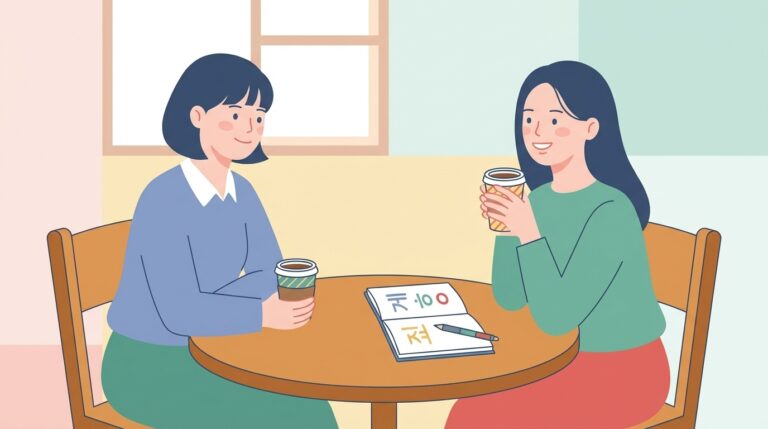
Setting: A cozy café in Hongdae on a rainy afternoon. You arrive 25 minutes late for your meetup with your Korean classmate, Min-woo (민우), who looks visibly chilly and disappointed.
Characters:
* Min-woo (민우): Your reliable Korean study buddy who values punctuality.
* You (당신): Rushed and apologetic, wanting to clear up why you were late.
[1] 민우: (시계를 보며 한숨을 쉰다) 왔어? 연락도 없이 늦어서 무슨 일 있는 줄 알았잖아.
(Wat-seo? Yeon-rak-do eop-si neu-jeo-seo mu-seun il inneun jul ar-at-janh-a.)
"You're here? You were late without texting, so I thought something bad happened."

[2] You: [🥺 손을 모으고 진심 어린 표정으로] 민우야, 진짜 미안해! 배터리가 갑자기 꺼져서 연락을 못 했어.
(Min-u-ya, jin-jja mi-an-hae! Bae-teo-ri-ga gap-ja-gi kkeo-jyeo-seo yeon-rak-eul mot haet-seo.)
"Min-woo, I'm so sorry! My phone battery suddenly died so I couldn't reach you."

[3] 민우: (팔짱을 살짝 풀며) 아, 그랬어? 나는 네가 약속 잊어버린 줄 알고 서운했지.
(A, geu-raet-seo? Na-neun ne-ga yak-sok i-jeo-beo-rin jul al-go seo-un-haet-ji.)
"Ah, really? I thought you forgot about our plan and felt a bit hurt."

[4] You: [🤝 테이블 쪽으로 몸을 기울이며] 절대 아니야! 그런 뜻이 아니었어. 오해하지 마.
(Jeol-dae a-ni-ya! Geu-reon tteu-si a-ni-eot-seo. O-hae-ha-ji ma.)
"Never! That wasn't my intention at all. Please don't misunderstand."

[5] 민우: (표정이 누그러지며) 날씨도 추운데 기다리느라 살짝 삐칠 뻔했다.
(Nal-ssi-do chu-un-de gi-da-ri-neu-ra sal-jjak ppi-chil ppeon-haet-da.)
"It's freezing outside, so I almost pouted waiting for you."

[6] You: [☕ 메뉴판을 건네며] 기분 나빴다면 정말 미안해. 내가 따뜻한 음료랑 디저트 살게!
(Gi-bun na-ppat-da-myeon jeong-mal mi-an-hae. Nae-ga tta-tteut-han eum-ryo-rang di-jeo-teu sal-ge!)
"If I made you feel bad, I'm truly sorry. Let me buy warm drinks and dessert!"

[7] 민우: (웃으며) 그럼 난 딸기 케이크! 오해 다 풀렸다.
(Geu-reom nan ttal-gi ke-i-keu! O-hae da pul-lyeot-da.)
"Then I want strawberry cake! Misunderstanding completely cleared!"

[8] You: [😄 안도하며 웃음] 좋아, 바로 주문하자!
(Joh-a, ba-ro ju-mun-ha-ja!)
"Awesome, let's order right away!"
🔀 Interactive Decision Branch
What would you say if Min-woo still seemed quiet and distant after Turn 3?
- Choice A: “왜 그렇게 화를 내? 배터리 나간 건 내 잘못이 아니잖아.” (Why are you so angry? It’s not my fault the battery died.)
- Choice B: “마음 상하게 해서 미안해. 오해 풀릴 때까지 내가 얘기 다 들을게.” (I’m sorry for hurting your feelings. I’ll listen to whatever you have to say so we can clear this up.)
- Choice C: “그냥 잊어버리고 커피나 마시자.” (Let’s just forget it and drink coffee.)
Feedback:
* Choice A (Bad): Defensive and invalidates their feelings. It escalates a minor delay into a relationship rift.
* Choice B (Best): Validates their 서운함 (feeling left out/hurt) while focusing on open communication.
* Choice C (Risk): Sweeping emotions under the rug without addressing the knot (앙금) often causes bigger misunderstandings later.
Phase 6: 10-Second Emotional Shadowing Drill
Practice reading these lines aloud with the emotional rhythm markers (/ = brief breath pause):
[🥺 진심으로 사과하며 / Apologetic]
“진짜 고의가 아니었어요 / 기분 나빴다면 미안해요.”
(Jin-jja go-ui-ga a-ni-eot-seo-yo / gi-bun na-ppat-da-myeon mi-an-hae-yo.)-
[🤝 따뜻하게 풀며 / Warm & Reconciling]
“우리 서운한 거 있으면 / 지금 다 털어버리고 풀자.”
(U-ri seo-un-han geo it-seu-myeon / ji-geum da teol-eo-beo-ri-go pul-ja.) -
[😊 안도하며 활기차게 / Relieved & Cheerful]
“오해 풀어줘서 고마워 / 내가 맛있는 밥 살게!”
(O-hae pul-eo-jwo-seo go-ma-wo / nae-ga mas-it-neun bap sal-ge!)
Phase 7: K-Culture Mini Dictionary
- 오해 (O-hae) | Misunderstanding / Wrong impression
- Usage: Used whenever intentions and interpretations don’t match. (e.g., 오해를 사다 = to inadvertently cause misunderstanding).
- 앙금 (Ang-geum) | Lingering sediment / Residual ill feelings or resentment
- Usage: Metaphor for the settled sediment at the bottom of juice; used in phrases like 마음속 앙금을 털어내다 (to clear emotional sediment).
- 풀다 (Pul-da) | To untangle, loosen, resolve
- Usage: Used for everything from untying shoes (신발끈을 풀다) to resolving misunderstandings (오해를 풀다) and stress (스트레스를 풀다).
- 화해 (Hwa-hae) | Reconciliation / Making peace
- Usage: The mutual act of agreeing that the conflict is over and friendship is restored (화해하다).
Phase 8: Survival Kit for Travelers
Top 3 Instant Survival Phrases
- “제가 한국말이 서툴러서 실수를 했어요.”
(Je-ga han-gung-mar-i seo-tul-reo-seo sil-su-reul haet-seo-yo.)
Pro Tip: Perfect when you accidentally used informal speech (반말) with a shop owner or elderly person. - “나쁜 뜻으로 말한 게 아니었어요.”
(Na-ppeun tteus-eu-ro mal-han ge a-ni-eot-seo-yo.)
Pro Tip: Use this if your translation app outputs an awkward or overly blunt phrase. - “괜찮으시다면 다시 설명해 주실 수 있나요?”
(Gwaen-chanh-eu-si-da-myeon da-si seol-myeong-hae ju-sil su in-na-yo?)
Pro Tip: Politely resets a confusing conversation before miscommunication escalates.
Editor’s Travel Note
When navigating Korea, transit misunderstandings happen frequently (like boarding the wrong subway line in opposite directions). Install the Naver Map App download to confirm station exit numbers and train directions in English before asking staff, keeping communication smooth and stress-free.
Phase 9: A Step Deeper — The Culture of “풀다 (Untangling)”
In Korean culture, negative emotions and conflicts are viewed like tangled thread (실타래) or knots tied in a string. Rather than “fighting to win an argument,” the cultural ideal is to 풀다 (untie/dissolve) the tension so that 정 (deep affectionate bond) can flow naturally again. Leaving an issue unaddressed turns into 한 (deep-seated sorrow) or 앙금 (unspoken resentment). A genuine reconciliation in Korea means leaving zero knots behind.
💬 Your Turn: Have you ever experienced a funny or awkward cultural misunderstanding with a Korean speaker? Share your story in the comments below!
Phase 10: FAQ & Common Mistakes
Q: Is saying “미안합니다” enough when someone is visibly offended?
A: While “미안합니다” acknowledges error, adding an explanation of your intent (“그런 뜻이 아니었습니다”) and checking their feelings (“기분 상하게 해드려 죄송합니다”) makes the apology far more sincere and effective.
Q: Can I use “오해하지 마” with my boss or professor?
A: No! “오해하지 마” is casual (반말). In formal or professional settings, always use “오해 없으시길 바랍니다” or “오해를 드려 죄송합니다”.
Q: What is the difference between 사과 (apology) and 화해 (reconciliation)?
A: 사과 is one-way (taking responsibility and apologizing), whereas 화해 is mutual (both parties agreeing to move forward together peacefully).
🚨 TOP 3 Common Mistakes
- Relying solely on direct English translations: Saying “그것은 나의 실수가 아니다” sounds robotic and defensive. Instead say: “제 의도는 그게 아니었어요.”
- Ignoring honorific levels during apologies: Dropping into casual speech when emotional feels disrespectful. Stick to -요 / -습니다 endings.
- Smirking or laughing awkwardly: In some cultures, nervous laughter diffuses tension; in Korea, smiling during an apology looks insincere (장난치는 것처럼 보임).
Phase 11: Action Missions
- 🥉 Bronze Mission (Solo Practice): Stand before a mirror and repeat “오해하지 마세요, 그런 뜻이 아니었어요” 3 times with sincere eye contact and hand gestures.
- 🥈 Silver Mission (Social Connection): Leave a comment on your favorite K-Drama clip identifying the exact timestamp where two characters should have used “오해를 풀다”.
- 🥇 Gold Mission (Real Life): If you currently have a small awkward misunderstanding with a friend, send them a gentle KakaoTalk message: “우리 오해 풀자! 커피 마실래?”
- 🎮 K-Culture Mission: Watch an episode of a drama like Our Beloved Summer or Crash Landing on You and spot how characters use body language to signal they are ready to make up.
Phase 12: Interactive Quiz Challenge
Q1. (Scenario) Your Korean coworker looks taken aback by an abrupt email you wrote. Which phrase is best to de-escalate the misunderstanding?
* A) 왜 화가 났어요?
* B) 제가 쓴 표현에 오해가 있었던 것 같아요. 그런 뜻이 아니었습니다.
* C) 그냥 무시하세요.
Q2. (Fill-in-the-blank) Complete the natural phrase: “서운한 거 다 ________ 오해 풀자.”
Q3. (True/False) In Korean culture, buying someone a meal or drink after an argument is considered a common way to seal reconciliation.
👉 Click to view Answers & Explanations
- Q1 Answer: B (Politely acknowledges the communicative gap without blaming the other party).
- Q2 Answer: 털어버리고 (or 잊고) — “서운한 거 다 털어버리고 오해 풀자” (Let’s shake off all hurt feelings and clear the misunderstanding).
- Q3 Answer: True — Sharing food/drinks (밥 한 끼, 술 한잔) is a vital non-verbal ritual for 화해 (reconciliation).







