

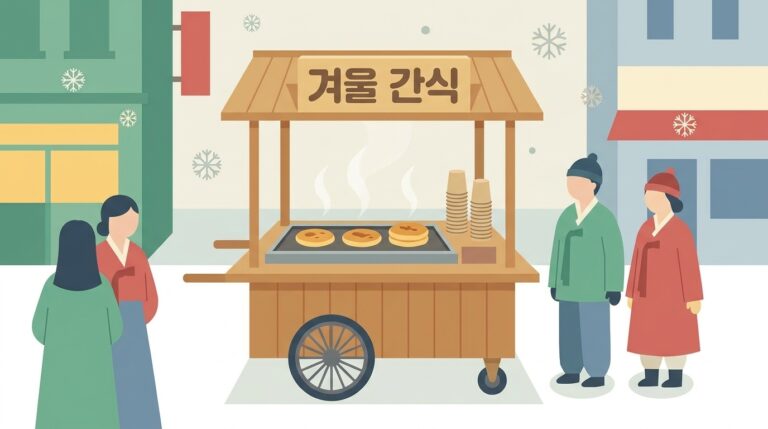
Phase 1: Empathy (Story-Immersive Opening)
안녕하세요! 매일한글 에디터입니다.
Imagine this: It is a freezing December evening in Seoul. Your breath turns into white clouds as the wind bites through your coat. Suddenly, a sweet, warm aroma of caramelized brown sugar, cinnamon, and sizzling oil pulls you toward a small, glowing street cart. The vendor presses a round dough ball with a steel press—sizzle!—and hands it to you tucked snugly inside a folded paper cup.
Excited, you take a big bite right away… and ouch! Lava-hot syrup explodes onto your tongue. You scramble for words to thank the vendor or ask for napkins, but freeze up because textbook Korean never quite prepared you for the fast-paced, cozy reality of a winter street stall.
Don’t worry! In today’s guide, based on real feedback from dozens of beginner learners who had the exact same tongue-burning experience, we will master the simple, natural expressions you need to order, cool down, and savor Korea’s favorite winter street snack: Hotteok (호떡).
Phase 2: Top 3 Core Expressions Deep-Dive
1. 호떡 하나 주세요 (Hotteok hana juseyo)
- Pronunciation: ho-tteok ha-na ju-se-yo (Sounds like: ho-ttuck ha-na joo-say-yo)
- Meaning: “One hotteok, please.” (Literal: Hotteok one give me please)
- K-Culture Moment: You will see this everywhere in K-Dramas whenever the main leads go on an impromptu romantic winter date at a street stall.
- Editor’s Insight: In Korean street stalls, you state the item first, then the native Korean number (하나/둘/셋), followed by 주세요 (please give). It is polite, quick, and foolproof.
- Situation Spectrum: Casual (⚠️ with friends: 하나 줘) / Semi-formal (✅ 하나 주세요) / Formal (🚫 overly stiff: 하나 주십시오)
- 🤔 Think About It: Why do Koreans place the item before the quantity in street markets? It immediately catches the vendor’s attention amidst the noisy sizzle!
2. 뜨거우니까 조심하세요 (Tteugeounikka josimhaseyo)
- Pronunciation: tteu-geo-u-ni-kka jo-sim-ha-se-yo (Sounds like: ttoo-guh-oo-nee-kka jo-sheem-ha-say-yo)
- Meaning: “It is hot, so please be careful.”
- K-Culture Moment: The warm street cart owner (이모님 imonim) hands you your fresh snack with a motherly look of concern.
- Editor’s Insight: -으니까 means “because / since”. Street vendors often warn you because the molten brown sugar inside hotteok stays scalding hot long after the crust cools.
- Situation Spectrum: Casual (⚠️ 뜨거우니까 조심해) / Semi-formal (✅ 뜨거우니까 조심하세요) / Formal (✅ 뜨거우니 조심하십시오)
- 🤔 Think About It: Notice how caring warnings are woven into daily customer service in Korea? It reflects the culture of Jeong (warm affection).
3. 호호 불어서 드세요 (Ho-ho bureoseo deuseyo)
- Pronunciation: ho-ho bu-reo-seo deu-se-yo (Sounds like: ho-ho boo-ruh-suh doo-say-yo)
- Meaning: “Please blow on it (ho-ho) before you eat.”
- K-Culture Moment: In variety shows like Running Man or 2 Days & 1 Night, cast members can be seen furiously blowing “ho-ho” on street snacks during cold weather missions.
- Editor’s Insight: The onomatopoeia 호호 (ho-ho) describes the gentle, pursed-lip blowing sound made to cool down hot food. In fact, that is part of why it’s called 호떡 (Hotteok) in popular folk etymology!
- Situation Spectrum: Casual (⚠️ 호호 불어 먹어) / Semi-formal (✅ 호호 불어서 드세요) / Formal (⚠️ formal dining doesn’t usually use onomatopoeia)
- 🤔 Think About It: English says “blow on your food”, but Korean turns the sound of breath itself (ho-ho) into a verb phrase. How do onomatopoeias differ in your native language?
Phase 3: Textbook Korean vs. Real-World Korean
Situation 1: Ordering your snack
- 📖 Textbook Korean: 이것을 한 개 주문하고 싶습니다. (Igeoseul han gae jumunhago sipsumnida. – I would like to order one piece of this.)
- 🗣️ Real-World Korean: 이거 하나 주세요! (Igeo hana juseyo! – One of this, please!)
- 💡 Why is it different?: In bustling street markets, long textbook grammar sounds robotic. Stating the item pronoun (이거) and 주세요 is clean, fast, and completely natural for A2 learners.
Situation 2: Reacting to the hot temperature
- 📖 Textbook Korean: 음식이 대단히 뜨겁습니다. (Eumsigi daedanhi tteugeopseumnida. – The food is extremely hot.)
- 🗣️ Real-World Korean: 와, 진짜 뜨겁네요! (Wa, jinjja tteugeomneyo! – Wow, it’s really hot!)
- 💡 Why is it different?: Real Korean conversations frequently use exclamation markers like 진짜 (really) and ending suffix -네요 to express immediate sensory reactions.
Phase 4: K-Culture Deep Dive & Non-Verbal Manners
4-1. 눈치 (Nunchi) & Street Food Gestures
- The Two-Hand Cup Grip: When receiving your hotteok in a paper cup, accept it with both hands (or touch your forearm with your left hand) to show basic Korean etiquette.
- The Paper Cup Slit: Gently pinch the bottom of the paper cup to push the hotteok upward as you eat, rather than digging your fingers inside.
- Trash Discipline: Never walk away and discard the oily cup on general street corners. Eat near the cart and throw it into the vendor’s dedicated trash bin (쓰레기통).
4-2. Cultural Code: Winter Street Food & Cash Culture
In Korea, winter is officially announced not by the calendar, but by the appearance of three street heroes: Bungeoppang (붕어빵), Eomuk (어묵), and Hotteok (호떡). While Korea is largely a cashless society, many traditional pojangmacha (street carts) still prefer crisp cash (현금) or instant bank transfers (계좌이체). Carrying 5,000 KRW in your pocket during winter is an essential local tip!
Phase 5: Real-Life Roleplay Scenario
- Location: A steaming winter food cart in Jongno, Seoul.
- Characters: You (A2 Korean learner) & Vendor Auntie (이모님, Imonim).
- You: 안녕하세요! 호떡 하나 주세요. 🎭 (Smiling, rubbing hands from the cold)
(Annyeonghaseyo! Hotteok hana juseyo. / Hello! One hotteok, please.) - Vendor: 네, 바로 구워 줄게요. 잠깐만 기다려요~ 🎭 (Pressing the round dough onto the griddle)
(Ne, baro guwo julgeyo. Jamkkanman gidaryeoyo~ / Sure, I’ll grill it right up. Just a moment~) - You: 네! 날씨가 진짜 춥네요. 🎭 (Looking at the sizzling oil)
(Ne! Nalssiga jinjja chumneyo. / Yes! The weather is really cold.) - Vendor: 그러니까요~ 자, 여기 있어요. 조심해요! 🎭 (Placing hotteok into a paper cup and handing it over)
(Geureonikkayo~ Ja, yeogi isseoyo. Josimhaeyo! / Exactly~ Here you go. Be careful!) - Vendor: 꿀이 뜨거우니까 호호 불어서 드세요! 🎭 (Gesturing blowing air)
(Kkuri tteugeounikka ho-ho bureoseo deuseyo! / The syrup is hot, so blow on it before eating!) - You: 와, 감사합니다! 얼마예요? 🎭 (Taking the cup with two hands)
(Wa, gamsahamnida! Eolmayeyo? / Wow, thank you! How much is it?) - Vendor: 이천 원이에요. 🎭 (Pointing to the cash box)
(Icheon wonieyo. / It is 2,000 won.) - You: 여기 이천 원 있어요. 맛있게 먹겠습니다! 🎭 (Handing two 1,000 KRW bills with a bow)
(Yeogi icheon won isseoyo. Masitge meokgetseumnida! / Here is 2,000 won. I will enjoy it!)
🔀 Interactive Decision Branch
What should you do right after receiving the boiling-hot hotteok?
* Choice A: Bite deep into the center immediately to taste the brown sugar filling.
* Choice B: Gently blow on the edge, nibble the crust first, and let the steam escape.
* Choice C: Throw away the paper cup immediately because it feels too greasy.
- Feedback:
- Choice A (Risk): 🚨 Danger! The molten brown sugar will burn your palate. Remember: 호호 불어서 드세요!
- Choice B (Best): 🌟 Perfect! You eat like a true local, avoiding burns while enjoying the crispy outer dough.
- Choice C (Bad): ❌ Without the cup, you will burn your fingers and drip syrup all over your clothes!
Phase 6: 10-Second Emotion Shadowing Drill
Repeat these sentences with the exact intonation pauses (/) and emotions:
[😊 Excitement]저기요, / 호떡 하나만 / 주세요! (Jeogiyo, / hotteok hanaman / juseyo!)[😮 Careful & Alert]안에 꿀이 / 엄청 뜨거워요! (Ane kkuri / eomcheong tteugeowoyo!)[😋 Pure Joy]호~ 호~ 불어서 / 먹으니까 / 진짜 맛있어요! (Ho~ ho~ bureoseo / meogeunikka / jinjja masisseoyo!)
Phase 7: K-Culture Mini Dictionary
- 호떡 (Hotteok): A beloved pan-fried sweet pancake filled with brown sugar, honey, cinnamon, and crushed nuts.
- 계좌이체 (Gyejwa-iche): Instant mobile bank transfer; widely used at Korean street stalls when you do not have cash.
- 길거리 음식 (Gilgeori eumsik): Street food; a vital pillar of Korean culinary and late-night culture.
- 꿀 (Kkul): Literally “honey”, but commonly used by vendors to refer to the melted sweet syrup inside hotteok.
Phase 8: Traveler Survival Kit
Survival Expressions TOP 3
- 현금만 돼요? (Hyeongeumman dwaeyo?) – Is it cash only?
- Pro Tip: Ask this before ordering if you forgot your wallet.
- 휴지 있어요? (Hyuji isseoyo?) – Do you have tissue/napkins?
- Pro Tip: Street syrup can be sticky; vendors keep tissue boxes hanging nearby.
- 종이컵 하나 더 주세요. (Jong-ikeop hana deo juseyo.) – Please give me one more paper cup.
- Pro Tip: If the cup gets too hot to hold, doubling the cups solves the problem!
Editor’s Travel Note
Before heading to street food hubs like Gwangjang Market or Namdaemun Market, make sure to install Naver Map app on your mobile device rather than Google Maps for accurate stall locations and operating hours. Keep a few 1,000 KRW bills ready in an easily accessible pocket!
Phase 9: One Step Deeper (Reflection)
In Korean culture, food is never just sustenance—it is an exchange of warmth (정, Jeong). When an elderly street vendor tells you “호호 불어서 드세요“, she isn’t giving culinary instructions; she is offering maternal care to a cold stranger. Food carts in Korea function as communal shelters where rich and poor alike stand side-by-side under plastic tarps to escape the winter chill.
💬 Your Turn: What is your country’s ultimate comfort street food for freezing weather? Have you ever burned your tongue trying to eat it too fast? Share your story in the comments below!
Phase 10: FAQ & Common Mistakes
Q: Can I pay with an international credit card at hotteok stalls?
A: Most small traditional street carts do not accept foreign credit cards. It is strongly recommended to carry physical cash (KRW) or use local bank transfer apps if you have a Korean bank account.
Q: Is hotteok vegetarian or vegan-friendly?
A: Traditional sweet hotteok dough is usually vegan (flour, yeast, sugar, water), but some stalls add milk powder or butter, and savory versions may contain seafood or meat. Always ask: “고기나 우유 들어갔어요?” (Gogina uyu deureogasseoyo? – Does it contain meat or milk?).
Q: What is the difference between 씨앗호떡 (Ssiat Hotteok) and regular 호떡?
A: Ssiat Hotteok originated in Busan and is sliced open after frying to be stuffed with sunflower seeds, pumpkin seeds, and pine nuts, giving it a much crunchier, nuttier texture.
🚨 Common Mistakes Warning Board
- Mistake: Saying “이것을 주십시오” at a casual street cart.
- Correct Action: Use the friendly, polite “이거 하나 주세요” instead.
- Mistake: Eating while walking away immediately without grabbing napkins.
- Correct Action: Stay near the cart, enjoy the heat, and use the vendor’s tissue dispenser.
- Mistake: Squeezing the paper cup too hard.
- Correct Action: Hold it gently around the sides. Squeezing shoots molten syrup out of the top onto your chin!
Phase 11: Action Missions
- 🥉 Bronze Mission: Stand in front of your mirror, hold a coffee mug like a hotteok cup, and practice saying “호떡 하나 주세요!” with a bright smile.
- 🥈 Silver Mission: Share this blog post on your Instagram Story or X (Twitter) with your favorite Korean street food emoji.
- 🥇 Gold Mission: Visit a Korean grocery store or street cart in your city, order completely in Korean using “~ 주세요”, and say “호호 불어서 먹었어요” on your social media!
- 🎮 K-Culture Mission: Watch an episode of a winter K-Drama (like Weightlifting Fairy Kim Bok-joo or Goblin) and spot the characters eating winter street snacks under a tent.
Phase 12: Interactive Quiz Challenge
1. Situation Quiz: You arrive at a hotteok stand and want 2 hotteoks. What is the most natural sentence?
* A) 호떡 두 개 주세요 (Hotteok du gae juseyo)
* B) 호떡 둘을 나에게 줘라 (Hotteok dureul na-ege jwora)
* C) 호떡을 주문하겠습니다 (Hotteogeul jumunhagetseumnida)
👉 Click to reveal Answer & Explanation
Answer: A
호떡 두 개 주세요 is the standard, polite, and natural phrasing for ordering two hotteoks at a street stall.
2. Fill-in-the-Blank: Complete the vendor’s caring advice:
“뜨거우니까 ______ 불어서 드세요!”
👉 Click to reveal Answer & Explanation
Answer: 호호 (ho-ho)
호호 is the sound of blowing gentle air to cool down steaming food.
3. True or False: Hotteok street stalls in Korea always prefer American Express and Visa credit cards over cash.
👉 Click to reveal Answer & Explanation
Answer: False (X)
Street food stalls in Korea predominantly operate on cash (현금) or domestic mobile transfers (계좌이체).







