

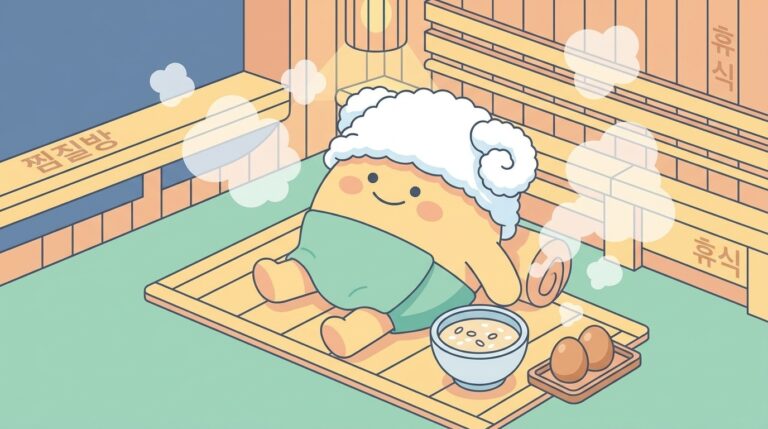
The Ultimate Guide to the Iconic K-Sauna Sheep Head Towel
Phase 1: Empathy & Storytelling Opening
안녕하세요! Welcome back to Daily Hangul! I’m your Korean culture navigator. Have you ever watched a classic K-Drama scene where the characters are sitting on warm heated floors, wearing matching oversized t-shirts and shorts, cracking hard-boiled eggs on their foreheads, and sporting cute little sheep horns made out of towels on their heads? You probably thought: “I definitely want to try that when I visit Korea!”
However, walking into a traditional Korean bathhouse (Jjimjilbang, 찜질방) for the very first time can feel intimidating. From navigating the locker keys to folding a small hand towel into those iconic “sheep head” (양머리, Yang-meori) buns, small details can leave you puzzled. Don’t worry! This beginner-friendly guide is designed with real feedback from fellow learners so you can master the essential Korean phrases, fold your towel like a local pro, and feel 100% confident relaxing at any Korean spa.
Phase 2: Deep-Dive into 3 Essential Expressions
1. 수건 하나 더 주세요 (Su-geon ha-na deo ju-se-yo)
- Pronunciation: [soo-guhn ha-nah duh joo-seh-yoh] (Think “Sue-gun” like a water gun, “Ha-na” like the number one, “Duh”, and “Juice-say-yo”)
- Meaning: Literal: “Please give me one more towel.” | Natural Nuance: Polite and standard way to request an extra towel at the counter or front desk.
- K-Culture Moment: Asking the front desk staff (Ka-un-teo, 카운터) for an extra towel to make your sheep head hat without getting your shower towel wet.
- Editor’s Insight: The word deo (더) means “more”. You can use this pattern across Korea when asking for extra side dishes or water!
- Situation Spectrum: Casual: ⚠️ (수건 더 줘 – only close friends) | Semi-formal: ✅ (수건 하나 더 주세요) | Formal: ✅ (수건 한 장 더 부탁드립니다)
- 🤔 Think About It: In English, we usually say “Can I have another towel?” phrasing it as an inquiry of ability, whereas Korean directly states the object followed by the honorific request ju-se-yo (please give).
2. 양머리 어떻게 만들어요? (Yang-meo-ri eo-tteo-ke man-deu-reo-yo?)
- Pronunciation: [yahng-muh-ree uh-ttuh-keh mahn-deu-ruh-yoh] (“Yang” rhymes with song, “Muh-ree” sounds like Murray, “Uh-tuh-kay”)
- Meaning: Literal: “How do you make a sheep head?” | Natural Nuance: “Could you show me how to fold the sheep head towel?”
- K-Culture Moment: Asking your Korean friend or a friendly local lounging in the clay sauna room (Hwangto-bang) for help.
- Editor’s Insight: Yang (양) means sheep/lamb, and meori (머리) means head or hair. This visual metaphor has been beloved across Korean pop culture since the early 2000s.
- Situation Spectrum: Casual: ⚠️ (양머리 어떻게 만들어?) | Semi-formal: ✅ (양머리 어떻게 만들어요?) | Formal: 🚫 (너무 격식 차릴 필요 없음)
- 🤔 Think About It: In Korean, polite inquiries in daily situations just need the soft ending -eo-yo rather than overly stiff grammatical constructs.
3. 식혜랑 계란 주세요 (Sik-hye-rang gye-ran ju-se-yo)
- Pronunciation: [sheek-hyeh-rahng gyeh-rahn joo-seh-yoh] (“Sheek-hye” like chic-hye, “Gye-ran” like gay-rahn)
- Meaning: Literal: “Sweet rice punch and eggs, please.” | Natural Nuance: Ordering the legendary Jjimjilbang snack combo.
- K-Culture Moment: The iconic moment at the snack bar (Mae-jeom) where everyone rehydrates with ice-cold sweet rice punch after sweating in the hot kilns.
- Editor’s Insight: The particle -rang (랑) means “and / with”. It connects two nouns naturally in spoken speech.
- Situation Spectrum: Casual: ⚠️ (식혜랑 계란 줘) | Semi-formal: ✅ (식혜랑 계란 주세요) | Formal: ✅ (식혜와 계란 부탁드립니다)
- 🤔 Think About It: Food pairings in Korea often come in culturally set duos (like Chicken & Beer, or Rice Punch & Baked Eggs). Knowing the pair makes ordering seamless!
Phase 3: Textbook Korean vs. Real Native Korean
- Situation A: Asking for extra towels
- 📖 Textbook Korean: 저에게 수건을 한 장 더 주실 수 있습니까? (Jeo-e-ge su-geon-eul han jang deo ju-sil su it-seum-ni-kka?)
- 🗣️ Real Native Korean: 수건 하나 더 주세요! (Su-geon ha-na deo ju-se-yo!)
- 💡 Why is it different? While the textbook phrase is grammatically flawless, spoken Korean drops unnecessary pronouns (“to me”) and particles (-eul) in fast, everyday service interactions.
- Situation B: Expressing that the hot room feels good
- 📖 Textbook Korean: 온도가 매우 따뜻하고 만족스럽습니다. (On-do-ga mae-u tta-tteut-ha-go man-jok-seu-reop-seum-ni-da.)
- 🗣️ Real Native Korean: 와, 시원하다~! (Wa, si-won-ha-da~!)
- 💡 Why is it different? Koreans famously say Si-won-ha-da (literally “cool/refreshing”) when sitting in hot water or hot saunas to describe bodily relief and tension release!
Phase 4: K-Culture Deep-Dive & Non-Verbal Manners
4-1. Nunchi & Jjimjilbang Etiquette
- Two-Hand Rule: When receiving your spa clothes (Jjimjilbang-bok) and towels at the counter, accept them with both hands or with your left hand lightly supporting your right forearm. This demonstrates respect instantly.
- Towel Usage in Baths vs. Common Areas: Small towels are used in the wet bath area to dry off or balance on top of your head in hot baths (never soak them inside the communal water tubs!). The dry towel is folded into the sheep head hat in the dry common lounge area.
4-2. The Sheep Head Phenomenon
- The Yang-meori trend blew up in the early 2000s through classic Korean dramas and variety shows (like Happy Together). It keeps long hair neat, absorbs forehead sweat in sauna rooms, and adds an adorable photo-ready charm to your spa stay.
Phase 5: Real-Life Roleplay Scenario
Setting: Inside a cozy, pine-scented Jjimjilbang lounge in Seoul. Min-ji (a friendly local sitting on the floor mats) notices Alex trying to fold a towel.
- Turn 1 (Alex): 저기요… 혹시 양머리 어떻게 만들어요?
(Jeo-gi-yo… hok-si yang-meo-ri eo-tteo-ke man-deu-reo-yo?)
“Excuse me… by any chance, how do you make the sheep head?”
🎭 Scratching head sheepishly with an unfolded towel. -
Turn 2 (Min-ji): 아, 양머리요? 쉬워요! 제가 알려드릴게요.
(A, yang-meo-ri-yo? Swi-wo-yo! Je-ga al-lyeo-deu-ril-ge-yo.)
“Ah, the sheep head? It’s easy! I will show you.”
🎭 Smiling warmly and laying the towel flat on the floor. -
Turn 3 (Min-ji): 먼저 수건을 삼등분으로 접으세요.
(Meon-jeo su-geon-eul sam-deung-bun-eu-ro jeob-eu-se-yo.)
“First, fold the towel into thirds lengthwise.”
🎭 Demonstrating the neat 3-fold strip. -
Turn 4 (Alex): 이렇게 접으면 돼요?
(I-reo-ke jeob-eu-myeon dwae-yo?)
“Do I fold it like this?”
🎭 Following along step-by-step. -
Turn 5 (Min-ji): 네! 그리고 양쪽 끝을 바깥으로 돌돌 마세요.
(Ne! Geu-ri-go yang-jjok kkeut-eul ba-kkat-eu-ro dol-dol ma-se-yo.)
“Yes! And roll both outer ends outward like cuffs.”
🎭 Rolling each sleeve end 3 times tightly. -
Turn 6 (Alex): 와, 신기해요! 모자가 됐어요.
(Wa, sin-gi-hae-yo! Mo-ja-ga dwaet-eo-yo.)
“Wow, fascinating! It turned into a hat.”
🎭 Putting the towel hat on head with a big smile. -
Turn 7 (Min-ji): 잘 어울려요! 이제 식혜 마시러 갈래요?
(Jal eo-ul-lyeo-yo! I-je sik-hye ma-si-reo gal-lae-yo?)
“It suits you well! Shall we go grab some Sik-hye now?”
🎭 Pointing toward the snack counter. -
Turn 8 (Alex): 좋아요! 식혜랑 계란 먹어요.
(Jo-a-yo! Sik-hye-rang gye-ran meog-eo-yo.)
“Sounds great! Let’s eat sweet rice punch and eggs.”
🎭 Standing up cheerfully with sheep ears on.
🔀 Interactive Choice Point
You are at the snack counter to order. What do you say to the clerk?
- Option A: “식혜랑 훈제계란 주세요!” (Sik-hye-rang hun-je-gye-ran ju-se-yo!)
- 👉 Feedback [Best]: Perfect! 100% natural, polite, and clearly gets you sweet rice drink and smoked eggs instantly.
- Option B: “야, 식혜 줘.” (Ya, sik-hye jwo.)
- 👉 Feedback [Bad]: Very rude! Ya and casual imperative endings should never be spoken to staff or strangers.
- Option C: “식혜를 주문하는 것이 가능한지 여쭙고 싶습니다.” (Sik-hye-reul ju-mun-ha-neun geos-i ga-neung-han-ji yeo-jjup-go sip-seum-ni-da.)
- 👉 Feedback [Risk]: Overly formal and poetic; the snack bar clerk might look confused by the excessive stiffness!
Phase 6: 10-Second Emotion Shadowing Drill
Practice out loud with these emotion guides and pause marks (/):
[😊 Exciting & Friendly]- 저기요! / 양머리 / 어떻게 만들어요? /
(Jeo-gi-yo! / Yang-meo-ri / eo-tteo-ke man-deu-reo-yo? /)
- 저기요! / 양머리 / 어떻게 만들어요? /
[😋 Delighted & Hungry]- 시원한 식혜랑 / 계란 주세요! /
(Si-won-han sik-hye-rang / gye-ran ju-se-yo! /)
- 시원한 식혜랑 / 계란 주세요! /
[😌 Relaxed & Content]- 와~ / 따뜻해서 / 너무 좋다! /
(Wa~ / tta-tteut-hae-seo / neo-mu jo-ta! /)
- 와~ / 따뜻해서 / 너무 좋다! /
Phase 7: K-Culture Mini Dictionary
- 찜질방 (Jjim-jil-bang): Traditional Korean public bathhouse equipped with hot kiln saunas, sleeping mats, snack cafes, and heated ondol floors.
- 양머리 (Yang-meo-ri): Literally “sheep head”; the towel folded into two round ear-like buns worn snugly on the head.
- 식혜 (Sik-hye): Traditional Korean sweet malt-and-rice dessert beverage, served chilled with ice flakes in spas.
- 매점 (Mae-jeom): The small convenience/snack kiosk inside public venues like spas, train stations, and schools.
Phase 8: Traveler’s Survival Kit
Top 3 Survival Phrases
- 락커 어디예요? (Rak-keo eo-di-ye-yo?) – “Where are the lockers?”
- Pro Tip: Keep your electronic wristband on at all times; it serves as your locker key and your payment method at the snack bar!
- 몇 시까지 해요? (Myeot si-kka-ji hae-yo?) – “Until what time are you open?”
- Pro Tip: Many large Jjimjilbangs operate 24 hours, making them great budget overnight stays.
- 계산해 주세요. (Gye-san-hae ju-se-yo.) – “Check out, please.”
- Pro Tip: Settle all food and massage charges accumulated on your key band at the counter before leaving.
Editor’s Travel Note
- Install the Naver Map Navigation App on iOS and Android to search for top-rated
24시 찜질방(24-hour Jjimjilbang) near your accommodation. - Remember: Shoes go into a shoe locker first before entering the main gender-separated bath/locker rooms!
Phase 9: A Step Deeper: Community & Shared Warmth
In Korean culture, the Jjimjilbang is far more than a simple bath; it is a communal living room. Families, couples, and friends lay side by side on the floor mats, sharing simple snacks without pretension. Shedding fancy clothes for identical lounge uniforms creates a sense of shared equality and collective warmth (Jeong, 정).
💬 Your Turn: Have you ever worn a sheep head towel or visited a Korean sauna? Share your favorite K-Drama sauna moment in the comments below!
Phase 10: FAQ & Common Mistakes
Q: Can men and women hang out together wearing the sheep head towel?
A: Yes! While the shower and nude soaking bath areas are strictly divided by gender, the main Jjimjilbang lounge, kiln rooms, and snack areas are unisex spaces where everyone wears the provided uniforms and towel hats together.
Q: How do you pay for food at the Jjimjilbang snack bar?
A: You don’t need cash or physical cards inside the lounge. You simply tap your electronic wrist locker key at the snack counter and pay the total balance when you check out at the front desk.
Q: Is it okay to take photos wearing the sheep towel?
A: Yes, taking selfies in the common public lounge (Bul-ga-ma / recreation floor) is completely fine and popular! However, cameras and phones are strictly prohibited inside the wet bathing and changing rooms.
🚨 Common Mistakes Warning Board
| Mistake | What Happens | Correct Action |
|---|---|---|
| ❌ Wearing shoes past the entrance | Footwear dirties the clean indoor floor | Leave outdoor shoes inside the designated shoe locker immediately upon arrival. |
| ❌ Putting towels inside the bath water | Unhygienic and frowned upon by locals | Keep small towels placed dry on your head or beside the tub. |
| ❌ Leaving without settling wristband tab | The exit gate shoe locker won’t unlock | Always stop by the settlement kiosk or counter before opening your shoe locker. |
Phase 11: Action Missions
- 🥉 Bronze Mission (Solo Practice): Take a standard hand towel at home, fold it in thirds lengthwise, roll the outer ends outward 3 times each, and wear your first Yang-meori!
- 🥈 Silver Mission (Social Share): Snap a quick mirror selfie with your sheep head towel and tag
@DailyHangulon Instagram with#YangmeoriChallenge! - 🥇 Gold Mission (Real Life): Walk up to a Jjimjilbang counter in Korea and order “식혜랑 계란 주세요!” with natural confidence.
- 🎮 K-Culture Mission: Spot a sheep head towel in an episode of your favorite K-Drama or variety show and repeat the actor’s lines.
Phase 12: Interactive Quiz Challenge
1. Situation Judgment
You want to ask for another towel at the front counter. Which phrase is the most natural A1 expression?
* A) 수건 하나 더 주세요
* B) 수건을 내놓아라
* C) 식혜 주세요
🔍 Click to Reveal Answer & Explanation
Answer: A
수건 하나 더 주세요 (Su-geon ha-na deo ju-se-yo) is the standard, polite way to ask for an additional towel. Option B is an ancient warrior command, and Option C asks for sweet rice punch!
2. Fill-in-the-Blank
“식혜___ 계란 주세요!” (Please give me sweet rice punch and eggs!)
* Fill in the connector particle meaning “and”: [ ]
🔍 Click to Reveal Answer & Explanation
Answer: 랑 (rang)
식혜랑 (Sik-hye-rang) attaches to words ending in a vowel to mean “and”. If the noun ends in a consonant, you use -i-rang (이랑).
3. True or False Cultural Quiz
Statement: You are allowed to take photos with your sheep towel inside the wet shower bath zone.
* (True / False)
🔍 Click to Reveal Answer & Explanation
Answer: False
Photography is strictly forbidden in the locker and wet bath areas for privacy. Photos are only allowed in the unisex lounge and sauna rooms where everyone is wearing clothes!







