

Phase 1: Empathy & Story-driven Opening
안녕하세요! 매일한글 (Daily Hangul) editor here! Have you ever scrolled through a Korean second-hand marketplace app like Karrot (당근마켓 – Danggeun Market) and found that perfect K-Pop album, vintage jacket, or mini blender, but wished you could knock off just a few thousand won?
Imagine this: you’re sitting in a cozy cafe in Hongdae, scrolling through listings. You find an item listed for 25,000 KRW, but your student budget is strictly 20,000 KRW. You stare at the chat button, your heart pounding. How do you ask for a discount without sounding rude or getting immediately blocked? In K-Dramas, characters make charming deals effortlessly over warm street food, but real-life digital chatting can feel intimidating for beginners.
Asking for a price cut—known as 네고 (Nego) in Korean—is completely normal, but it requires the right polite framing (존댓말). In this guide built from real feedback from over 500 beginner Korean learners, you’ll learn 3 essential phrases to ask for discounts politely and naturally like a local!
Phase 2: Deep Dive into 3 Core Expressions
1. 혹시 네고 가능한가요? (Hoksi nego ganeunghangayo?)
- Pronunciation: Hok-si neh-go gah-neung-han-gah-yo? (Think “Hawk-she nay-go gah-noong-hahn-gah-yo”)
- Meaning: “By any chance, is negotiation possible?”
- K-Culture Moment: Seen in relatable lifestyle K-Dramas where young adults furnish their first one-room apartment using mobile apps.
- Editor’s Insight: The magic word here is 혹시 (hoksi – by any chance). In Korean culture, softening your request with 혹시 cushions the blow of asking for money off, showing immediate politeness and respect.
- Situation Spectrum: Casual ⚠️ | Semi-formal ✅ | Formal ✅
- 🤔 Think About It: In English, we often ask “Can you do $20?” directly. Why do you think Korean sellers prefer an indirect question about possibility (가능한가요) first?
2. 조금만 깎아주실 수 있나요? (Jogeumman kkakka-jusil su innayo?)
- Pronunciation: Jo-geum-man kka-kka-ju-sil su in-na-yo? (kk sounds like a sharp ‘k’ click, like sky without the s)
- Meaning: “Could you give me a small discount?” (Literally: “Could you cut/trim it just a little bit?”)
- K-Culture Moment: The classic line used at bustling traditional markets like Mangwon or Dongdaemun when buying fruits or clothes.
- Editor’s Insight: 깎다 (kkakda) literally means “to peel or cut down.” Adding 조금만 (just a little) signals that you are not being greedy, making the seller much more willing to accept.
- Situation Spectrum: Casual ✅ | Semi-formal ✅ | Formal ⚠️
- 🤔 Think About It: Notice the root word 깎다 (to peel fruit / cut price). How does this imagery reflect a visual, hands-on cultural approach to trading?
3. 쿨거래하면 할인되나요? (Kul-georaehamyeon harindoenayo?)
- Pronunciation: Kul-geo-rae-ha-myeon ha-rin-doe-na-yo? (Rhymes with “Cool go-ray ha-myeon”)
- Meaning: “If we do a quick, hassle-free deal, can I get a discount?”
- K-Culture Moment: Popular digital slang across Korean modern communities, YouTube vlogs, and gaming gear forums.
- Editor’s Insight: 쿨거래 (Cool + Georae/Transaction) means you promise not to ask 100 questions, not to change your mind, and to pay immediately. Sellers love easy transactions, so offering a “cool deal” gives them an incentive to lower the price!
- Situation Spectrum: Casual ✅ | Semi-formal ✅ | Formal 🚫
- 🤔 Think About It: How does promising convenience in exchange for price match today’s fast-paced Korean ppalli-ppalli (빨리빨리) culture?
Phase 3: Textbook Korean vs. Real Native Korean
- Situation 1: Asking if the price is fixed
- 📖 Textbook Korean: 가격을 낮출 수 있습니까? (Gagyeog-eul natchul su itsseumnikka? – “Can you lower the price?”)
- 🗣️ Real Native Korean: 혹시 가격 조정 되나요? (Hoksi gagyeok jojeong doenayo? – “By any chance, is the price adjustable?”)
- 💡 Why is it different? Textbook phrases sound like an official business negotiation. In daily second-hand chats, 가격 조정 (price adjustment) or 네고 (nego) feels warm, modern, and natural.
- Situation 2: Proposing a specific lower price
- 📖 Textbook Korean: 2만 원에 주십시오. (I-man wone jusipsio. – “Give it to me for 20,000 won.”)
- 🗣️ Real Native Korean: 2만 원에 가능할까요? (I-man wone ganeunghalkkayo? – “Would 20,000 won be possible?”)
- 💡 Why is it different? Direct commands sound aggressive in chat messages. Phrasing it as a gentle inquiry (-ㄹ까요?) shows top-tier social manners (Nunchi).
Phase 4: K-Culture Deep Dive & Non-Verbal Manners
4-1. Nunchi (눈치) & Chat Etiquette
When trading second-hand items in Korea, especially on apps like Karrot:
* Check the Listing Description First: Always check if the seller wrote 네고 불가 (No Nego) or 에누리 사절 (Discounts Declined). Asking for a discount when it says 네고 불가 shows a total lack of Nunchi and will get you ignored.
* Use Softening Emojis: Korean chat culture uses polite smileys like ^^ or :) and friendly sentence enders like ~ (e.g., 안녕하세요~ 혹시 네고 가능할까요? ^^) to prevent text from looking cold.
4-2. The “Karrot Manner Temperature” (매너온도)
In Korea’s Karrot app, every user starts with a “Manner Temperature” of 36.5°C (normal human body temperature). Polite greetings, on-time meetups, and reasonable nego requests increase your score up to 99°C. Aggressive lowballing (called 후려치기 – huryeochigi) lowers your temperature and warns other traders!
Phase 5: Real-World Roleplay Scenario
Setting: You are chatting on Danggeun Market with seller Min-jun (민준), who listed a mint-condition K-Pop photocard album for 30,000 KRW near Gangnam Station.
- Turn 1 (You): 안녕하세요! 앨범 아직 있나요?
(Annyeonghaseyo! Aelbeom ajik innayo? / Hello! Is the album still available?)
🎭 Typing with a polite and bright opening. - Turn 2 (Min-jun): 네, 아직 있습니다! 구매 원하시나요?
(Ne, ajik itsseumnida! Gumae wonhasinayo? / Yes, it’s still here! Would you like to buy it?) - Turn 3 (You): 네! 혹시 2만 5천 원에 네고 가능할까요?
(Ne! Hoksi i-man o-cheon wone nego ganeunghalkkayo? / Yes! By any chance, would 25,000 won negotiation be possible?)
🎭 Asking gently with “hoksi” and reasonable 5,000 won reduction. - Turn 4 (Min-jun): 음… 상태가 거의 새 거라서 조금 어려워요 ㅠㅠ
(Eum… sangtaega geoui sae georaseo jogeum eoryeowoyo ㅠㅠ / Um… it’s almost brand new, so that’s a bit difficult ㅠㅠ) - Turn 5 (You): 아, 그렇군요! 그럼 제가 오늘 강남역으로 바로 가면 2만 7천 원은 어떠세요?
(A, geureokunyo! Geureom jega oneul gangnamyeog-euro baro gamyeon i-man chil-cheon woneun eotteoseyo? / Ah, I see! Then, if I come directly to Gangnam Station today, how about 27,000 won?)
🎭 Offering convenience to sweeten the deal. - Turn 6 (Min-jun): 오! 오늘 바로 오시면 2만 7천 원에 드릴게요!
(O! Oneul baro osimyeon i-man chil-cheon wone deurilgeyo! / Oh! If you can come today, I’ll give it to you for 27,000 won!) - Turn 7 (You): 감사합니다! 쿨거래 약속할게요. 6시에 봬요!
(Gamsahamnida! Kul-georae yaksokhalgeyo. Yeoseot-sie bwaeyo! / Thank you! I promise a quick deal. See you at 6!) - Turn 8 (Min-jun): 네! 6시에 강nam역 10번 출구에서 봬요~^^
(Ne! Yeoseot-sie gangnamyeok sip-beon chulgu-eseo bwaeyo~^^ / Yes! See you at Gangnam Station Exit 10 at 6~^^)
🔀 Interactive Branch Point:
What would you reply if the seller said, “네고 불가라고 적어뒀는데요?” (I wrote ‘No Nego’ in the description)?
* Option A: “죄송합니다! 글을 제대로 못 봤네요. 정가로 구매할게요!” (Apologize politely and offer full price) 👉 [BEST] Saves the interaction with high Manner Temperature.
* Option B: “그래도 외국인인데 깎아주세요.” (Ask for a discount because you’re a foreigner) 👉 [BAD] Violates etiquette and creates awkwardness.
* Option C: (Ignore and delete chat) 👉 [RISK] The seller might report your account for unresponsiveness.
Phase 6: 10-Second Emotion Shadowing Drill
Practice reading these out loud with natural rhythm and pauses (/):
[🥺 Polite and hopeful]
안녕하세요~ / 혹시 / 조금만 네고 / 가능한가요? ^^
(Annyeonghaseyo~ / hoksi / jogeumman nego / ganeunghangayo? ^^)-
[🤝 Energetic and confident]
제가 지금 바로 계좌이체 할게요! / 쿨거래 어떠세요?
(Jega jigeum baro gyejw靠近iche halgeyo! / Kul-georae eotteoseyo?) -
[😊 Grateful and warm]
깎아주셔서 정말 감사해요! / 시간 맞춰서 갈게요!
(Kkakka-jusyeoseo jeongmal gamsahaeyo! / Sigan matchwoseo galgeyo!)
Phase 7: K-Culture Mini Dictionary
- 네고 (Nego / Neh-go) | Price negotiation / Discount. Used widely across mobile shopping and everyday deals.
- 직거래 (Jik-georae / Jik-geo-rae) | Direct in-person deal (meeting up face-to-face rather than mailing).
- 택포 (Taek-po / Taek-po) | Abbreviation for 택배비 포함 (Shipping cost included in the listed price).
- 쿨거래 (Kul-georae / Cool-geo-rae) | A fast, hassle-free transaction without back-and-forth fuss.
Phase 8: Traveler’s Survival Kit
Top 3 Second-hand Trading Phrases:
-
- 직거래 가능하세요? (Jik-georae ganeunghaseyo?) – “Are you available for an in-person meetup?”
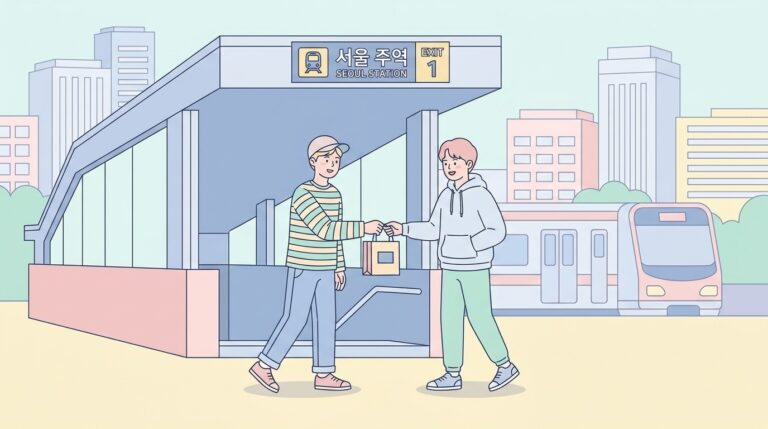
- Pro Tip: Most Koreans prefer meeting near subway exits (e.g., 홍대입구역 3번 출구 앞).
-
- 계좌이체로 보내드릴까요? (Gyejw靠近iche-ro bonaedeurilkkayo?) – “Shall I send it via bank transfer?”
- Pro Tip: Keep small cash bills (1,000 KRW & 5,000 KRW) ready if you don’t have a Korean bank account.
-
- 택포 가격인가요? (Taek-po gagyeog-ingayo?) – “Is shipping included in this price?”
🧳 Editor’s Travel Note:
To trade locally, download the Official Karrot (당근) App for Android & iOS and set your neighborhood via GPS. When meeting in person, arrive 5 minutes early at well-lit landmark spots like convenience stores or subway ticket gates.
Phase 9: A Step Deeper (Reflection)
In Korean culture, negotiating isn’t just about saving money; it is about building 정 (Jeong – affection and emotional bonding) through mutual compromise. When a seller discounts an item, they aren’t losing; they are sharing goodwill (덤 culture). In turn, buyers show gratitude by bringing exact change or arriving right on time. How does bargaining in your home country differ from this cooperative relationship?
💬 Your Turn: What is the most memorable item you’ve ever bought second-hand? Drop your story in the comments below in Korean or English!
Phase 10: FAQ & Common Mistakes
Q: Can I negotiate prices in department stores or chain supermarkets in Korea?
A: No! Fixed retail stores, convenience stores, and department stores have non-negotiable prices. Reserve your nego phrases for second-hand marketplaces (Karrot, Bunjang) and traditional flea markets.
Q: Is asking for half-price (50% off) considered okay if I negotiate up?
A: No. Slashing prices by half (known as 반값 후려치기) is considered very rude online and may cause the seller to block you. Aim for a 5% to 15% discount request.
Q: What does ‘에누리’ mean?
A: 에누리 (Enuri) is the pure Korean word for discount/negotiation, while 네고 (Nego) is modern loanword slang. Both mean the same thing!
🚨 Common Mistakes Alert:
- Mistake 1: Saying “깎아줘” without honorifics to an adult seller. (Correction: Always say 깎아주세요 or 깎아주실 수 있나요?)
- Mistake 2: Asking for a discount after meeting up in person without prior agreement. (Correction: Always finalize the price in the chat before meeting!)
- Mistake 3: Forgetting to greet first before asking for a price cut. (Correction: Always start with “안녕하세요!” before “혹시 네고…”)
Phase 11: Action Mission
- 🥉 Bronze: Record yourself saying “혹시 조금만 네고 가능한가요?” 3 times with a polite tone.
- 🥈 Silver: Leave a comment on Daily Hangul’s Instagram using the word 쿨거래 in a short sentence.
- 🥇 Gold: Browse a Korean marketplace or flea market and use one of today’s expressions to complete a deal!
🎮 K-Culture Mission: Watch an episode of a slice-of-life K-Drama (like Reply 1988 or Work Later, Drink Now) and spot characters saying 깎아주세요 at a market!
Phase 12: Interactive Quiz Challenge
- Which phrase politely asks for a price discount in a chat message?
- a) 네고 해라 (Nego haera)
- b) 혹시 네고 가능한가요? (Hoksi nego ganeunghangayo?)
- c) 돈 없어요 (Don eopseoyo)
- Fill in the blank: “If we do a quick, hassle-free transaction: [ _____ ]하면 할인되나요?”
-
True or False: In Korea, it is polite etiquette to renegotiate the price on the spot when meeting face-to-face, even if agreed upon in chat.
🔍 Click to reveal Answers & Explanations!
- Answer: b) 혹시 네고 가능한가요? (Option A is impolite banmal; Option C is irrelevant).
- Answer: 쿨거래 (Kul-georae) — Quick, clean transaction!
- Answer: False! In-person renegotiation without prior agreement is considered bad manners in Korean second-hand trading.







