

Phase 1: Empathy (Welcome & K-Culture Scene)
안녕하세요! 매일한글 에디터입니다. (Hello! I’m your lead editor at Daily Hangul.)
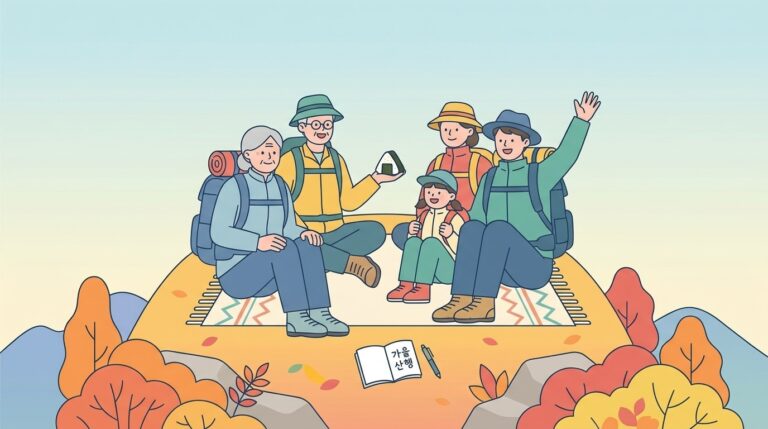
Picture this: You’ve just joined a weekend Korean hiking club (산악회) for a trek up Bukhansan. Everyone is geared up in vibrant color-blocked outdoor gear from head to toe. Halfway through the steep incline, as you catch your breath, a friendly deung-san veteran hands you a cold slice of cucumber and a piece of sweet fish cake, smiling warmly while saying, “정상 찍고 내려가서 막걸리 한잔해야죠!”
You smile and nod, but inside your head, questions race: Wait, did they say ‘dot the peak’? Are we drinking rice wine right after this intense workout? How do I politely say I’m keeping up without sounding completely out of breath?
If you’ve ever felt intimidated by the uniquely social, fast-paced, and food-centered nature of Korean hiking groups, you are not alone! Hiking in Korea isn’t just exercise—it’s a vibrant social ritual built on community bonding, culinary treats, and shared endurance. Today, based on real feedback from intermediate Korean learners who joined local san-ak-hoe groups, we are diving into authentic B2-level phrases and cultural etiquette so you can hike like a true local.
Phase 2: Key Expressions Deep Dive
1. 안전 산행 하세요! (An-jeon san-haeng ha-se-yo!)
- Pronunciation: [An-jeon san-haeng ha-se-yo] (Think: “Un-john sun-haeng ha-say-yo”)
- Meaning: “Have a safe hike!” (Often abbreviated in texting/social clubs as 안산하세요! or simply 안산!)
- K-Culture Moment: As hiking members meet at the trailhead entrance near the subway station, they greet each other with warm hand waves and this encouraging blessing before taking off.
- Editor’s Insight: While beginners learn “조심히 다녀오세요” (Go carefully), intermediate hikers use 안전 산행 to immediately sound like an experienced insider who respects mountain safety.
- Situation Spectrum: Casual ⚠️ | Semi-formal ✅ | Formal ✅
- 🤔 Think About It: In many Western cultures, hikers might just say “Hi” or “Have a good one.” Why do you think Koreans specifically emphasize safety and shared group responsibility before starting a hike?
2. 정상 찍고 내려와서 막걸리 한잔해요. (Jeong-sang jjeik-go nae-ryeo-wa-seo mak-geol-li han-jan-hae-yo.)
- Pronunciation: [Jeong-sang jjeik-go nae-ryeo-wa-seo mak-geol-li han-jan-hae-yo]
- Meaning: Direct: “Let’s hit the summit and drink a glass of Makgeolli when we descend.” / Nuance: “Let me motivate you—the real fun starts after we reach the top!”
- K-Culture Moment: Used by group leaders or hiking buddies midway through a steep climb to motivate exhausted members when motivation starts flagging.
- Editor’s Insight: The verb 찍다 (to stamp/hit) is colloquial for reaching a landmark or goal (e.g., 정상 찍다 = to reach the peak). It adds an energetic, goal-oriented vibe to your sentence.
- Situation Spectrum: Casual ✅ | Semi-formal ✅ | Formal 🚫
- 🤔 Think About It: How does tying a challenging physical task to a shared post-reward (뒤풀이) change group dynamics during outdoor activities?
3. 제 속도에 맞춰서 천천히 올라가도 될까요? (Je sok-do-e mat-chwee-eo cheon-cheon-hi ol-la-ga-do doel-kka-yo?)
- Pronunciation: [Je sok-do-e mat-chwee-eo cheon-cheon-hi ol-la-ga-do doel-kka-yo?]
- Meaning: “Would it be okay if I go slowly at my own pace?”
- K-Culture Moment: Korean hiking groups tend to move remarkably fast! When you need to assert your boundaries without breaking the group rhythm, this polite request is your ultimate tool.
- Editor’s Insight: Using ~해도 될까요? (May I…?) combined with 제 속도 (my pace) shows high-level polite negotiation skills in Korean social dynamics.
- Situation Spectrum: Casual ⚠️ | Semi-formal ✅ | Formal ✅
- 🤔 Think About It: How do you balance group harmony (눈치) with expressing personal physical limits in your native culture?
Phase 3: Textbook Korean vs. Real Korean
Situation 1: Encouraging a struggling hiker
- 📖 Textbook Korean: 힘내세요. 얼마 안 남았습니다. (Cheer up. Not much left.)
- 🗣️ Real Korean: 다 왔어요! 조금만 더 힘내면 정상이에요! (We’re basically there! Just a little more push and we’re at the summit!)
- 💡 Why different? Hikers in Korea love energetic, immediate phrases. Note: “다 왔어요” (We’re almost there) is famous for being used even when there are 30 minutes left, as a friendly motivational fib!
Situation 2: Proposing an after-hike gathering
- 📖 Textbook Korean: 등산이 끝난 후에 같이 식사합시다. (Let’s eat together after hiking.)
- 🗣️ Real Korean: 하산하고 뒤풀이 어디로 갈까요? (Where should we go for the post-hike gathering after descent?)
- 💡 Why different? 하산 (descent) and 뒤풀이 (after-party/gathering) are specialized terms universally used across Korean sports and social clubs.
Phase 4: K-Culture Deep Dive & Non-Verbal Manners
4-1. 눈치 (Nunchi) & Gestures on the Trail
- Passing Etiquette: When passing someone on a narrow rocky trail, step aside slightly, bow your head gently, and say “먼저 지나갈게요~” (I’ll go ahead first) or “수고하십니다!” (Great effort!).
- Food Sharing Manners: Never reject snacks offered on the peak abruptly. If offered an apple slice or yanggaeng (sweet red bean jelly), accept it with two hands (양손), say “감사히 잘 먹겠습니다!”, and offer something back from your bag if you have it!
4-2. Culture Code: The Legend of * 뒤풀이 (Dwi-pul-i) *
In Korea, hiking is incomplete without the downstream feast. Near the base of almost every major mountain in Korea, you will find street-side restaurants serving fresh pajeon (seafood green onion pancake), tofu kimchi, and makgeolli served in traditional brass bowls. Joining the 뒤풀이 is where genuine friendships (정) are forged!
Phase 5: Real-Life Roleplay Scenario
Setting: Reaching the peak of Gwanaksan with a local hiking club (산악회).
Characters: You (Intermediate Hiker) & Min-su (Hiking Club Captain)
- Min-su: 🎭 (Wiping sweat with a neck towel, smiling broadly) “와, 드디어 관악산 정상 찍었습니다! 모두 고생하셨어요!”
(Wow, we finally hit the Gwanaksan peak! Great job everyone!) - You: 🎭 (Panting slightly, taking out a water bottle) “정말 힘들었지만 경치가 대단하네요. 민수 님, 안산 이끌어 주셔서 감사합니다.”
(It was really tough, but the view is amazing. Minsu, thanks for leading a safe hike.) - Min-su: 🎭 (Pointing down toward the valley) “이제 슬슬 하산해 볼까요? 내려가서 파전에 막걸리 한잔해야죠!”
(Shall we start heading down soon? We ought to have a glass of makgeolli with pajeon down below!) - You: 🎭 (Nodding with enthusiasm) “좋습니다! 안 그래도 출출했는데 뒤풀이 장소는 정해졌나요?”
(Sounds great! I was getting hungry anyway, is the after-party spot decided?) - Min-su: 🎭 (Chuckling) “산입구에 있는 단골 두부집으로 가려고요. 혹시 못 드시는 음식 있으세요?”
(We’re going to my favorite tofu spot near the entrance. Do you have any dietary restrictions?) - You: 🎭 (Smiling politely) “저는 다 잘 먹습니다. 제 속도에 맞춰서 천천히 내려가도 될까요?”
(I eat everything well. Would it be okay if we head down at a comfortable pace?) - Min-su: 🎭 (Thumping his chest reassuringly) “당연하죠! 뒤에서 제가 보폭 맞춰서 같이 걸어드릴게요. 걱정 마세요!”
(Of course! I’ll walk behind you and match your pace. Don’t worry!) - You: 🎭 (Bowing slightly with gratitude) “든든하네요! 그럼 조심해서 하산하겠습니다.”
(That’s so reassuring! Then let’s descend carefully.)
🔀 Interactive Choice Point
At the end of the hike, the team invites you to an optional 2nd round (2차) at a draft beer place, but you are physically exhausted. What do you say?
- Option A: “저는 피곤해서 그냥 집에 가겠습니다.” (I’m tired so I’ll just go home.)
- Option B: “오늘 너무 즐거웠습니다! 저는 먼저 들어가 볼 테니, 다들 2차 재밌게 즐기세요!”
- Option C: “2차 안 가면 안 되나요?”
Feedback:
* Option A (Risk): A bit too blunt. It might make the club leader feel uncomfortable.
* Option B (BEST ✅): Perfect B2 etiquette! You express genuine gratitude (오늘 너무 즐거웠습니다), state your departure politely (먼저 들어가 볼게요), and wish them a good time.
* Option C (Bad 🚫): Sounds overly direct and critical of the group’s decision.
Phase 6: 10-Second Emotion Shadowing Drill
Practice these lines out loud with the specified emotions!
[😊 Exuberant & Energetic]
“와 / 드디어 / 정상 찍었다! / 경치 진짜 대박이다!”
(Wa / deu-di-eo / jeong-sang jjeik-da! / gyeong-chi jin-jja dae-bak-i-da!)-
[🥺 Slightly Tired but Polite]
“저… / 죄송하지만 / 제 속도에 맞춰서 / 천천히 올라가도 될까요?”
(Jeo… / joe-song-ha-ji-man / je sok-do-e mat-chwee-eo / cheon-cheon-hi ol-la-ga-do doel-kka-yo?) -
[🥳 Welcoming & Excited]
“하산 완료! / 이제 맛있는 파전에 / 막걸리 한잔하러 가시죠!”
(Ha-san wan-ryeo! / i-je mas-in-neun pa-jeon-e / mak-geol-li han-jan-ha-reo ga-si-jo!)
Phase 7: K-Culture Mini Dictionary
- 산악회 (San-ak-hoe) | Noun | Hiking club or mountaineering association. Ranges from casual weekend social groups to serious alpine climbing teams.
- 뒤풀이 (Dwi-pul-i) | Noun | The post-activity gathering or after-party where members eat, drink, and bond.
- 줍깅 (Jup-ging) | Noun | A portmanteau of Korean 줍다 (to pick up) and English jogging/hiking (Plogging). Picking up trash while hiking Korean trails.
- 알탕 (Al-tang) | Slang/Culture | Literally ‘egg soup’, but colloguially refers to dipping your feet or body into a ice-cold mountain stream after a long hike to cool off.
Phase 8: Traveler’s Survival Kit
Survival Top 3 Phrases
- 화장실이 어디에 있나요? (Hwa-jang-sil-i eo-di-e in-na-yo?) – Where is the restroom?
- 이 쪽이 정상으로 가는 길인가요? (I jjok-i jeong-sang-eu-ro ga-neun gil-in-ga-yo?) – Is this the way to the summit?
- 사진 한 장만 찍어 주실 수 있나요? (Sa-jin han jang-man jjeik-eo ju-sil su in-na-yo?) – Could you take a picture of me?
Editor’s Travel Note
Before heading to mountains like Bukhansan, Seoraksan, or Hallasan, make sure to check trail maps on Naver Map App Download or KakaoMap. Unlike Google Maps, Korean navigation apps provide detailed elevation gain and accurate hiking trail pathing across Korea!
Phase 9: A Step Deeper (Cultural Reflection)
In Korean outdoor culture, hiking is rarely a solitary endeavor. The concept of Jeong (정)—an indelible sense of warmth, attachment, and communal bonding—thrives on the trails. When strangers offer you candy on a steep incline or insist on sharing their lunch at the peak, it reflects Korea’s collective spirit where everyone gets to the top together.
💬 Your Turn: Have you ever experienced food-sharing or group encouragement during outdoor sports in your country? How does it compare to Korea’s 산악회 culture? Share your story in the comments!
Phase 10: FAQ & Common Mistakes
Q: Can I join a local hiking club as a foreigner?
A: Absolutely! Platforms like Meetup, Instagram, and KakaoTalk Open Chats host dozens of bilingual and Korean-speaking hiking clubs across major cities.
Q: Is drinking Makgeolli on the mountain legal?
A: While light drinking at base camp restaurants (뒤풀이) is standard practice, alcohol consumption on designated peak zones inside National Parks is strictly prohibited and fined for safety.
Q: What should I wear when hiking in Korea?
A: Koreans take outdoor gear seriously! Technical outerwear, hiking boots, and sun protection (hats/sleeves) are strongly recommended even for moderate trails.
🚨 Common Mistakes Warning Board
- Mistake 1: Saying “수고하세요” to someone older who is still working/hiking while you leave.
- Correct Action: Say “수고하셨습니다!” (Past tense) when wrapping up or passing by.
- Mistake 2: Refusing offered snacks with a harsh “아니요” (No).
- Correct Action: Say “아, 감사합니다! 괜찮습니다!” with a gentle hand gesture.
- Mistake 3: Walking too far ahead of your assigned group guide.
- Correct Action: Keep pace with the group leader to respect group coordination (눈치).
Phase 11: Action Mission & Engagement
- 🥉 Bronze: Record yourself saying “안전 산행 하세요!” with smooth pronunciation.
- 🥈 Silver: Watch a Korean outdoor vlog on YouTube and identify the phrase “정상 찍다” or “뒤풀이”.
- 🥇 Gold: Use “제 속도에 맞춰서 올라갈게요” during a real conversation or hike with Korean friends!
🎮 K-Culture Mission: Next time you watch a Korean drama featuring a mountain scene (like Work Later, Drink Now), spot what food they eat when they get down to the mountain entrance!
Phase 12: Interactive Quiz Challenge
Question 1 (Situation Judgment)
What is the best way to politely tell your hiking club leader that you need to slow down?
* A) “너무 빠릅니다. 천천히 가세요.”
* B) “제 속도에 맞춰서 천천히 올라가도 될까요?”
* C) “저는 더 못 갑니다.”
🔍 Click to view Answer & Explanation
Answer: B
Explanation: Option B uses polite Korean (~해도 될까요?) while expressing your personal boundary without sounding demanding or negative.
Question 2 (Fill-in-the-blank)
Fill in the missing word: “정상 ____ 내려와서 막걸리 한잔해요!”
* A) 찍고
* B) 먹고
* C) 자고
🔍 Click to view Answer & Explanation
Answer: A (찍고)
Explanation: 정상 찍다 is the idiomatic Korean expression meaning to reach or ‘hit’ the summit.
Question 3 (True or False)
True or False: In Korean hiking culture, 뒤풀이 refers to the warm-up stretch before climbing.
🔍 Click to view Answer & Explanation
Answer: False
Explanation: 뒤풀이 refers to the post-hike social gathering/meal after descending the mountain!







